
Metallurgical Kiln Sealing: DRI Industry Guide
Metallurgische Industrie
A DRI sponge iron plant needs a kiln seal engineered for near-zero air ingress, because DRI rotary kilns operate under a reducing atmosphere where air leakage causes process failure, not just efficiency loss. When atmospheric oxygen reaches hot, porous sponge iron at the inlet or discharge end, the reduced iron re-oxidises and metallization falls below specification; the sealing requirement is therefore stricter than in cement, where false air only degrades fuel efficiency. The same logic, low-tolerance sealing against a controlled atmosphere, extends to the other metallurgical rotary kilns Oswal serves, including nickel laterite reduction and ferroalloy pre-reduction.
The metallurgical industry use case for kiln sealing
In a direct reduced iron plant, the kiln seal protects the product, not just the heat balance. India is the world's largest producer of sponge iron, and most Indian DRI capacity is coal-based rotary-kiln route, which makes the metallurgical seal a core process component rather than an efficiency accessory. The reduction reaction converts iron oxide to metallic iron under a CO-rich gas envelope; that equilibrium is acutely sensitive to oxygen partial pressure, so a small air leak shifts the local atmosphere toward oxidising conditions and reverses the work already done.
The consequence is direct and measurable. A persistent 5-10% air leak at the kiln outlet can suppress finished metallization by 2-4 percentage points, which can drop Grade 1 coal-based product below the 90% metallization minimum and force EAF rejection or a price penalty. For the full process, see sponge iron production, and for the route comparison that frames why the rotary kiln dominates Indian DRI, DRI versus blast furnace iron.
The kiln process chain in a DRI plant
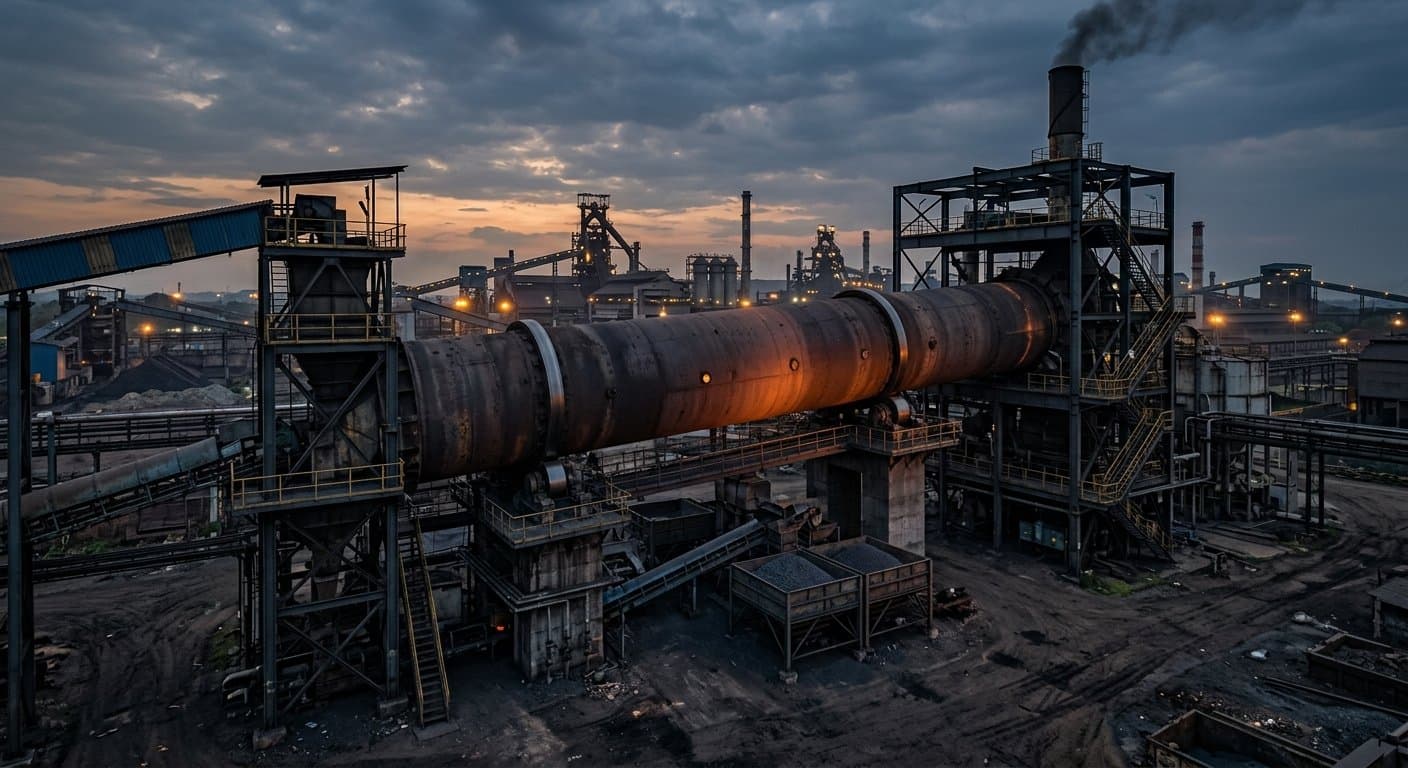
The DRI rotary kiln process chain charges iron ore and reductant coal at the feed end, reduces the ore under a controlled CO-rich atmosphere along the kiln, and discharges hot sponge iron into a rotary cooler, with the inlet and outlet seals guarding the two highest-risk air-ingress points.
| Stage | Function | Approximate temperature |
|---|---|---|
| Feed end / preheat | Iron ore, coal, and dolomite charged; volatiles released | ambient to ~950°C |
| Reduction zone | Fe₂O₃ → Fe under CO-rich gas; controlled air ports along the shell | 950-1,050°C |
| Discharge end | Metallized sponge iron exits to cooler | 200-400°C product |
| Rotary cooler | Indirect water cooling of reactive sponge iron | 400°C down to ~100-120°C |
The inlet seal sits at the feed end, which is typically under slight negative pressure as the ID fan draws gas through the process, so any gap pulls atmospheric air straight into the reduction zone. The outlet and cooler-transition seals guard the discharge, where sponge iron exits at 200-400°C and is still highly reactive: its porous internal surface area is roughly 10,000 times that of solid iron, so any oxidant present attacks an enormous active surface. For the chemistry, see coal-based sponge iron production and why sponge iron is called sponge. Adjacent metallurgical kilns share the pattern: nickel laterite calcination and pre-reduction in the rotary kiln of an RKEF line runs to around 900°C before electric-furnace smelting [1], and ferroalloy pre-reduction kilns similarly hold a controlled atmosphere that air ingress disturbs.
Sealing requirements specific to the metallurgical industry: temperature, atmosphere, dust profile
Metallurgical kiln sealing requirements are defined first by atmosphere and only second by temperature: the reducing gas envelope means air ingress is a product-quality failure, so the leakage tolerance is far tighter than in cement or lime. This is the central distinction of the vertical.
Reducing atmosphere: a gas environment in which the oxygen partial pressure is kept low enough that iron oxides are driven toward metallic iron. In a DRI rotary kiln this is a CO-rich mixture in the solid bed; any false air locally raises oxygen partial pressure and reverses reduction.
The governing conditions:
- Atmosphere. Reducing. Near-zero oxygen ingress is the target, especially at the discharge end where hot sponge iron is most reactive. This is the requirement that sets metallurgical sealing apart and the reason a single worn interface can put product off-spec.
- Temperature. The reduction zone runs 950-1,050°C; the cooler transition handles 200-400°C product that is still chemically active. Graphite-based elements cover the high-temperature interfaces.
- Dust. Iron-ore fines, char, and dolomite create an abrasive load, so abrasion-resistant construction and controlled contact pressure are needed to keep the seal tight over a campaign.
- Movement. Standard rotary-kiln radial expansion and axial float, which the seal must compensate for while holding a tighter leakage limit than oxidising-process kilns allow.
Because of the stricter tolerance, many DRI operators treat the kiln-outlet and rotary-cooler-inlet as two distinct sealing positions, each with its own assembly, and a double-seal configuration at that interface is becoming standard in new plants. See kiln sealing in DRI plants for the failure mechanism in detail.
Recommended Oswal products for the metallurgical industry
For DRI rotary kilns the primary match is the Duplex Kiln Sealing System, whose hybrid lamella-plus-graphite design delivers the low, stable leakage a reducing atmosphere demands while compensating for shell movement [2]. The two critical interfaces are addressed by the Kiln Outlet Sealing System at the discharge/cooler transition, where the reactivity risk is highest, and the Kiln Inlet Sealing System at the feed end. Component-level options are the Graphite-Based Sealing Elements for the high-temperature zone, High-Temperature Radial Seals for circumferential contact, and Axial Compensation Seals for kiln float. For nickel laterite and ferroalloy reduction kilns the same product family applies, with the Integrated False Air Control programme suited to operations that need leakage controlled across both the kiln and the cooler interface as a system.
Metallurgical industry application examples
In DRI kilns we have audited, the outlet-to-cooler interface is the highest-consequence seal, because a leak there contacts the most reactive material at the worst moment. A representative case: an 80 TPD coal-based kiln tracking 92% metallization at the discharge loses 2-4 points when the outlet seal develops a 5-10% leak, dropping product toward or below the Grade 1 line and forcing it to be blended down or rejected. Restoring the outlet seal returns metallization to specification; the value recovered is saleable iron, not just fuel.
A second recurring case is the inlet seal cooling and oxidising the early reduction zone. Air entering near the feed end competes with the reduction reactions at peak temperature, lowering productivity in a way operators sometimes misattribute to coal quality before the seal is checked. A third pattern appears in nickel laterite RKEF lines, where air ingress in the pre-reduction kiln undercuts the metallization the downstream electric furnace relies on; the sealing logic carries straight across from DRI. For the quality framework behind these examples, see sponge iron quality control.
Empfohlene Produkte
Oswal-Lösungen für Metallurgische Industrie
Integrated False Air Control
Energie Schutz Durch Präzision Abdichtung Konstruktion
Kiln Inlet Sealing System
Verbrennung Stabilität at the Feed Ende
Kiln Outlet Sealing System
Extrem Temperatur Leistung at the Klinker Austrag Zone
Axial Compensation Seals
Kontrolliert Abdichtung Unter Longitudinal Ofen Bewegung
Quellen
- FEECO International / Nickel Institute, *Rotary kiln-electric furnace (RKEF) processing of nickel laterite ores*, 2024. https://feeco.com/processing-of-nickel-laterite-ores-on-the-rise/ and https://nickelinstitute.org/en/blog/2024/august/nickel-industry-part-2-processing-nickel-laterites-and-smelting/
- Oswal Industries, *OSWAL Kiln Seals product catalogue* and *Duplex Kiln Sealing System catalogue*, 2024 (product specifications and configuration).
Häufig gestellte Fragen
Häufige Fragen zur Ofendichtung in der metallurgische industrie.
Viele metallurgische Prozesse erfordern entweder reduzierende oder oxidierende Atmosphären, die für die Produktchemie prozesskritisch sind. Die Direktreduktion von Eisen erfordert beispielsweise eine CO-reiche reduzierende Atmosphäre; jeder Eintritt von atmosphärischer Luft oxidiert das Eisenprodukt zurück zu Eisenoxid, was die Metallisierung und die Produktqualität unmittelbar verringert. Eine effektive Ofenabdichtung schützt die Prozessatmosphäre.
Ja. Oswal-Dichtungssysteme sind je nach Anwendungsfall für reduzierende, oxidierende oder neutrale Atmosphären ausgelegt. Graphitbasierte Dichtungselemente werden typischerweise in Anwendungen mit reduzierender Atmosphäre bevorzugt, wie beispielsweise bei der Herstellung von DRI-Eisenschwamm, wobei die Werkstoffspezifikationen auf die spezifische Zusammensetzung des Betriebsgases abgestimmt sind.
Die meisten metallurgischen Drehrohröfen arbeiten an den Dichtungsschnittstellen bei 950–1.200 °C, was im Vergleich zur Zementindustrie (über 1.400 °C am Auslauf) moderat ist. Oswal-Dichtungssysteme werden für die Betriebstemperatur des jeweiligen Ofens spezifiziert. Die Materialgüte sowohl für die Lamellen- als auch für die Graphitkomponenten wird während der technischen Prüfphase ausgewählt, um die thermische Stabilität am Auslegungspunkt zuzüglich einer Sicherheitsmarge zu gewährleisten.
Anfrage zur Metallurgische Industrie-Dichtung
Teilen Sie Ihre Ofenkonfiguration und Betriebsbedingungen mit unserem Konstruktionsteam.
Angebot anfordern“Überall dort, wo Hochtemperatur-Drehrohröfen unter kontrollierter Atmosphäre betrieben werden, sorgen Oswal-Dichtungssysteme für Energieeffizienz und Prozessstabilität.”