
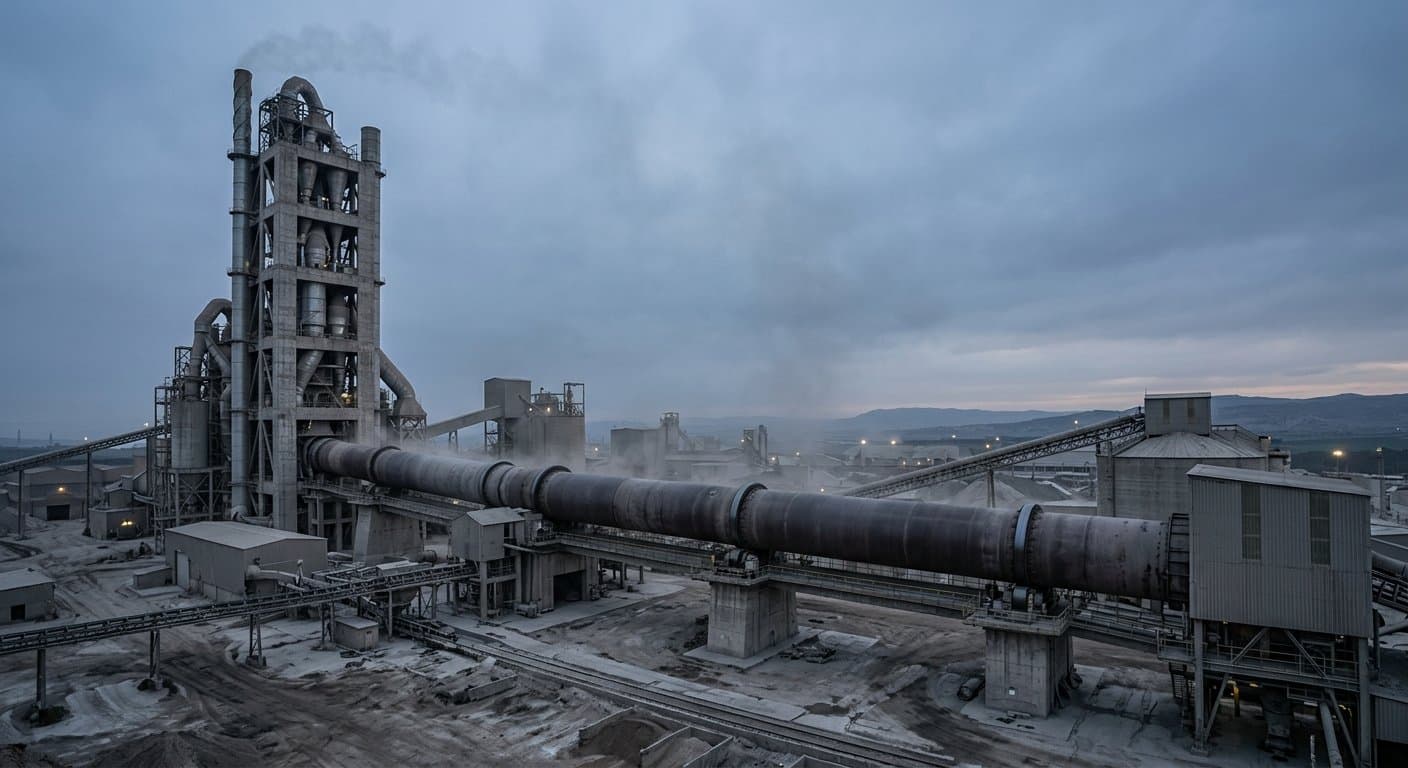
Cement Kiln Sealing: Industry Guide
Zementindustrie
A cement plant needs a kiln seal that controls false air at the inlet and outlet hood interfaces while accommodating continuous shell movement: radial expansion, axial float, and ovality. The dominant failure mode in the cement industry is not catastrophic seal rupture; it is gradual false air ingress that raises specific heat consumption, destabilises the flame, and overloads the ID fan. A cement kiln seal must therefore deliver low, stable leakage across thermal cycles rather than a perfect static fit, which is why cement plants increasingly specify hybrid sealing rather than a single-principle graphite or lamella seal. Oswal supplies rotary kiln sealing for the cement industry, with rotary kiln seal types matched to the inlet and outlet conditions of dry-process clinker kilns.
The cement industry use case for kiln sealing
In the cement industry, the kiln seal is an energy-control component, not a peripheral mechanical part. The rotary kiln in a cement plant is the single largest thermal asset on site, and every cubic metre of unintended air drawn in through a worn seal must be heated to process temperature, which directly raises fuel cost. Plants typically accumulate 5-8% false air between shutdowns, and each 1% increase in false air adds roughly 3 kcal/kg clinker to exhaust heat loss [1]. On a kiln producing 5,000 tonnes of clinker per day, that loss compounds into a measurable fuel and emissions penalty over a campaign.
The cement kiln seal sits at two positions: the kiln inlet, at the feed end where preheated raw meal enters from the riser duct, and the kiln outlet, at the discharge end where clinker drops into the cooler. Both interfaces are under draft, so any gap pulls atmospheric air into the system. Cement kiln protection therefore starts with sealing: a stable inlet and outlet seal protects the flame, the refractory, and the clinker chemistry at the same time. For the upstream context, see how the cement manufacturing process feeds the kiln, and how false air in cement kilns propagates through the pyroprocessing chain.
The pyroprocessing and kiln process chain in a cement plant
The cement plant process chain runs raw meal through a preheater, a calciner, the rotary kiln, and a clinker cooler, and the kiln seals bracket the hottest section of that chain. The standard modern configuration is the dry process with a multi-stage cyclone preheater and a precalciner.
| Stage | Function | Approximate temperature |
|---|---|---|
| Preheater tower | Progressive heat exchange between rising kiln gas and descending raw meal | 60-900°C across stages |
| Calciner | Limestone decomposition (CaCO₃ to CaO); ~90% calcination before the kiln | 850-900°C [1] |
| Rotary kiln | Clinkerisation; formation of alite and the clinker phases | 1,450°C material, ~2,000°C flame |
| Clinker cooler | Rapid quench of clinker, recuperation of secondary and tertiary air | 1,450°C down to ~100°C |
The kiln inlet seal sits between the kiln and the riser/smoke chamber that connects to the preheater and calciner. The kiln outlet seal sits between the kiln nose ring and the cooler hood. Modern dry-process kilns operate at a specific heat consumption of roughly 680-750 kcal/kg clinker, against a theoretical minimum near 380-420 kcal/kg [1]; the gap between the two is heat loss, and false air is a controllable part of it. For the detail on the thermal sequence, see the cement pyroprocessing explainer, and for the fuel-efficiency framing, specific heat consumption in cement kilns.
Sealing requirements specific to the cement industry: temperature, atmosphere, dust profile
Cement kiln sealing requirements are defined by high but oxidising-stable temperatures, heavy abrasive dust, and large dynamic shell movement, not by atmosphere chemistry. Unlike a DRI kiln, the cement kiln runs an oxidising atmosphere, so false air degrades efficiency rather than destroying product. That changes the sealing target: the priority is low, stable leakage and long wear life under abrasive clinker dust, rather than the near-zero oxygen ingress a reducing process demands.
False air: atmospheric air drawn into the kiln system through unintended openings (seals, hood interfaces, inspection ports) rather than through the controlled combustion-air path. Quantified as a percentage of total combustion air; in cement, 5-8% is common between shutdowns and each 1% adds roughly 3 kcal/kg clinker to exhaust loss [1].
Three loading conditions drive the cement kiln seal specification:
- Temperature. The inlet end sees gas near 900-1,100°C; the outlet hood sees radiant heat off 1,450°C clinker. Graphite sealing elements handle the high-temperature zone; the sealing assembly must tolerate thermal shock on every stop and start.
- Dust. Clinker and raw-meal dust are highly abrasive. The seal contact face wears continuously, so abrasion-resistant construction and a controlled contact-pressure mechanism are required to keep leakage stable as the seal wears.
- Movement. The shell expands radially, floats axially on its tyres, and develops ovality. A rigid seal cannot follow this, so the assembly must compensate for radial expansion and axial displacement at the same time. See kiln hood inlet and outlet configurations for how these interfaces are arranged.
The honest trade-off: a pure lamella seal adapts well to movement but is more exposed at sustained high temperature, while a pure graphite seal handles heat but resists dynamic compensation under heavy shell distortion. Cement kilns with high ovality or frequent stops generally need both behaviours, which is the case for a hybrid duplex configuration.
Recommended Oswal products for the cement industry
For most cement kilns, the primary match is the Duplex Kiln Sealing System, which combines lamella flexibility for axial and radial movement with graphite durability for high-temperature sealing in one assembly [2]. The inlet and outlet are addressed by the Kiln Inlet Sealing System and the Kiln Outlet Sealing System respectively; the inlet seal stabilises the combustion profile and protects upstream calcination, and the outlet seal is built for abrasion resistance and thermal-shock tolerance under heavy dust load [2]. Where movement and thermal duty are handled separately, the High-Temperature Radial Seals, Axial Compensation Seals, and Graphite-Based Sealing Elements are the component-level options. For plants treating false air as a system rather than a single interface, the Integrated False Air Control programme combines sealing, monitoring, and retrofit across the inlet, outlet, hood, and duct transitions.
Cement industry application examples
In retrofits we have audited on dry-process kilns, the largest single false-air source is usually the outlet seal at the kiln-to-cooler hood interface, where heat and abrasion degrade the contact face fastest. A typical pattern: a kiln tracking 5-6% measured false air at commissioning drifts to 9-12% over a campaign as the outlet seal wears, with the ID fan compensating by drawing more power until the seal is replaced. Restoring the outlet seal returns leakage toward the commissioning baseline and recovers the associated exhaust heat.
A second recurring case is the high-ovality kiln. On older shells with pronounced ovality, single-principle seals lose contact on each rotation, producing a cyclic leakage path that fixed-geometry seals cannot close. The Duplex system is designed specifically for this condition, maintaining sealing pressure independent of kiln distortion [2]. A third common finding is inlet-seal leakage destabilising the flame: air entering near the feed end shifts the temperature profile and calcination stability, which operators often misread as a burner problem before the seal is checked. For the diagnostic workflow, see the cement plant audit methodology.
Empfohlene Produkte
Oswal-Lösungen für Zementindustrie
Duplex Kiln Seal
Hybride Lamellen- + Graphit-Technologie
Kiln Inlet Sealing System
Verbrennung Stabilität at the Feed Ende
Kiln Outlet Sealing System
Extrem Temperatur Leistung at the Klinker Austrag Zone
Integrated False Air Control
Energie Schutz Durch Präzision Abdichtung Konstruktion
Quellen
- Cement Plant Optimization / INFINITY for Cement Equipment, *Thermal energy efficiency and clinkerization heat balance*, 2023-2024. https://www.cementindusneed.com/clinkerization/ and https://www.cementequipment.org/home/everything-you-need-to-know-about-thermal-energy-efficiency-in-cement-industry/
- Oswal Industries, *OSWAL Kiln Seals product catalogue* and *Duplex Kiln Sealing System catalogue*, 2024 (product specifications and configuration).
Häufig gestellte Fragen
Häufige Fragen zur Ofendichtung in der zementindustrie.
Falschluft ist unkontrolliert einströmende Umgebungsluft, die durch undichte oder verschlissene Schnittstellen in den Ofen, den Kalzinator oder das Kanalsystem gelangt. Sobald sie sich im System befindet, muss sie auf Prozesstemperatur aufgeheizt werden, was zu einem unnötigen Brennstoffverbrauch führt. Bei einem typischen älteren Zementofen kann Falschluft je nach Zustand der Dichtungen den spezifischen Brennstoffverbrauch um 5–15 % erhöhen.
Branchenstudien beziffern die typischen Kraftstoffeinsparungen durch eine verbesserte Ofenabdichtung auf 3–10 %. Bei älteren Öfen mit erheblichen Leckagen können die Einsparungen am oberen Ende dieses Bereichs liegen. Der exakte Wert für ein spezifisches Werk wird durch ein technisches Audit ermittelt, bei dem die Falschluft an jeder Schnittstelle gemessen und die darauf entfallenden Kraftstoffkosten quantifiziert werden.
Ein Oswal Duplex-Dichtungssystem ist für eine Standzeit von 3–5 Jahren zwischen dem Austausch wesentlicher Komponenten ausgelegt und entspricht damit den typischen Revisionszyklen von Zementöfen. Verschleißteile (Lamellen- und Graphitkomponenten) können ausgetauscht werden, ohne die darunterliegende strukturelle Dichtung zu entfernen, wodurch die Gesamtlebensdauer des Systems verlängert wird. Im Rahmen des Wartungs- und Inspektionsservices wird eine Überprüfung alle 6–12 Monate empfohlen.
Anfrage zur Zementindustrie-Dichtung
Teilen Sie Ihre Ofenkonfiguration und Betriebsbedingungen mit unserem Konstruktionsteam.
Angebot anfordern“Überall dort, wo Hochtemperatur-Drehrohröfen unter kontrollierter Atmosphäre betrieben werden, sorgen Oswal-Dichtungssysteme für Energieeffizienz und Prozessstabilität.”