
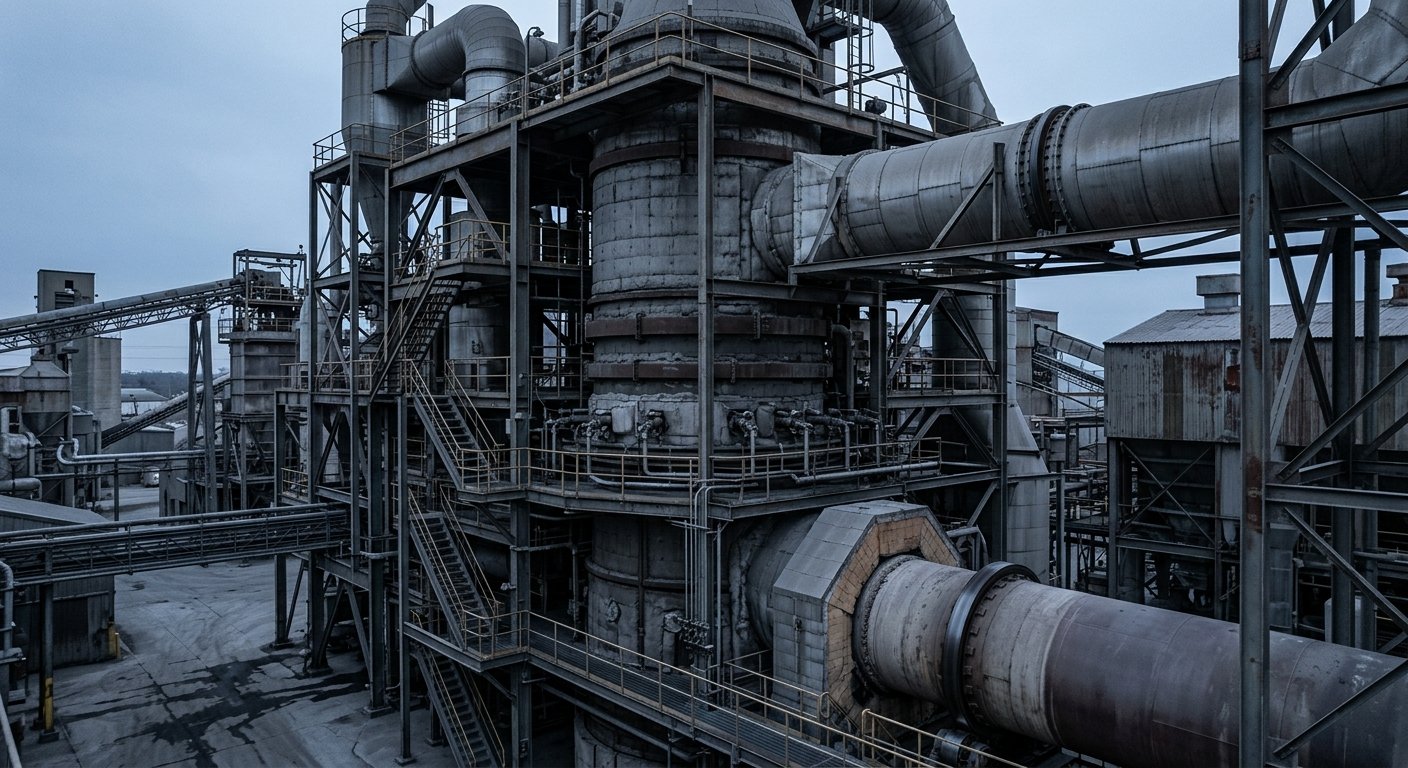
Der Zementkalzinator erklärt: ILC vs. SLC, Funktion und Betrieb
Der Zementkalzinator schließt 90–95 % der Kalksteinentsäuerung vor dem Ofen ab. Einblick in die ILC- vs. SLC-Aufteilung, Brennstofffeuerung und Betriebsdaten.
Ein Zementkalzinator ist der Behälter zwischen dem Vorwärmerturm und dem Drehrohrofen, in dem etwa 90-95 % der Kalksteinkalzinierung (CaCO₃ → CaO + CO₂) durch Brennstoffverbrennung in einem kontrollierten Gasstrom bei 850-900 °C abgeschlossen werden (Infinity for Cement Equipment, basierend auf den Konventionen des Holderbank-Zementkurses). Die Begriffe „Kalzinator“ und „Vorkalzinator“ werden synonym verwendet; die Vorsilbe „Vor-“ betont, dass die Reaktion vor dem Drehrohrofen stattfindet.
Dieser Artikel behandelt die Aufgaben des Kalzinators, die Unterschiede zwischen den Architekturen des Inline-Kalzinators (ILC) und des Separate-Line-Kalzinators (SLC), die Betriebskennzahlen sowie die Auswirkungen von Falschluft auf die Kalzinatorleistung. Er setzt Vertrautheit mit der allgemeinen Zement-Pyroprozesskette und dem speisenden Vorwärmerturm voraus.
Was ist ein Zementkalzinator?
Ein Zementkalzinator ist ein brennstoffbeheizter Reaktor, der die Zersetzung von CaCO₃ zu CaO abschließt, bevor das Rohmehl in den Drehrohrofen gelangt. Die Reaktion beginnt bei etwa 650 °C und läuft ab ca. 830 °C effizient ab; der Kalzinator ist so dimensioniert, dass Gas und Material lange genug bei 850-900 °C gehalten werden, um einen Kalzinierungsgrad von 90-95 % zu erreichen.
Kalzinierung. Die endotherme Zersetzung von Calciumcarbonat zu Calciumoxid und Kohlendioxid: CaCO₃ → CaO + CO₂. Dies ist die dominierende chemische Reaktion bei der Zementherstellung und die Quelle von etwa 60 % der prozessbedingten CO₂-Emissionen des Zements.
Bevor Vorkalzinatoren in den frühen 1970er Jahren kommerziell eingeführt wurden, musste die Kalzinierung innerhalb des Drehrohrofens selbst abgeschlossen werden. Die Entkopplung der Kalzinierung von der Klinkerbildung in zwei separate Aggregate ermöglichte erst den modernen Trockenprozess-Ofen mit Kapazitäten von 6.000 bis 12.000 t/Tag.
Die Energieaufteilung zwischen Kalzinator und Ofen
In einem modernen Ofen mit Vorkalzinator werden etwa 60 % der gesamten Brennstoffenergie im Kalzinator und 40 % am Hauptbrenner des Ofens eingesetzt. Der von FLSmidth veröffentlichte ILC-Bereich liegt bei 55-65 % am Kalzinator, bei einem Kalzinierungsgrad von 92-95 % am Ofeneinlauf (FLSmidth Preheater Calciner Systems Broschüre).
Diese Aufteilung resultiert daraus, dass die beiden Verbrennungsumgebungen sehr unterschiedlich sind. Der Ofenbrenner arbeitet mit einer Flammentemperatur von fast 2.000 °C und einer Verweilzeit im Sekundenbereich. Der Kalzinator arbeitet bei 870-890 °C mit einer Gasverweilzeit von 3-5 Sekunden (Aspen Plus Kalzinatormodellierung, ScienceDirect 2023). Da der Kalzinator kühler und mit längeren Verweilzeiten arbeitet, toleriert er grobe, feuchte oder flüchtigkeitsarme Brennstoffe, die der Ofenbrenner nicht verarbeiten kann. Dies ist der Hauptgrund, warum Ersatzbrennstoffe primär am Kalzinator aufgegeben werden.
Inline-Kalzinator (ILC) vs. Separate-Line-Kalzinator (SLC)
Die beiden dominierenden Kalzinator-Architekturen sind der Inline-Kalzinator (ILC), der sich in der Ofensteigleitung befindet und Brennstoff in einer Mischung aus Ofenabgas und Tertiärluft verbrennt, und der Separate-Line-Kalzinator (SLC), ein paralleles Gefäß, das ausschließlich mit Tertiärluft aus dem Klinkerkühler gespeist wird, wobei das Ofengas an der Verbrennungszone vorbeigeführt wird.
Der ILC ist mechanisch einfacher: eine vertikale oder schleifenförmige Verlängerung der Ofensteigleitung, bei der der Brennstoff in einen Gasstrom injiziert wird, der bereits die Verbrennungsprodukte des Ofens enthält. Die Tertiärluft wird entweder durch den Ofen (In-Line Air-Through, IAT) oder über eine separate Leitung unterhalb des Kalzinators (In-Line Air-Separate, IAS) zugeführt. Die Investitionskosten sind niedriger und Nachrüstungen an bestehenden Öfen einfacher. Der Nachteil: Die Verbrennungszone arbeitet bei ca. 10-14 % O₂, da das Ofengas den Sauerstoffgehalt verdünnt, was den Einsatz von extrem flüchtigkeitsarmen Brennstoffen einschränkt.
Der SLC nutzt ein separates Gefäß parallel zur Ofensteigleitung. Tertiärluft, die direkt aus dem Klinkerkühler abgesaugt wird, versorgt die Verbrennungszone mit nahezu 21 % O₂; das Ofengas umgeht die Verbrennungszone und wird stromabwärts wieder zusammengeführt. Die heißere, sauerstoffreiche Umgebung ermöglicht die Verbrennung von Petrolkoks und unterstützt die gestufte Verbrennung zur NOx-Minderung. Die Investitionskosten liegen 10-20 % höher als bei einem vergleichbaren ILC.
OEM-Nomenklatur: FLSmidth ILC und SLC / SLC-D; KHD PYROCLON; thyssenkrupp Polysius Prepol-Familie (die Varianten AS-MSC und MSC-CC für gestufte Verbrennung, mit dem Prepol SC Stufenverbrenner als aktuelle Ergänzung für grobe Ersatzbrennstoffe); IKN Pyrobox (kompakter ILC). Varianten umfassen SLC-I (Hybrid) und SLC-D (Downdraft, für Petrolkoks).
Tertiärluftleitung. Feuerfest ausgekleidete Rohrleitung, die heiße Luft (700-900 °C) vom Klinkerkühler zum Kalzinator leitet und dabei den Ofen umgeht. Sie liefert den Sauerstoff für die Verbrennung im Kalzinator und ist das Konstruktionsmerkmal, das den SLC vom ILC unterscheidet.
ILC vs. SLC: Vergleich
Der ILC eignet sich für Werke mit einfacheren Brennstoffmischungen und geringerem Investitionsbedarf. Der SLC ist ideal für Werke, die eine Ersatzbrennstoffrate (EBS) von über 60 % anstreben, Petrolkoks einsetzen oder in Regionen mit strengen NOx-Grenzwerten operieren.
| Merkmal | Inline-Kalzinator (ILC) | Separate-Line-Kalzinator (SLC) |
|---|---|---|
| Tertiärluftzufuhr | Durch den Ofen (IAT) oder per Leitung zur Steigleitung (IAS) | Unabhängige Leitung vom Kühler zum Behälter |
| Ofengas in der Verbrennungszone | Ja, mit Tertiärluft vermischt | Nein, Ofengas umgeht die Verbrennung |
| O₂ in der Verbrennungszone | ~10-14 % | ~21 % (reine Tertiärluft) |
| Brennstoffflexibilität (EBS-Rate) | Typisch 30-50 %, in modernen Designs 60-80 % | Typisch 60-80 %, mit SLC-D und Stufenverbrennern bis zu 100 % angestrebt |
| NOx-Kontrolle durch Stufung | Begrenzt | Hoch (gestufte Verbrennung konstruktiv integriert) |
| Investitionskosten | Niedriger (Basiswert) | ~10-20 % höher als ILC |
| Komplexität der Nachrüstung | Niedriger (nutzt vorhandene Steigleitung) | Höher (neuer Behälter + Tertiärluftleitung + Zyklonstrang) |
| Typischer Anwendungsfall | Öfen mittlerer Kapazität, Mischbrennstoffe mit moderatem Gehalt an Flüchtigen | Große Öfen, Petrolkoksfeuerung, hohe EBS-Raten, NOx-regulierte Regionen |
Quellensynthese: FLSmidth ILC / SLC technische Literatur, thyssenkrupp Polysius Materialien zur Brennstoffsubstitution, Peer-Review-Arbeiten zur ILC-EBS-Substitution (MDPI Cleantechnol. 2023).
Betriebsdaten
Ein moderner Zementkalzinator arbeitet bei einer Gastemperatur von 870-890 °C mit einer Gasverweilzeit von 3-5 Sekunden und einem O₂-Gehalt am Auslass von 2-4 % (trocken). Diese Zahlen sowie der Anteil der Brennstofffeuerung und der Kalzinierungsgrad am Ofeneinlauf bilden das Betriebsfenster, das jeder Anlageningenieur kennen sollte.
| Parameter | Typischer Bereich | Quelle |
|---|---|---|
| Gastemperatur Kalzinator | 870-890 °C | FLSmidth ILC Literatur; Holderbank Zementkurs |
| Gasverweilzeit | 3-5 s (kompakte Behälter 1,4-1,7 s; verlängerte ILC-Leitungen bis 5 s) | Aspen Plus Modellierung, ScienceDirect 2023 |
| Anteil Brennstofffeuerung (an Gesamtenergie) | 55-65 % am Kalzinator | FLSmidth |
| Kalzinierungsgrad am Ofeneinlauf | 92-95 % | FLSmidth; Holderbank |
| EBS-Substitution (ILC, modern) | Typisch 30-50 %, bis zu ~80 % in Low-NOx-Designs | MDPI Cleantechnol. 2023 |
| EBS-Substitution (SLC) | Typisch 60-80 %; OEM-Ziele bis 100 % in SLC-D/Stufenverbrennern, real meist 80-90 % | thyssenkrupp Polysius; FLSmidth |
| O₂ am Auslass (trocken) | 2-4 % | Holderbank Zementkurs |
Warum der Kalzinator betrieblich entscheidend ist
Der Kalzinator ist der wichtigste Hebel für Modernisierungen in der Pyroprozesskette. Er ermöglicht einen höheren Ofendurchsatz, nimmt den Großteil jedes Ersatzbrennstoffprogramms auf und ist der Ort, an dem Ringbildungen und Probleme im Schwefelkreislauf zuerst auftreten.
- Durchsatz. Da 90-95 % der Kalzinierung vor dem Ofen abgeschlossen sind, kann der Ofen kürzer und schneller gebaut werden, was den spezifischen Durchsatz pro m³ Ofenvolumen erhöht.
- Ersatzbrennstoffsubstitution. Die kühlere Umgebung mit längerer Verweilzeit verbrennt grobe, minderwertige und feuchtere Brennstoffe, die der Ofenbrenner nicht akzeptiert. Der Ofenbrenner bleibt der Engpass: 50-60 % EBS sind dort typisch, gegenüber 80-90 % im Kalzinator (OEM-Ziele bis 100 %).
- Ringbildung an der Schnittstelle Ofen-Kalzinator. Wo Kalzinatorgas in den Ofen eintritt, kann die teilweise Zersetzung von Sulfat- und Alkalikondensaten zu „Schneemännern“ oder Ringablagerungen im Ofeneinlauf führen, insbesondere bei schwefelreichen Brennstoffen.
- Schwefelkreislauf. SO₃-reiches Rohmehl interagiert mit Alkalien im Kalzinator-Vorwärmer-Bereich. Ein schlecht betriebener Kalzinator kann die Schwefelkontrolle verlieren und einen Ofen-Bypass erzwingen.
Wie Falschluft die Kalzinatorleistung beeinflusst
Falschlufteintritt in das Kalzinator-Vorwärmer-Gehäuse verdünnt die Verbrennungsluft, senkt die Austrittstemperatur und erzwingt eine zusätzliche Brennstofffeuerung, um das Kalzinierungsziel von 90-95 % zu halten. Jeder Prozentpunkt Falschluft über dem Basiswert schlägt sich als messbarer Mehrverbrauch in kcal/kg im spezifischen Brennstoffverbrauch der Ofenlinie nieder.
Die entscheidenden Schnittstellen sind die Ofeneinlaufdichtung (wo die Steigleitung auf den rotierenden Ofen trifft), die Kanaldichtungen zwischen den Zyklonen im Vorwärmerstrang und die Inspektionsöffnungen am Kalzinatorgehäuse selbst. Die Methodik zur Quantifizierung wird im Artikel über Falschluft in Zementöfen behandelt. Bei Audits, die das Engineering-Team an verschiedenen Standorten der Zementindustrie durchgeführt hat, trugen Leckagen im Kalzinatorbereich typischerweise 20-30 % zur gesamten Falschluft der Ofenlinie bei. Die integrierte Falschluftkontrolle von Oswal zielt direkt auf diese Schnittstellen ab.
Common questions about this topic
Ein Vorwärmer ist ein Zyklonturm, der das Rohmehl mithilfe von Ofenabgasen ohne zusätzliche Befeuerung erwärmt. Ein Kalzinator ist ein befeuerter Reaktor, der die Kalzinierungsreaktion des Kalksteins einleitet, bevor das Rohmehl in den Drehrohrofen gelangt. In modernen Trockenanlagen befinden sich beide Komponenten im selben Turm, wobei die Vorwärmerzyklone oben und der Kalzinator an der Basis, direkt über dem Ofeneinlauf, angeordnet sind. Der Artikel zum Vorwärmerturm behandelt die Zyklonseite im Detail.
Etwa 60 % am Kalzinator und 40 % am Hauptbrenner des Drehofens bei einem modernen Precalcinator-Drehofen. Der veröffentlichte ILC-Bereich von FLSmidth liegt bei 55-65 % am Kalzinator. Diese Aufteilung ermöglicht einen kürzeren und schnelleren Ofen im Vergleich zu älteren Konstruktionen, bei denen die gesamte Kalzinierungsarbeit im Ofen erfolgen musste.
Die SLC-D- und fortschrittlichen ILC-Stufenfeuerungskonzepte zielen auf eine AF-Substitutionsrate von bis zu 100 % im Kalzinator ab; im kommerziellen Maßstab werden typischerweise 80–90 % erreicht, wobei einzelne Anlagen dauerhaft die 100-%-Marke überschreiten. Der Drehrohrofenbrenner stellt hierbei den Engpass dar: Am Hauptbrenner ist eine AF-Substitutionsrate von 50–60 % üblicher, da die hohen Flammentemperaturen und die kurze Verweilzeit einen feineren, trockeneren und energiereicheren Brennstoff erfordern. Anlagen mit hohem AF-Einsatz priorisieren die Substitution im Kalzinator und betrachten die Substitution am Ofenbrenner als separate, technisch anspruchsvollere Nachrüstung.
Sources
- Infinity for Cement Equipment, *The Ultimate Guide to Precalciners in Cement Manufacturing*, 2023. Synthesises Holderbank Cement Course and Juan Ortega's industry training material
- FLSmidth (now FLS), *Preheater Calciner Systems*, technical brochure. Operating envelope for the ILC and SLC product lines
- Mikulčić et al., *Alternative Fuel Substitution Improvements in Low NOx In-Line Calciners*, Clean Technologies (MDPI), 2023. Peer-reviewed quantitative treatment of ILC AF substitution limits
- Pedrazzi et al., *Aspen Plus simulation of an inline calciner for white cement production with a fuel mix of petcoke and producer gas*, Energy (ScienceDirect), 2023. Source for residence time and gas-flow modelling
- thyssenkrupp Polysius, *Fuel Substitution* (prepol family: AS-MSC, MSC-CC, and the prepol SC step combustor). OEM reference for staged-combustion ILC variants and coarse-AF combustion chambers
- Cembureau, *Activity Report 2023*. European cement industry baseline figures for dry-process kiln configurations
- International Energy Agency (IEA), *Cement Roadmap*. Energy intensity context for the precalciner kiln line
- VDZ (Verein Deutscher Zementwerke), *VDZ Activity Report*. German cement industry conventions for kiln-audit and calciner operating data. https://www.vdz-online.de/ --- *If you are evaluating a calciner-enclosure sealing retrofit or sizing a false-air audit on a precalciner kiln, the [engineering-consulting team](/en/services/engineering-consulting) works the methodology above on-site.*
Verwandte Artikel
Discuss Your Sealing Requirements
Our engineering team can help identify the right sealing solution for your application.
Contact Engineering Team“Überall dort, wo Hochtemperatur-Drehrohröfen unter kontrollierter Atmosphäre betrieben werden, sorgen Oswal-Dichtungssysteme für Energieeffizienz und Prozessstabilität.”