
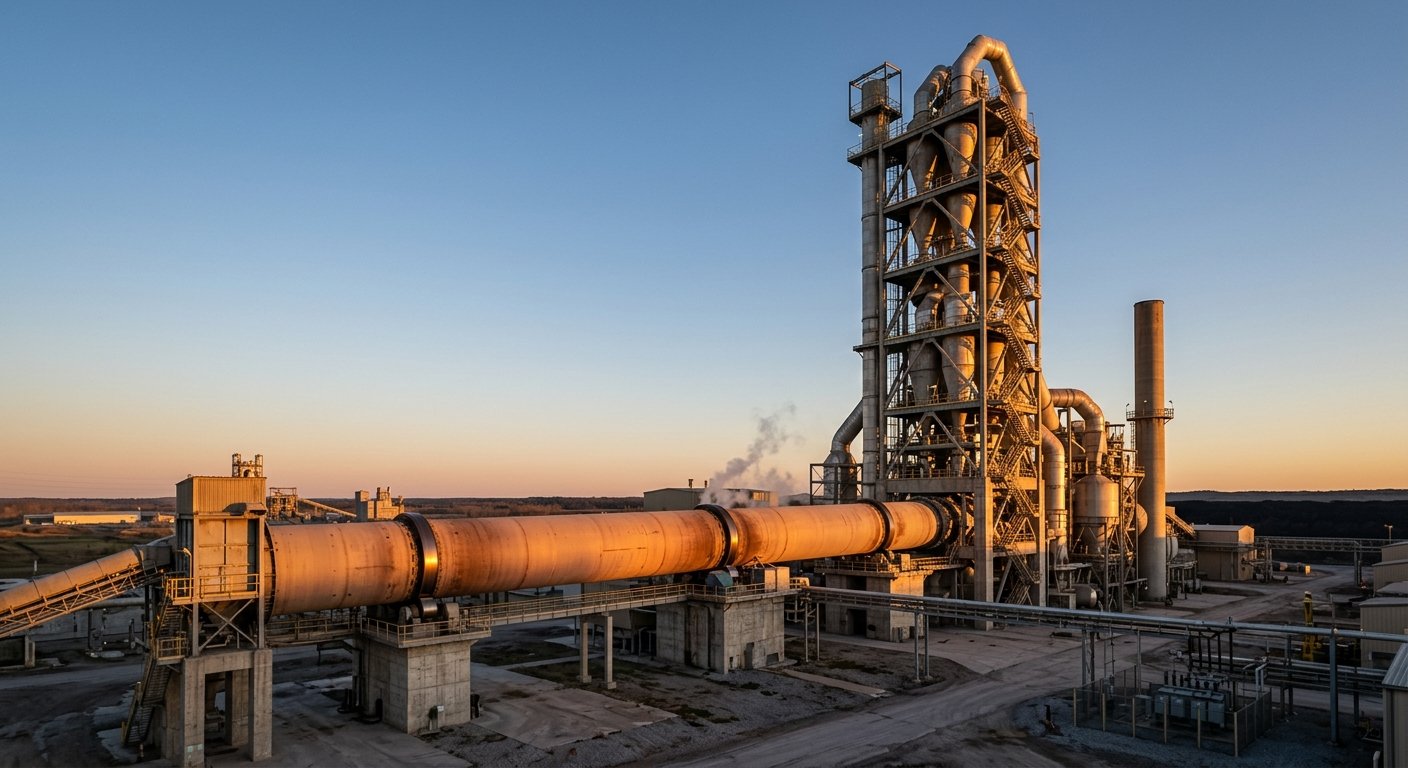
False Air in Cement Kilns: Measurement, Cost, Control
False air is uncontrolled air ingress into a cement kiln, costing 1.5-2.5 kcal/kg clinker per percent. Measurement, energy cost, benchmarks, and control.
False air is uncontrolled ambient air drawn into a cement kiln's pyroprocessing system through unintended openings, rather than through the controlled primary- and secondary-air paths feeding combustion. It is one of the most underestimated efficiency losses in cement plant operations: in older European dry-process plants, false air routinely accounts for 12-20% of total gas flow at the ID fan, costing 1.5-2.5 kcal/kg clinker for every percentage point above optimum [1][2][3]. This guide covers what false air is, where it enters, how to measure it, what it costs, how it cascades into refractory and capacity penalties, what the industry benchmarks are, and which reduction strategies actually work.
What is false air in a cement kiln?
False air, sometimes called false air ingress or parasitic air, is the air that enters a kiln system through unintended openings (seal failures, hood interfaces, inspection ports, cracked ductwork) instead of through the controlled combustion-air path. It is "false" because it bypasses the heat-recovery and combustion-control architecture of the plant: it does no thermodynamic work, takes no instructions from the operator, and is pulled in only because the ID fan creates a negative pressure across the entire kiln line that turns every opening into a leak.
The mechanism is simple. The ID fan downstream of the preheater establishes a draft that holds the kiln gas path under suction relative to the building. Combustion air for the burner enters at the controlled inlets: primary air through the burner pipe, secondary air from the clinker cooler through the hood, tertiary air via the duct to the calciner where one exists. Any opening anywhere else in the suction zone admits ambient air.
False air. Uncontrolled ambient air drawn into a cement kiln through unintended openings (seals, hood interfaces, inspection ports, refractory cracks). Distinct from controlled combustion air. Quantified as a percentage of total gas flow at a defined downstream measurement point, conventionally the ID fan inlet.
Primary air. Combustion air delivered through the burner pipe, directly atomising and shaping the flame. Typically 8-15% of total combustion air in a modern dry-process kiln.
Secondary air. Hot combustion air drawn from the clinker cooler through the kiln hood. Typically 60-85% of total combustion air and the largest heat-recovery stream in the plant.
Older European cement plants commissioned in the 1970s-80s typically run 12-20% false air at the ID fan before any retrofit, per Cembureau and VDZ data [1][2]. Modern plants run 6-10%. That gap is the economic case for almost every kiln-sealing intervention in the industry today.
Where false air enters: the 4 critical interfaces
Four interfaces account for the majority of false air ingress on a typical cement kiln line: the kiln inlet seal, the kiln outlet seal, the cooler-to-kiln transition, and the preheater cyclone stages. In retrofits Oswal has audited, the kiln hood and inlet-seal interfaces alone account for 30-50% of kiln-side ingress, which is why hood-area sealing is consistently the highest-ROI first move.
| Interface | Why it leaks | Typical contribution to kiln-side ingress |
|---|---|---|
| Kiln inlet seal | Rotating shell meets stationary inlet hood / smoke chamber. Affected by shell expansion, ovality, and axial movement | 20-35% |
| Kiln outlet seal | Rotating shell meets stationary outlet hood, hottest interface in the plant, abrasive dust load | 15-25% |
| Cooler-to-kiln transition | Hood / grate-cooler interface geometry, satellite-cooler tube ends; geometry-dependent ingress under negative pressure | 10-20% |
| Preheater cyclone stages + ductwork | Per-stage cyclone joints, expansion bellows, inspection doors, dip-tube interfaces | 1-2% per stage, cumulative across 4-6 stages |
Source: composite of VDZ kiln-audit conventions [2], Holderbank Cement Course Vol 2 [3], and Oswal retrofit audit records.
The kiln inlet seal and kiln outlet seal are the two interfaces where the rotating kiln shell meets a stationary structure, and they fail in service for a specific reason: the kiln shell expands radially, displaces axially under thermal growth, and exhibits residual ovality that varies with kiln age and rotation. A rigid seal designed for static geometry does not accommodate that movement. The Oswal product catalog covers this in plain terms: "Conventional rigid sealing systems fail under dynamic conditions" [4].
ID fan. The induced-draft fan downstream of the preheater that pulls combustion and process gases through the kiln system. Its capacity sets the upper limit on gas throughput; every cubic metre of false air it has to move is a cubic metre of kiln gas it cannot. On older plants the ID fan can become the kiln's biggest single electrical load.
Secondary ingress points are the inspection doors and ports along the preheater, refractory cracks and shell penetrations, and any place a flange or expansion bellow has fatigued. None of these compete with the four primary interfaces for total volume, but they accumulate, and on plants where the four primaries have been retrofitted, the secondaries become the bottleneck. The preheater tower and kiln hood configurations pieces cover the geometry of these interfaces in more depth.
How false air is measured
False air is measured by comparing oxygen (O₂) concentration at two points along the kiln gas path; the increase in O₂ between the upstream and downstream sample points quantifies the air that leaked in between them. The technique is an oxygen mass balance and it is the only quantitative method recognised in industry kiln-audit practice [2][3].
The formula:
False air % = ((O2_out − O2_in) / (20.9 − O2_out)) × 100
Where:
- O2_in. Oxygen concentration (% v/v, dry basis) at the upstream sample point
- O2_out. Oxygen concentration (% v/v, dry basis) at the downstream sample point
- 20.9. Oxygen concentration of ambient air (% v/v)
Measurement is done section by section, not as a single global number. Standard sample points are the kiln hood, the kiln inlet (riser duct or smoke chamber), each preheater cyclone stage, the calciner inlet and outlet where a precalciner is fitted, and the ID fan inlet. The instrumentation in everyday use is a zirconia (ZrO₂) probe for continuous in-situ monitoring, a paramagnetic O₂ analyser for portable audit work, and an extractive sampling train for hot or dust-laden interfaces.
The full methodology, sample-point map, worked numerical example, and practical disciplines around dry-basis correction and isokinetic sampling are covered in the companion piece, how false air is measured in a cement kiln. That piece is the operating reference for plant engineers running an audit.
The energy cost: fuel consumption math
Every percentage point of false air above optimum costs approximately 1.5-2.5 kcal/kg clinker of additional specific heat consumption plus 0.3-0.5 kWh/t in additional ID-fan electrical load [2][3][5]. The thermodynamic reason is direct: every kilogram of false air that enters the kiln system must be heated from ambient (roughly 30 °C) to the temperature at which it leaves the gas path (300-350 °C at the preheater exit, much higher at the kiln-inlet interface). That sensible-heat duty is paid out of the burner.
The 1.5-2.5 kcal/kg-per-% convention comes from the Holderbank Cement Course (Holcim's standard plant-engineering training corpus) and is cross-validated in the peer-reviewed cement-energy literature, most notably Madlool et al. (2011) in Renewable and Sustainable Energy Reviews [5]. The range reflects the spread between hot-end ingress (which costs more, because the leaked air displaces secondary or tertiary air) and cold-end ingress (which costs somewhat less but still adds preheater duty).
Worked example. A 5,000 tonne-per-day dry-process kiln with a baseline of 8% false air and an actual figure of 13%, that is 5 percentage points above baseline. At 2.0 kcal/kg-per-% (mid-range Holderbank), the SFC penalty is 10 kcal/kg clinker. On 5,000 t/day of clinker, that is 50 million kcal/day, or roughly 18,250 million kcal/year of additional fuel. At coal at $140/t with a lower heating value of 6,000 kcal/kg, that is about 3,040 tonnes of additional coal per year, or roughly $425,000-700,000 in annual fuel cost depending on coal price and operating hours. The ID-fan electrical penalty adds another $30,000-80,000/year at industrial-grade power tariffs. A modest hood-area sealing retrofit (the Duplex Kiln Sealing System and integrated hood resealing) at sub-million-dollar capex typically pays back within 12-18 months on a kiln this size [3][5][6].
Specific heat consumption. The total thermal energy consumed per kilogram of clinker, conventionally expressed in kcal/kg clinker or GJ/t clinker on a lower-heating-value, dry basis. Distinct from specific fuel consumption (SFC), which is the fuel-energy input per kg clinker. In practice the two converge in a well-instrumented plant.
The global cement industry's weighted-average SHC is approximately 3.4-3.5 GJ/t clinker (~810-840 kcal/kg) per the Global Cement and Concrete Association's "Getting the Numbers Right" database [6]. Best-in-class modern dry-process plants run below 700 kcal/kg. The difference between best-in-class and the global average is dominated by three factors: process type (wet vs dry), heat-recovery quality (preheater stages, cooler efficiency), and false air. Of the three, false air is the only one that can be addressed without a capital project.
The cascade effects: ID fan, refractory life, NOx, capacity
False air's costs extend beyond fuel: it loads the ID fan, destabilises the flame and refractory thermal profile, raises NOx in some operating regimes, and at high ingress levels it becomes the kiln's capacity bottleneck. The fuel penalty is the headline; the cascade effects are the reason false air control is consistently the highest-ROI energy-efficiency intervention in cement [3][5][7].
| Effect | Mechanism | Typical magnitude |
|---|---|---|
| ID fan electrical load | False air adds m³/h that the fan must move; kWh scales linearly | +0.3-0.5 kWh/t clinker per 1% false air [2][7] |
| Refractory life | False air at the kiln-inlet zone cools lower preheater stages, destabilising temperature profile; thermal cycling shortens campaign | Variable; campaigns 10-25% shorter on high-ingress plants per Holderbank data [3] |
| NOx emissions | Excess oxygen at the burning zone raises thermal NOx; flame instability raises peak temperatures | Non-linear; site-specific. Cembureau / ECRA technical notes [1][7] |
| Capacity bottleneck | At fixed ID-fan capacity, m³/h of false air directly displaces m³/h of usable kiln gas | High-ingress plants run draught-limited at 80-90% of nameplate |
Sources as cited per row. Magnitudes are typical ranges; specific plant performance varies with kiln age, configuration, and operating regime.
The capacity-bottleneck effect is the one plant heads tend to underestimate. A kiln limited at the ID fan, drawing 12-15% false air, is running at meaningfully below nameplate purely because its fan is moving air it should not be moving. Sealing intervention recovers capacity without an ID fan upgrade; on older plants where the ID fan was being sized for replacement, sealing has occasionally deferred the capex outright [7].
The combustion-stability effect is less visible but matters operationally. Variable false air destabilises flame shape and free-lime trajectory, raising the burden on the kiln operator and increasing off-spec clinker risk. The kiln operator who reports "the kiln's been hard to drive lately" is often describing the symptom of a degraded seal that nobody has yet quantified.
Industry benchmarks: what's "normal" vs "needs intervention"
Acceptable false air in a modern, well-sealed dry-process cement kiln is under 8-10% kiln-to-ID-fan, with under 5-8% combined across the kiln hood and inlet sections and under 1-2% per preheater stage. Older European plants typically run 12-20% before retrofits; values above 20% indicate seal failure, hood-interface damage, or refractory-joint deterioration and warrant immediate intervention [1][2][3].
| Section | "Good" range (% false air) | "Needs intervention" |
|---|---|---|
| Kiln hood + kiln inlet | < 5-8% combined | > 15% |
| Preheater (per stage) | < 1-2% per stage | > 3% per stage |
| Total kiln-to-ID-fan | < 8-10% | > 20% |
Conventions per VDZ and Holderbank kiln-audit guidance [2][3]. "Good" assumes a modern, well-tuned dry-process plant; wet-process and semi-dry kilns baseline higher.
The threshold shifts with plant age, process type, and kiln size. Wet-process and semi-dry kilns tolerate higher absolute figures because their gas volumes and excess-air ratios are larger. Very large kilns (>10,000 t/day) have larger sealing surfaces and slightly higher absolute tolerance, but per-stage preheater ratios remain tight. The full benchmark discussion, including how the threshold shifts with plant age, why a single global figure can mask a localised problem, and how the economic threshold scales with kiln size, is in the companion piece, acceptable false air percentage in a cement kiln.
Reduction strategies and where each one breaks down
Five practical reduction strategies cover the majority of the false-air retrofit scope: kiln inlet and outlet seal replacement, cooler-to-kiln transition resealing, preheater duct and inspection-port sealing, refractory-joint and shell-crack repair, and process-side measures. Each has a different cost, a different time-to-effect, and a different failure mode.
| Strategy | What it addresses | Typical reduction | Where it breaks down |
|---|---|---|---|
| 1. Kiln inlet and outlet seal replacement | The two highest-volume interfaces | 30-50% of kiln-side ingress | Fails if shell ovality and axial-movement envelope were not properly characterised before seal selection |
| 2. Cooler-to-kiln transition resealing | Grate cooler hood, satellite cooler tube interfaces | 10-20% of kiln-side ingress | Complicated by hot-zone abrasion and refractory geometry |
| 3. Preheater duct and inspection-port sealing | Cumulative per-stage ingress | 1-2% per stage, additive across stages | High-temperature gasket fatigue, doors that get re-opened during operation |
| 4. Refractory-joint and shell-crack repair | Often-missed sources, not visible from outside | Variable; can be 5-10% of total | Requires kiln stop; not a routine intervention |
| 5. Process-side measures (negative-pressure tuning, ID-fan VFD, draught control) | Tunes the boundary condition rather than the leak | 1-3% on a well-sealed kiln | Cannot substitute for a physical seal; gains are operational, not structural |
The five strategies are not alternatives; on most older plants the retrofit programme runs in roughly the order above, with the inlet/outlet seal replacement carrying the largest single payback and the process-side measures coming in as the final layer once the physical leaks are closed [3][5][7].
Seal selection within strategy 1 is itself a sub-decision. Lamella seals flex to accommodate movement but are more sensitive to thermal cycling than graphite; graphite seals provide durability in high thermal zones but are stiffer. The duplex hybrid combines both: "The Duplex Kiln Sealing System is a proprietary Oswal innovation developed to combine the advantages of two sealing principles into a unified solution," integrating lamella flexibility for movement adaptation with graphite durability for high-temperature sealing [4]. For plants with frequent thermal cycling or pronounced shell ovality, the hybrid is usually the better fit; for plants running steady at high temperature, graphite-dominant configurations suffice.
The integrated approach pulls the five strategies into a single programme. Oswal's integrated false air control system productises sealing, monitoring, and retrofit as one workflow, rather than selling a seal in isolation. The reason this matters in practice is that a seal installed without baseline measurement and without follow-up monitoring rarely delivers its design-intent reduction over the long run; the seal degrades, nobody re-measures, and the savings drift back.
Named industry references for the case-economics envelope: Heidelberg Materials' Brevik facility (Norway), the world's first industrial-scale CCS-on-cement project, was officially opened in June 2025 and has been capturing, liquefying, and shipping CO₂ during ramp-up since summer 2025, with a design capacity of 400,000 tonnes CO₂ per year [9]. Upstream energy-efficiency work is a recognised precondition for cement-CCS economics across the IEA / GCCA roadmap framing [8], and a similar pattern is visible at other Northern European plants pursuing oxyfuel and post-combustion capture: false-air control comes before carbon capture, because every kcal not consumed is a kcal that does not need to be captured.
For plants sizing a retrofit case from scratch, the engineering consulting team typically scopes a baseline audit, quantifies the section-by-section false-air profile, attaches it to an SFC and ID-fan-load case, and walks through the strategy ladder above with cost and payback for each layer.
Common questions about this topic
False air enters through any unsealed or worn interface between the rotating kiln shell and the stationary parts of the kiln line: the kiln inlet at the calciner riser duct, the kiln outlet at the clinker discharge hood, the radial shell-to-stationary-component transition, and axial expansion joints. Older kilns with degraded or missing seals are the typical source. Process pressure differential across the interface drives air ingress through any clearance the seal does not close.
False air is measured using portable instrumentation that quantifies the volumetric ingress at each interface, typically by oxygen-content analysis at multiple points along the kiln gas path or by pitot-tube velocity traverses combined with chemical-balance analysis. The output is a per-interface false air volume that can be summed to a total system value. The Oswal Engineering Consulting & Audit service includes this measurement campaign.
Industry benchmarks place well-sealed cement kilns at 5-10% false air against the total kiln gas flow. Poorly sealed or older kilns can be 20% or higher. The economic threshold for retrofit upgrade depends on the specific plant; for most modern cement plants, false air levels above 12-15% indicate that a seal upgrade will produce measurable fuel-cost benefit with a payback window of 6-18 months.
False air is air that gets into a cement kiln through openings it shouldn't, rather than through the controlled combustion-air inlets. It is "false" because it does no thermodynamic work in the process: it just gets heated up and pushed out by the ID fan, costing fuel and electricity in the process. The classical sources are worn seals at the kiln inlet and outlet, leaks at the cooler-to-kiln transition, and joints across the preheater cyclones.
Four interfaces dominate: the kiln inlet seal (rotating shell meets stationary inlet hood), the kiln outlet seal (rotating shell meets stationary outlet hood), the cooler-to-kiln transition, and the preheater cyclone stages. In retrofits Oswal has audited, the kiln hood and inlet seal alone typically account for 30-50% of kiln-side false air, which is why hood-area sealing is usually the first retrofit move. Secondary sources are inspection doors, refractory cracks, and fatigued flange or bellow joints.
Roughly 1.5-2.5 kcal per kilogram of clinker for every percentage point of false air above optimum, per the Holderbank Cement Course convention and Madlool et al. (2011) [3][5]. On a 5,000 t/day kiln running 5 percentage points above baseline, that translates to roughly $400,000-700,000 per year in additional fuel at typical coal prices, plus another $30,000-80,000 in additional ID-fan electrical load. The numbers scale roughly linearly with kiln size.
Under 8-10% kiln-to-ID-fan is considered acceptable for a modern dry-process plant, with under 5-8% combined across the kiln hood and inlet and under 1-2% per preheater stage. Older European plants commonly baseline at 12-20% before retrofit; anything above 20% indicates seal failure, hood damage, or refractory-joint deterioration. The full benchmark discussion, including how the threshold shifts with plant age and process type, is in acceptable false air percentage in a cement kiln.
By comparing O₂ concentration at two sample points along the kiln gas path. The formula is False air % = ((O2_out − O2_in) / (20.9 − O2_out)) × 100. The full methodology, including the sample-point sequence, instrument types, dry-basis correction, and a worked numerical example, is in how false air is measured in a cement kiln.
Primary air is the controlled combustion air delivered through the burner pipe, typically 8-15% of total combustion air, used to atomise fuel and shape the flame. False air is uncontrolled ingress through unintended openings, doing no combustion work. The two are not on a spectrum; they are different categories of air with different physical destinations. Secondary air (the hot air drawn from the clinker cooler through the kiln hood, 60-85% of combustion air) is the other major controlled stream and is where most of the kiln's heat recovery happens.
Yes, in two ways. Excess oxygen at the burning zone raises thermal NOx formation, and variable false air destabilises flame shape, which produces transient peak temperatures that disproportionately generate NOx. The relationship is non-linear and operating-regime-specific, so plant-level quantification requires its own measurement; Cembureau and ECRA technical notes are the conventional industry references [1][7].
No. Some ingress is unavoidable at every rotating interface and every joint in the gas path. The realistic goal is to keep the cumulative figure under the section benchmarks (under 8-10% kiln-to-ID-fan, under 1-2% per preheater stage), not to chase zero. Plants chasing zero typically over-engineer the inlet seal and under-invest in the secondary sources, which is the wrong allocation of capex.
The right choice depends on the kiln's operating regime. Lamella seals flex to accommodate axial and radial movement but are more sensitive to thermal cycling; graphite seals provide durability in high-temperature zones but are stiffer. Hybrid configurations like the Duplex Kiln Sealing System combine lamella flexibility with graphite durability and work well on plants with pronounced shell ovality or frequent thermal cycling. For plants running steady at high temperature, graphite-dominant configurations are often sufficient.
The mechanical replacement of an inlet or outlet seal typically takes 3-7 days of kiln stop, often scheduled into a planned refractory campaign so the kiln does not have to stop for sealing alone. Payback on hood-area sealing for a high-ingress plant is usually sub-12-month at typical coal prices; full programme paybacks (inlet, outlet, cooler-to-kiln, preheater) run 12-24 months. Oswal's engineering consulting team typically scopes the audit, the retrofit envelope, and the payback case in one engagement.
Sources
- Cembureau, *Activity Report 2023*. European cement industry baseline figures, including dry-process kiln O₂ ranges and false-air conventions
- Verein Deutscher Zementwerke (VDZ), *VDZ Activity Report* (annual). German cement industry association; publishes the kiln-audit and false-air benchmark conventions used in this piece
- Holderbank Group / Holcim, *Cement Manufacturing: Process Technology*, Volume 2 (Holderbank Cement Course training corpus). Canonical training reference for the false-air O₂ balance formula and the 1.5-2.5 kcal/kg-per-% SFC penalty convention across the cement industry.
- Oswal Engineers, *Kiln Sealing Systems: Global Benchmark in False Air Control* (product catalogue). Source for the Duplex Kiln Sealing System product description and the engineering-challenge framing around shell expansion, ovality, and axial movement.
- N. A. Madlool, R. Saidur, M. S. Hossain, N. A. Rahim, "A critical review on energy use and savings in the cement industries," *Renewable and Sustainable Energy Reviews* 15(4), 2011, pp. 2042-2060
- Global Cement and Concrete Association (GCCA), *Getting the Numbers Right* (GNR) database. Source for the global weighted-average specific heat consumption figure
- European Cement Research Academy (ECRA). Technical notes on ID-fan electrical consumption, kiln gas balance, and NOx formation
- International Energy Agency, *Cement Technology Roadmap* and *Energy Technology Perspectives* (latest editions). Reference for cement industry decarbonisation pathway and the framing of upstream energy efficiency
- Heidelberg Materials, *Brevik CCS Project* press releases (mechanical completion December 2024; official opening June 2025; first CO₂ shipments summer 2025). https://www.heidelbergmaterials.com/en/pr-2025-06-18 ; https://www.brevikccs.com/en --- *Auditing false air on a specific kiln configuration is one of the engineering-consulting team's standard scopes. If you are sizing a retrofit case or commissioning a baseline measurement campaign, the [engineering consulting service](/en/services/engineering-consulting) walks the methodology above on-site.*
Related Articles
Discuss Your Sealing Requirements
Our engineering team can help identify the right sealing solution for your application.
Contact Engineering Team“Wherever high-temperature rotary kilns operate under controlled atmosphere, Oswal sealing systems ensure energy efficiency and process stability.”