
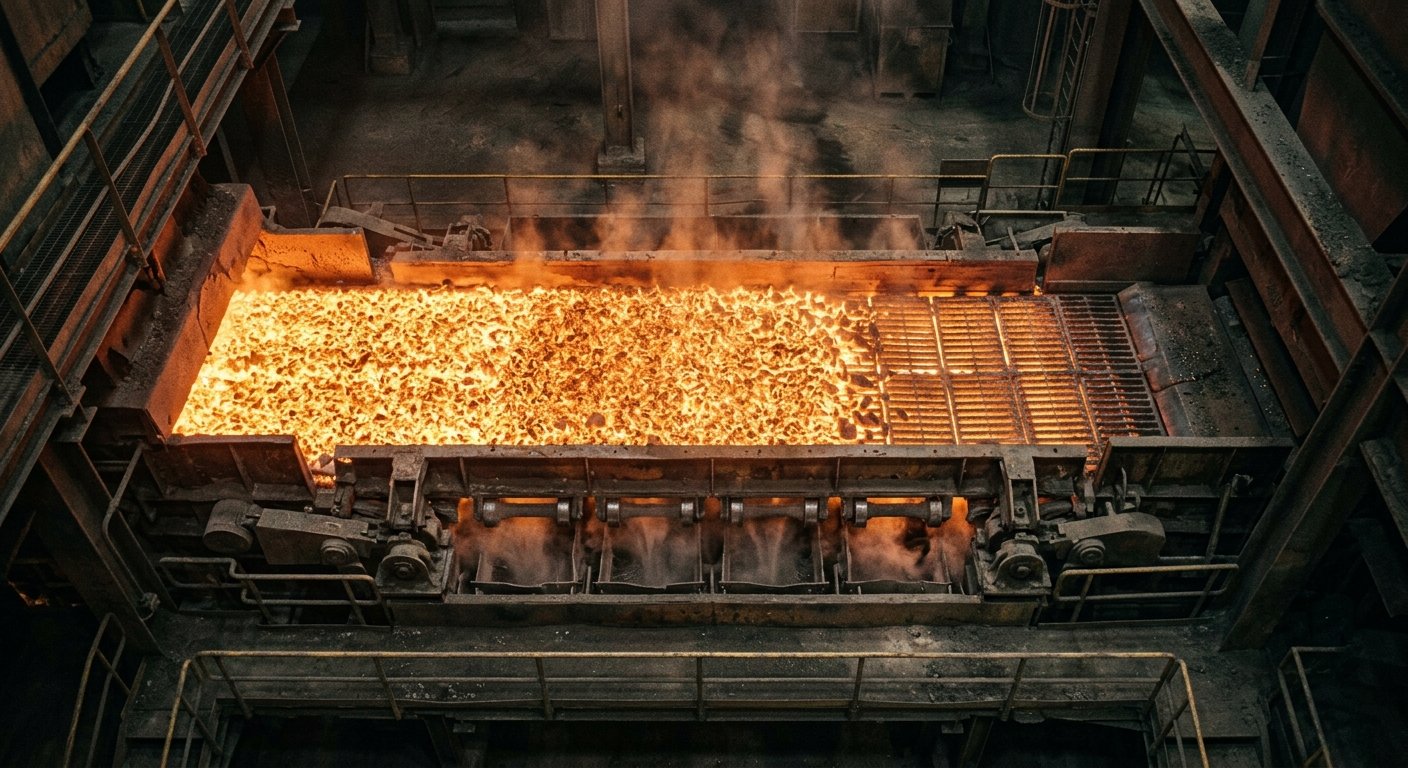
Wie funktioniert ein Klinkerkühler?
Ein Klinkerkühler schreckt den aus dem Ofen austretenden Klinker von ca. 1.400 °C auf ca. 100 °C mittels Gegenstromluft ab und gewinnt dabei Wärme als Sekundär- und Tertiärverbrennungsluft zurück.
Ein Klinker-Kühler kühlt Klinker, der den Drehofen bei etwa 1.400 °C verlässt, auf eine Transporttemperatur von 100-150 °C ab, indem Umgebungsluft im Gegenstrom durch das Klinkerbett geleitet wird. Die aufgenommene Wärme wird zurückgewonnen, indem die nun heiße Luft zurück in den Hauptbrenner des Ofens (Sekundärluft) und den Precalciner (Tertiärluft) geleitet wird. Unten: die Funktion, die drei Kühlerkonstruktionen, der Effizienzvergleich und die Abdichtungsschnittstelle zwischen Ofen und Kühler.
Die Funktion eines Klinker-Kühlers
Der Kühler erfüllt zwei Aufgaben gleichzeitig: Er friert die Klinkerminerale ein und gewinnt Wärme zurück. Eine schnelle Abkühlung im Bereich von 1.250 bis 1.200 °C fixiert Alit (C3S), die wichtigste festigkeitsgebende Phase im Portlandzementklinker; eine langsame Abkühlung lässt Alit zu Belit und freiem Kalk zurückverwandeln, was die 28-Tage-Festigkeit verringert [1]. Die heiße Kühlluft verlässt den Kühler bei 800-1.100 °C und wird zwischen Sekundärluft für den Ofenbrenner und, bei Anlagen mit Precalciner, Tertiärluft für den Kalzinator aufgeteilt. Ein moderner Kühler gibt etwa 1.000-1.200 kJ/kg Klinker als Verbrennungsluft zurück, was etwa 30-40 % des spezifischen Brennstoffverbrauchs des Ofens ausmacht [2].
Das thermische Profil durch das Kühlerbett ist steil und lohnt sich zu untersuchen. Klinker tritt bei 1.400-1.450 °C in den Kühler ein, fällt innerhalb der ersten zwei Meter des Bettes unter den Lüftern der Rückgewinnungszone um etwa 1.000 °C ab und kühlt sich in der Nachkühlzone auf 200-300 °C ab, bevor er bei 100-150 °C auf den Klinkertransporteur ausgetragen wird. Der statische Unterrostdruck bei modernen Hubrostkühlern liegt in der Rückgewinnungszone (den Hochdruck-Kammerlüftern) bei 70-110 mbar und fällt über die Nachkühlzone, wo Niederdrucklüfter die abnehmende thermische Last bewältigen, auf 30-50 mbar ab. Die Betttiefe ist die primäre Prozesssteuerung: 600-800 mm sind typisch, wobei tiefere Betten die Rückgewinnungseffizienz durch Verlängerung der Gas-Feststoff-Kontaktzeit erhöhen, aber auch den Druckabfall erhöhen, den die Lüfter überwinden müssen. Deshalb wird die Betttiefe im geschlossenen Regelkreis mit der Rostgeschwindigkeit und der Klinkeraustragsrate gesteuert. Der Zusammenhang zwischen Abkühlrate und Klinkerqualität erstreckt sich auch auf die Aluminiumphase: Ein schnelles Abschrecken bewahrt die glasartige, weniger reaktive C3A-Morphologie, die für Sulfatbeständigkeit bevorzugt wird, während eine langsame Abkühlung C3A kristallisiert und die frühe Hydratationswärme erhöht.
Klinker-Kühler: die Wärmetauscher-Einheit unmittelbar nach dem Drehofen, die Klinker mit Umgebungsluft abschreckt und dann die erwärmte Luft als Sekundär- und Tertiärverbrennungsluft in den Pyroprozess zurückführt.
Die drei Haupttypen von Klinker-Kühlern
Drei Kühlerkonstruktionen sind industriell im Einsatz: Hubrostkühler (dominierend bei modernen Anlagen), Satelliten- (Planeten-) Kühler, die am Ofenauslass angebracht sind, und eigenständige Trommelkühler.
Bei einem Hubrostkühler bewegt sich der Klinker horizontal auf einem Hubrost, während Umgebungsluft von unten durch das Bett geblasen wird. Hubrostkühler der dritten und vierten Generation (FLSmidth Cross-Bar, KHD PYROFLOOR², IKN Pendulum) gewinnen 75-80 % der Klinkerwärme zurück [3]. Bei einem Satelliten- (Planeten-) Kühler sind 8-12 Rohre um den Ofenauslass geschraubt und drehen sich mit dem Ofen; die Konstruktion ist kompakt, aber die Rückgewinnung erreicht maximal 55-65 % und es gibt keinen Tertiärluftabzug [4]. Trommelkühler sind eine separate rotierende Trommel nach dem Ofen, mechanisch einfach, mit einer Effizienz ähnlich wie Satellitenkühler; marginal im Zementbereich, üblich bei Kalk und DRI.
Das Fehlen eines Tertiärluftabzugs bei Satelliten- und Trommelkühlern ist der strukturelle Grund, warum Precalciner-Anlagen fast ausschließlich auf Hubrostkühler umgestiegen sind: Ohne eine heiße Tertiärluftleitung zum Kalzinator muss der Precalciner seine Verbrennungsluft durch den Ofen ziehen, was die Ofengasgeschwindigkeiten erhöht und dazu neigt, die Brennzone aus der Position zu schieben. Aus demselben Grund steigert die Rückgewinnungseffizienz von Hubrostkühlern direkt die Gesamtwärmeeffizienz im Zement-Vorwärmer- und Kalzinator-Kreislauf. Jeder Prozentpunkt Rückgewinnungseffizienz des Kühlers entspricht etwa 8-12 kcal/kg Klinker bei einer typischen Precalciner-Anlage, weshalb vierte Generationen von Kühler-Nachrüstungen trotz der mechanisch einfachsten Einheit der Ofenlinie immer wieder in den Investitionsplänen von Anlagen auftauchen.
Kühlervergleich
| Kühlertyp | Prinzip | Rückgewinnungseffizienz | Kapazitätsbereich | Typischer Anwendungsfall |
|---|---|---|---|---|
| Hubrost (3./4. Gen.) | Klinkerbett auf Rosten, Quer-Gegenstromluft von unten | 75-80 % | 1.500-12.000 t/Tag | Moderne Zementanlagen, mit Precalciner ausgestattet |
| Satellit (Planetarisch) | Rohre um den Ofenauslass, drehen sich mit dem Ofen | 55-65 % | 500-3.000 t/Tag | Ältere kleine bis mittlere Zementöfen, ohne Precalciner |
| Trommel | Separate rotierende Trommel nach dem Ofen | 55-65 % | 200-2.000 t/Tag | Kalk, DRI, Nischenzement |
Effizienzbereiche nach Madlool et al. [3], ECRA Technology Papers [2] und OEM-Spezifikationen. Die Aufrüstung eines älteren Hubrostkühlers (60-70 %) auf einen modernen (75-80 %) reduziert den SFC in veröffentlichten Fallstudien typischerweise um 30-50 kcal/kg Klinker. Siehe Klinker-Kühler-Konstruktion und Betrieb für den vollständigen Nachrüstungsrahmen und die Aufschlüsselung des spezifischen Wärmeverbrauchs für die Bündelung von Kühlereffekten mit Verbesserungen auf der Vorwärmerseite.
Die Schnittstelle zwischen Ofen und Kühler
Die Ofenhaube, die stationäre Einhausung zwischen dem rotierenden Ofenauslass und dem Kühler-Einlass, ist einer der größten Eintrittspunkte für Falschluft bei einer modernen Anlage. Die Schnittstelle ist heiß (1.400 °C auf der Ofenseite), abrasiv, thermisch zyklisch und überspannt eine rotierende zu stationäre Grenze. Hier eindringende Falschluft senkt die Sekundärlufttemperatur, erhöht den SFC und kann die Brennzone destabilisieren. Ein Temperaturabfall der Sekundärluft um 50 °C, wie er durch 8-10 % Falschluft an der Haube verursacht wird, kostet bei einer typischen Precalciner-Anlage etwa 12-18 kcal/kg Klinker, zusätzlich zur Last des ID-Lüfters, die die zusätzliche Gasmasse auferlegt. Die Geometrie des Abzugs ist ebenfalls wichtig: Siehe Konfigurationen des Ofenhauben-Einlasses und -Auslasses für die Gestaltung des Übergangs von der Haube zum Kühler bei OEM-Konstruktionen. Das Ofenauslass-Abdichtungssystem und die umfassendere integrierte Falschluftregelung zielen auf diese Schnittstelle ab; die gleiche Logik gilt für die Kalk- und DRI-Anlagen, die über die Zementindustrie-Seite abgedeckt werden.
Common questions about this topic
Ein Rostkühler befördert Klinker horizontal auf einem hin- und hergehenden Rost, wobei Kühlluft im Querstrom von unterhalb angeordneten Kammergebläsen nach oben geblasen wird; ein Satellitenkühler (Planetenkühler) verwendet 8–12 Rohre, die um den Auslauf des Drehrohrofens verschraubt sind. Rostkühler erreichen einen Rekuperationswirkungsgrad von 75–80 % und liefern sowohl Sekundärluft für den Ofenbrenner als auch Tertiärluft für den Vorcalcinator. Satellitenkühler erreichen maximal 55–65 % und liefern ausschließlich Sekundärluft, weshalb sie bei neuen Anlagen mit Vorcalcinator unüblich sind [3][4].
Ein moderner Rostkühler mit einem Rekuperationswirkungsgrad von 75–80 % führt etwa 1.000–1.200 kJ/kg Klinker als Verbrennungsluft zurück, was etwa 30–40 % des spezifischen Brennstoffverbrauchs des Drehrohrofens entspricht [2]. Der Austausch eines älteren Rostkühlers durch eine Konstruktion der vierten Generation reduziert den spezifischen Brennstoffverbrauch (SFC) typischerweise um 30–50 kcal/kg Klinker, abhängig von der Ofenkapazität und den Brennstoffpreisen.
Sources
- H. F. W. Taylor, *Cement Chemistry*, 2nd edition, Thomas Telford, 1997. Standard reference for clinker phase formation and the effect of cooling rate on alite stability.
- European Cement Research Academy (ECRA), *State of the Art Cement Manufacturing: Current Technologies and their Future Development*, ECRA Technology Papers
- N. A. Madlool, R. Saidur, M. S. Hossain, N. A. Rahim, "A critical review on energy use and savings in the cement industries", *Renewable and Sustainable Energy Reviews*, 15(4): 2042-2060, 2011
- IEA and Cement Sustainability Initiative, *Cement Technology Roadmap: Carbon Emissions Reductions up to 2050*. International Energy Agency
- FLSmidth, KHD Humboldt Wedag, and IKN technical brochures for the Cross-Bar, PYROFLOOR², and Pendulum cooler families respectively. Cited for design-specification ranges only, not for performance marketing claims. --- *If you are evaluating a cooler retrofit or auditing the kiln-hood interface on a specific line, the [engineering-consulting team](/en/services/engineering-consulting) works through the cooler heat balance and the sealing-interface methodology above on-site.*
Verwandte Artikel
Discuss Your Sealing Requirements
Our engineering team can help identify the right sealing solution for your application.
Contact Engineering Team“Überall dort, wo Hochtemperatur-Drehrohröfen unter kontrollierter Atmosphäre betrieben werden, sorgen Oswal-Dichtungssysteme für Energieeffizienz und Prozessstabilität.”