
The Clinker Cooler: Design, Operation, and Why It Matters for Sealing
A clinker cooler quenches hot clinker and recovers its heat. Grate vs planetary vs rotary types, recuperation efficiency, and the sealing interfaces.
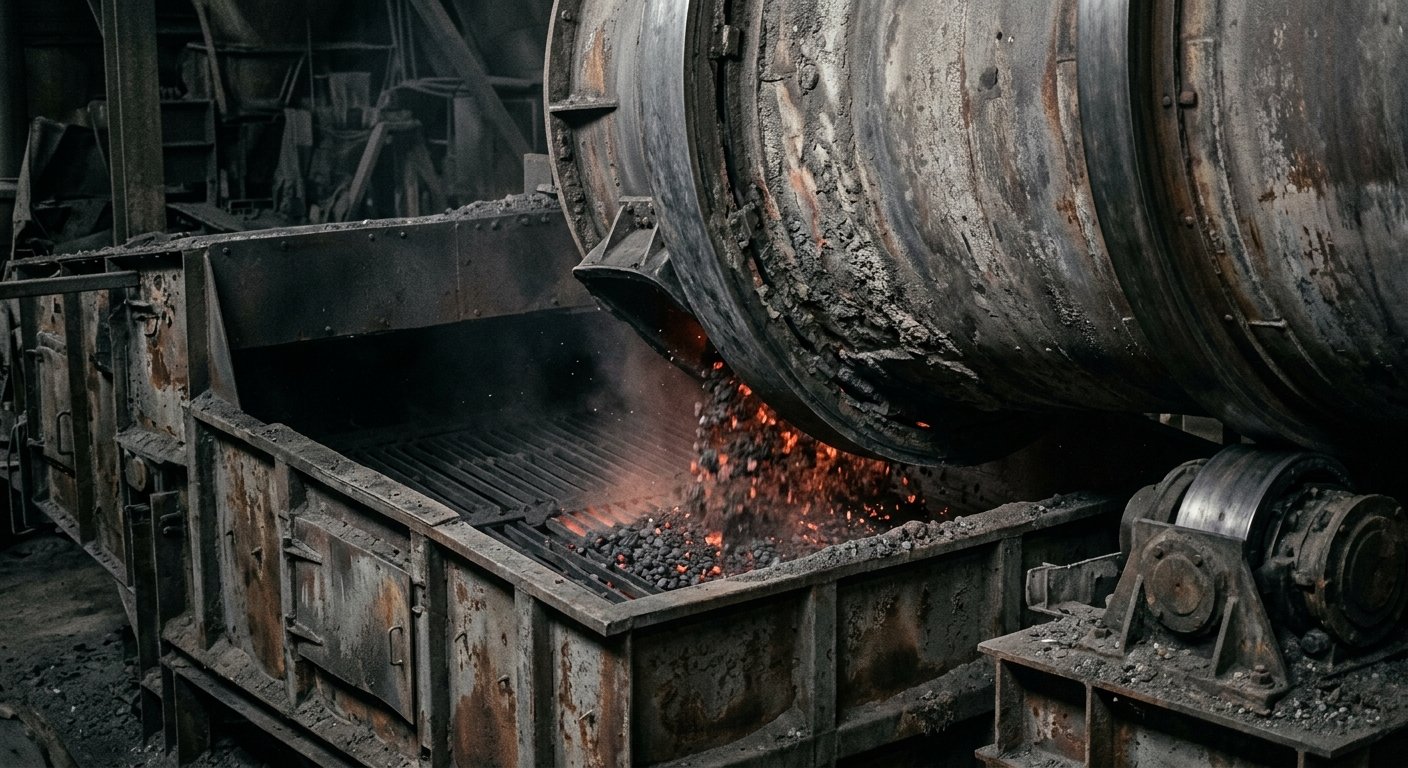
A clinker cooler is the equipment at the discharge end of a cement kiln that rapidly cools clinker from about 1,400 C down to roughly 100 C or less, and recovers the clinker's sensible heat as hot secondary and tertiary combustion air [1][2]. It does two jobs at once: it sets the clinker's final mineral structure through the cooling rate, and it returns a large share of the kiln's heat back to the burner. This piece covers what a clinker cooler does, the three cooler types and how they compare, recuperation-efficiency benchmarks, the sealing interfaces where the cooler meets the kiln, and the decision frame for a cooler retrofit or replacement. The step-by-step mechanism of operation is covered separately in how a clinker cooler works; this piece is the design, types, and sealing reference.
What does a clinker cooler do?
A clinker cooler quenches hot clinker and recuperates its heat. Quenching protects clinker quality; recuperation protects plant efficiency. Both matter, and a cooler that does one well but the other badly is a problem.
The quality job is about cooling rate, not just final temperature. Rapid cooling below ~1,250 C locks the alite (C3S) crystal structure that gives cement its strength and traps the aluminate phase (C3A) in a glassy state that is less reactive to sulfate attack and easier to grind [3][4]. Cool the clinker too slowly and some C3S reverts to belite (C2S) and free lime, permanently lowering strength and producing large C3A crystals that make the clinker hard to grind [3]. So the cooler is not a post-process; it is the last reaction stage of pyroprocessing.
The efficiency job is heat recovery. Clinker leaves the kiln carrying a large amount of sensible heat. The cooler blows ambient air through the clinker bed; that air heats up and is drawn back into the kiln as secondary air (through the hood, for the main burner) and tertiary air (ducted to the calciner). The fraction of clinker heat returned this way is the cooler's defining performance metric.
Clinker cooler. The equipment at the kiln discharge that cools clinker from ~1,400 C to ~65-100 C and recovers its sensible heat into the combustion-air streams. The fourth component of the pyroprocessing line.
Recuperation efficiency. The fraction of clinker sensible heat that the cooler returns to the kiln as hot secondary and tertiary air, rather than losing to the cooler vent stack. The headline cooler KPI.
Secondary air. Hot combustion air drawn from the cooler through the kiln hood to the main burner; the largest heat-recovery stream in the plant.
Tertiary air. Hot air ducted from the cooler to the calciner. Only coolers that can supply it (grate coolers) are compatible with precalciner kilns.
Cooler types: grate, planetary/satellite, rotary
Three cooler architectures are in service: grate coolers (the dominant modern design), planetary or satellite coolers (tubes bolted around the kiln shell), and rotary coolers (a separate inclined rotating drum). They differ in heat-recovery efficiency, clinker exit temperature, maintenance load, and whether they can supply tertiary air.
| Cooler type | Recuperation efficiency | Clinker exit temperature | Supplies tertiary air? | Maintenance / wear | Status |
|---|---|---|---|---|---|
| Grate cooler (modern: cross-bar / walking floor) | ~70-80% [5][6] | ~65-100 C (as low as ambient +65 C) [1][2] | Yes | Grate plates, seals, fans; higher parts count | Industry standard for new and upgraded lines |
| Grate cooler (conventional reciprocating) | ~60-65% [5][6] | ~120-150 C | Yes | Grate-plate wear, red-river risk | Common on older lines, often retrofit target |
| Planetary / satellite cooler | <60% [5][6] | 120-200 C [2] | No | No separate drive; tube wear, no tertiary air | Older design, unsuitable for large precalciner kilns |
| Rotary cooler | <55% [5] | high, variable | No | Simple, robust, low recovery | Largely superseded |
Sources: recuperation ranges from Madlool et al. (2011) [5] and ECRA practice [6], cross-checked against IIP Network IETD figures (modern grate "65% or higher") [7]; exit temperatures from cement-process cooler literature [1][2]. Recuperation efficiency depends on the measurement boundary; see the benchmark section.
The grate cooler moves clinker across a perforated grate while cooling air is blown up through the bed. Modern designs (cross-bar and walking-floor grates) hold a deeper, more uniform bed and distribute air better than the older reciprocating grates, which is why their recuperation is higher. The grate cooler is the only type that supplies tertiary air, so it is the only choice for a precalciner kiln of any size. The trade-off is mechanical complexity: grate plates, drive mechanisms, multiple cooling fans, and the seals that keep false air out.
The planetary (satellite) cooler is a set of tubes bolted around the kiln discharge so they rotate with the kiln. It needs no separate drive and no separate building, which made it attractive on older mid-size lines. But it cannot supply tertiary air, which rules it out for large precalciner kilns, and its recuperation is lower because the geometry limits how much heat it can pull back. Clinker leaves a planetary cooler hotter, typically 120-200 C [2].
The rotary cooler is a separate inclined rotating drum downstream of the kiln. It is simple and robust but has the lowest heat recovery of the three and has been largely superseded by grate coolers on modern lines.
Recuperation efficiency benchmarks
Recuperation efficiency, the fraction of clinker sensible heat returned to the kiln as secondary and tertiary air, is the headline cooler KPI. Modern high-efficiency grate coolers reach about 70-80%; conventional reciprocating grate coolers about 60-65%; planetary and rotary coolers typically below 60% [5][6][7]. The number is worth defining carefully, because different sources draw the boundary differently.
recuperation efficiency = Q_recovered / Q_clinker_in
Where:
- recuperation efficiency. Fraction of clinker heat returned to the kiln (dimensionless, expressed as %)
- Q_recovered. Heat carried back to the kiln in secondary and tertiary air, kcal/kg clinker
- Q_clinker_in. Sensible heat entering the cooler with the hot clinker, kcal/kg clinker
A note on the spread in published figures: some sources report a cooler's overall energy efficiency (which can read above 80% because it counts all heat leaving the clinker, including the part vented), while the recuperation efficiency that matters for fuel saving counts only the heat returned to the kiln. One detailed exergy study of a grate cooler found a base-case energy efficiency of about 81% but a heat-recovery (recuperation) efficiency of only about 21% before optimization, illustrating how far the boundary definition can move the number [8]. The 70-80% figure used here is the practitioner recuperation convention for a well-run modern grate cooler [5][6]; a poorly tuned or worn cooler can sit well below it.
The practical consequence is fuel. The gap between a modern grate cooler and a legacy planetary cooler is on the order of 30-60 kcal/kg clinker of additional fuel demand [5][6], because the heat a planetary cooler fails to recuperate has to be supplied by the burner instead. That is the same heat-balance lever covered in the specific heat consumption reference, just seen from the cooler end. A good cooler also drops clinker to ~65-100 C, low enough for conveyors and good grindability; a planetary cooler leaving clinker at 150-200 C costs both recovered heat and downstream handling margin [1][2].
The sealing interfaces: where the cooler meets the kiln
The cooler-to-kiln transition is one of the four major false-air ingress interfaces on a kiln line: the rotating kiln discharge meets the stationary cooler inlet under negative pressure, and any gap there admits ambient air that displaces hot secondary air and steals recuperated heat [9][10]. This is the genuine reason a cooler discussion belongs on a kiln-sealing site. False air here is doubly costly: it adds heating duty like any false air does, and it directly attacks the recuperation the cooler exists to deliver, because the cold ingress dilutes and cools the secondary-air stream going to the burner.
Cooler-to-kiln transition (kiln outlet / hood). The interface where the rotating kiln shell discharges clinker into the stationary cooler and hood. The hottest and most abrasive sealing location in the plant, and one of the four dominant false-air interfaces.
The seal at this interface is the kiln-outlet seal. It is the hardest seal duty in the plant: the highest temperature, the heaviest abrasive dust load from falling clinker, and constant relative movement between the rotating shell and the stationary hood. The shell also grows axially as it heats, so the seal has to absorb that movement without opening a gap. That is the job of the axial compensation seals, which accommodate the kiln's thermal axial growth at the outlet; a rigid seal designed for static geometry fails here within a campaign.
The technology trade-off at this interface is the standard one. Lamella seals flex to follow shell movement but are more sensitive to thermal cycling; graphite seals hold up in the high-temperature, abrasive zone but are stiffer. For plants with pronounced shell ovality or frequent thermal cycling, a hybrid configuration usually fits better; for steady high-temperature running, a graphite-dominant arrangement is often enough. In retrofits Oswal audits, the kiln-outlet and cooler-transition interface is consistently the hottest, most abrasive seal on the line, which is why it is treated as a distinct engineering problem rather than a scaled-up inlet seal. The mechanism, measurement, and benchmarks for ingress at this and the other interfaces are in the false air reference, and Oswal's integrated false air control system addresses the cooler interface as part of one sealing-plus-monitoring workflow rather than a part sold in isolation.
The upgrade decision frame: retrofit or replace?
A cooler upgrade is justified when measured recuperation efficiency sits well below ~70%, when clinker exit temperature is chronically high, or when a planetary cooler blocks a precalciner conversion; the payback comes from the SHC reduction the recovered heat delivers [5][6]. The decision is rarely "replace immediately." It is usually a ladder.
The factors that drive it:
- Measured recuperation vs benchmark. A cooler running below ~65% on a kiln that should support 75-80% is leaving 30-60 kcal/kg of fuel on the table [5][6].
- Clinker exit temperature. Chronically high exit temperature (a planetary cooler at 150-200 C, or a worn grate cooler with red-river hot streaks) flags both lost heat and downstream handling and grindability penalties [2][3].
- Tertiary-air requirement. A planetary cooler cannot feed a calciner. If the plant wants to add a precalciner to cut kiln load, the cooler has to change first.
- Wear and reliability. Grate-plate wear, red-river problems, and fan or seal degradation raise maintenance cost and cap throughput.
The order of operations matters. Before committing to a full cooler swap, seal the cooler-to-kiln interface and tune the cooling-air distribution: that is the low-capital first move that recovers heat without a capital project, and it is often enough to defer or resize the larger investment. The installation and retrofit and engineering consulting teams scope this sequence as a single audit.
Worked example. Take a 5,000 t/day kiln whose planetary cooler recuperates ~58% and a candidate grate-cooler upgrade that would reach ~76%. If that recuperation gain returns 45 kcal/kg clinker of heat that the burner currently has to supply, the saving is 45 kcal/kg × 5,000,000 kg/day = 225 million kcal/day. At a coal lower heating value of 6,000 kcal/kg that is about 37.5 tonnes of coal per day, on the order of 12,000 tonnes per year on a 330-day basis. Whether that justifies a full cooler replacement or "seal-and-tune first, replace later" depends on the cooler's mechanical condition and the plant's capital position, which is exactly the analysis the upgrade decision is.
| Variable | Value | Notes |
|---|---|---|
| Kiln capacity | 5,000 t clinker/day | Typical mid-size single line |
| Recuperation gain | 58% → 76% | Planetary to modern grate |
| Heat recovered | ~45 kcal/kg clinker | Mid-range for this gap [5][6] |
| Coal LHV | 6,000 kcal/kg | Typical thermal coal |
| Coal saved | ~12,000 t/year | 330 operating days |
Common questions about this topic
A clinker cooler is the equipment at the discharge end of a cement kiln that rapidly cools clinker from about 1,400 C to roughly 100 C or less and recovers the clinker's heat as hot secondary and tertiary combustion air [1][2]. It is the fourth component of the pyroprocessing line. It serves two purposes at once: setting clinker quality through the cooling rate, and recovering kiln heat to cut fuel use.
A clinker cooler blows ambient air up through a bed of hot clinker; the air heats up and is drawn back to the kiln as secondary and tertiary combustion air, while the clinker cools and is conveyed away [1][2]. In a grate cooler the clinker moves across a perforated grate; in a planetary cooler it tumbles through tubes that rotate with the kiln. The detailed step-by-step mechanism is covered in how a clinker cooler works.
A grate cooler is a separate unit that moves clinker across an air-blown grate and can supply tertiary air to a calciner, reaching ~70-80% recuperation efficiency; a planetary (satellite) cooler is a set of tubes bolted around the kiln shell that needs no separate drive but cannot supply tertiary air and recuperates below ~60% [2][5]. Grate coolers also leave clinker cooler (~65-100 C vs 120-200 C). The planetary cooler is the simpler, older design; the grate cooler is the modern standard, especially for precalciner kilns.
Recuperation efficiency is the fraction of the clinker's sensible heat that the cooler returns to the kiln as hot secondary and tertiary air, rather than losing it to the cooler vent stack [5][6]. A modern grate cooler reaches about 70-80%; a planetary cooler stays below 60%. It is the cooler's headline KPI because every percentage point not recuperated is fuel the burner has to supply, which is the same lever covered in specific heat consumption.
Rapid cooling locks the clinker's mineral structure: it preserves alite (C3S, the strength phase) and traps aluminate (C3A) in a glassy, grindable, sulfate-resistant state [3][4]. Cooling too slowly reverts some C3S to belite and free lime, permanently lowering cement strength, and grows large C3A crystals that make the clinker hard to grind. So the cooler is the last reaction stage of clinker formation, not just a heat exchanger.
The cooler-to-kiln transition is one of the four dominant false-air interfaces on a kiln line, and ingress here is doubly costly: it adds heating duty and it dilutes and cools the secondary air the burner depends on, directly attacking the cooler's recuperation [9][10]. The kiln-outlet seal at this interface is the hottest, most abrasive seal in the plant. The mechanism and benchmarks are in the false air reference.
A modern grate cooler drops clinker to roughly 65-100 C (often quoted as ambient plus ~65 C), which is low enough for conveyor handling and good grindability [1][2]. A planetary or rotary cooler leaves clinker hotter, typically 120-200 C, which costs both recovered heat and downstream handling margin. Persistently high exit temperature is one of the signals that a cooler upgrade is due.
Upgrading from a low-recuperation cooler (a planetary cooler below ~60%) to a modern grate cooler (~70-80%) typically recovers 30-60 kcal/kg clinker of fuel that the burner would otherwise have to supply [5][6]. On a 5,000 t/day kiln a 45 kcal/kg gain is on the order of 12,000 tonnes of coal a year. The saving feeds straight into the plant's specific heat consumption and fuel-cost line.
The kiln-outlet seal handles the rotating-shell-to-stationary-hood interface at the cooler, and axial compensation seals absorb the kiln's thermal axial growth so the seal does not open a gap as the shell expands [9]. It is the highest-temperature, most abrasive seal duty in the plant. Lamella, graphite, and hybrid configurations each suit different thermal-cycling and ovality conditions.
Generally no, because a planetary (satellite) cooler cannot supply the separate tertiary-air stream a precalciner needs, and the constraint becomes binding as kiln size grows [2][5]. A plant wanting to add a precalciner to a planetary-cooler line usually has to convert to a grate cooler first. This tertiary-air requirement is one of the main reasons planetary coolers have been displaced on large modern lines.
Sources
- INFINITY for Cement Equipment, *Everything you need to know about Clinker Coolers*. Cooler function, clinker exit temperatures, and grate-cooler operation
- Imubit, *Clinker Cooler Heat Recovery, Air Distribution, and Throughput Optimization*. Recuperation as the primary KPI; planetary vs grate exit temperatures
- Çimsa, *What is Clinker? The Relationship Between Clinker Phases and Grinding Parameters*. Cooling rate, C3S/C3A, glass phase, and grindability
- Understanding Cement, *Reactions in the cement kiln, clinkering*. Rapid-cooling effect on clinker phases
- Madlool, N.A., Saidur, R., Hossain, M.S., Rahim, N.A., *A critical review on energy use and savings in the cement industries*, Renewable and Sustainable Energy Reviews, 15(4), pp. 2042-2060, 2011. Cooler recuperation by type and SHC impact
- European Cement Research Academy (ECRA), *Technical Reports* and *Catalogue of Best Practices*. Cooler-efficiency benchmarks and upgrade practice
- Industrial Efficiency Technology & Measures (IIP Network / IETD), *Conversion to High-Efficiency Grate Coolers*. Modern grate-cooler heat-recovery efficiency
- Ahamed, J.U., et al., *Assessment of energy and exergy efficiencies of a grate clinker cooling system through the optimization of its operational parameters*, Energy, 46(1), pp. 664-674, 2012. Base-case energy vs heat-recovery efficiency boundary distinction
- Verein Deutscher Zementwerke (VDZ), *VDZ Activity Report* (annual). Kiln-outlet and cooler-transition false-air interface conventions
- Holderbank Group / Holcim, *Cement Manufacturing: Process Technology*, Volume 2 (Holderbank Cement Course). Clinker-cooler chapter and false-air interface treatment
Related Articles
Discuss Your Sealing Requirements
Our engineering team can help identify the right sealing solution for your application.
Contact Engineering Team“Wherever high-temperature rotary kilns operate under controlled atmosphere, Oswal sealing systems ensure energy efficiency and process stability.”