
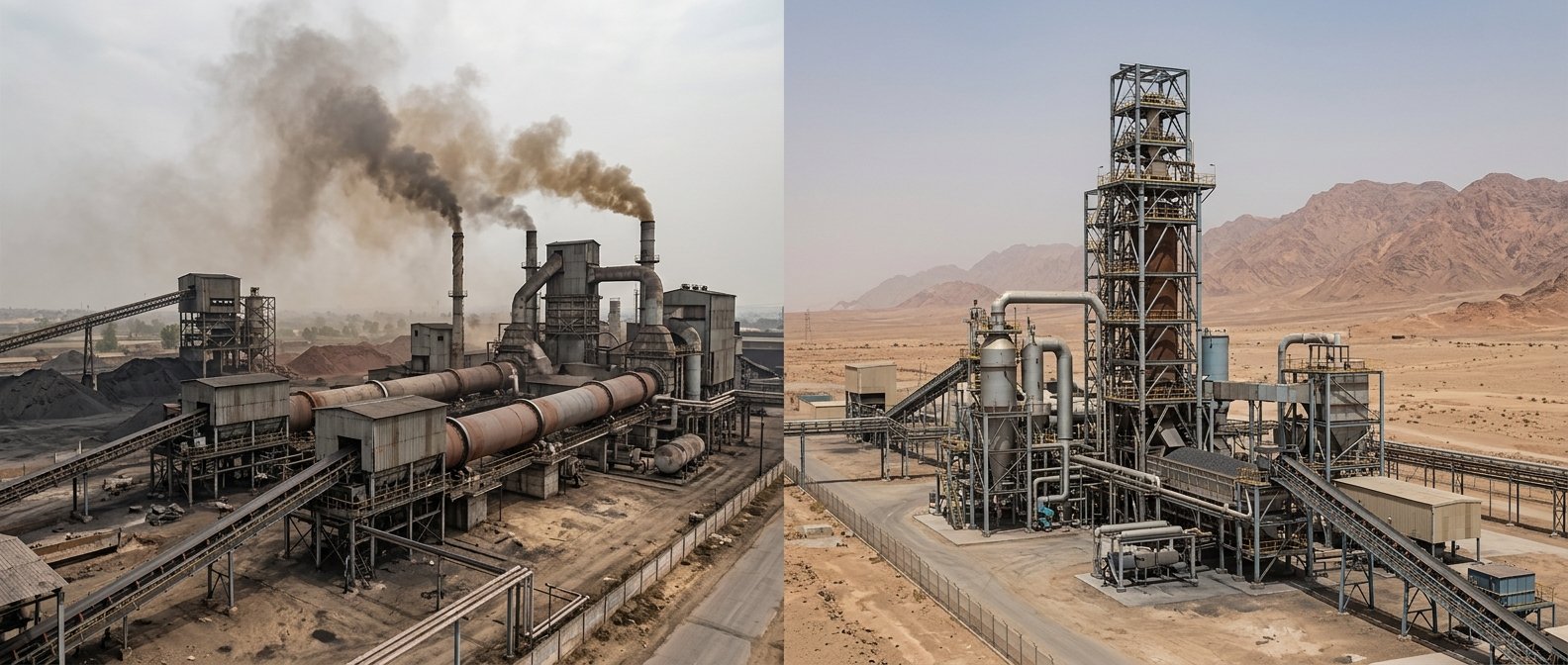
Kohlebasiertes vs. gasbasiertes DRI: Welches Verfahren für welchen Markt
Kohlebasiertes DRI dominiert in Indien mittels Drehrohröfen; gasbasiertes DRI dominiert in der MENA-Region mittels Schachtöfen. Vergleich von Einsatzstoffen, Skalierung, Metallisierungsgrad und Emissionen.
Sowohl kohlebasiertes als auch gasbasiertes DRI reduzieren Eisenerz unterhalb des Schmelzpunkts zu festem metallischem Eisen. Sie unterscheiden sich jedoch in Bezug auf Einsatzstoffe, Prozessanlagen, Skalierung, Metallisierungsgrad, CO2-Fußabdruck und geografische Eignung, was jeweils bestimmt, welcher Weg für einen bestimmten Markt und ein gegebenes Ressourcenumfeld geeignet ist. Im Jahr 2024 erreichte die weltweite DRI-Produktion 140,8 Mio. Tonnen: Schachtöfen (überwiegend gasbasiert) produzierten etwa 72 % und Drehrohröfen (überwiegend kohlebasiert) etwa 24 % [1]. Indien trug 2024 mit 54,8 Mio. Tonnen zur weltweiten Produktion bei, wovon etwa 80 % kohlebasiert waren [2][1]. Dieser Artikel legt den Entscheidungsrahmen für den Vergleich der beiden Verfahren dar.
Zwei Wege zum gleichen Produkt
Beide Verfahren beginnen mit Eisenerzpellets oder Stückerz sowie einem Reduktionsmittel und zielen darauf ab, den Eisenoxiden unterhalb des Schmelzpunkts von Eisen (~1.538 °C für reines Eisen) Sauerstoff zu entziehen, um ein festes metallisches Produkt zu erzeugen. Reaktor, Reduktionsmittel und Maßstab unterscheiden sich jedoch grundlegend.
Kohlebasierter Weg. Ein rotierender, geneigter zylindrischer Ofen (typischerweise 60–100 m lang, 4–6 m Durchmesser) erhitzt ein Bett aus Eisenerz und nicht-verkokender Kohle. Die Kohle verbrennt kontrolliert im Freiraum, wodurch ein CO-reiches Gas entsteht, das in das Erzbett eindringt und die Eisenoxide über eine Verweilzeit von 8–12 Stunden reduziert [3]. Das Produkt verlässt den Ofen bei etwa 200–400 °C und gelangt in einen Trommelkühler. Indiens DRI-Industrie mit 285 Anlagen basiert fast vollständig auf dieser Technologie, mit einzelnen Ofenkapazitäten von 50–500 Tagestonnen (TPD) [3][4].
Gasbasierter Weg. Eisenerzpellets oder Stückerz wandern durch einen vertikalen Gegenstrom-Schachtofen (Midrex- oder ENERGIRON/HYL-Konfiguration). Ein heißes reformiertes Gas (CO + H2, typischerweise 90–92 % Reduktionsgas) strömt aufwärts durch das absinkende Erz und reduziert es über eine Verweilzeit von 5–8 Stunden [5][6]. Das Produkt wird heiß ausgetragen (HDRI, ca. 700 °C) für die direkte Beschickung von Elektrolichtbogenöfen (EAF) oder gekühlt (CDRI) für den Massengutumschlag und die Lagerung. Die Kapazität eines Einzelmoduls reicht von 0,5 Mio. t/a bis 2,5 Mio. t/a (ENERGIRON, Nucor Steel) [6].
Vergleich im Entscheidungsrahmen
| Parameter | Kohlebasiert (Drehrohrofen) | Gasbasiert (Schachtofen) |
|---|---|---|
| Primäres Reduktionsmittel | Nicht-verkokende Kohle | Reformiertes Erdgas; oder Wasserstoff (aufkommend) |
| Schlüsselprozesse / Lizenzgeber | SL/RN (LKAB/Outokumpu-Erbe), TISCO, indische Varianten | Midrex (Kobe/Primetals); ENERGIRON (Tenova/Danieli) |
| Typische Einheitskapazität | 50–500 TPD pro Ofen | 0,5–2,5 Mio. t/a pro Modul |
| Reaktortyp | Drehrohrofen, 60–100 m Länge | Vertikaler Gegenstrom-Schachtofen |
| Metallisierung | 88–92 % | 92–95 % |
| Kohlenstoff im Produkt | 0,08–0,2 % | 1,0–2,5 % (einstellbar über Kühlgas-Methan) |
| Spezifischer Energiebedarf | 4,1–5,3 Gcal/t DRI (17–22 GJ/t) [4] | ~10–12 GJ/t (Gaseinsatz) [5] |
| THG-Intensität | 1.391–1.880 kg CO2/t DRI [7] | 815–1.160 kg CO2/t DRI (NG); unter 100 kg/t (H2-DRI) [7][8] |
| Capex-Profil | Niedriger (modular, Kohle-Infrastruktur) | Höher (Gasreformierung, große Bauwerke) |
| Gas-/Stromabhängigkeit | Niedrig (nur Kohle) | Hoch (Erdgasversorgung; Pipelinenetz) |
| Geografischer Schwerpunkt | Indien (dominant), Südafrika, China (traditionell) | MENA, Iran, Russland, Mexiko, USA, Europa (grüner Stahl) |
| Übergang zu H2 | Nicht möglich (Reaktor inkompatibel mit Gasphasen-Reduktionsmittel) | Ja, MIDREX Flex und ENERGIRON ZR sind H2-ready |
Der kohlebasierte Weg: Warum Indien den Drehrohrofen wählte
Indien entschied sich für den kohlebasierten Drehrohrofen, da das Land über keine kommerziell nutzbaren heimischen Vorkommen an metallurgischer Kokskohle (erforderlich für Hochöfen) verfügt, jedoch über beträchtliche Reserven an nicht-verkokender Kohle. Zudem ist der Drehrohrofen modular genug, um die kleinen und mittleren Elektroofen-Stahlproduzenten zu bedienen, die den indischen DRI-Verbrauch dominieren [2][3][4].
Indien ist der weltweit größte DRI-Produzent: 54,8 Mio. Tonnen im Jahr 2024 (World Steel Association) [2], wovon etwa 80 % kohlebasiert waren [3]. Die 285 DRI-Anlagen in Indien betreiben meist 100-TPD-Öfen und beliefern Induktionsöfen sowie Mini-EAF-Kunden im sekundären Stahlsektor [4]. Das SL/RN-Verfahren und seine indischen Adaptionen sind die dominierende Technologie.
Der spezifische Kohleverbrauch für den Drehrohrofen-Weg liegt bei etwa 950–1.000 kg Kohle pro Tonne DRI, bei einem spezifischen Energieverbrauch von typischerweise 4,1–5,3 Gcal/t-DRI (17–22 GJ/t-DRI) [4]. Dies ist pro Tonne deutlich höher als beim gasbasierten Verfahren, was die inhärente Ineffizienz widerspiegelt, Kohle sowohl zur Erzeugung von Prozesswärme als auch von Reduktionsgas im selben Gefäß zu verbrennen.
Die Skalenbeschränkung ist grundlegend. Ein einzelnes Midrex- oder ENERGIRON-Schachtofenmodul mit 1–2,5 Mio. t/a kann den verstreuten Bedarf von 50–500 TPD des indischen Induktionsofen-Gürtels nicht wirtschaftlich decken. Die geringere wirtschaftliche Mindestgröße des Drehrohrofens (50 TPD) ist ein entscheidendes Merkmal für die indische Marktstruktur.
Qualitätsfolgen des kohlebasierten Weges werden in kohlebasierte Eisenschwammproduktion und Eisenschwamm-Qualitätskontrolle behandelt. Der entscheidende Qualitätskompromiss: Kohlebasiertes DRI liefert 88–92 % Metallisierung und 0,08–0,2 % Kohlenstoff, während gasbasiertes DRI 92–95 % Metallisierung und 1,0–2,5 % einstellbaren Kohlenstoff liefert. Für den vollständigen Eisenschwamm-Produktionsprozess siehe den C9-Grundlagenartikel.
Der gasbasierte Weg: Warum MENA und Entwickler von grünem Stahl den Schachtofen wählten
Gasbasiertes DRI mittels Schachtofen dominiert in der MENA-Region, im Iran, in Russland, Mexiko und ist die bevorzugte Route für neue Projekte für grünen Stahl in Europa und Nordamerika. Diese Regionen verfügen über reichlich und relativ günstiges Erdgas, und der großskalige Schachtofen liefert eine höhere Metallisierung, ein Produkt mit einstellbarem Kohlenstoffgehalt und einen klaren Weg zu grünem Stahl mittels Wasserstoff [1][5][6].
MIDREX ist der führende Lizenzgeber. Seine Anlagen produzierten 2024 76,2 Mio. Tonnen, 54,1 % der gesamten weltweiten DRI-Produktion und ein neuer Jahresrekord [1]. Der Super-Megamod-Schachtofen mit 7,5 m Durchmesser produziert 2,2 Mio. t/a DRI in einem einzigen Modul [5]. Das 5,0-m-Modul von Qatar Steel hat seit 1978 über 28,7 Mio. Tonnen DRI kumuliert produziert [1]. SULB (United Steel Company, Bahrain) betreibt eine 1,5 Mio. t/a HDRI/CDRI-Kombinationsanlage und hat eine kumulierte Produktion von über 15 Mio. Tonnen überschritten [1].
ENERGIRON (Joint Venture von Tenova/Danieli). Die größte ENERGIRON-Installation mit einem Einzelmodul ist die 2,5-Mio.-t/a-Anlage von Nucor Steel in den USA [6]. Der Prozess zeichnet sich durch seine Selbstreformierungsfunktion aus: Der Reaktor nutzt das Erzbett als Reformierungskatalysator, was die Investitionskosten im Vergleich zu Designs mit externem Reformer senkt.
Der gasbasierte Schachtofen ist der einzige kommerziell erprobte DRI-Reaktor, der auf wasserstoffbasierte Reduktion umgestellt werden kann. MIDREX Flex- und ENERGIRON ZR-Designs können bei sinkenden Wasserstoffkosten zunehmende Anteile von Wasserstoff in das Reduktionsgas beimischen. Bei 100 % H2 reduziert der Betrieb von MIDREX Flex die CO2-Emissionen um etwa 97 % im Vergleich zur Hochofen-BOF-Stahlherstellung [8].
Gasbasiertes DRI-Produkt enthält zudem mehr Kohlenstoff pro Tonne Produkt: 1,5–2,5 % Kohlenstoff, eingestellt durch Anpassung des Methangehalts im Kühlgas. Jedes Kilogramm Kohlenstoff, das in das EAF-Bad gelangt, liefert etwa 2,3 kWh chemische Energie und reduziert den Bedarf an elektrischer Energie. Dies ist ein qualitätsbezogener Vorteil bei der Stahlherstellung, den der kohlebasierte Weg strukturell nicht bieten kann.
Emissionen und der Übergang zu grünem Stahl
Gasbasiertes DRI emittiert bei der aktuellen Erdgasmischung etwa 33–41 % weniger CO2 als kohlebasiertes DRI; die Lücke vergrößert sich bei wasserstoffbasiertem Betrieb auf etwa 97 % [7][8].
Gemessen als kg CO2 pro Tonne produziertem DRI:
| Route | THG-Intensität (kg CO2/t DRI) | Quelle |
|---|---|---|
| Kohlebasiertes DRI (Drehrohrofen, indische Bedingungen) | 1.391–1.880 | Biswas et al. (2022) LCA [7] |
| Gasbasiertes DRI (NG-Reformierung, MIDREX) | 815–1.160 | Biswas et al. (2022) LCA [7] |
| Gasbasiertes DRI (H2-DRI, MIDREX Flex bei 100 % H2) | ~60–100 (geschätzt) | Midrex [8] |
| Hochofen-BOF (zum Vergleich) | 1.800–2.000 kg CO2/t Stahl | World Steel Assoc [9] |
Indiens kohlebasierte DRI-Anlagen stehen vor einer strukturellen Herausforderung bei der Dekarbonisierung: Der Drehrohrofen kann nicht auf Wasserstoff als Einsatzstoff umgestellt werden. Jeder Übergang zu emissionsärmerer Eisenherstellung für indische Anlagen erfordert neue gasbasierte oder wasserstoffbasierte Schachtöfen, keine Nachrüstungen bestehender Öfen. Dies beginnt sich in den Diskussionen des indischen Stahlministeriums über einen Netto-Null-Stahl-Fahrplan abzuzeichnen, obwohl der Zeitplan unklar bleibt.
Für die Betreiber in der MENA-Region und Europa ist der gasbasierte Weg bereits als Übergangstechnologie positioniert: Dieselbe Anlage, die heute mit Erdgas betrieben wird, kann schrittweise Wasserstoff beimischen, während das Angebot an erneuerbaren Energien wächst. Diese Optionalität ist der primäre strategische Vorteil des gasbasierten Weges bei einer Investitionsentscheidung für neue Anlagen.
Auswirkungen der Ofenabdichtung auf die jeweiligen Verfahren
Beide Verfahren erfordern eine effektive Abdichtung am Reaktorein- und -auslass, aber die Folgen eines Versagens unterscheiden sich [10][11].
Kohlebasierte Drehrohröfen. Die Ofenein- und -auslassdichtungen sind die primären Barrieren gegen das Eindringen von Falschluft und die Re-Oxidation des Produkts. Am Austragsende (200–400 °C) ist der Eisenschwamm reaktiv und porös. Ein Dichtungsversagen an der Austragshaube oder der Schnittstelle zum Kühler führt zu direktem Verlust der Metallisierung: Ein anhaltendes Eindringen von 5–10 % Falschluft kann die Metallisierung um 2–4 Prozentpunkte senken und das Produkt unter die Spezifikation IS 15774:2018 Grade 1 drücken. Die Dichtungsintegrität ist in kohlebasierten Anlagen ein Problem der Produktqualität, nicht nur der Energieeffizienz.
Gasbasierte Schachtöfen. Der Schachtofen arbeitet unter positivem Reduktionsgasdruck, was bedeutet, dass geringfügige Leckagen von Umgebungsluft weniger wahrscheinlich in das Reaktorbett eindringen. Die Abdichtung am Gasauslass, an der Produktaustragsschleuse und im Kühlgaskreislauf ist technisch kritisch, aber der Prozess ist von Natur aus toleranter gegenüber geringem Kontakt mit atmosphärischer Luft als der kohlebasierte Drehrohrofen. Der Qualitätskontrollmechanismus in gasbasierten Anlagen ist primär die CO/H2-Gaszusammensetzung und nicht die physische atmosphärische Abdichtung.
Das Duplex-Ofenabdichtungssystem ist besonders für kohlebasierte DRI-Öfen geeignet, bei denen der kontinuierliche Kampagnenbetrieb zwischen geplanten Wartungsfenstern zu einer anhaltenden Belastung durch verschleißbedingte Dichtungsdegradation führt. Das Doppelbarrieren-Design bewahrt die atmosphärische Integrität am Austragsende, selbst wenn die Primärdichtung ihre Verschleißgrenze erreicht. Oswal bedient die metallurgische Industrie mit Dichtungssystemen sowohl für DRI- als auch für andere Ofenanwendungen in diesem Sektor. Mehr zum Thema Abdichtung finden Sie unter Warum Ofenabdichtung in DRI-Anlagen wichtig ist.
Common questions about this topic
Gasbasiertes DRI (Schachtofen) erreicht durchweg einen höheren Metallisierungsgrad von 92–95 % im Vergleich zu 88–92 % bei kohlebasiertem DRI aus Drehrohröfen [2][5]. Der Schachtofen nutzt ein präzise gesteuertes Reduktionsgas (CO + H2), das auf den angestrebten Metallisierungsgrad optimiert ist; die Reduktionsbedingungen im Drehrohrofen lassen sich über die Ofenlänge hinweg schwieriger gleichmäßig kontrollieren. Lufteintritte an den Ofendichtungen in kohlebasierten Anlagen können den Metallisierungsgrad zusätzlich unter den konstruktiven Zielwert des Ofens drücken, was zu einer Prozessvariabilität führt, die bei der gasbasierten Route in dieser Form nicht auftritt.
Nicht unmittelbar in Indien, wo das kohlebasierte Verfahren etwa 80 % der Produktion ausmacht und die kleinteilige Struktur des Sektors (100–500 Tagestonnen-Öfen zur Versorgung von Induktionsofen-Kunden) den Einsatz großer gasbasierter Schachtöfen für die meisten Betreiber wirtschaftlich unpraktikabel macht [3][4]. Das kohlebasierte Verfahren weist jedoch einen wesentlich höheren Emissionsfußabdruck auf und lässt sich nicht auf Wasserstoff umstellen. Langfristig dürften Kapazitätserweiterungen bei der indischen DRI-Produktion im größeren Maßstab gas- oder wasserstoffbasierte Schachtöfen begünstigen. Die kohlebasierten Anlagen werden voraussichtlich bis zum Ende ihrer wirtschaftlichen Nutzungsdauer betrieben, anstatt umgerüstet zu werden.
Nein. Die beiden Routen verwenden grundlegend unterschiedliche Reaktoren. Eine kohlebefeuerte Anlage verwendet einen Drehrohrofen; eine gasbefeuerte Anlage verwendet einen Gegenstrom-Schachtofen mit einer vorgeschalteten Gasreformieranlage. Ein Wechsel erfordert den Bau einer neuen Anlage. Die hohe Kapitalintensität eines Midrex- oder ENERGIRON-Moduls (und der dafür erforderlichen Gasinfrastruktur) bedeutet, dass Umstellungsentscheidungen im Stadium von Neuinvestitionen getroffen werden und nicht als Nachrüstungen bestehender Öfen. Indische Produzenten, die Kapazitätserweiterungen über etwa 0,5 Mio. t/a hinaus prüfen, untersuchen zunehmend gasbasierte Optionen, insbesondere da die LNG-Importinfrastruktur ausgebaut wird.
Sources
- Midrex Technologies, *World DRI Production Reaches 140.8 Mt in 2024*, Midrex 2024 World DRI Statistics
- World Steel Association, citing India DRI production 54.8 Mt, 2024. Reported at:
- IspatGuru, *Coal Based Direct Reduction Rotary Kiln Process*, Samir Sarkar
- The Energy and Resources Institute (TERI), *Energy-Efficient Technology Options for Direct Reduction of Iron Process*, 2021
- Midrex Technologies, *MIDREX Process overview and shaft furnace specifications*
- ScienceDirect, *ENERGIRON direct reduction technology overview*
- Biswas, S. et al., *Comparative life cycle assessment of natural gas and coal-based directly reduced iron (DRI) production: A case study for India*, Journal of Cleaner Production, 2022
- Midrex Technologies, *Ultra-Low CO2 Ironmaking: Transitioning to the Hydrogen Economy*
- World Steel Association, *Steel's Contribution to a Low Carbon Future*, BF-BOF emissions reference
- Kintek Furnace, *Why Is Sealing Important in a Rotary Kiln?*, technical note
- Bureau of Indian Standards, *IS 15774:2018 Sponge Iron / DRI / HBI / CBI for Steel Making (First Revision)*, 2018
Verwandte Artikel
Discuss Your Sealing Requirements
Our engineering team can help identify the right sealing solution for your application.
Contact Engineering Team“Überall dort, wo Hochtemperatur-Drehrohröfen unter kontrollierter Atmosphäre betrieben werden, sorgen Oswal-Dichtungssysteme für Energieeffizienz und Prozessstabilität.”