
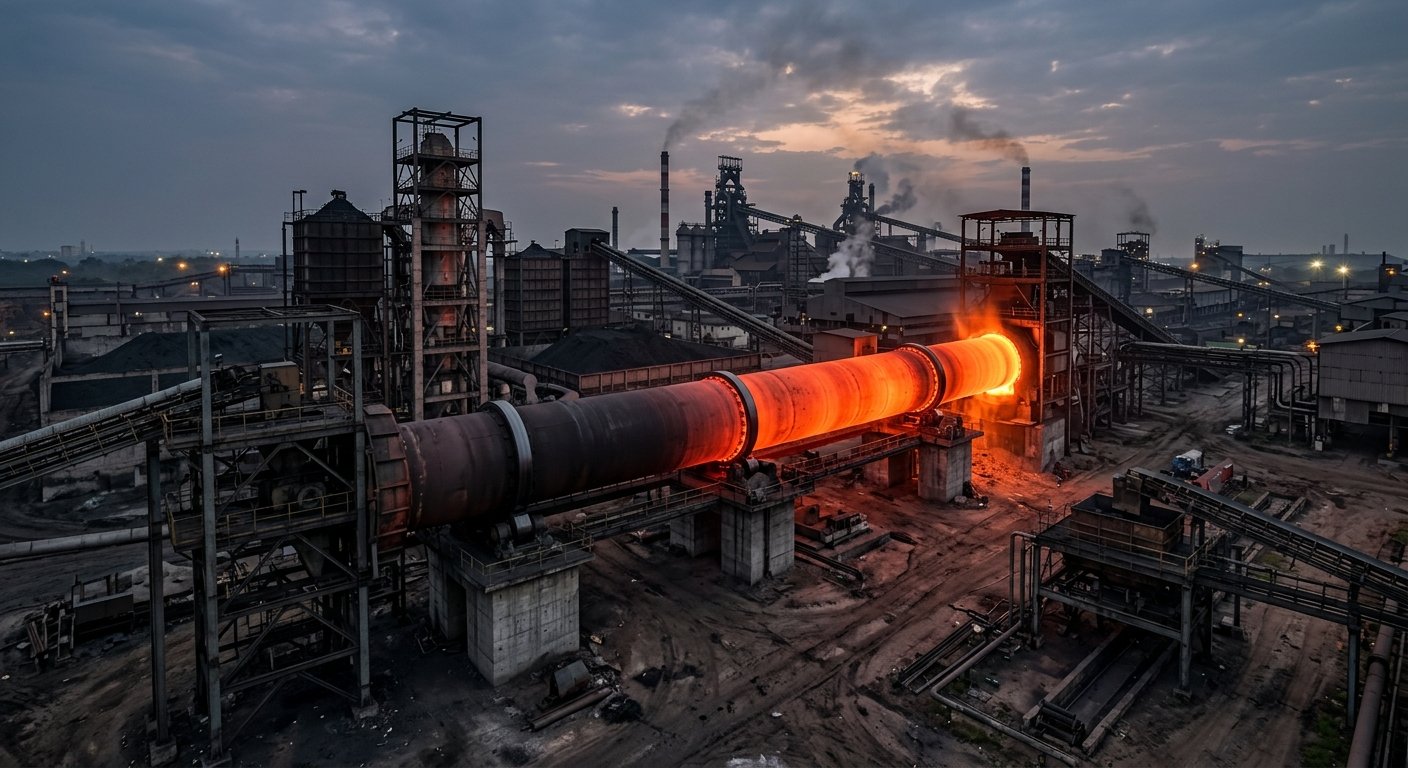
Why Kiln Sealing Matters in DRI Plants
In DRI rotary kilns, air ingress causes re-oxidation and metallization loss, not just wasted energy. Why reducing atmospheres need near-zero false air.
In a DRI rotary kiln, air ingress causes product re-oxidation and loss of metallization: the iron already reduced reverts toward oxide, rendering the sponge iron off-specification. In a cement kiln, false air degrades thermal efficiency; in a DRI kiln, it destroys the product itself. Understanding this distinction is the starting point for any serious assessment of sealing in sponge iron and direct reduction plants.
What makes DRI kiln sealing different from cement kiln sealing
The DRI rotary kiln operates under a reducing gas envelope: a CO-rich mixture with a CO/CO2 ratio typically above 3:1 in the active reduction zone [1][2]. This gas atmosphere drives the thermodynamic equilibrium that converts iron oxides to metallic iron. That equilibrium is extremely sensitive to oxygen partial pressure.
Reducing atmosphere: a gas environment in which the partial pressure of oxygen is kept low enough that iron oxides are thermodynamically driven toward metallic iron. In DRI rotary kilns this means a CO-rich mixture in the solid bed, with the freeboard managed separately through controlled air ports along the kiln shell.
Even a small air leak at the kiln inlet or outlet hood shifts the local atmosphere toward oxidising conditions. The already-reduced iron in the product bed, which is porous and highly reactive, begins to revert. This is re-oxidation: the metallization the process spent 8-12 hours building is degraded in minutes if unchecked oxygen reaches hot sponge iron [2][3].
In cement, the standard question is how much false air raises specific fuel consumption. In DRI, the question is how much metallization has been lost from the finished product. One costs fuel; the other costs saleable iron.
| Parameter | Cement kiln (false air effect) | DRI kiln (air ingress effect) |
|---|---|---|
| Primary consequence | Higher specific heat consumption (kcal/kg clinker) | Re-oxidation of reduced iron; metallization loss |
| Nature of harm | Efficiency degradation | Product quality degradation; potential specification failure |
| Typical tolerance | Up to 10-15% false air before urgent action | Near-zero oxygen ingress at discharge end |
| Economic impact | Higher fuel bill | Off-spec product, EAF rejection, lost revenue |
Where air enters a DRI kiln and why each point matters
The two highest-risk air ingress points are the inlet seal (feed end, where raw iron ore and reductant coal enter) and the outlet seal (discharge end, where hot sponge iron exits into the rotary cooler) [1][3].
Inlet end. The kiln interior is typically under slight negative pressure near the feed end because the ID fan draws gas through the process. Any gap in the inlet seal draws atmospheric air into the kiln, where it mixes with the reducing gas. The feed end runs at peak reduction temperatures (950-1,050°C), so oxygen ingress here directly competes with the reduction reactions.
Outlet end and cooler transition. The sponge iron exits at 200-400°C into a rotary cooler, where indirect water cooling brings it to approximately 100-120°C before discharge [2]. At 200-400°C, sponge iron is still highly reactive. Its internal surface area is approximately 10,000 times greater than that of solid iron [3], because the porous microstructure created during reduction exposes enormous active iron surface to any oxidant present. A failed seal at the hood-cooler interface allows atmospheric air to contact this reactive material.
Cooler seal. Many DRI operators treat the kiln-outlet and rotary-cooler-inlet as two distinct sealing positions, each requiring its own seal assembly. In practice, a double-seal configuration at this critical interface is becoming standard in new plant designs.
How seal failure translates to metallization loss
A persistent seal leak of 5-10% false air at the kiln outlet can suppress finished metallization by 2-4 percentage points [1][2]. A product that was tracking at 92% metallization may exit the cooler at 88-90%, which is below the Grade 1 threshold under IS 15774:2018, the Bureau of Indian Standards specification for sponge iron/DRI [4].
Degree of metallization: (Fe_metallic / Fe_total) × 100%. For Grade 1 coal-based DRI under IS 15774:2018: minimum 90%. EAF steelmakers typically require 90% for coal-based and 92% for gas-based product.
The economic consequence is direct. On an 80 TPD kiln, a 2-point metallization drop means approximately 1.6 tonnes per day of metallic iron is substituted by residual oxide in the charge, which the downstream EAF must smelt again at additional energy cost. Repeated quality failures can result in a price penalty of INR 500-1,000/t or contract rejection. Each unplanned kiln shutdown for emergency seal repair costs 3-5 days of lost production.
See sponge iron quality control for the full specification framework across all five quality parameters.
Seal design requirements specific to DRI kilns
DRI kilns impose constraints that cement kiln sealing designs do not always address in full [1][3]:
Temperature profile. The DRI kiln discharge zone operates at 200-400°C, lower than the 900-1,100°C at a cement kiln outlet. This sounds easier, but lower temperature means the sponge iron is not yet inert. Seal designs optimised only for high-temperature abrasion resistance may underperform at the atmospheric-control task that matters most at the cooler interface.
Abrasive fines. Char particles and iron ore fines are highly abrasive. Sealing elements that cannot handle continuous fine-particle abrasion will develop micro-gaps that cumulatively allow significant air ingress over a campaign.
Atmosphere integrity, not just volume reduction. In cement, the goal is to reduce false air to an acceptable level. In DRI, the goal at the discharge end is close to zero oxygen ingress. This is a tighter specification and requires seal design that maintains contact force and conformance under thermal cycling.
A duplex kiln sealing system provides a primary and a secondary sealing barrier at each seal position. If the primary seal wears during a campaign, the secondary barrier holds atmosphere control until the next planned maintenance window. High-temperature radial seals are used where the kiln-hood interface geometry requires radial contact force rather than axial compression.
Operational benefits of a well-sealed DRI kiln
Effective inlet and outlet sealing in a DRI plant delivers three measurable operating benefits beyond metallization protection.
Stable atmosphere control. A tight seal keeps the CO/CO2 ratio in the reduction zone stable, reducing the frequency of manual adjustments to air ports and coal injection. Operators report that a well-sealed kiln is easier to run consistently to specification.
Lower specific coal consumption. Air ingress causes parasitic combustion of CO and volatile matter from coal before it reaches the reduction zone. Eliminating the ingress means more reducing gas per tonne of coal charged, improving the coal-to-metallization efficiency of the process.
Longer campaign intervals. Planned seal maintenance can be scheduled around the kiln's campaign plan. Emergency shutdowns for seal failure are among the most disruptive events in a DRI plant because unplanned downtime interrupts the thermal steady-state the kiln needs for consistent product quality.
For plants on the metallurgical industry supply chain, seal reliability directly affects delivery reliability. Oswal's installation and retrofit service covers both new-plant seal specification and retrofit of existing kiln hoods where seal performance has degraded.
Common questions about this topic
No. In a cement kiln, false air degrades thermal efficiency and raises specific fuel consumption, typically costing 15-35 kcal/kg clinker per percentage point of excess false air. In a DRI kiln, air ingress at the discharge end causes re-oxidation of already-reduced iron, directly cutting metallization and pushing product out of specification for EAF steelmakers. The cement consequence is an energy cost; the DRI consequence is a product quality failure and potential revenue loss.
The most robust configuration for coal-based DRI rotary kilns uses a duplex (double-barrier) seal at both the inlet and outlet hood positions. The primary barrier handles normal operating conditions; the secondary maintains atmosphere control if the primary is partially worn. For the abrasive environment at the DRI kiln outlet and cooler interface, graphite-based sealing elements or high-temperature radial seals are preferred for their self-lubricating wear resistance. The choice between element types depends on the specific kiln diameter, hood geometry, and thermal cycling frequency.
Most DRI plant operators inspect seals at every planned kiln shutdown, typically every 6-8 weeks in continuous operation. The primary inspection items are: seal-gap width at the kiln-hood interface, char and fines accumulation at the seal face (which can accelerate wear and create hard spots), and any localised temperature anomaly on the hood shell that may indicate air ingress channelling at a specific position. A systematic inspection approach is covered in the kiln seal inspection and maintenance guide.
Sources
- IspatGuru, *Coal Based Direct Reduction Rotary Kiln Process*, Samir Sarkar, IspatGuru.com
- Sarangi, A. and Sarangi, B., *Sponge Iron Production in Rotary Kiln*, New Age International, 2011. Available via Google Books:
- Kintek Furnace, *Why Is Sealing Important in a Rotary Kiln?*, technical note
- Bureau of Indian Standards, *IS 15774:2018 Sponge Iron / Direct Reduced Iron (DRI), Hot Briquetted Iron (HBI) and Cold Briquetted Iron (CBI) for Steel Making (First Revision)*, 2018
Related Articles
Discuss Your Sealing Requirements
Our engineering team can help identify the right sealing solution for your application.
Contact Engineering Team“Wherever high-temperature rotary kilns operate under controlled atmosphere, Oswal sealing systems ensure energy efficiency and process stability.”