
Duplex Kiln Seal
Precision False Air Control Under Real Kiln Movement
The Duplex Kiln Sealing System is a proprietary Oswal innovation (often called a duplex kiln seal) developed to overcome the limitations of conventional single-principle sealing technologies. Rotary kilns operate under continuous axial displacement, radial expansion, shell ovality, and extreme thermal load. Static sealing systems fail when exposed to dynamic mechanical conditions. The Duplex system was engineered not for theoretical alignment - but to perform across all rotary kiln seal types based on real kiln behavior.Engineering Outcome
“Adaptive sealing architecture. Thermal durability. Dynamic compensation under real kiln movement.”
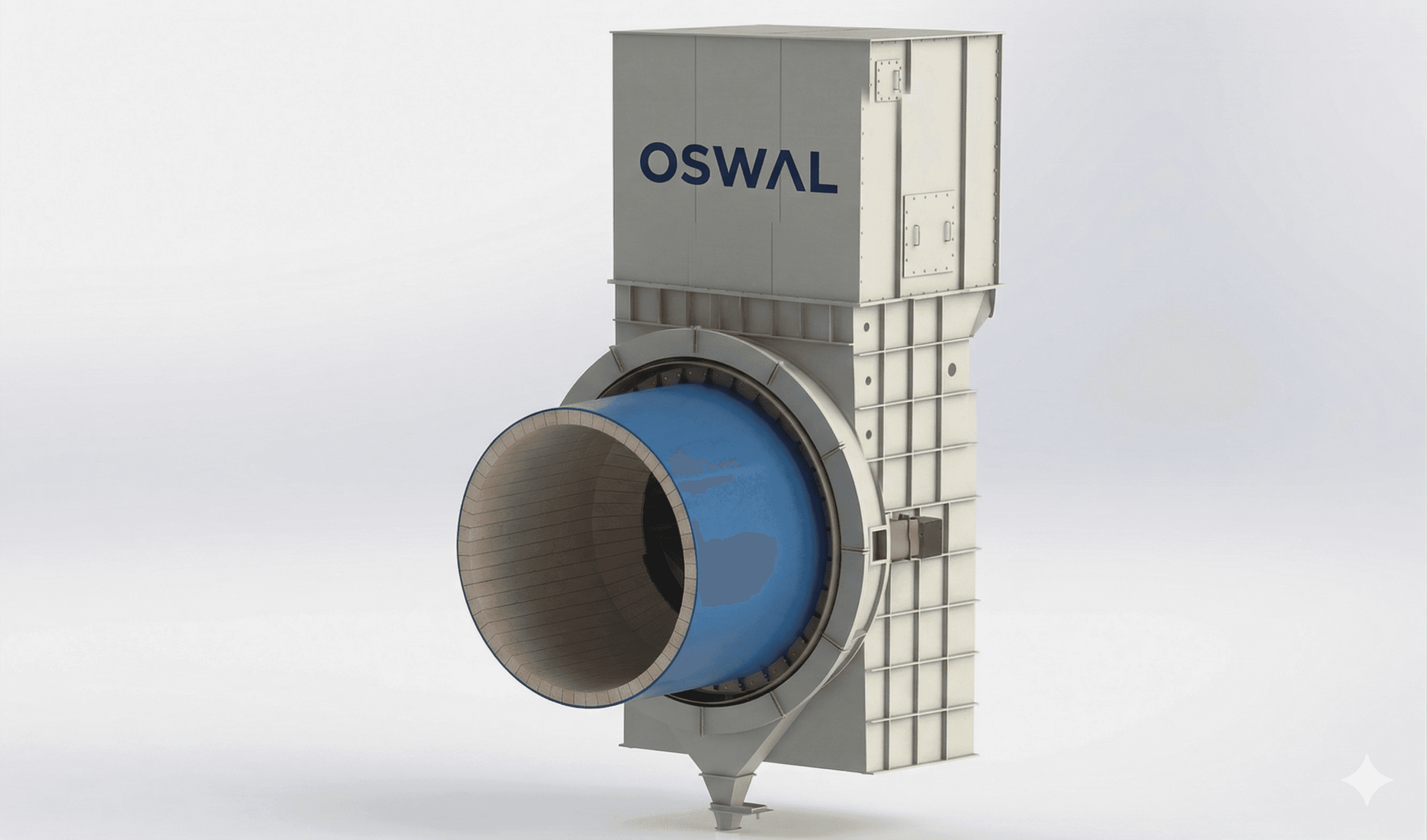
The Duplex Hybrid Architecture: Why Two Sealing Principles Outperform One
The Duplex Kiln Sealing System combines two sealing principles in a single architecture: spring-loaded lamella elements for adaptive compliance to kiln motion, and graphite-based contact sealing for residual leakage control. The two principles work in series. The lamella section absorbs shell ovality, axial drift, and dynamic kiln motion. The graphite section provides the tight final seal against false air, free to act because the lamella has already absorbed the movement that would defeat a rigid graphite-only design. This hybrid arrangement is what lets the Duplex outperform single-principle systems under real-world cement, lime, and metallurgical kiln operating conditions, where shell motion and high-temperature contact sealing usually pull seal design in opposite directions.
Traditional kiln sealing systems are typically based on either flexible metallic lamella segments or graphite-based continuous contact sealing. Each principle has inherent advantages - and inherent limitations. Lamella systems provide adaptability but may lack high-temperature durability. Graphite systems provide thermal resistance but may struggle with dynamic compensation under significant mechanical movement. Oswal's engineering objective was to integrate both principles into a single adaptive system.
The rotary kiln operates as a dynamically expanding structure. Conventional rigid sealing systems fail under dynamic conditions.
Operating Conditions
- Radial shell expansion
- Axial kiln displacement
- Thermal growth
- Ovality fluctuation
- Variable operational load conditions
Without Proper Sealing
- False air ingress
- Fuel overconsumption
- Combustion instability
- ID fan overload
- Emissions variability
The Duplex Kiln Sealing System integrates lamella flexibility for movement adaptation with graphite durability for high-temperature sealing, plus radial and axial compensation capability. The lamella layer absorbs movement variations. The graphite layer ensures consistent thermal sealing performance. This dual-layer configuration creates redundancy and reliability.
Three key engineering principles that define the Duplex Kiln Seal:
Primary lamella interface for adaptive movement compensation
Secondary graphite sealing interface for continuous high-temperature contact
Structural housing for stable mounting
Controlled pressure distribution mechanism
Controlled pressure distribution mechanism
Retrofit Compatibility
Installation does not require excessive structural modification and can be engineered for retrofit applications.
Applicable Industries
Engineered for multiple sectors
Product Gallery
Explore detailed visuals of our high-quality kiln seals and manufacturing processes.
Key Advantages of the Duplex System
Eight engineering and commercial advantages that make the Duplex the global benchmark in false air control.
Custom-Engineered Configuration
Each sealing system is specifically designed to match kiln geometry, operating conditions, and process requirements - ensuring optimal sealing performance rather than a generic fit.
Advanced False Air Control
The Duplex architecture effectively prevents false air ingress, maintaining stable kiln pressure and enabling controlled combustion conditions across varying operating loads.
Dual-Layer Sealing Integrity
Integration of lamella flexibility and graphite sealing creates a dual-layer mechanism, ensuring continuous contact, redundancy, and high reliability under dynamic kiln movement.
Reduced ID Fan Load & Power
By minimising unnecessary air ingress, the system enables reduction in ID fan speed, directly cutting operating costs.
Adaptive Kiln Movement Compensation
Engineered to compensate for shell eccentricity and ovality, maintaining sealing integrity despite real operating conditions.
Fast Installation - ~9 Days
Designed for efficient implementation, the system can be installed within approximately 9 days during a scheduled kiln shutdown, minimising production loss and ensuring rapid commissioning.
Extended Service Life
High-quality graphite sealing elements deliver long operational lifespan with stable friction characteristics and predictable wear progression.
Rapid ROI - 6 to 18 Months
Through fuel savings, power reduction, and improved process stability, the system typically delivers payback within 6 to 18 months - making it a high-impact efficiency upgrade.
Power Summary
“Adaptive sealing. Reduced energy loss. Measurable performance gains.”
Precision-engineered false air control with rapid ROI and long-term operational reliability.
Engineering Performance
Plant-Level Impact
Built to Last
Reduced maintenance frequency
Lower seal replacement cost
Extended refractory stability
Improved kiln availability
Long-term fuel savings
Technical Documentation
Duplex Kiln Seal - Technical Datasheet
Oswal Kiln Seals - Full Product Catalog
Need custom technical documentation?
Our engineering team provides specification sheets, installation guides, and application-specific documentation on request.
Frequently Asked Questions
Common questions about the Duplex Kiln Seal.
The Duplex is Oswal's hybrid kiln sealing system combining two sealing principles in a single architecture: spring-loaded lamella elements for adaptive compliance to shell movement, and graphite-based contact sealing for residual leakage control. The two principles work in series. The lamella section absorbs kiln motion and ovality; the graphite section provides the tight final seal against false air. This hybrid design outperforms single-principle systems under real-world kiln movement and is Oswal's flagship product.
10-14 weeks for engineered Duplex sealing systems from order confirmation to delivery, including kiln-specific dimensioning, manufacturing, and quality inspection. Spare lamella and graphite wear elements have shorter lead times, generally 4-8 weeks. Expedited delivery can be arranged on request for urgent shutdown windows.
Yes. The Duplex is engineered for retrofit installation on existing rotary kilns without structural modification of the kiln shell or hood. Typical retrofit install is approximately 9 days during a scheduled kiln shutdown. The Oswal engineering team conducts a pre-install survey to confirm fit and identify any interface adjustments needed for the specific kiln line.
Talk to Our Engineers
Discuss Your Sealing Requirements
Our engineering team will identify the optimal sealing solution for your specific kiln configuration and operating conditions.