
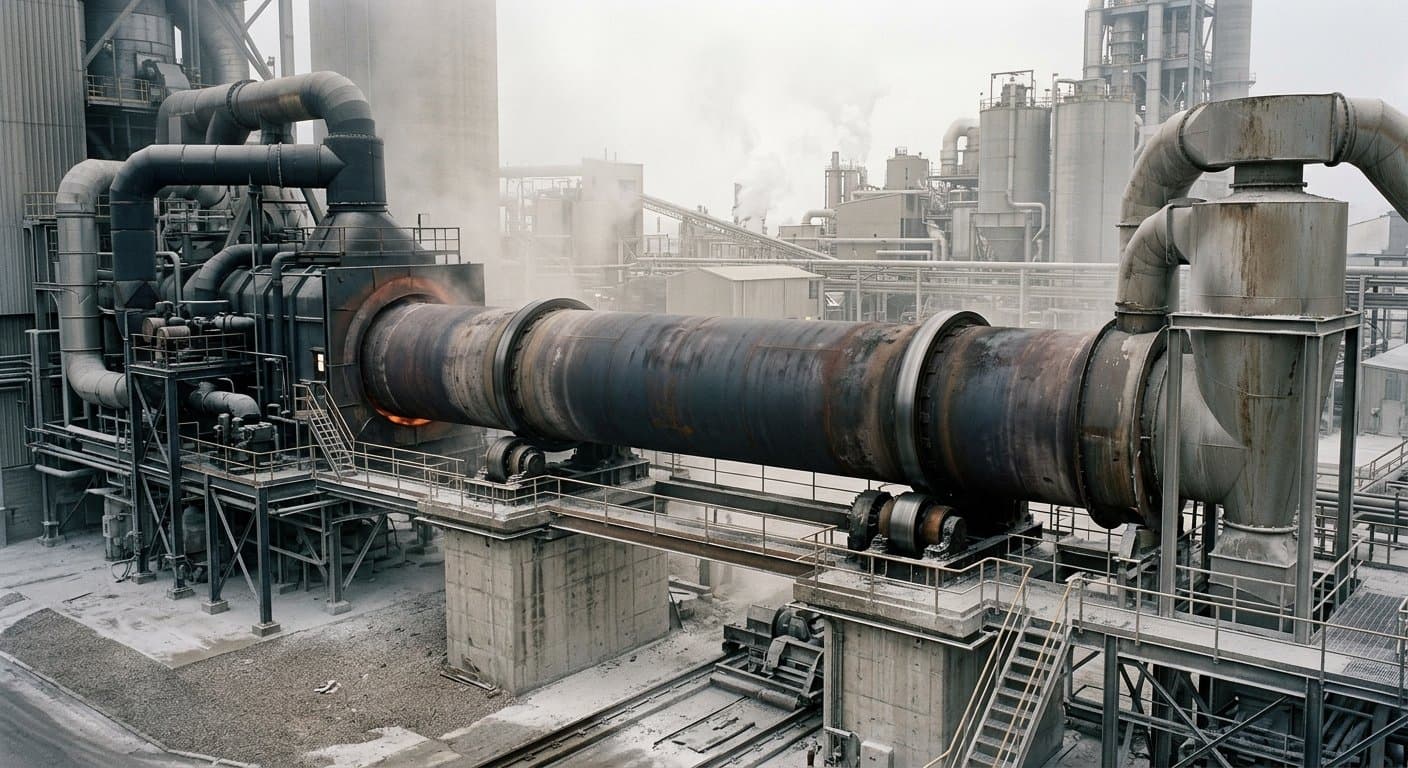
Chemical Industry Kiln Sealing: TiO2 Guide
Chemical Industry
A chemical plant running a calciner rotary kiln, such as a titanium dioxide manufacturer or a phosphate rock processor, needs a kiln seal that controls false air at the inlet and discharge hoods while resisting a fine, corrosive, often acidic dust at calcining temperatures of roughly 850-1,200°C. The atmosphere in most specialty-chemical calcination is oxidising, so false air is an efficiency and product-uniformity problem rather than a product-destroying one; the sealing target is low, stable leakage and material durability against chemically aggressive dust. Because product properties such as TiO₂ crystal phase and particle size are fixed by holding a precise calcining temperature, and false air disturbs that profile, sealing protects product specification as well as fuel.
The chemical industry use case for kiln sealing
In a specialty chemicals rotary kiln, the seal protects a temperature-defined product and a corrosive process at the same time. In titanium dioxide manufacture by the sulfate route, the hydrated TiO₂ cake is calcined at roughly 850-1,000°C to remove combined water, develop the rutile crystal structure, and control primary particle size [1]; the calcining temperature directly sets pigment quality, so a false-air leak that disturbs the temperature profile feeds straight into product consistency. Phosphate rock processing and other specialty calcinations follow the same logic on different chemistries.
The chemical-vertical keyword universe is the smallest of Oswal's industries, but the sealing duty is real and distinctive because the dusts are corrosive. For a titanium dioxide tio2 calciner the off-gas and dust can carry sulphur and chloride species depending on the route, which attack seal materials chemically as well as abrasively. The seal that holds these conditions keeps both the heat balance and the product specification stable, while limiting fugitive emissions of fine pigment dust.
The kiln process chain in a chemical calciner
The chemical calcination kiln chain feeds a precipitated or beneficiated solid into a rotary kiln, drives off combined water and volatiles, sets the product crystal structure and particle size, and cools the product, with the seals bracketing the high-temperature calcining zone.
| Stage | Function | Approximate temperature |
|---|---|---|
| Drying / preheat | Free and surface moisture removed | ambient to ~400°C |
| Dehydration / devolatilisation | Combined water and volatiles driven off | 400-800°C |
| Calcining (e.g. TiO₂ rutile development) | Crystal structure developed; particle size set | 850-1,200°C [1] |
| Cooler | Calcined product quenched | falling from ~900-1,200°C |
The kiln inlet seal sits at the feed end and the outlet seal at the cooler hood; both are under draft and both admit air if the contact face is worn or chemically degraded. For titanium dioxide, the sulfate route calcines at about 850-1,000°C while the chloride route processes at 700-1,200°C depending on the step [1]. The product's defining properties, rutile development and particle size for TiO₂, are temperature-dependent, so a stable temperature profile, controlled by draft and therefore by sealing, governs the result. Phosphate rock processing kilns and other specialty-chemical calciners share the chain and differ mainly in feed chemistry and the corrosivity of the dust.
Sealing requirements specific to the chemical industry: temperature, atmosphere, dust profile
Chemical kiln sealing requirements are defined by an oxidising atmosphere, high calcining temperatures, and a fine, chemically corrosive dust that attacks seal materials. Material compatibility, not just abrasion resistance, is the distinguishing concern of this vertical.
Calcination (chemical): thermal treatment that removes combined water and volatiles from a precipitated or beneficiated solid and develops its target crystal structure and particle size, with the calcining temperature setting product properties (for TiO₂, rutile development and pigment particle size at roughly 850-1,000°C in the sulfate route) [1].
The governing conditions:
- Temperature. The calcining zone runs roughly 850-1,200°C [1], so the high-temperature interfaces need graphite-based sealing elements rated for continuous service with thermal-cycling tolerance.
- Atmosphere. Oxidising in most specialty calcinations, so the target is stable low leakage rather than zero oxygen ingress; the benefit is fuel saved and a temperature profile that holds product specification.
- Dust and corrosion. Fine pigment or chemical dust is both abrasive and chemically aggressive (sulphur and chloride species depending on the route), so seal material compatibility and abrasion-resistant construction together govern seal life.
- Movement. Standard rotary-kiln radial expansion and axial float, which the seal must follow while resisting the corrosive load.
The trade-off is the familiar lamella-versus-graphite balance, with material selection weighted toward corrosion resistance. For most chemical calciners a hybrid assembly that combines movement compensation with durable high-temperature, corrosion-tolerant sealing is the appropriate fit.
Chemical industry application examples
In chemical calciners we have assessed, corrosive dust attack is the defining seal-life constraint rather than abrasion alone. A typical case: a sulfate-route TiO₂ calciner running near 900°C sees its discharge-end seal degraded by combined abrasion and sulphur-bearing dust, shortening the seal-replacement interval relative to a chemically benign process at the same temperature. A higher-durability graphite-and-lamella assembly holds the seal longer and keeps leakage from drifting up.
A second recurring case is product-property variability traced to inlet-seal leakage. Because TiO₂ rutile development and particle size are temperature-set, air entering near the feed end that disturbs the calcining profile can show up as off-spec pigment before any deliberate process change is made; the cause is often an unsealed interface rather than the burner. A third pattern appears in phosphate rock processing and other specialty calciners, where the corrosive feed loads the seal in the same way and the same sealing logic applies. Across the chemical vertical the common thread is that material compatibility decides seal life.
Recommended Oswal products for the chemical industry
For TiO₂, phosphate, and specialty-chemical calciners the primary match is the Duplex Kiln Sealing System, pairing lamella movement compensation with graphite high-temperature sealing in a configuration suited to corrosive, high-heat service [2]. The feed and discharge are covered by the Kiln Inlet Sealing System and Kiln Outlet Sealing System; component-level options are the Graphite-Based Sealing Elements, High-Temperature Radial Seals, and Axial Compensation Seals. For leakage managed across the whole kiln, see Integrated False Air Control.
Prodotti consigliati
Soluzioni Oswal per Chemical Industry
Controllo integrato falsa aria
Protezione dell'energia attraverso l'ingegneria della sigillatura di precisione
Tenute radiali ad alta temperatura
Sigillatura circonferenziale controllata sotto espansione termica
Tenute di compensazione assiale
Sigillatura controllata sotto movimento Longitudinale Kiln
Sistema di tenuta ingresso forno
Stabilità alla combustione al fine del mangime
Fonti
- Titanium dioxide production references (Chemcess / Essential Chemical Industry), *Sulfate and chloride process calcination temperatures and rutile development*, 2023-2024. https://chemcess.com/an-in-depth-exploration-of-industrial-titanium-dioxide-production-methods/ and https://www.essentialchemicalindustry.org/chemicals/titanium-dioxide.html
- Oswal Industries, *OSWAL Kiln Seals product catalogue* and *Duplex Kiln Sealing System catalogue*, 2024 (product specifications and configuration).
Domande frequenti
Domande comuni sulla sigillatura del forno nell'industria.
I forni rotativi sono utilizzati in tutto il settore della chimica specialistica per la lavorazione del biossido di titanio, la calcinazione dei fosfati, la rigenerazione del carbone attivo, la produzione di pigmenti ceramici, la lavorazione di ossidi e solfati speciali e una serie di altre reazioni che richiedono un trattamento termico in atmosfera controllata. Ogni applicazione presenta un proprio profilo di compatibilità termica, atmosferica e chimica che determina le specifiche delle tenute.
Le reazioni chimiche speciali dipendono da una precisa composizione dei gas all'interno del forno. L'ingresso di aria in qualsiasi punto lungo la lunghezza del forno altera la stechiometria locale rispetto alle condizioni di progetto, generando un prodotto non conforme alle specifiche. Un'efficace sigillatura del forno impedisce l'ingresso di aria e mantiene l'atmosfera di reazione definita dal progetto di processo.
Sì. I sistemi di tenuta Oswal sono specificati per l'ambiente corrosivo del processo chimico in questione. Gli elementi di tenuta a base di grafite presentano un'ottima compatibilità chimica con molti gas di processo (clorurati, solforati e altri) e sono generalmente preferiti alle lamelle nelle applicazioni corrosive. Le classi di materiale sia per le lamelle che per i componenti in grafite vengono selezionate durante la fase di audit ingegneristico in base alla specifica composizione del gas.
Chemical Industry Indagine sulla chiusura
Condividi la configurazione del forno e le condizioni operative con il nostro team di ingegneri.
Richiedi un preventivo“Ovunque i forni rotanti ad alta temperatura operino in atmosfera controllata, i sistemi di tenuta Oswal garantiscono efficienza energetica e stabilità di processo.”