
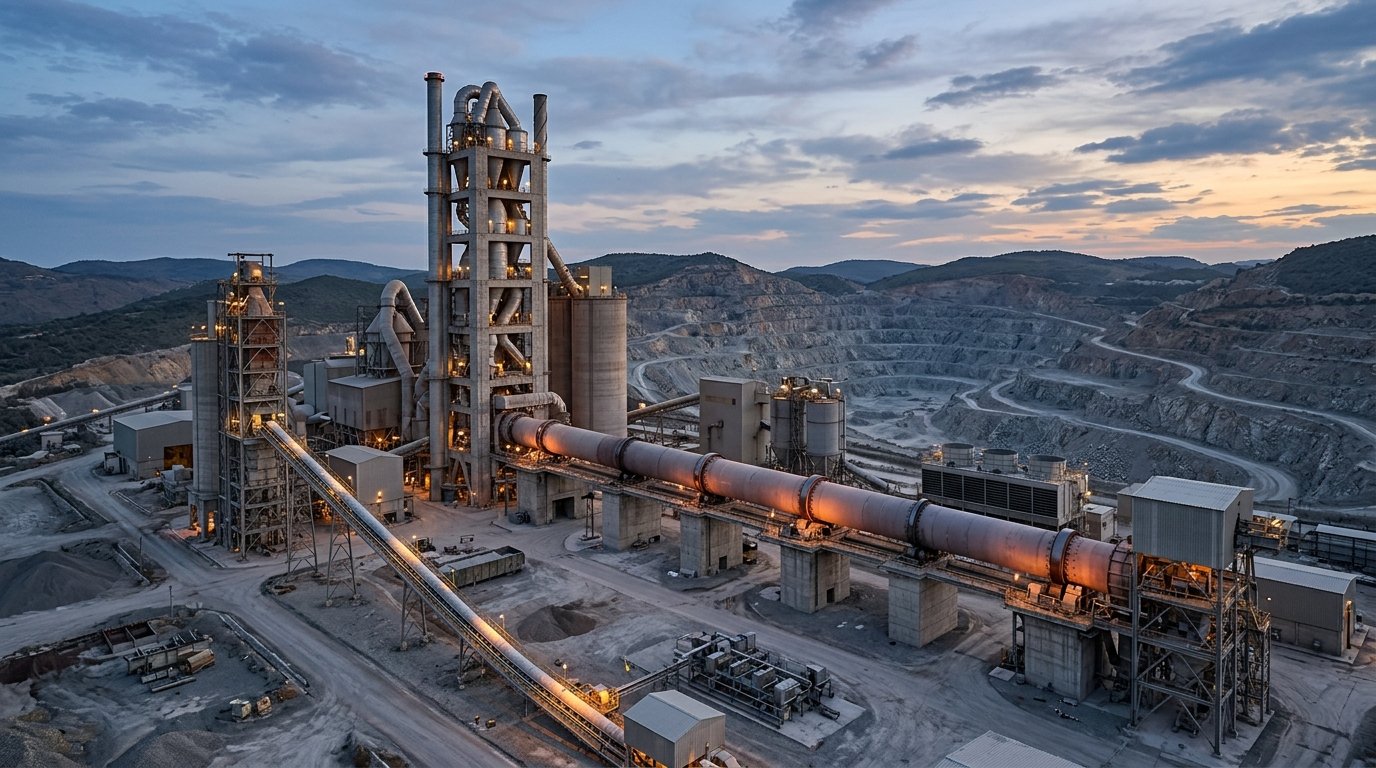
The Cement Manufacturing Process Explained
The cement manufacturing process turns limestone into clinker into cement across 7 stages. A plant engineer's walkthrough with energy and emissions data.
The cement manufacturing process is the sequence of operations that converts quarried limestone and clay into Portland cement, passing through raw material extraction, raw meal preparation, preheating and calcination, pyroprocessing in a rotary kiln, clinker cooling, grinding, and dispatch. The reference plant for this walkthrough is a modern dry-process line, the configuration behind almost all of the roughly 4.1 billion tonnes of cement produced worldwide in 2024 [1]. The chemistry is concentrated in the kiln line (stages 3 to 5), where limestone is decarbonated and the oxides react into clinker at around 1,450 C. This piece walks each of the seven stages, then quantifies the energy and emissions footprint per tonne.
This is "cement" in the construction-binder sense, the powder that hardens concrete, not the dental or adhesive sense of the word.
The cement manufacturing process at a glance
The cement manufacturing process runs in seven stages, from quarry to dispatch, with the chemistry concentrated in the kiln line (stages 3 to 5) where limestone is decarbonated and reacted into clinker. The first two stages prepare and correct the raw chemistry, the middle three apply heat, and the last two finish and ship the product. The table below replaces the process-flow diagram: it is the structured reference for what happens, where, and at what temperature.
| Stage | What happens | Key equipment | Material in → out | Typical temperature |
|---|---|---|---|---|
| 1. Extraction and crushing | Quarry limestone and clay, crush to < 25 mm | Crushers, quarry plant | Rock → crushed feed | Ambient |
| 2. Raw meal preparation | Grind and blend to target oxide chemistry | Raw mill, blending silos | Crushed feed → raw meal | Ambient to ~110 C |
| 3. Preheating and calcination | Heat-exchange against kiln gas; decarbonate the limestone | Cyclone preheater, calciner | Raw meal → calcined meal | ~300 to 900 C |
| 4. Pyroprocessing | Sinter the oxides into clinker | Rotary kiln, burner | Calcined meal → clinker | ~1,450 C (material) |
| 5. Clinker cooling | Quench clinker, recover heat to combustion air | Grate or planetary cooler | Hot clinker → cool clinker | ~1,400 → ~120 C |
| 6. Grinding and additives | Grind clinker with gypsum and SCMs into cement | Finish mill | Clinker + additives → cement | Ambient |
| 7. Storage and dispatch | Store, sample, pack, and ship | Silos, packers | Cement → bulk or bagged | Ambient |
Reference configuration: modern dry-process plant with a multi-stage cyclone preheater and precalciner. Temperatures are material temperatures, not flame or gas temperatures.
Modern plants are dry-process: the raw meal enters the kiln line as a dry powder. The older wet process fed a water-based slurry and carried a large evaporation penalty, which is why it has been phased out almost everywhere new capacity is built. The dry-process default matters because most older course material still draws the wet-process diagram, which overstates energy use and misrepresents the modern preheater line.
Cement. A fine inorganic powder that, mixed with water, sets and hardens through hydration and binds aggregates into concrete. Portland cement, the dominant type, is made by grinding clinker with gypsum. Cement is the binder; concrete is the finished composite of cement, aggregate, and water.
Stage 1: Raw material extraction and crushing
Stage 1 extracts limestone (the calcium source, around 80% of the raw mix) and clay or shale (the silica, alumina, and iron sources) from a quarry, then crushes them to under about 25 mm for downstream grinding. Limestone supplies the calcium oxide that becomes the silicate phases in clinker; clay and shale supply the silica, alumina, and iron that complete the chemistry.
Quarrying is by drilling and blasting (or ripping in softer deposits), followed by primary and secondary crushing. The crushed material is stockpiled and pre-blended to smooth out the natural variation in the quarry face, because the kiln downstream is unforgiving about chemistry swings.
Few quarries deliver the exact oxide balance the process needs, so corrective materials are added: bauxite or laterite for alumina, iron ore or mill scale for iron, and sand for silica. The point of stage 1 is not just to make rock smaller, it is to start steering the chemistry toward the target the kiln requires. Plants that run on the same limestone deposit Oswal seals kilns for, across cement plant operations worldwide, live or die on the consistency of this blend.
Stage 2: Raw meal preparation
Stage 2 grinds the crushed raw materials into a fine powder called raw meal, homogenises it, and corrects its chemistry so the kiln feed hits target Lime Saturation Factor, silica modulus, and alumina modulus. Raw meal is the kiln feed: a dry powder, typically ground so that 85-90% passes a 90-micron sieve.
Raw meal. The finely ground, chemically corrected, and homogenised powder that feeds the kiln line. Also called raw mix or kiln feed. Its oxide chemistry, expressed through control moduli, sets the phase composition of the clinker that forms downstream.
Grinding is done in a vertical roller mill or a ball mill, with the kiln exhaust gas often used to dry the feed in the mill. The ground meal is homogenised in blending silos, because the kiln tolerates only narrow chemistry variation. The control targets are three moduli: Lime Saturation Factor (LSF), held in a 0.66-1.02 range and typically 0.92-0.98; silica modulus (SM), usually 2.0-3.0; and alumina modulus (AM), usually 1.0-4.0 [2]. These ratios are what stage 2 actually controls, and they determine whether the clinker will be high-alite, high-belite, or off-spec. The full grinding and blending workflow is covered in the dedicated raw meal preparation piece.
Stage 3: Preheating and calcination
Stage 3 passes raw meal up a multi-stage cyclone preheater tower against the rising kiln exhaust gas, then through a calciner where roughly 90-95% of the limestone decarbonates (CaCO3 → CaO + CO2) before the meal reaches the rotary kiln. This is where the bulk of the process CO2 is released, and where most of the kiln line's thermal efficiency is won or lost.
The preheater is a counter-current heat exchanger. Raw meal is fed at the top and cascades down through four to six cyclone stages while hot kiln gas rises through them, so the meal is progressively heated and the gas is progressively cooled. A modern five-stage tower drops the exhaust to around 300-350 C at the top, which is the dominant recoverable heat loss in the system. The mechanics of the counter-current cascade are detailed in the preheater tower piece.
The calciner sits at the base of the tower and burns roughly 60% of the plant's total fuel. It holds the meal at about 850-900 C, the temperature at which limestone decomposes. Calcination is strongly endothermic: decomposing one kilogram of calcium carbonate absorbs about 1,780 kJ (178 kJ per mole) [3]. Shifting most of the fuel into the calciner lets the rotary kiln run smaller and cooler than it otherwise would, which is the central reason precalciner kilns dominate modern capacity. The combustion and decarbonation detail lives in the calciner piece.
Stage 4: Pyroprocessing in the rotary kiln
Stage 4 is pyroprocessing: the calcined meal enters the inclined, rotating kiln, climbs to a burning-zone material temperature of around 1,450 C, and the oxides react into clinker, the alite, belite, aluminate, and ferrite nodules that become cement. This is the heart of the process and the most thermally severe environment in the plant.
The kiln is a steel tube lined with refractory, set on a 3-4% incline and rotating slowly so that material tumbles toward the discharge end. The burner fires from the discharge (hot) end with a flame around 2,000 C, against which the burning-zone material reaches about 1,450 C [4]. A liquid phase forms at around 1,250-1,300 C, and the clinkering reactions complete as free lime is driven down, the practical target being under about 1.5%. The chemistry of those reactions is covered in the pyroprocessing and what is clinker pieces; the energy frame is the subject of the specific fuel consumption piece.
Clinker. The sintered, nodular intermediate (3-25 mm) produced in the kiln burning zone, composed mainly of four calcium-silicate and calcium-aluminate phases. Ground with gypsum, clinker becomes Portland cement. It is the carbon- and energy-intensive core of the process.
Stage 4 is where sealing comes in, because the rotating kiln shell meets stationary structures at two interfaces: the kiln inlet (feed end) and the kiln outlet (discharge end, into the hood). Those interfaces have to seal a moving shell that expands radially, drifts axially, and runs slightly out of round, against a fixed wall, at temperature. When the seal fails, ambient air is drawn into the kiln through the gap. That uncontrolled ingress is false air, and it costs fuel, destabilises the flame, and can bottleneck kiln throughput at the induced-draft fan. In retrofits we have audited, the kiln hood and inlet-seal interfaces are consistently among the largest single sources of kiln-side ingress.
This is the unit operation Oswal's products are built around. The kiln inlet seal and kiln outlet seal close the two rotating-to-stationary interfaces, and the broader kiln sealing product line covers the geometry of the hood and transition. The interaction between hood geometry and seal selection is covered in the kiln hood and inlet/outlet configurations piece.
Stage 5: Clinker cooling
Stage 5 quenches hot clinker (around 1,400 C) to roughly 100-150 C in a clinker cooler, recovering sensible heat back into the secondary and tertiary combustion air and locking in the clinker phase mineralogy. The cooler does two jobs: it makes the clinker handleable, and it is a heat exchanger that returns hot air to the burner and calciner.
Rapid quenching matters chemically. Cooling the clinker quickly preserves the reactive alite phase and prevents it from reverting toward belite and free lime, so the cooler protects the strength chemistry that the kiln just produced. Modern grate coolers recover roughly 75-80% of the clinker's sensible heat back into combustion air; older planetary or satellite coolers recover under about 60%, and that recuperation gap is worth tens of kcal per kilogram of clinker. The cooler design and heat-recovery detail are covered in the clinker cooler and clinker cooling pieces.
Stage 6: Cement grinding and additives
Stage 6 grinds cooled clinker with around 5% gypsum, plus supplementary cementitious materials, into finished cement, with the clinker-to-cement ratio setting both performance and carbon footprint. This is the stage that turns the kiln's output into a saleable, standard-conforming product.
Gypsum (calcium sulfate) is co-ground with the clinker to control setting: without it, the aluminate phase (C3A) would cause a flash set within minutes of adding water. Supplementary cementitious materials, mainly fly ash, ground granulated blast-furnace slag, calcined clay, and limestone, are interground or blended in to replace a portion of the clinker. The fraction of clinker in the final cement is the clinker-to-cement ratio, and lowering it is both a cost lever and the industry's main decarbonisation lever, since clinker carries almost all of cement's CO2. The role of these materials is detailed in the supplementary cementitious materials piece, and the resulting product families (OPC, PPC, PSC) are compared in the cement types piece.
Stage 7: Storage and dispatch
Stage 7 stores finished cement in silos and dispatches it in bulk (road tanker or rail) or bagged form, with quality control sampling each batch against the relevant standard. The cement is stored dry, because it reacts with atmospheric moisture and CO2 over time, which is why bagged cement has a shelf life.
Quality control at dispatch checks fineness (Blaine surface area), setting time, compressive strength, and chemistry against the governing standard: EN 197-1 in Europe, ASTM C150 / C595 in the United States, or IS 269 in India, among others. Bulk cement moves by pneumatic tanker or rail to ready-mix and precast plants; bagged cement (commonly 25 or 50 kg) serves the retail and small-contractor market.
Energy and emissions footprint
Producing one tonne of cement consumes roughly 3.4-3.5 GJ of thermal energy and 90-130 kWh of electricity, and emits approximately 0.6 tonne of CO2, of which about 60% is process CO2 from calcination and about 40% is combustion CO2 from fuel [5][6]. The calcination split is the defining feature of cement's carbon problem: most of the CO2 comes from the limestone chemistry itself, not from burning fuel, so it cannot be removed by switching fuels alone.
| Metric | Typical value | Unit | Source |
|---|---|---|---|
| Thermal energy (per t clinker) | 3.4-3.5 | GJ/t clinker | GCCA GNR; IEA [5] |
| Thermal energy (per t clinker) | ~810-840 | kcal/kg clinker | GCCA GNR [5] |
| Electrical energy (per t cement) | 90-130 | kWh/t cement | IEA Cement [5] |
| CO2 (per t cement) | ~0.6 | t CO2/t cement | IEA; Carbon Brief [5][6] |
| Process (calcination) share of CO2 | ~60 | % | Carbon Brief [6] |
| Combustion (fuel) share of CO2 | ~40 | % | Carbon Brief [6] |
| World clinker-to-cement ratio | ~0.71 | ratio | IEA Cement [5] |
Thermal energy is conventionally reported per tonne of clinker on a lower-heating-value basis; electricity and CO2 are reported per tonne of finished cement. 1 GJ/t = ~239 kcal/kg.
The scale is what makes these per-tonne numbers matter. Global cement production was about 4.1 billion tonnes in 2024, with China at roughly 1.9 billion tonnes (under half the world total for the first time since 2008) and India second at about 0.45 billion tonnes [1]. At roughly 0.6 tonne of CO2 per tonne, cement accounts for an estimated 7-8% of global CO2 emissions [6][7]. That is why even small per-tonne efficiency gains, including cutting parasitic losses like false air, aggregate into large absolute savings. The fuel-energy side of this ledger is the subject of the specific fuel consumption piece.
Common questions about this topic
The cement manufacturing process has seven stages: raw material extraction and crushing, raw meal preparation, preheating and calcination, pyroprocessing in the rotary kiln, clinker cooling, cement grinding with additives, and storage and dispatch. The chemistry is concentrated in stages 3 to 5, where limestone is decarbonated and the oxides react into [clinker](/en/blog/what-is-clinker) at around 1,450 C. The first two stages prepare and correct the raw chemistry; the last two finish and ship the product.
The dry process feeds the kiln line a dry powder (raw meal), while the wet process fed a water-based slurry that had to be evaporated, carrying a large energy penalty. Modern plants are dry-process with a multi-stage cyclone [preheater tower](/en/blog/cement-preheater-tower-how-it-works) and precalciner, consuming around 3.4-3.5 GJ/t clinker, whereas legacy wet-process kilns consumed 5-6 GJ/t or more. The wet process survives only in a few plants with very wet raw materials; almost all new capacity is dry-process.
Clinker is the hard, nodular intermediate produced in the rotary kiln, composed mainly of four calcium-silicate and calcium-aluminate phases, which is then ground with gypsum to make cement. It forms in the [pyroprocessing](/en/blog/cement-pyroprocessing-explained) stage at a burning-zone temperature of around 1,450 C. Clinker is the carbon- and energy-intensive core of cement; the full chemistry is covered in the dedicated [what is clinker](/en/blog/what-is-clinker) piece.
Cement is the fine powder binder; concrete is the finished composite made by mixing cement with water, sand, and aggregate. Cement is an ingredient of concrete, not a synonym for it: a typical concrete is only about 10-15% cement by mass. The full comparison is in the [cement versus concrete](/en/blog/cement-vs-concrete-difference) piece.
Cement clinker forms at a burning-zone material temperature of around 1,450 C, produced by a kiln flame of around 1,800-2,100 C [4]. A liquid phase appears at about 1,250-1,300 C, which is when most of the clinkering reactions accelerate. The calcination step that precedes it, where limestone decomposes, runs lower, at about 850-900 C in the calciner.
Producing one tonne of cement emits approximately 0.6 tonne of CO2, of which about 60% comes from calcination (the limestone chemistry) and about 40% from fuel combustion [6]. Across roughly 4.1 billion tonnes of annual production, cement accounts for an estimated 7-8% of global CO2 emissions [1][7]. Because most of the CO2 is process CO2 from the chemistry itself, fuel switching alone cannot decarbonise cement; lowering the clinker ratio and capturing CO2 are the larger levers.
Raw meal (also called raw mix or kiln feed) is the finely ground, chemically corrected powder that feeds the kiln line, made by grinding and blending limestone with clay and corrective materials. Its oxide chemistry, controlled through the Lime Saturation Factor, silica modulus, and alumina modulus, determines the clinker phase composition downstream. The preparation workflow is detailed in the [raw meal preparation](/en/blog/raw-meal-preparation-cement-plant) piece.
Gypsum (calcium sulfate) is co-ground with clinker, at around 5%, to control setting time by retarding the reaction of the aluminate phase (C3A), which would otherwise cause a flash set within minutes of adding water. It does not change the clinker chemistry; it regulates how the finished cement behaves when mixed. Other additives, the [supplementary cementitious materials](/en/blog/supplementary-cementitious-materials), are added at the same stage to replace a portion of the clinker.
False air is uncontrolled ambient air drawn into the kiln system through unintended openings, such as worn seals at the kiln inlet and outlet, rather than through the controlled combustion-air path. It costs fuel because the burner has to heat air that does no work, loads the induced-draft fan, and can cap kiln throughput. Controlling it is one of the highest-return efficiency interventions in a plant; the full treatment is in the [false air](/en/blog/understanding-false-air-in-cement-kilns) piece.
Thermal energy is measured as specific fuel consumption or specific heat consumption, expressed in kcal/kg clinker or GJ/t clinker, and electrical energy in kWh/t cement. A modern dry-process plant runs around 3.4-3.5 GJ/t clinker thermal and 90-130 kWh/t cement electrical [5]. The thermal metric, how it is defined, and the levers that move it are covered in the [specific fuel consumption](/en/blog/specific-fuel-consumption-cement-kiln) piece.
Sources
- U.S. Geological Survey, *Mineral Commodity Summaries 2025: Cement*. World cement production estimate (~4.1 billion tonnes, 2024), China and India figures
- ScienceDirect Topics, *Lime Saturation Factor* (overview, drawing on cement-chemistry references). LSF window 0.66-1.02; silica and alumina modulus ranges
- Standard thermochemistry: enthalpy of calcium carbonate decomposition ~178 kJ/mol (≈1,780 kJ/kg CaCO3). Corroborated in H. F. W. Taylor, *Cement Chemistry*, 2nd ed., Thomas Telford, 1997
- Understanding Cement, *Reactions in the cement kiln (clinkering)*. Burning-zone material temperature ~1,450 C; flame ~2,000 C; liquid-phase onset ~1,250-1,300 C
- Global Cement and Concrete Association, *Getting the Numbers Right (GNR)* database, and International Energy Agency, *Cement* (energy-system tracking). Thermal energy ~3.4-3.5 GJ/t clinker; electricity 90-130 kWh/t cement; world clinker ratio ~0.71
- Carbon Brief, *Q&A: Why cement emissions matter for climate change* (2018, updated). ~0.6 t CO2/t cement; ~60% process / ~40% combustion split
- Chatham House, *Why cement is a major contributor to climate change* (2018). Cement ~8% of global CO2 emissions
Verwandte Artikel
Discuss Your Sealing Requirements
Our engineering team can help identify the right sealing solution for your application.
Contact Engineering Team“Überall dort, wo Hochtemperatur-Drehrohröfen unter kontrollierter Atmosphäre betrieben werden, sorgen Oswal-Dichtungssysteme für Energieeffizienz und Prozessstabilität.”