
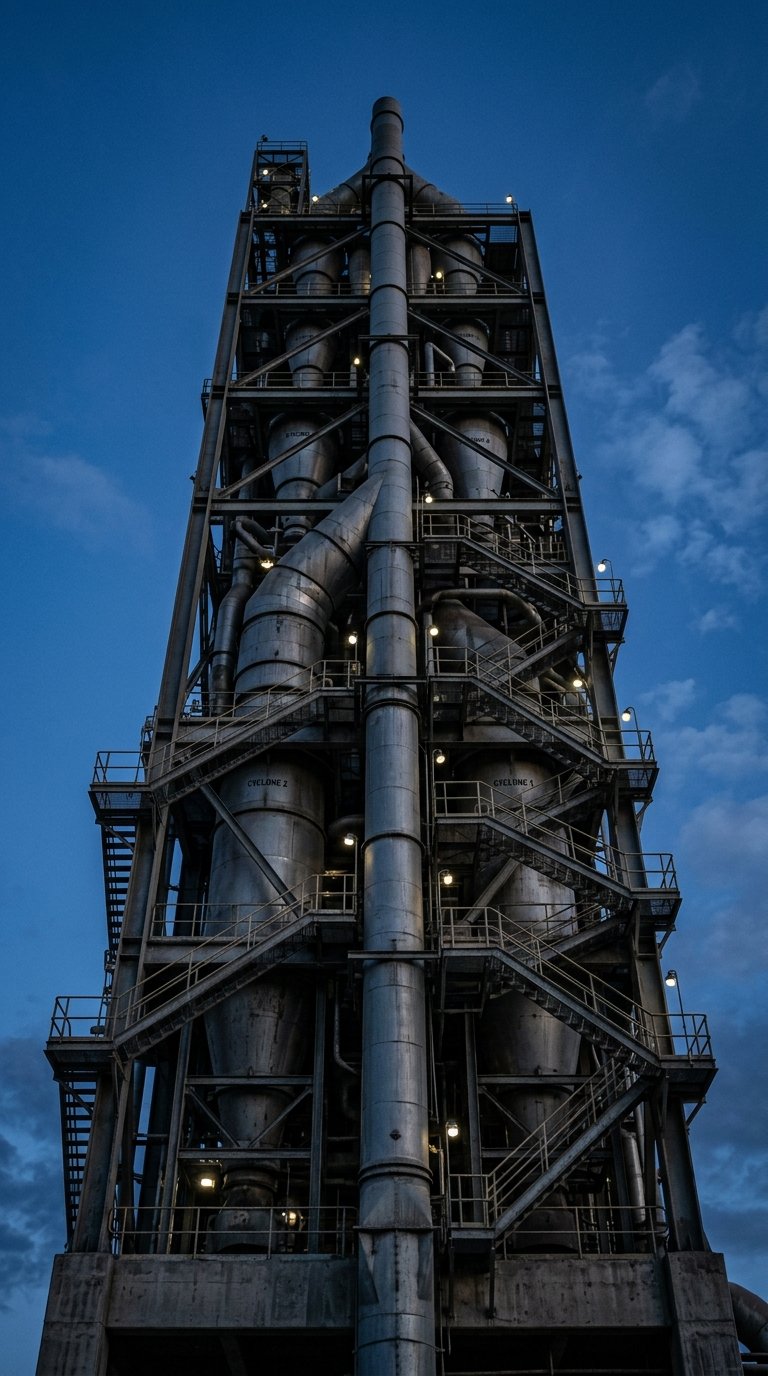
La torre di preriscaldamento del cemento: funzionamento
Una torre di preriscaldamento del cemento riscalda la farina cruda a circa 800-900°C in una cascata di cicloni prima dell'ingresso nel forno. Stadi, temperature, perdite di carico e compromessi operativi.
Una torre di preriscaldo per cemento riscalda la farina cruda da circa 60-80°C a 800-900°C prima che entri nel forno rotante, utilizzando un contatto in controcorrente con i gas di scarico caldi del forno in una cascata verticale di cicloni. La torre recupera gran parte dell'energia termica presente nei gas in uscita dal forno ed è il principale motivo per cui i moderni forni a processo a secco operano con un consumo specifico di combustibile pari a circa la metà rispetto alle vecchie linee a processo a umido.
Questo articolo illustra la funzione della torre, il funzionamento degli stadi a ciclone, le temperature operative e le perdite di carico a ogni stadio, il compromesso tra 4, 5 e 6 stadi e le quattro problematiche operative che più spesso degradano le prestazioni. L'argomento si inserisce nel cluster piroprocesso del cemento.
Cosa fa la torre di preriscaldo
Una torre di preriscaldo è uno scambiatore di calore gas-solido che utilizza i gas in uscita dal forno per preriscaldare la farina cruda prima dell'ingresso nel forno, con gas e farina che fluiscono in direzioni opposte. Senza di essa, il forno dovrebbe riscaldare la farina cruda dalla temperatura ambiente a quella di clinkerizzazione utilizzando solo combustibile, configurazione tipica di un vecchio forno a processo a umido con 1.300-1.400 kcal/kg di clinker. Un moderno preriscaldatore a 5 stadi con precalcinatore riduce tale valore a 690-740 kcal/kg (Cembureau Activity Report 2024; Madlool et al., 2011).
Nell'ingegneria del cemento, il termine "preriscaldatore" è l'abbreviazione di torre di preriscaldo a cicloni in sospensione, non del preriscaldatore d'aria a serpentina utilizzato nelle caldaie di potenza; il mezzo di scambio termico è la farina cruda stessa, sospesa nel flusso di gas.
Preriscaldatore a sospensione: una torre verticale di cicloni in cui la farina cruda viene dispersa in un flusso di gas di scarico caldi del forno, riscaldata per contatto diretto gas-solido, separata dal gas dall'azione ciclonica e scaricata allo stadio inferiore. La cascata è complessivamente in controcorrente: la farina scende, il gas sale.
Come funzionano gli stadi a ciclone
Ogni stadio in un preriscaldatore per cemento è un ciclone che separa la farina cruda dai gas caldi del forno: la farina scende attraverso i tubi di immersione (dip tubes) verso lo stadio inferiore, mentre il gas sale attraverso i condotti di risalita verso lo stadio superiore. I cicloni svolgono due compiti contemporaneamente: trasferiscono calore tra gas e solidi durante i pochi secondi di contatto in sospensione in ogni condotto di risalita, per poi separare le fasi.
Ogni ciclone è dotato di un ingresso gas tangenziale, un tubo di immersione (vortex finder) che definisce il percorso di uscita del gas attraverso la parte superiore, un corpo inferiore conico e una valvola a clapet per lo scarico della farina sul fondo. La farina esce attraverso la valvola nel condotto di risalita dello stadio inferiore, viene trascinata verso l'alto e convogliata al ciclone successivo. La farina si muove dall'alto verso il basso per gravità, il gas si muove dal basso verso l'alto spinto dal ventilatore di tiraggio indotto (ID fan) posto in cima alla torre.
La calcinazione (CaCO₃ → CaO + CO₂) inizia negli stadi inferiori del preriscaldatore intorno ai 700-800°C ed è in gran parte completata nel precalcinatore prima dell'ingresso nel forno. In una linea con precalcinatore, la farina arriva all'ingresso del forno calcinata per circa il 95-98% (VDZ Activity Report; Holderbank Cement Course Vol 2), il che consente al forno stesso di essere corto e ad alta produttività. Il calcinatore è trattato in un articolo dedicato.
Tubo di immersione (vortex finder): l'inserto cilindrico nella parte superiore di ogni ciclone che definisce il percorso di uscita del gas. L'usura del tubo di immersione riduce l'efficienza di separazione del ciclone, aumentando il trascinamento di polvere verso lo stadio superiore.
Temperature di stadio, flusso di gas e perdita di carico
In un tipico preriscaldatore moderno a 5 stadi, il gas entra nello stadio inferiore a 1.000-1.100°C ed esce dallo stadio superiore a 300-350°C; la farina cruda entra nello stadio superiore a 60-80°C ed esce dallo stadio inferiore a 800-900°C. La perdita di carico totale del preriscaldatore è di 600-800 mmH₂O, con ogni stadio che contribuisce per circa 100-180 mmH₂O.
| Stadio (dall'alto al basso) | T gas in (°C) | T gas out (°C) | T farina in (°C) | T farina out (°C) | ΔP stadio (mmH₂O) |
|---|---|---|---|---|---|
| 1 (superiore) | 450-500 | 300-350 | 60-80 | 250-300 | 100-150 |
| 2 | 600-650 | 450-500 | 250-300 | 450-500 | 100-150 |
| 3 | 750-800 | 600-650 | 450-500 | 600-650 | 120-150 |
| 4 | 900-950 | 750-800 | 600-650 | 700-750 | 130-160 |
| 5 (inferiore) | 1.000-1.100 | 900-950 | 700-750 | 800-900 | 150-180 |
| Torre totale | 600-800 |
Intervalli indicativi per un preriscaldatore a 5 stadi con precalcinatore. I valori variano in base al design dell'OEM, all'umidità della farina cruda, al tasso di combustibili alternativi e all'ingresso di aria parassita. Fonti: Holderbank Cement Course Vol 2; VDZ Activity Report; Madlool et al. 2011.
Il volume specifico di gas allo stadio superiore è tipicamente di 1,4-1,6 Nm³/kg di clinker su una moderna linea a processo a secco, con un carico di polvere di 80-120 g/Nm³ prima del precipitatore elettrostatico o del filtro a maniche (Holderbank Vol 2). Entrambi i valori determinano il dimensionamento del ventilatore ID e il design del condizionamento gas a valle.
4, 5 o 6 stadi: il compromesso di design
Un numero maggiore di stadi recupera più calore, riducendo il consumo specifico di combustibile, ma ognuno aggiunge altezza alla torre, perdita di carico, potenza del ventilatore ID e costi di capitale. Il 4 stadi era la norma negli anni '70-'80; il 5 stadi è lo standard moderno; il 6 stadi viene utilizzato dove l'elettricità è economica rispetto al combustibile.
| Configurazione | T gas stadio sup. (°C) | ΔP totale (mmH₂O) | Potenza vent. ID | Contributo tipico SFC (kcal/kg clinker) |
|---|---|---|---|---|
| 4 stadi | 380-420 | 450-600 | Minore | 720-780 |
| 5 stadi (standard moderno) | 300-350 | 600-800 | Maggiore | 690-740 |
| 6 stadi | 250-300 | 800-1.000 | Massima | 670-710 |
Fonti: Madlool et al. 2011; IEA Technology Roadmap: Low-Carbon Transition in the Cement Industry, 2018, aggiornato 2023; ECRA.
Passare da 4 a 5 stadi consente solitamente un risparmio nell'ordine di 25-40 kcal/kg di clinker (i riferimenti del settore convergono vicino a 25 kcal/kg solo per il risparmio sui gas in uscita), ma aggiunge 150-200 mmH₂O di perdita di carico, quindi il costo dell'energia elettrica per il ventilatore deve essere compensato dal guadagno energetico del combustibile. I prezzi locali dell'energia determinano il punto di pareggio. In India, dove il carbone è economico e l'elettricità di rete è costosa, il 5 stadi è lo standard e il 6 stadi è raro; nel Nord Europa, in Canada e in alcune parti del Brasile, dove le reti a prevalenza idroelettrica rendono l'elettricità economica, il 6 stadi è più comune (ECRA; IEA 2018). Il compromesso passa attraverso il consumo specifico di combustibile, che è la metrica che definisce la redditività della configurazione.
L'altezza è l'altro vincolo. Una torre a 6 stadi può superare i 140 m, aumentando i costi delle opere civili, la protezione dai fulmini e (in alcune giurisdizioni) l'approvazione per il sorvolo aereo. Molti revamping si fermano a 5 stadi anche dove il caso energetico per il 6 sarebbe altrimenti favorevole.
Problemi operativi comuni
Le quattro problematiche che più spesso degradano le prestazioni del preriscaldatore sono le ostruzioni dei cicloni, gli accumuli nei condotti di risalita, l'usura dei tubi di immersione e l'ingresso di aria parassita nei giunti dei cicloni e nelle valvole di scarico della farina.
- Ostruzioni dei cicloni. Tipicamente negli stadi inferiori, dove la farina parzialmente calcinata diventa appiccicosa intorno ai 700-800°C. Cause: alto contenuto di alcali, cloruri o zolfo nella miscela cruda; bassa velocità locale del gas; o punti freddi dovuti a un isolamento inadeguato. Vengono rimosse tramite cannoni ad aria o lance ad acqua durante il funzionamento, o manualmente durante una fermata del forno.
- Accumuli nei condotti di risalita. Incrostazioni sul condotto tra i cicloni inferiori, comuni dove il calcinatore scarica nel preriscaldatore. Riducono la sezione trasversale, aumentano la perdita di carico e spesso richiedono la rimozione meccanica durante le fermate.
- Usura dei tubi di immersione. I tubi di immersione si erodono a causa del carico di solidi e si ossidano negli stadi ad alta temperatura. Un tubo di immersione usurato riduce la separazione del ciclone: i solidi vengono trascinati verso l'alto invece di cadere, aumentando il carico di polvere sul ventilatore ID e degradando l'efficienza termica stadio dopo stadio. La pratica standard prevede la sostituzione dei tubi di immersione con un ciclo di 3-5 anni negli stadi caldi.
- Ingresso di aria parassita. Aria che entra dai giunti dei cicloni, dalle guarnizioni dei passi d'uomo, dalle tenute delle valvole di scarico della farina e dall'interfaccia forno-condotto di risalita. Ogni kg di aria parassita è un kg che il ventilatore ID deve movimentare e un kg che deve essere riscaldato dalla temperatura ambiente: una doppia penalità di combustibile ed elettricità. L'articolo Aria parassita nei forni da cemento copre l'argomento in modo completo; la procedura di misurazione è descritta in come viene misurata l'aria parassita.
Perché l'efficienza del preriscaldatore è importante per il resto dell'impianto
L'efficienza del preriscaldatore stabilisce il limite minimo per il consumo specifico di combustibile del forno: un maggiore recupero di calore nella torre significa meno combustibile nel forno e un minor carico parassita sul ventilatore ID. Nel bilancio termico del forno, circa il 30-35% dell'energia totale del combustibile finisce come gas di scarico del preriscaldatore, e il preriscaldatore ne recupera circa il 60-70% nella farina (Holderbank Vol 2); ciò che esce dallo stadio superiore a 300-350°C è il residuo, tipicamente utilizzato per l'essiccazione nel mulino crudo.
Due implicazioni pratiche. Una piccola riduzione della temperatura di uscita allo stadio superiore a flusso costante del ventilatore ID si traduce in un guadagno misurabile di SFC sul forno (generalmente nell'ordine di alcune kcal/kg di clinker ogni 5°C, secondo la revisione di Madlool 2011 e in linea con la pratica standard del bilancio termico), quindi anche modesti miglioramenti termici spostano l'ago dell'SFC. Inoltre, l'aria parassita nel preriscaldatore rappresenta la doppia penalità sopra citata; è la leva su cui agisce il sistema integrato di controllo dell'aria parassita negli impianti di cemento. Su una torre con un 12-15% di aria parassita, sigillare i giunti dei cicloni e le interfacce delle valvole è uno degli interventi a più alto ROI prima di qualsiasi revamping per il recupero di calore.
Sources
- Cembureau, *Activity Report 2023*. European Cement Association
- IEA, *Technology Roadmap: Low-Carbon Transition in the Cement Industry*, 2018 (refreshed 2023)
- Madlool, N. A., Saidur, R., Hossain, M. S., Rahim, N. A., *A critical review on energy use and savings in the cement industries*, Renewable and Sustainable Energy Reviews, 15(4), 2011, pp. 2042-2060
- Verein Deutscher Zementwerke (VDZ), *VDZ Activity Report* (annual). German Cement Works Association
- Holderbank Group / Holcim, *Cement Manufacturing: Process Technology*, Volume 2 (Holderbank Cement Course training corpus). Standard industry reference for preheater heat balance and stage temperatures.
- European Cement Research Academy (ECRA), technical reports on preheater design and energy efficiency. https://ecra-online.org/ --- *If you are evaluating a preheater retrofit or auditing false air on a specific cyclone stack, the [engineering-consulting team](/en/services/engineering-consulting) walks the methodology above on-site, from stage-by-stage O₂ balance to sealing-interface specification.*
Articoli correlati
Discuss Your Sealing Requirements
Our engineering team can help identify the right sealing solution for your application.
Contact Engineering Team“Ovunque i forni rotanti ad alta temperatura operino in atmosfera controllata, i sistemi di tenuta Oswal garantiscono efficienza energetica e stabilità di processo.”