
Bauxite Refining and the Alumina Refinery Bottleneck
The alumina refinery converts bauxite to alumina via the Bayer process. Why refining, not mining or smelting, is the aluminium supply bottleneck.
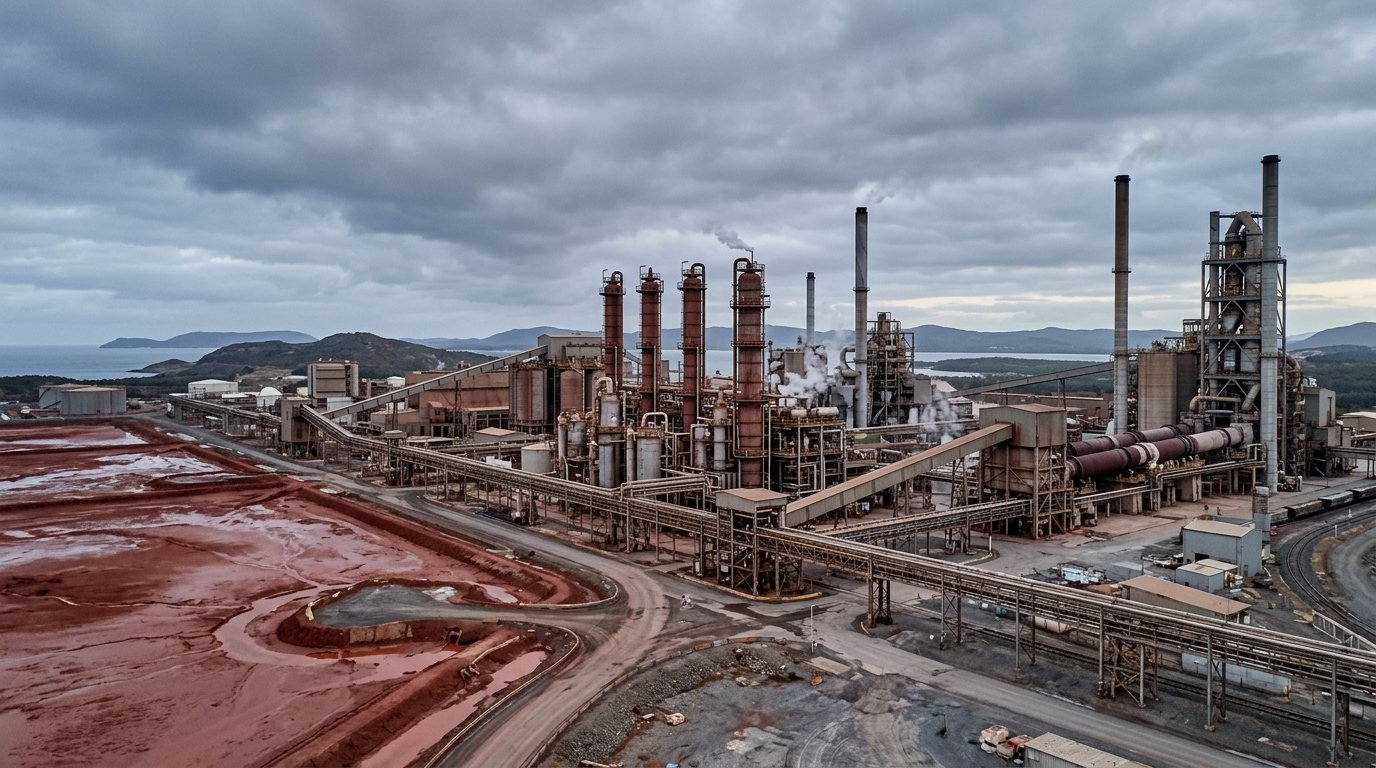
An alumina refinery is a hydrometallurgical plant that converts bauxite ore into alumina (Al₂O₃) through the Bayer process, the single intermediate stage between bauxite mining and aluminium smelting. It is not an oil refinery and it does not produce metal; it produces a white powder that smelters then reduce to aluminium. This piece treats the refinery as an industrial asset: why it is the most capital- and energy-intensive link in the aluminium chain, where global capacity sits, and why refining (not mining and not smelting) is the structural bottleneck the market keeps running into.
What is an alumina refinery?
An alumina refinery is the plant that refines bauxite into alumina. It sits in the middle of a three-stage value chain: mining produces bauxite ore, refining converts that ore to alumina, and smelting reduces alumina to primary aluminium. The "refinery" label confuses some searchers because it shares a name with petroleum refining, but the chemistry is unrelated: an alumina refinery runs a caustic-soda hydrometallurgical cycle, not hydrocarbon distillation.
Alumina refinery: an industrial plant that refines bauxite ore into anhydrous alumina (Al₂O₃) using the Bayer process. It is the intermediate stage between bauxite mining and aluminium smelting, and produces alumina powder, not metal.
The mass losses across the chain are large. Producing one tonne of alumina takes roughly 1.9-3.6 tonnes of bauxite depending on ore grade [1], and producing one tonne of primary aluminium then takes roughly 1.9-2.0 tonnes of alumina. That double reduction is why a constrained refining step propagates so visibly to the metal market. Oswal's mineral-processing kiln sealing work covers the rotary calcination equipment inside these plants.
How bauxite becomes alumina (the Bayer process, briefly)
Bauxite refining runs on the Bayer process: caustic digestion, clarification, precipitation, and calcination, with the spent caustic-soda liquor reconcentrated and recycled so the plant operates continuously. Digestion dissolves the aluminium-bearing minerals in hot sodium hydroxide at 140-270 °C depending on the ore mineralogy, clarification separates the insoluble residue (red mud), precipitation crystallises aluminium hydroxide out of the clarified liquor, and calcination drives off the bound water to leave anhydrous alumina [2].
This piece covers the refinery as an asset, not the reaction chemistry in detail. For the step-by-step chemistry, see the Bayer process. The stage that matters for plant engineers reading this is the last one, calcination, because that is where the refinery runs kiln-class thermal equipment.
The calcination step: rotary kiln vs gas-suspension calciner
Calcination is the final Bayer stage: aluminium hydroxide is heated to roughly 1,000-1,100 °C to remove chemically bound water and convert it to stable anhydrous alumina [3]. Refineries do this in one of two equipment classes: an older-style rotary kiln running soak calcination, or a modern gas-suspension (stationary) calciner where the solids are entrained in hot gas. Both reach the same chemistry; they differ in thermal efficiency and footprint.
Rotary kilns are the legacy technology and many older refineries still run them. Gas-suspension and flash calciners are the modern standard for new capacity because they recover heat more aggressively and cut specific thermal energy relative to a long rotary kiln. The trade-off: suspension calciners are more sensitive to feed consistency, while rotary kilns tolerate variable feed but lose efficiency to a larger heated gas volume.
The table below summarises the Bayer refining stages, their function, typical operating condition, and the equipment class involved.
| Refining stage | Function | Typical condition | Equipment |
|---|---|---|---|
| Digestion | Dissolve alumina from bauxite in caustic soda | 140-270 °C, elevated pressure [2] | Pressure digesters / autoclaves |
| Clarification | Separate insoluble red mud from liquor | ~100 °C [2] | Settlers, thickeners, filters |
| Precipitation | Crystallise Al(OH)₃ from clarified liquor | 55-75 °C [2] | Seeded precipitation tanks |
| Calcination | Drive off bound water to yield Al₂O₃ | 1,000-1,100 °C [3] | Rotary kiln or gas-suspension calciner |
Whether rotary or suspension, the calciner has rotating-to-stationary interfaces and gas-handling ductwork where unintended air can leak in. False air ingress raises the volume of gas the calciner has to heat, which raises fuel use per tonne of alumina, the same penalty a cement or lime kiln pays. The product itself, calcined alumina, is graded by calcination temperature and crystal phase, so control over the calciner matters beyond throughput; the smelter-grade versus special-grade distinction is set here. The same calcination logic governs adjacent mineral-processing lines such as kaolin calcination.
Why refining is the bottleneck (not mining, not smelting)
Refining is the structural bottleneck in the aluminium chain because the alumina refinery is the most capital-intensive, most energy-intensive, slowest-to-permit asset of the three stages, and it carries the red-mud liability. Bauxite mines can be expanded relatively quickly and smelters are constrained mainly by power contracts; the refinery in the middle is the hardest piece to add.
Four factors compound:
- Capital and lead time. A greenfield alumina refinery is a multi-billion-dollar project with a build-out measured in years, not months. Capacity cannot be switched on to meet a price spike.
- Energy intensity. Refining consumes large quantities of process steam for digestion plus high-temperature heat for calcination at 1,000-1,100 °C [3]. Energy is a structural cost, not a marginal one.
- Permitting and red mud. Every tonne of alumina generates roughly 1.0-1.5 tonnes of red mud (bauxite residue), a strongly alkaline slurry at pH 10-13 that requires engineered, lined containment [4]. Residue storage drives much of the permitting difficulty.
- Geographic concentration. Refining is far more concentrated than mining, so a disruption at a few large plants moves the global balance (see the next section).
Red mud (bauxite residue): the alkaline insoluble slurry of iron oxides, silica, and titania left after digestion, produced at roughly 1.0-1.5 tonnes per tonne of alumina. Its storage and permitting burden is a primary reason refineries are slow to permit and build.
Global alumina refining capacity and concentration
World alumina production reached about 147.0 million tonnes in 2024, up 2.6% year on year, of which China produced roughly 82.4 million tonnes, about 58% of the global total [5]. That concentration is the headline fact: refining is geographically far more concentrated than bauxite mining. Of that 2024 output, metallurgical-grade alumina (smelter feed) was 93.95% and chemical-grade alumina 6.05% [5].
Bauxite mining, by contrast, is spread across more producers. World bauxite production was forecast at roughly 463.7 million tonnes in 2025, with Australia at about 100 million tonnes in 2024 and Guinea, China, and Brazil among the other leaders [6]. Known reserves are large and widely distributed: USGS puts bauxite resources at 55-75 billion tonnes, with Guinea alone holding about 7.4 billion tonnes, roughly 26% of the global total [6]. The raw material is not the constraint; the capacity to refine it is.
Recent events illustrate how thin the margin is. In 2024 Alcoa moved to curtail its Kwinana refinery in Western Australia, removing about 2.2 million tonnes per year of capacity, while a gas-pipeline fire near Rio Tinto's Gladstone operations in Queensland cut roughly 1.2 million tonnes per year of output [7]. On the additive side, the USGS recorded a new 1-million-tonne-per-year refinery at Mempawah, Indonesia shipping its first alumina in 2025, and a 4.7-million-tonne-per-year refinery near Collie, Australia [6]. New capacity arrives in large discrete blocks years apart, which is why the balance tightens and loosens in cycles rather than adjusting smoothly.
What the bottleneck means for downstream aluminium
When refining capacity tightens, alumina prices spike and smelters absorb the cost, because alumina is a large share (roughly 30-40%) of the cash cost of producing primary aluminium. A refinery problem is therefore a smelter-margin problem within weeks. Through 2024 the combination of Australian output cuts and a Guinea bauxite export disruption pushed spot alumina to an all-time high around US$695 per tonne in Q4 2024, a year-on-year rise of more than 70% [7][8].
The asymmetry is the point. Smelters can throttle pots and miners can slow shipments, but neither can manufacture refining capacity on demand. The market clears through price, and that signal lands on aluminium producers who have no short-term substitute for alumina. For a refiner on tight capacity, every tonne lost to calciner downtime or thermal inefficiency is a tonne the market cannot easily replace, which raises the value of uptime well above its normal level.
Oswal's mineral-processing kiln sealing connection
In an alumina refinery, the rotary calciner is a kiln-class asset whose inlet and outlet seals govern thermal efficiency and uptime in the same way a cement or lime kiln seal does. The mechanism is identical: the interface between rotating shell and stationary hood or ductwork is where unintended air enters, and false air in rotary kilns raises the gas volume the system has to heat per tonne of product.
In a tight alumina market, that efficiency penalty is also a capacity penalty, because fuel spent heating leaked air is heat not available for throughput. Oswal's mineral-processing kiln sealing work covers calciners in this equipment class. The refinery economics above are set upstream of any seal, but seal integrity is one of the few availability levers a refiner controls directly.
Oswal supplies kiln sealing systems for rotary calciners in alumina refineries and related mineral-processing operations. For the upstream chemistry, see the Bayer process; for the product the calciner makes, see what calcined alumina is used for.
Common questions about this topic
No. An alumina refinery is a hydrometallurgical plant that refines bauxite ore into alumina (Al₂O₃) using the Bayer process, a caustic-soda chemistry. It shares the word "refinery" with petroleum refining but has no process relationship to it: there is no crude oil, no distillation, and no fuel output. The product is a white alumina powder that aluminium smelters then reduce to metal, as described in the [Bayer process explainer](/de/blog/what-is-the-bayer-process).
Producing one tonne of alumina takes roughly 1.9-3.6 tonnes of bauxite, depending on the ore grade and the dominant aluminium mineral [1]. Lower-grade or boehmite- and diaspore-rich ores sit at the higher end. Downstream, one tonne of primary aluminium then takes roughly 1.9-2.0 tonnes of alumina, so the bauxite-to-metal mass loss across the full chain is large.
Alumina refining is the bottleneck because the refinery is the most capital-intensive, energy-intensive, and slowest-to-permit asset in the aluminium chain, and it carries the red-mud disposal liability. Bauxite mines expand relatively quickly and smelters are limited mainly by power contracts, but a greenfield refinery is a multi-year, multi-billion-dollar build that also generates roughly 1.0-1.5 tonnes of alkaline red mud per tonne of alumina [4]. Refining capacity is also geographically concentrated, so a few plant outages move the global balance.
China is by far the largest alumina producer, at about 82.4 million tonnes in 2024, roughly 58% of world output of about 147.0 million tonnes [5]. Australia, Brazil, and India are the next largest. This concentration contrasts with bauxite mining, which is spread across Australia (about 100 million tonnes in 2024), Guinea, China, and Brazil [6]. The mismatch between where bauxite is mined and where it is refined is one reason bauxite export policy in countries like Guinea can move alumina and aluminium prices.
Sources
- IntechOpen, "Aluminum Mineral Processing and Metallurgy: Iron-Rich Bauxite and Bayer Red Muds" (1.9-3.6 t bauxite per t alumina)
- ScienceDirect, "Bayer Process, an overview," *ScienceDirect Topics*
- SpringerLink, "Production of Smelter Grade Alumina (SGA) by Calcination," in *Proceedings of the 50th Annual Conference of Metallurgists*
- Red Mud Project, "Production" (red mud tonnage and alkalinity per tonne alumina)
- International Aluminium Institute alumina-production data, reported via AL Circle, "2024: World alumina production grows 2.6%" (147.0 Mt total; China 82.4 Mt / 58%; 93.95% metallurgical / 6.05% chemical grade)
- U.S. Geological Survey, *Mineral Commodity Summaries 2026: Bauxite and Alumina* (world bauxite ~463.7 Mt 2025; Australia ~100 Mt 2024; reserves 55-75 bn t; Guinea ~7.4 bn t; Mempawah 1 Mt/yr; Collie 4.7 Mt/yr)
- S&P Global / American Metal Market, alumina supply disruptions 2024 (Alcoa Kwinana ~2.2 Mt/yr curtailment; Rio Tinto Gladstone ~1.2 Mt/yr; price escalation)
- Discovery Alert, "Alumina Price Volatility and Market Dynamics" (spot alumina all-time high ~US$695/t Q4 2024; >70% YoY rise)
Verwandte Artikel
Discuss Your Sealing Requirements
Our engineering team can help identify the right sealing solution for your application.
Contact Engineering Team“Überall dort, wo Hochtemperatur-Drehrohröfen unter kontrollierter Atmosphäre betrieben werden, sorgen Oswal-Dichtungssysteme für Energieeffizienz und Prozessstabilität.”