
Mineral Processing Kiln Sealing: Alumina Guide
Mineral Processing
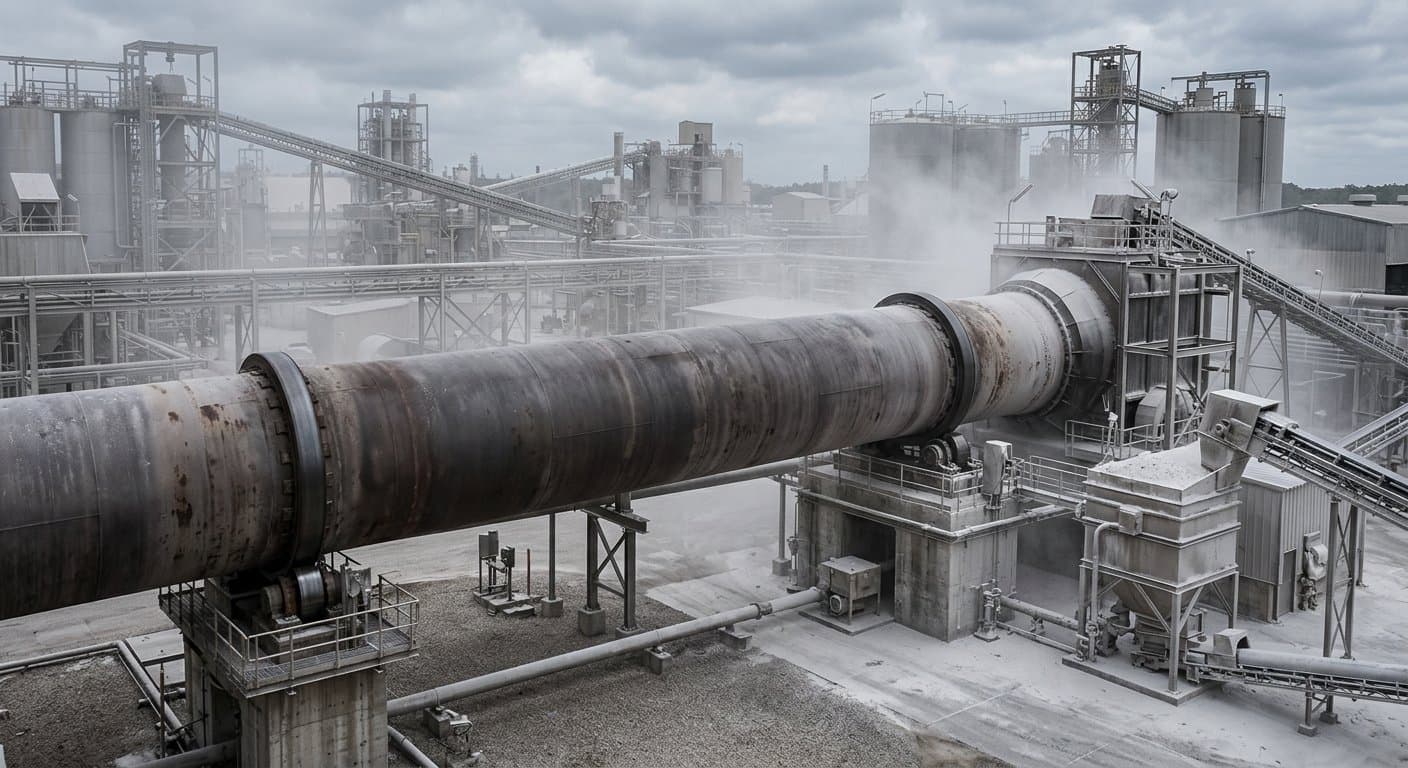
A mineral processing plant calcining alumina or bauxite needs a kiln seal that controls false air at the inlet and discharge hoods of a rotary kiln running above 1,000°C under an extremely fine, abrasive oxide dust. The atmosphere in alumina calcination is oxidising, so false air is an efficiency and product-uniformity problem rather than a product-destroying one; the sealing target is low, stable leakage and long wear life against fine α-alumina dust. Because the crystal phase of the product is set by holding a precise calcining temperature, and false air disturbs that temperature profile, sealing in the alumina and calcined-bauxite industries protects product grade as well as fuel.
The mineral processing industry use case for kiln sealing
In an alumina refinery, the calcination kiln seal protects both the heat balance and the phase of the product. Calcination of alumina converts aluminium hydroxide (gibbsite) to aluminium oxide; the calcining temperature determines whether the output is a transitional gamma alumina or fully converted alpha alumina, and complete conversion to chemically inert α-Al₂O₃ requires holding above about 1,250°C [1]. A false-air leak that disturbs the calcining-zone temperature can leave the product short of its target phase, which matters for both metallurgical-grade and specialty calcined alumina.
The energy stake is large. Calcination of bauxite and alumina is fuel-intensive, with rotary-kiln routes running near 4.5 GJ per tonne of alumina [1], so every percent of false air admitted through a worn seal adds parasitic heat load. For the upstream context, see what is the Bayer process, the bauxite refining and alumina refinery chain, and the grade detail in calcined alumina uses and calcined alumina grades.
The kiln process chain in alumina and bauxite calcination
The mineral processing kiln chain feeds a precipitated or washed hydrate into a rotary kiln, drives off chemically combined water, sets the oxide crystal phase, and cools the calcined product, with the seals bracketing the high-temperature calcining zone. For alumina, the feed is gibbsite from the Bayer process; for calcined bauxite, the feed is dried bauxite ore.
| Stage | Reaction / function | Approximate temperature |
|---|---|---|
| Drying / preheat | Free moisture removed; feed heated | ambient to ~500°C |
| Dehydroxylation | Al(OH)₃ → Al₂O₃ + H₂O; bound water driven off | 500-1,000°C |
| Calcining / phase conversion | Transition aluminas toward α-Al₂O₃ | 1,000-1,250°C+ [1] |
| Cooler | Calcined alumina or bauxite quenched | 1,000°C+ down to ~100°C |
The kiln inlet seal sits at the feed end and the outlet seal at the cooler hood; both are under draft and both admit air if the contact face is worn. The phase outcome is temperature-dependent, so a stable temperature profile, which depends on draft and therefore on sealing, directly controls product grade. Calcined kaolin follows the same kind of thermal route, driving off structural water from the clay to produce metakaolin and then fully calcined kaolin; see kaolin calcination. Note the industry trend: stationary flash calciners are displacing rotary kilns for primary alumina (about 3.0 GJ/t versus 4.5 GJ/t) [1], but rotary kilns remain widespread for calcined bauxite, specialty aluminas, and kaolin, where the sealing duty below is unchanged.
Sealing requirements specific to mineral processing: temperature, atmosphere, dust profile
Mineral processing kiln sealing requirements are defined by very high temperature, an oxidising atmosphere, and an exceptionally fine, hard, abrasive oxide dust. Calcined α-alumina is one of the hardest common industrial powders, so seal-face wear is the dominant lifetime constraint.
Calcination (alumina): thermal treatment that removes chemically combined water from aluminium hydroxide and converts it to aluminium oxide, with the calcining temperature setting the crystal phase (transitional gamma below ~1,000°C, alpha above ~1,250°C) [1].
The governing conditions:
- Temperature. The calcining zone runs 1,000-1,250°C and higher for full alpha conversion [1], so the high-temperature interfaces need graphite-based sealing elements and the assembly must tolerate thermal cycling.
- Atmosphere. Oxidising, so the target is stable low leakage rather than zero oxygen ingress. The benefit of tighter sealing here is fuel saved and a stable temperature profile that holds the product phase.
- Dust. Fine, hard α-alumina and calcined-bauxite dust are highly abrasive; this is the harshest dust constraint of the oxidising-process kilns, so abrasion-resistant construction and a controlled contact-pressure mechanism are essential to keep leakage stable as the face wears.
- Movement. Standard radial expansion and axial float, which the seal must follow while resisting the abrasive load.
The trade-off is the familiar one: lamella follows movement but is more exposed at sustained high temperature, while graphite handles heat but resists dynamic compensation. The combination of very high temperature and very abrasive dust in alumina calcination makes a hybrid assembly the usual fit.
Recommended Oswal products for mineral processing
The primary match for alumina, bauxite, and kaolin calcination kilns is the Duplex Kiln Sealing System, which is listed for mineral processing kilns among its typical applications and pairs lamella movement compensation with graphite high-temperature sealing for abrasive, high-heat service [2]. The feed and discharge are covered by the Kiln Inlet Sealing System and Kiln Outlet Sealing System, the latter built for abrasion resistance under heavy dust. Component-level, the Graphite-Based Sealing Elements handle the high-temperature zone, the High-Temperature Radial Seals maintain circumferential contact, and the Axial Compensation Seals absorb kiln float. For leakage managed across the whole kiln, see Integrated False Air Control.
Mineral processing industry application examples
In alumina and calcined-bauxite kilns we have assessed, abrasive seal-face wear is the defining maintenance pattern: fine α-alumina dust erodes the contact face faster than clinker or lime dust, so the seal-replacement interval is the metric operators watch. A typical case: a calcined-bauxite kiln drifts upward in measured false air over a campaign as the outlet seal abrades, raising specific fuel consumption on an already fuel-heavy process. A higher-durability graphite-and-lamella assembly extends the interval and holds leakage closer to baseline.
A second recurring case is phase variability traced to inlet-seal leakage. Air entering near the feed end disturbs the calcining-zone temperature, which can leave the product short of its target alpha content; operators tuning for grade consistency often find the temperature profile is being pulled by an unsealed interface, not by the burner. A third pattern appears in calcined kaolin lines, where the fine clay and metakaolin dust loads the seal in the same way and the same sealing logic applies. For the grade framework behind these cases, see calcined alumina grades.
Recommended Products
Oswal Solutions for Mineral Processing
High-Temperature Radial Seals
Controlled Circumferential Sealing Under Thermal Expansion
Axial Compensation Seals
Controlled Sealing Under Longitudinal Kiln Movement
Graphite Kiln Seal
Thermal Durability for High-Temperature Kiln Interfaces
Kiln Outlet Sealing System
Extreme Temperature Performance at the Clinker Discharge Zone
Sources
- Bayer process and alumina calcination references (ScienceDirect / Aluminium Guide / Wikipedia), *Calcination temperatures, crystal-phase conversion, and rotary-kiln versus flash-calciner energy use*, 2023-2024. https://www.sciencedirect.com/topics/engineering/bayer-process and https://en.wikipedia.org/wiki/Bayer_process
- Oswal Industries, *OSWAL Kiln Seals product catalogue* and *Duplex Kiln Sealing System catalogue*, 2024 (product specifications and typical applications).
Frequently Asked Questions
Common questions about kiln sealing in the mineral processing.
Rotary kilns are used across mineral processing for calcination, sintering, and pyrolytic processes. Major applications include bauxite calcination for alumina production, magnesia calcination (both caustic and dead-burned), dolomite calcination for refractory and steelmaking flux, titanium dioxide processing, zinc oxide production, and soda ash. Each process has its own thermal and atmosphere requirements that drive seal specification.
Mineral calcination depends on a precise thermal profile along the kiln length. False air ingress disrupts this profile, producing under-calcined product in the affected zone. Off-specification mineral product may need to be reprocessed, downgraded, or rejected entirely; product-cost impact of poor sealing typically exceeds fuel-cost impact.
Bauxite calcination kilns typically use the Oswal Duplex Kiln Sealing System or a Kiln Inlet plus Outlet pair, configured for the 950-1,100°C operating range. Dead-burned magnesia kilns operate at higher temperatures (1,400-1,600°C) and typically use graphite-only configurations with High-Temperature Radial Seals specified for the elevated temperature.
Mineral Processing Sealing Inquiry
Share your kiln configuration and operating conditions with our engineering team.
Request a Quote“Wherever high-temperature rotary kilns operate under controlled atmosphere, Oswal sealing systems ensure energy efficiency and process stability.”