
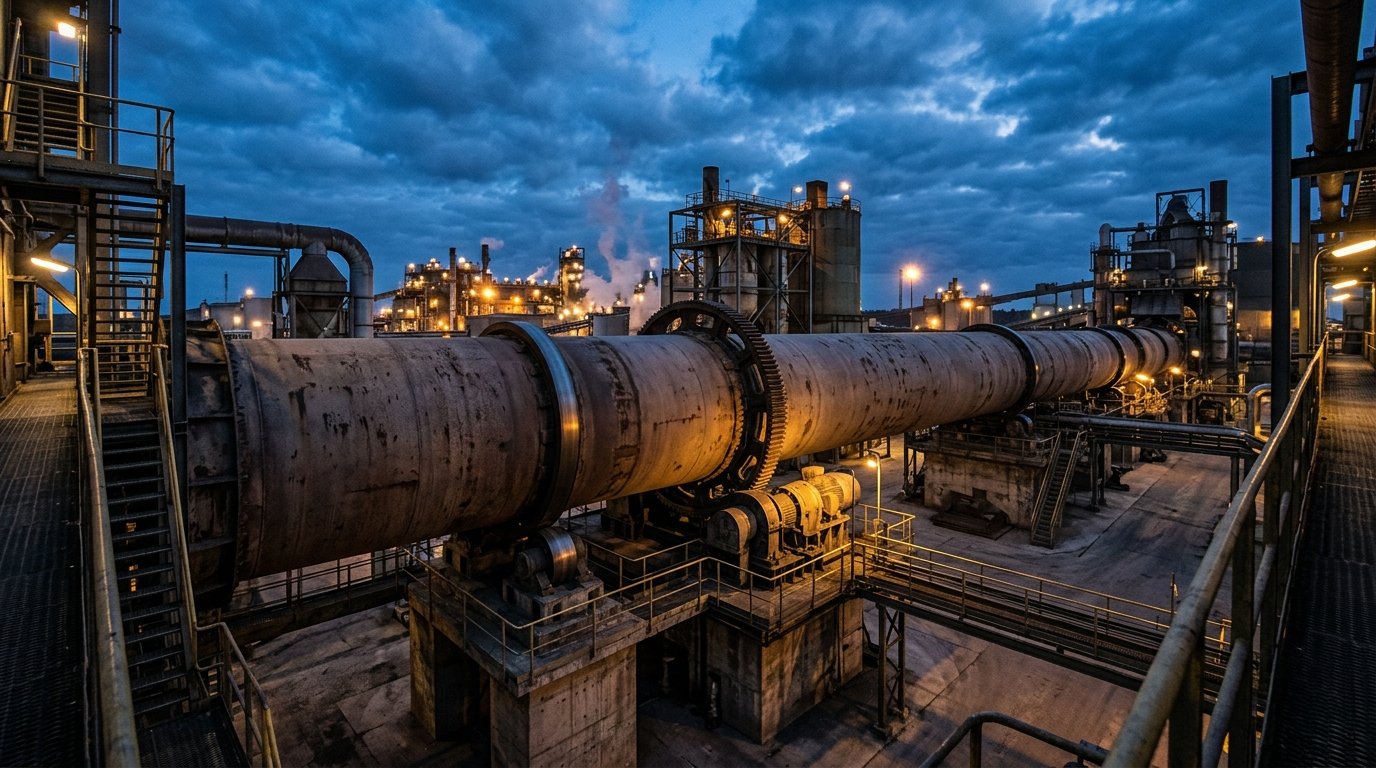
8 Industries That Run Rotary Kilns
The 8 industries that run rotary kilns: cement, lime, DRI, alumina, kaolin, waste incineration, ferroalloys, and specialty carbon, with process temperatures.
Eight industries run the bulk of the world's rotary kilns and rotary calciners: cement, lime, iron and steel (direct reduced iron), alumina, kaolin and clay, waste-to-energy and hazardous-waste incineration, ferroalloys and other metallurgical processing, and specialty minerals and carbon. The common thread is the equipment and the physics: a rotary kiln is an inclined, refractory-lined steel cylinder that calcines, reduces, or incinerates material at high temperature as it tumbles down the shell. Every one of these industries fights the same parasitic loss, false air drawn in at the rotating shell-to-hood interface, where a stationary hood meets a shell that never holds still. This piece walks the eight industries in order of installed base, with the rough process temperature for each and one line on why the seal matters there.
1. Cement
Cement is the largest user of rotary kilns by installed capacity: a rotary cement kiln sinters ground raw meal into clinker, the synthetic mineral that gives cement its strength. The material peaks at roughly 1,450 C in the burning (sintering) zone, while the flame and combustion gases run near 2,000 C to drive the final alite-forming reactions [1]. The full thermal sequence from preheater to cooler is covered in cement pyroprocessing. False air drawn in at the kiln inlet and outlet seals dilutes the gas, raises induced-draught fan load, and wastes fuel, which is why a well-specified inlet seal is one of the cheapest efficiency levers on a cement line; see false air in cement kilns and Oswal's cement sealing work.
2. Lime
Lime producers run rotary kilns to calcine limestone (calcium carbonate, CaCO3) into quicklime (calcium oxide, CaO), driving off carbon dioxide. The reaction runs at roughly 900 to 1,100 C, and by adjusting temperature and residence time the kiln can produce soft-burned or hard-burned lime across a wide reactivity range that vertical shaft kilns cannot match [2][3]. The chemistry and energy demand are set out in quicklime production, and the equipment trade-off against shaft kilns is in vertical shaft vs rotary lime kilns. The lime kiln runs hot and dusty, so false air at the seal pulls down combustion efficiency and pushes up specific fuel consumption, the same loss Oswal addresses across its lime sealing installations.
3. Iron and steel (sponge iron / DRI)
Coal-based direct reduction plants run rotary kilns to reduce iron ore to metallic iron in the solid state, producing sponge iron (direct reduced iron, DRI) as the feed for electric arc and induction furnaces. Reduction happens at roughly 1,000 to 1,100 C in the kiln's reduction zone, below the melting point of iron, so the ore is never liquefied [4]. India is the centre of this industry, producing about 54.7 million tonnes of DRI in 2024, the largest national output in the world [5]; the route is detailed in sponge iron production and coal-based sponge iron production. A failed seal here costs more than fuel: in-leaked air burns the reductant and lowers metallization, so DRI demands one of the tightest sealing tolerances of any rotary kiln, often met with the Duplex kiln sealing system across metallurgical plants.
4. Alumina
Alumina refineries run rotary kilns (and modern gas-suspension calciners) as the final Bayer-process step, heating aluminium hydroxide to drive off chemically bound water and leave anhydrous alumina (Al2O3). Calcination runs at roughly 1,000 to 1,100 C, which fixes the alpha-alumina content, particle size, and surface area that separate one product grade from another [6]. The refinery as an asset is covered in bauxite refining, and the grade framework in calcined alumina grades. Calciner false air is a fuel and product-quality loss, and the high-temperature, fine-dust discharge interface is exactly the abrasive duty that Oswal's mineral-processing sealing work is built for.
5. Kaolin and clay
Kaolin and clay processors run rotary calciners to dehydroxylate kaolinite, producing reactive metakaolin at roughly 500 to 800 C, or fully calcined pigment containing mullite above about 950 C, from a single raw material depending on peak temperature [7]. The product split, the temperatures, and the process routes are detailed in kaolin calcination. The calciner shell is comparatively cooler than a cement or DRI kiln, but it carries fine, abrasive product dust, so seal-face leakage both costs draught energy and risks product carryover, the kind of mineral-processing duty handled across Oswal's mineral-processing installations.
6. Waste-to-energy and hazardous-waste incineration
Waste incinerators run rotary kilns to thermally destroy mixed and hazardous waste, tumbling the feed down a temperature gradient ahead of a secondary combustion chamber (afterburner) that completes the destruction of flue-gas organics. The kiln runs at roughly 850 to 1,200 C depending on ashing or slagging mode, and EU law requires the gas to be held above 850 C for at least 2 seconds after the last combustion-air injection to destroy dioxin precursors [8][9]. The equipment is covered in rotary kiln incinerators and hazardous-waste incineration, and the energy-recovery side in waste-to-energy plants. Here false air is not just a fuel cost: enough ingress can drop the gas below the 850 C / 2-second condition and put the whole emissions case at risk, the sealing duty Oswal covers in waste management.
7. Ferroalloys and other metallurgical processing
Ferroalloy and specialty-metallurgical plants run rotary kilns to calcine and pre-reduce ores before a downstream smelting or leaching step. In the rotary-kiln electric-furnace (RKEF) route for ferronickel, nickel laterite is dried, calcined, and pre-reduced at roughly 850 to 1,000 C in the kiln before melting in an electric furnace at 1,500 to 1,600 C [10]. In titania feedstock production, ilmenite is reduced with coal in a rotary kiln at roughly 1,100 to 1,200 C to make synthetic rutile via the Becher process [11]. Both run hot, dusty, and reducing, which is the same demanding combination that makes the Duplex kiln sealing system a common answer across metallurgical kilns.
8. Specialty minerals and carbon
A long tail of specialty-mineral and carbon processors run rotary kilns and calciners for high-value products. Spent activated carbon is thermally reactivated in a rotary kiln at roughly 800 to 900 C to burn off adsorbed contaminants and restore pore structure [12]; petroleum coke is calcined at roughly 1,200 to 1,350 C to raise its density and electrical conductivity for the carbon-anode and graphite industries [13]; and titanium dioxide pigment and other technical minerals are calcined on the same equipment class. The temperatures span a wide band, but the sealing problem is constant, so the right seal is chosen per position and duty, the selection logic in the kiln seal comparison guide and across Oswal's mineral-processing range.
The common thread: false air at the rotating seal
Every industry above shares one mechanical reality: a rotating kiln shell meets a stationary inlet and outlet hood, and that interface has to be sealed against air ingress while the shell moves. The shell expands radially with heat, walks axially under thermal growth, and runs slightly out of round on every revolution, so a rigid seal opens a leakage gap the moment the shell moves away from it. The consequence differs by industry but the physics does not: wasted fuel and higher draught-fan load in cement, lime, and alumina; lost metallization in DRI; eroded combustion-temperature margin against a legal dioxin-destruction limit in waste incineration. The selection of lamella, graphite, or a hybrid per position is worked through in the kiln seal comparison guide, and tracking seal condition together with false-air measurement is the principle behind Oswal's integrated false air control and the Duplex kiln sealing system.
If you operate a rotary kiln in any of these industries and want the seal specified to your kiln's process, temperature, and movement profile rather than a generic part, our engineering team works the inlet and outlet positions case by case across cement, lime, metallurgical, mineral-processing, and waste applications. Contact us to walk through your configuration.
Common questions about this topic
The main industries that use rotary kilns are cement (clinker production), lime (quicklime calcination), iron and steel (coal-based direct reduced iron / sponge iron), alumina (Bayer-process calcination), kaolin and clay (metakaolin and calcined clay), waste-to-energy and hazardous-waste incineration, ferroalloys and other metallurgical processing (such as nickel laterite and ilmenite reduction), and specialty minerals and carbon (such as activated-carbon reactivation, petroleum-coke calcining, and titanium dioxide). In every case the rotary kiln calcines, reduces, or incinerates material at high temperature as it tumbles down an inclined, refractory-lined rotating shell.
The most common use of a rotary kiln is cement manufacture, where it sinters ground raw meal into clinker at a material temperature of roughly 1,450 C [1]. Cement is the largest user of rotary kilns by installed capacity worldwide, which is why most general descriptions of rotary kilns are framed around the cement application even though lime, DRI, alumina, and waste incineration all run the same equipment class.
Rotary kilns need seals because the rotating kiln shell meets a stationary inlet and outlet hood, and that gap has to be closed against false air, air drawn into the kiln through unintended openings rather than through the controlled combustion-air path. The shell expands, walks axially, and runs out of round as it turns, so the seal has to flex to follow it; otherwise it opens a leakage gap. False air wastes fuel and draught capacity in cement, lime, and alumina kilns, lowers metallization in DRI, and can erode the combustion-temperature margin in waste incinerators.
Sources
- INFINITY FOR CEMENT EQUIPMENT, *The Thermal Journey of Cement Clinker* (clinker sintering at ~1,450 C; flame ~2,000 C)
- INFINITY FOR CEMENT EQUIPMENT, *Lime Calcination* (quicklime production from limestone, 900-1,100 C)
- Oswal Engineers, *Kiln Sealing Systems* (lime and rotary-kiln sealing application coverage). `OSWAL_kilnseal.pdf`
- IspatGuru, *Direct Reduced Iron and its Production Processes* (coal-based rotary-kiln reduction at 1,000-1,100 C)
- Worldsteel / Indian DRI output, *2024 direct reduced iron production* (India ~54.7 Mt, largest national output)
- INFINITY FOR CEMENT EQUIPMENT / industry sources, *Alumina Calcination* (Bayer calcination of aluminium hydroxide to anhydrous alumina at ~1,000-1,100 C)
- Industry technical literature on kaolin calcination (dehydroxylation to metakaolin at ~500-800 C; mullite formation above ~950 C). See `drafts/kaolin-calcination.md` source set.
- European Union, *Directive 2010/75/EU on industrial emissions (Industrial Emissions Directive)*, Article 50 (combustion gas held above 850 C for at least 2 seconds)
- WtERT / rotary kiln incinerator technical literature (kiln operating temperature 850-1,200 C; secondary combustion chamber >1,100 C). See `drafts/rotary-kiln-incinerators.md` source set.
- Nickel Institute, *Nickel industry Part 2: Processing nickel laterites and smelting* (RKEF rotary-kiln calcination / pre-reduction ~850-1,000 C; electric furnace 1,500-1,600 C)
- *Becher process*, Wikipedia (ilmenite reduced with coal in a rotary kiln at ~1,100-1,200 C to make synthetic rutile)
- AGICO / GEMCO carbon-regeneration kiln technical literature (thermal reactivation of spent activated carbon at ~800-900 C)
- Resco Products, *Coke Calcining* (petroleum coke calcined at ~1,200-1,315 C / up to ~1,350 C)
Verwandte Artikel
Discuss Your Sealing Requirements
Our engineering team can help identify the right sealing solution for your application.
Contact Engineering Team“Überall dort, wo Hochtemperatur-Drehrohröfen unter kontrollierter Atmosphäre betrieben werden, sorgen Oswal-Dichtungssysteme für Energieeffizienz und Prozessstabilität.”