
DRI vs Blast Furnace Iron: What's the Difference?
DRI is solid reduced iron made below melting point; blast furnace pig iron is molten with 3.5-4.5% carbon. Compare process, product, and emissions.
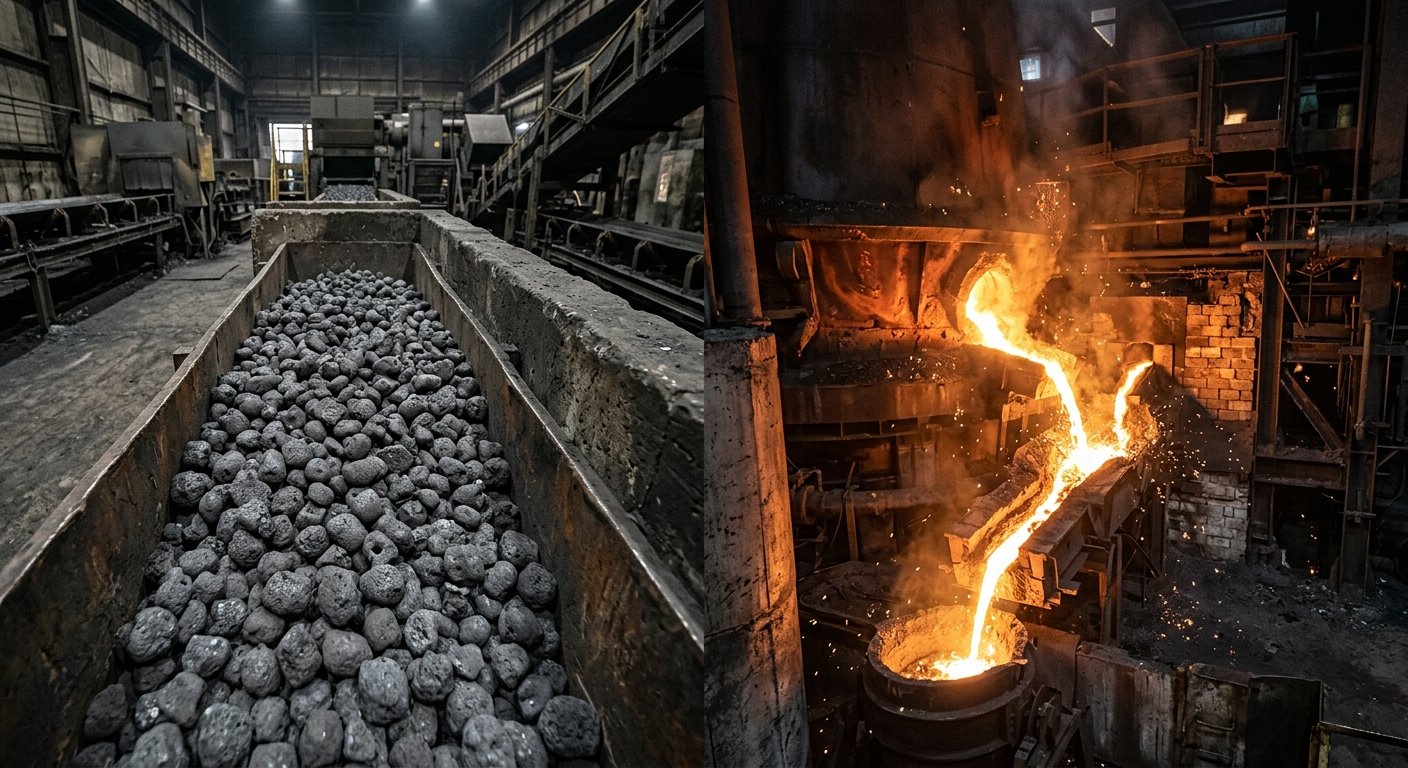
DRI (direct reduced iron, also called sponge iron) is iron ore reduced to solid metallic iron below its melting point, typically at 800-1,050°C, retaining a porous solid form with 90-94% total iron and 0.1-2.5% carbon. Blast furnace pig iron is produced by fully melting iron ore and metallurgical coke at approximately 1,450-1,500°C, yielding liquid iron containing 3.5-4.5% carbon [1][2]. They feed different downstream furnaces: DRI feeds electric arc furnaces (EAF) as a scrap substitute; pig iron feeds basic oxygen furnaces (BOF) in integrated steelworks. For background on how sponge iron is made, see the sponge iron production process guide.
| Property | DRI / Sponge Iron | Blast Furnace Pig Iron |
|---|---|---|
| State at production | Solid | Liquid (~1,450°C) |
| Process temperature | 800-1,050°C | 1,450-1,500°C |
| Carbon content | 0.1-2.5% (route-dependent) | 3.5-4.5% |
| Total iron content | ~90-94% | ~92-95% |
| Sulphur | 0.02-0.06% | 0.01-0.05% (after desulphurisation) |
| Reductant | Non-coking coal or reformed natural gas | Metallurgical coke |
| Downstream furnace | Electric arc furnace (EAF) | Basic oxygen furnace (BOF) |
| CO2 intensity | 800-1,900 kg CO2/t (route-dependent) [3] | ~1,800-2,000 kg CO2/t steel [4] |
| Typical unit capacity | 50-500 TPD (rotary kiln); up to 2.5 Mt/y (shaft furnace) | 1-4 Mt/y per blast furnace |
Sources: [1][2][3][4]. Route details and capacity data from Midrex 2024 World DRI Statistics and standard steelmaking references.
The key structural difference is that DRI bypasses the melting step entirely. The iron ore is heated in a reducing gas atmosphere until the oxygen is stripped from the iron oxides, but the material never becomes liquid. The product is a porous, sponge-like solid that retains the physical shape of the ore pellet or lump but is now predominantly metallic iron. Why it is called sponge iron is a direct consequence of this microstructure.
The blast furnace, by contrast, uses the carbon from coke to both reduce and melt the iron ore. The molten iron picks up 3.5-4.5% carbon from the coke, which lowers the melting point of the iron to approximately 1,150-1,200°C (from 1,538°C for pure iron), enabling continuous tapping as liquid pig iron. This high carbon content is why pig iron must be refined in a BOF before becoming steel: the converter blows oxygen through the liquid metal to oxidise the excess carbon down to steel carbon levels.
Reductant chemistry: where the carbon goes
The reductants are different in kind, not just degree. A blast furnace runs on metallurgical coke, a hard, porous, low-volatile carbon made by destructive distillation of coking coal at around 1,100 C. The coke does three jobs simultaneously inside the stack: it supplies CO by partial combustion at the tuyeres (2C + O2 to 2CO), it physically supports the burden so gas can flow upward through the column, and it dissolves into the liquid iron at the hearth to give the pig iron its 3.5-4.5% carbon. Direct reduction does none of this with coke. A coal-based rotary kiln burns ordinary non-coking coal in a sub-stoichiometric atmosphere to generate CO that reacts with iron oxide pellets sitting in the same kiln; a gas-based shaft furnace reforms natural gas into a mix of roughly 55% H2 and 35% CO that flows counter-current to a descending pellet bed [2]. The hydrogen route is significant because the only by-product of Fe2O3 reduction by H2 is water vapour, which is what makes hydrogen-based DRI the headline low-carbon pathway for primary steelmaking [5].
Product form and what it forces downstream
Because pig iron leaves the blast furnace as a liquid at around 1,450 C, the downstream process is already committed: torpedo cars carry it directly to a basic oxygen converter, where it is decarburised within minutes. There is no warehouse stage, no trading, no transport other than within the plant. DRI is the opposite. The product is a solid pellet, lump, or hot briquette that can be cooled, stored, blended with scrap, and charged into an EAF on a steelmaker's own schedule. Hot DRI (HDRI) can be conveyed at around 600-700 C directly into an adjacent EAF for an energy saving of roughly 120-150 kWh per tonne of steel, but the option of cold DRI or HBI means a DRI-EAF plant is far less geographically captive than a blast-furnace-BOF complex.
Scale, geography, and CO2 footprint
Capacity rules out direct substitution at any given site. A modern blast furnace produces 1-4 Mt of hot metal per year per unit, with the largest reaching around 5 Mt/y; a Midrex or ENERGIRON shaft furnace tops out at around 2.5 Mt/y, and coal-based rotary kilns run at 50-500 TPD, or roughly 18,000-180,000 t/y. Integrated steelworks therefore tend to be large coastal sites; DRI plants are far more modular and run economically at one to two orders of magnitude smaller. Geography reflects this: blast furnaces dominate in China, Japan, Korea, and legacy European steelmaking regions where coking coal and iron-ore supply chains were built around the integrated route. DRI dominates where natural gas is cheap or where coking coal is scarce: India (54.7 Mt in 2024, mostly coal-based rotary kiln), Iran (around 33 Mt, gas-based shaft), and the MENA region, with growing investment in North America for gas-based plants.
CO2 intensity follows the reductant. The blast furnace-BOF route emits approximately 1,800-2,000 kg CO2 per tonne of steel [4]. Coal-based DRI sits at 1,391-1,880 kg CO2 per tonne of DRI; gas-based DRI at 815-1,160 kg CO2 per tonne of DRI [3]. Hydrogen-based DRI cuts this by approximately 97% relative to the blast-furnace route [5], which is why the announced low-carbon-steel projects in Sweden, Germany, and the Gulf are all building shaft furnaces designed to accept progressively higher H2 fractions in the reducing gas. The coal-based vs gas-based DRI comparison breaks down the route-by-route emissions in more detail, and the upstream physics of why the product is porous is in why is sponge iron called sponge.
Common questions about this topic
No. DRI (direct reduced iron, also called sponge iron) is produced below the melting point as solid metallic iron with low carbon content (0.1-2.5%). Pig iron is produced in a blast furnace by fully melting iron ore and metallurgical coke at approximately 1,500°C, yielding liquid iron with 3.5-4.5% carbon [1][2]. DRI is an EAF scrap substitute; pig iron is an integrated steelmaking intermediate charged to a basic oxygen furnace. The metallurgical industry uses both, but in structurally different plant configurations.
DRI has a lower carbon footprint than blast furnace pig iron, though the gap varies by DRI route. The blast furnace-BOF route emits approximately 1,800-2,000 kg CO2 per tonne of steel [4]. Coal-based DRI (rotary kiln) emits roughly 1,391-1,880 kg CO2/t-DRI; gas-based DRI (MIDREX or ENERGIRON shaft furnace) emits 815-1,160 kg CO2/t-DRI [3]. Hydrogen-based DRI can reduce emissions by approximately 97% relative to the blast furnace route, making it the primary near-zero-emissions pathway for primary steelmaking [5]. The coal-based vs gas-based DRI comparison sets out the emissions differences between the two direct reduction routes in detail.
In a blast furnace, metallurgical coke dissolves into the liquid iron, raising carbon content to 3.5-4.5%. In direct reduction, the reductant (coal or reformed natural gas) reacts with iron oxide to produce metallic iron without melting; the solid product picks up far less carbon. Coal-based sponge iron from rotary kilns typically contains 0.08-0.2% carbon [2]. Gas-based DRI (Midrex, ENERGIRON) can be intentionally carburised to 1.5-2.5% carbon in the lower shaft during the cooling stage, making it more valuable as an EAF fuel input, but even at 2.5% it remains far below blast furnace pig iron carbon levels.
Yes, and this is its primary commercial role. DRI is used as a direct scrap substitute in EAF steelmaking, typically at 30-100% DRI charge fractions depending on product quality requirements. DRI contains 90-94% total iron, comparable to high-grade steel scrap, and its low residual tramp element content (copper, tin, chromium) makes it particularly valuable for producing high-quality flat products where scrap-contamination thresholds apply [2]. For large-volume EAF operators, DRI availability is more predictable than high-grade scrap availability, and the consistent chemical composition simplifies heat-to-heat process control.
Sources
- Wikipedia, *Pig iron*, citing standard steelmaking references for composition and process temperatures
- IspatGuru, *Direct Reduced Iron and its Production Processes*
- Biswas, S. et al., *Comparative life cycle assessment of natural gas and coal-based directly reduced iron (DRI) production: A case study for India*, Journal of Cleaner Production, 2022
- World Steel Association, *Steel's Contribution to a Low Carbon Future and Climate Resilient Societies*, World Steel Association, Brussels
- Midrex Technologies, *Ultra-Low CO2 Ironmaking: Transitioning to the Hydrogen Economy*
Related Articles
Discuss Your Sealing Requirements
Our engineering team can help identify the right sealing solution for your application.
Contact Engineering Team“Wherever high-temperature rotary kilns operate under controlled atmosphere, Oswal sealing systems ensure energy efficiency and process stability.”