
Lime Kiln Sealing: Industry Guide
Lime Industry
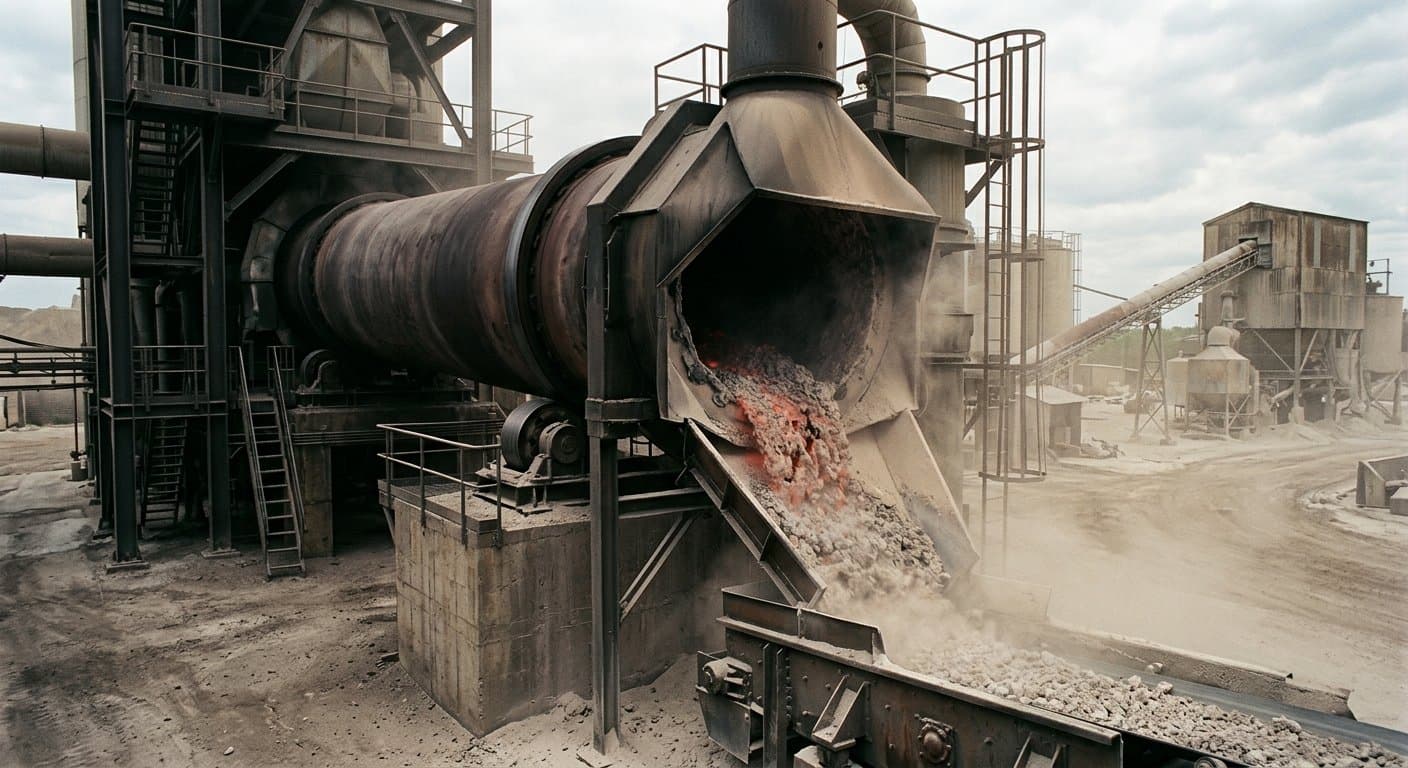
A lime plant needs a kiln seal that controls false air at the inlet and discharge hoods of a rotary calcining kiln running at 900-1,200°C under a heavily dusty, abrasive load. The atmosphere in lime calcination is oxidising, so false air is an efficiency and CO₂-purity problem rather than a product-destroying one; the sealing target is low, stable leakage and long wear life against fine quicklime dust. Because rotary lime kilns are highly endothermic and fuel-intensive, every percent of false air a seal admits is heat the burner must replace, which makes inlet and outlet sealing a direct lever on lime calcination energy cost.
The lime industry use case for kiln sealing
In a lime plant, the kiln seal protects the heat balance of a process that is intrinsically fuel-heavy. Limestone calcination is strongly endothermic, requiring roughly 1,784 kJ per kg of CaCO₃ decomposed, and a rotary lime kiln typically consumes on the order of 1,200 kcal per kg of quicklime produced [1]. Any false air drawn through a worn seal adds parasitic load to that already-high demand, because the air must be heated to calcining temperature and then carried out of the stack.
The seal also protects product and emissions. Air leakage at the hoods disturbs the draft and temperature profile, which can leave under-calcined cores or over-burn the lime surface, and it dilutes the kiln off-gas, which matters where the CO₂ stream is captured or used. For the upstream process detail, see quicklime production, and for the kiln-type decision that frames the sealing duty, vertical shaft versus rotary lime kilns.
The kiln process chain in lime calcination
The lime calcination process chain preheats limestone or dolomite, calcines it in the high-temperature zone, and cools the quicklime, with the kiln seals bracketing the calcining zone at the inlet and discharge ends. In a preheater-equipped rotary lime kiln the stone is heated to around 900°C by ~1,150°C kiln flue gas and reaches roughly 30% decomposition before it enters the kiln proper [1].
| Stage | Reaction / function | Approximate temperature |
|---|---|---|
| Preheater | Limestone heated by kiln off-gas; partial decomposition | up to ~900°C [1] |
| Calcining zone (rotary kiln) | CaCO₃ → CaO + CO₂ (quicklime); MgCO₃·CaCO₃ for dolomite | 900-1,200°C [1] |
| Cooler | Quicklime quenched, combustion air preheated | 1,000°C down to ~100°C |
The core reaction is direct calcination: CaCO₃ decomposes to CaO (quicklime) and CO₂ once the stone is held above ~900°C. The calcination of dolomite follows the same pattern for the combined calcium-magnesium carbonate. The kiln inlet seal sits at the feed/preheater transition and the outlet seal at the cooler hood; both are under draft and both leak air if the contact face is worn. Complete, uniform calcination depends on a stable temperature profile, which depends in turn on draft control, which depends on sealing.
Sealing requirements specific to the lime industry: temperature, atmosphere, dust profile
Lime kiln sealing requirements are set by sustained high temperature, an oxidising atmosphere, and an unusually fine, abrasive, chemically active dust. Quicklime (CaO) dust is finer and more reactive than clinker dust, and it is hygroscopic, so seal faces in a lime kiln face both abrasion and chemical attack.
False air in lime calcination: atmospheric air entering the kiln through worn seals or hood gaps instead of the controlled combustion-air path. It raises specific fuel consumption, disturbs the calcining temperature profile, and dilutes the CO₂-bearing off-gas.
The governing conditions:
- Temperature. The calcining zone runs 900-1,200°C [1], so the high-temperature interfaces need graphite-based sealing elements rated for continuous service in that band, with tolerance for the thermal cycling of stops and starts.
- Atmosphere. Oxidising, like cement, so the seal target is stable low leakage rather than zero oxygen ingress. The benefit of tighter sealing is fuel saved and a cleaner CO₂ stream, not protection of the product chemistry.
- Dust. Fine quicklime dust is abrasive and reactive; abrasion-resistant construction and a controlled contact-pressure mechanism keep leakage stable as the seal wears. Dolomite operations add magnesium oxide dust with similar handling demands.
- Movement. As with any rotary kiln, the shell expands radially and floats axially, so the seal must compensate for both while holding contact against the fine dust.
The trade-off mirrors cement: a lamella seal follows shell movement well but is more exposed at sustained high temperature, while graphite handles the heat but resists dynamic compensation. Lime kilns with significant movement or frequent campaigns are usually best served by a hybrid that provides both.
Recommended Oswal products for the lime industry
The primary match for a rotary lime kiln is the Duplex Kiln Sealing System, which pairs lamella movement compensation with graphite high-temperature sealing in one assembly and is listed for lime kilns among its typical applications [2]. The feed and discharge interfaces are covered by the Kiln Inlet Sealing System and Kiln Outlet Sealing System, the latter built for abrasion resistance and thermal-shock tolerance under heavy dust. At component level, Graphite-Based Sealing Elements handle the high-temperature zone, High-Temperature Radial Seals maintain circumferential contact against shell expansion, and Axial Compensation Seals absorb kiln float. For a whole-kiln approach to leakage, see Integrated False Air Control.
Lime industry application examples
In rotary lime kilns we have assessed, the discharge-hood seal is usually the first to degrade, because it combines the highest temperatures with the most reactive dust. A common pattern: a kiln commissioned at low measured leakage drifts upward over a campaign as fine quicklime abrades the outlet seal face, raising specific fuel consumption on an already fuel-intensive process. Restoring the outlet seal recovers the lost heat and steadies the calcining profile.
A second recurring case is dolomite operation, where the combined calcium-magnesium dust load and the slightly different thermal profile accelerate seal-face wear relative to straight limestone. Operators running calcination of dolomite on a kiln originally specified for limestone often find the seal-replacement interval shortens, which a higher-durability graphite-and-lamella assembly addresses. A third pattern is under-calcination traced to inlet-seal leakage: air entering near the feed end cools the early calcining zone, leaving partially reacted cores that show up as low available-lime content in the product.
Sources
- Lime calcination plant references / preheater rotary lime kiln process data, *Limestone rotary kiln calcination temperatures and heat consumption*, 2023-2024. https://limecalcinationplant.com/limestone-rotary-kiln/ and https://agicoengineering.com/lime-calcination-plant/quick-lime-production/
- Oswal Industries, *OSWAL Kiln Seals product catalogue* and *Duplex Kiln Sealing System catalogue*, 2024 (product specifications and typical applications).
Frequently Asked Questions
Common questions about kiln sealing in the lime industry.
False air at the feed end of a lime kiln cools the back section below the calcination threshold, producing soft-burned underreacted lime that fails reactivity specifications. False air at the discharge end disrupts burning uniformity, producing inconsistent lime quality across batches. Tight kiln sealing is one of the strongest levers for calcination quality control.
The Oswal Duplex Kiln Sealing System is the recommended primary configuration for most lime kilns, particularly the longer building-lime and chemical-grade installations. Shorter recovery-cycle kilns may use a simpler inlet-plus-outlet pair. The Engineering Consulting & Audit service quantifies the false air baseline before recommending a configuration.
Yes. Oswal sealing systems are engineered for retrofit installation on existing lime kilns without structural modification. Typical retrofit install is 7-10 days during a scheduled shutdown. A pre-install dimensional survey confirms fit. Payback on retrofit seal upgrades in lime applications is typically 6-18 months from fuel savings alone.
Lime Industry Sealing Inquiry
Share your kiln configuration and operating conditions with our engineering team.
Request a Quote“Wherever high-temperature rotary kilns operate under controlled atmosphere, Oswal sealing systems ensure energy efficiency and process stability.”