
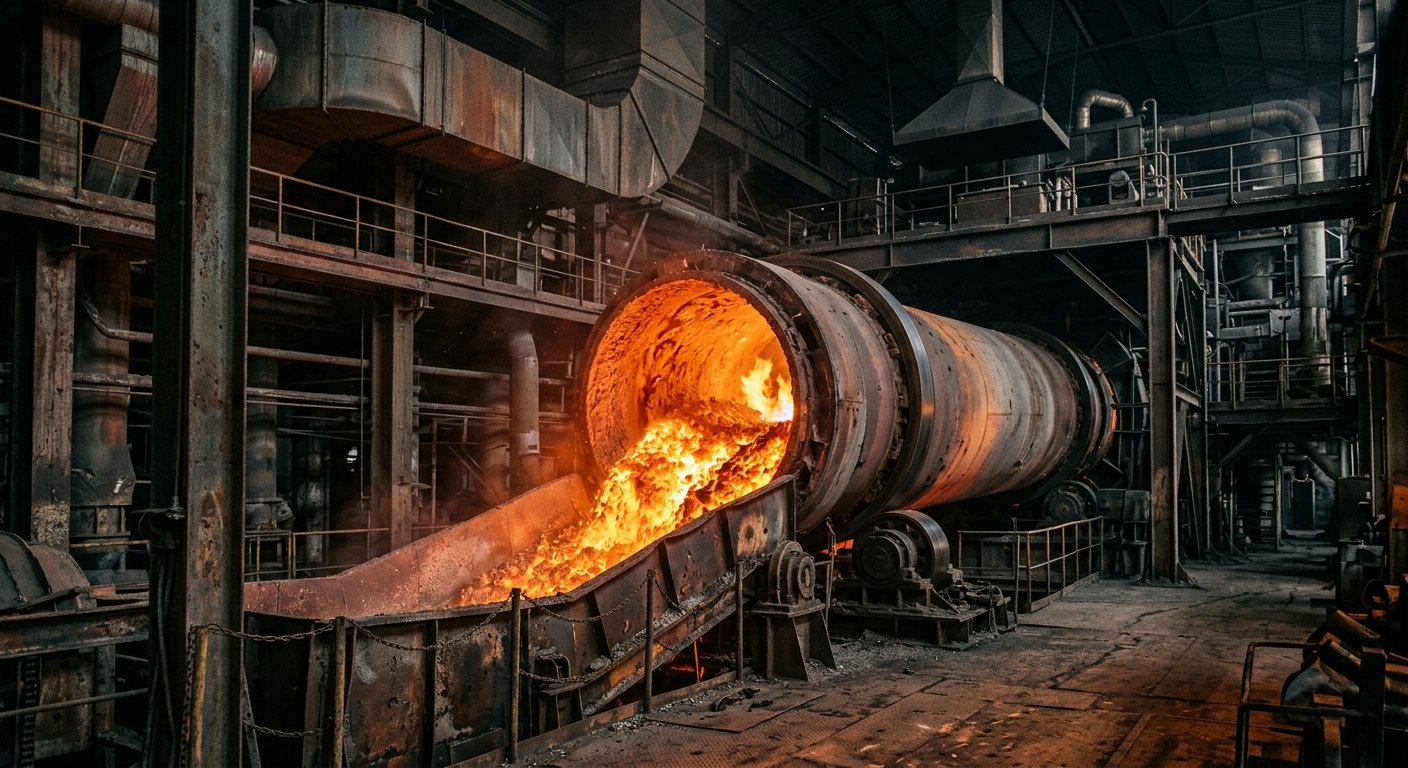
Quicklime Production: From Limestone to CaO
Quicklime: limestone calcination at 900-1100°C, the CaCO3->CaO reaction, energy (~3.2 GJ/t CaO), reactivity grades, and hydration to slaked lime.
Quicklime (calcium oxide, CaO) is produced by heating limestone (calcium carbonate, CaCO3) in a kiln at 900-1100°C until carbon dioxide is driven off, leaving a reactive solid used in steel, paper, water treatment, and environmental applications. The process is called calcination; it is strongly endothermic, consumes approximately 3.17-3.20 GJ per tonne of CaO at the theoretical minimum, and releases a fixed quantity of CO2 regardless of kiln type or fuel. Understanding the chemistry, energy demand, and the temperature-reactivity relationship is the foundation for any lime process engineering decision.
What is quicklime and how is it made?
Quicklime is calcium oxide, an alkaline solid produced by thermally decomposing limestone. The feedstock is quarried limestone; high-calcium limestone (above 95% CaCO3) yields quicklime with CaO content typically 93-98%. Dolomitic limestone (CaMg(CO3)2) yields a mixed calcium-magnesium oxide product (dolime), used in steel and refractory applications.
The United States produced approximately 16 million tonnes of quicklime and hydrated lime in 2024, valued at about $3.2 billion, placing lime consistently among the top ten mineral commodities by value [1]. Steel manufacturing, chemical and industrial processing, and flue gas treatment are the three largest end-use sectors in the US market [1].
For the full scope of lime industry applications and the engineering environments where quicklime is consumed, the industry page maps end-use sectors to the specific lime grade each requires.
Quicklime (calcium oxide, CaO): the product of limestone calcination; a white-to-grey reactive solid with a bulk density of 800-1,100 kg/m3 and a melting point of 2,613°C. Reacts exothermically with water to form calcium hydroxide (slaked lime). CaO content in commercial quicklime typically ranges from 90% to 98% depending on limestone purity and calcination conditions.
The calcination reaction: CaCO3 to CaO
The calcination of limestone is a strongly endothermic decomposition reaction in which calcium carbonate absorbs heat and releases carbon dioxide, leaving calcium oxide.
CaCO3 (s) -> CaO (s) + CO2 (g) delta H = +178 kJ/mol
- CaCO3: calcium carbonate (limestone feedstock), molecular weight 100.09 g/mol
- CaO: calcium oxide (quicklime product), molecular weight 56.08 g/mol
- CO2: carbon dioxide (gaseous by-product), molecular weight 44.01 g/mol
- delta H: standard reaction enthalpy; positive sign indicates heat must be supplied (endothermic)
On a per-kilogram basis, the enthalpy of calcination works out to 178 kJ/mol / 0.10009 kg/mol = approximately 1,778 kJ per kg of CaCO3 decomposed [2][3]. Expressed on a product basis: 178 kJ/mol / 0.05608 kg/mol CaO = approximately 3,174 kJ/kg CaO, or 3.17 GJ/t CaO. This is the thermodynamic floor for pure calcite; no kiln can consume less heat per tonne of product while still driving the reaction to completion.
Stoichiometry also fixes the CO2 release: 44.01 g/mol CO2 / 56.08 g/mol CaO = 0.785 kg CO2 per kg CaO for pure high-calcium limestone. This is an irreducible process emission, released by the chemical reaction itself, independent of which fuel the kiln burns. Total Scope 1 lime plant emissions, including fuel combustion, are typically 1.0-1.2 t CO2/t CaO. The cement calcination process follows the same chemistry; the cement calciner explained piece covers how cement plants manage this decomposition step at scale.
Energy of calcination: theoretical vs actual
The theoretical energy requirement for limestone calcination is approximately 3.17-3.20 GJ/t CaO for pure calcite feedstock. Actual kiln energy consumption is higher due to heat losses: exhaust gases leave at elevated temperature, kiln walls radiate heat, and the product exits carrying sensible heat [4][5].
| Basis | Energy (GJ/t CaO) | Notes |
|---|---|---|
| Theoretical minimum (pure calcite) | ~3.17-3.20 | Calcination endotherm only; zero losses |
| PFR / twin-shaft kiln (best commercial) | ~2.9-3.6 | Regenerative heat exchange; best-in-class at ~2.93 GJ/t [2] |
| Annular shaft kiln | ~3.6-4.5 | Intermediate; wider fuel flexibility than PFR |
| Rotary kiln with preheater | ~4.5-6.0 | Higher losses from rotating geometry and seal air ingress |
| Long rotary kiln (no preheater, legacy) | ~7.0-10.0 | Historical baseline; largely replaced |
Sources: EuLA kiln types [5]; Cimprogetti LimeCon2016 paper [2]; Howtopedia lime energy guide [4]; Wikipedia Lime kiln [6]. Actual figures depend on limestone purity, stone size, moisture, and kiln condition.
For dolomite (CaMg(CO3)2), the theoretical minimum is approximately 3.02 GJ/t mixed oxide product because the MgCO3 decomposition enthalpy is lower than CaCO3 [4]. The overall ranking of kiln types remains the same.
For a detailed breakdown of which kiln type to select for a given feedstock and product specification, see vertical shaft vs rotary lime kilns.
Calcination temperature and product reactivity
Calcination temperature is the single strongest predictor of quicklime reactivity: lower burning temperatures (900-1000°C) yield softer, highly reactive lime, while higher temperatures (above 1100°C) produce harder, denser lime with lower reactivity [7].
Reactivity is measured commercially by the t60 slaking test (EN 459-2): 600 g of CaO added to 2.5 L of water at 20°C; the time in seconds for the suspension to reach 60°C is the t60 figure. Lower t60 means higher reactivity.
| Reactivity grade | Calcination temperature | t60 (EN 459-2) | Typical end use |
|---|---|---|---|
| Very high (soft-burned) | 900-1000°C | under 3 min | Steel desulfurisation, water treatment |
| High | 1000-1100°C | 3-8 min | Flue gas treatment, paper making |
| Medium | 1100-1200°C | 8-25 min | Construction, soil stabilisation |
| Low (hard-burned) | above 1200°C | above 25 min | Refractory, certain chemical uses |
Source: composite of peer literature on calcination temperature and reactivity [7][8]. t60 thresholds are typical ranges; specific specifications vary by end user and application.
The mechanism is microstructural. At lower calcination temperatures, CaO crystals are small and porous, presenting a large surface area for hydration or gas-phase reactions. At higher temperatures, sintering reduces porosity and causes crystal growth, lowering surface area and reactivity. Limestone impurities (silica, magnesium, iron) also affect the result: a less pure limestone calcined at 1000°C may have lower reactivity than a high-purity limestone calcined at the same temperature.
Calcination begins at approximately 780°C for pure calcite under atmospheric CO2 partial pressure, but commercial kilns operate at 900-1100°C to achieve complete decomposition of the stone interior at practical throughput rates [3]. Residence time at temperature interacts with temperature: prolonged dwell at 1000°C will progressively sinter the product toward medium-reactivity grades.
From quicklime to slaked lime: the hydration step
Slaked lime (calcium hydroxide, Ca(OH)2) is produced by adding water to quicklime in a controlled hydration step. The reaction is exothermic and releases significant heat.
CaO (s) + H2O (l) -> Ca(OH)2 (s) delta H = -65 kJ/mol (exothermic)
- CaO: quicklime feedstock
- H2O: water, added in controlled proportion
- Ca(OH)2: calcium hydroxide (slaked lime / hydrated lime)
- delta H: negative sign indicates heat is released; the reaction can raise local temperatures above 100°C if water is added too rapidly or in insufficient quantity
Industrial hydrators control the water-to-lime ratio and temperature profile precisely. Under-hydration leaves residual CaO in the product; over-hydration yields lime putty or milk of lime (Ca(OH)2 in aqueous suspension) rather than dry powder. Modern automated hydrators produce a fine, uniform dry powder with consistent particle size [9].
Product forms:
- Dry hydrated lime (Ca(OH)2 powder): used in FGD systems, water treatment dosing, and soil stabilisation
- Lime slurry / milk of lime: Ca(OH)2 suspension in water, used in chemical processing and paper mills
- Lime putty: high-water-content paste used in traditional construction
Hydrated lime serves different markets than quicklime. Steel plants consume quicklime directly in basic oxygen furnaces and electric arc furnaces. FGD systems and water treatment plants typically use either dry hydrated lime or milk of lime. Understanding which product form is required determines whether a lime plant needs a hydrator in addition to the calcination kiln.
The lime industry page maps these end-use distinctions to the specific Oswal sealing applications relevant to each kiln type in the production chain.
Kiln type and its effect on product quality and operating cost
The type of lime kiln selected sets the ceiling on product reactivity and the floor on fuel cost per tonne of CaO. PFR kilns produce the most consistently reactive lime and operate closest to the 3.17 GJ/t thermodynamic minimum, but require gaseous fuel and uniform, coarse stone. Rotary kilns offer the widest stone-size and fuel flexibility and the widest product reactivity range, but consume 4.5-6.0 GJ/t in properly sealed operation.
For rotary lime kilns, seal quality at the inlet and outlet directly affects the actual GJ/t achieved. False air ingress dilutes combustion gases, increases fan throughput, and pushes the operating point toward the upper end of the 4.5-6.0 GJ/t range or beyond it. For the full kiln-type comparison, including capacity, capex, and fuel flexibility, see vertical shaft vs rotary lime kilns.
Oswal's sealing products, particularly the kiln inlet sealing system, are designed for the rotating-to-stationary interface on rotary lime kilns, where the energy penalty from poor sealing is largest. For the full false-air and seal context in lime plants, see kiln sealing for the lime industry.
Common questions about this topic
Limestone calcination begins at approximately 780°C for pure calcite under atmospheric conditions, but commercial lime kilns operate at 900-1100°C to achieve complete conversion of the stone interior at useful throughput rates [3][7]. Temperatures above 1100°C increase throughput rate but reduce product reactivity by sintering CaO crystals. For the relationship between kiln operating temperature and the reactivity grade of the resulting lime, and for which kiln types best control that temperature, see vertical shaft vs rotary lime kilns.
Quicklime is calcium oxide (CaO), produced directly by limestone calcination. Hydrated lime (also called slaked lime) is calcium hydroxide (Ca(OH)2), produced by adding controlled quantities of water to quicklime in a hydration step. Both are industrially important; quicklime is more concentrated and reactive, but the hydration reaction is exothermic and requires careful handling to avoid burns or fire. For the full range of applications by lime product form and the industries served, see the lime industry overview.
The calcination reaction releases approximately 0.785 kg of CO2 per kg of CaO produced from pure high-calcium limestone, derived from the molar masses of CO2 (44.01 g/mol) and CaO (56.08 g/mol). This is a fixed stoichiometric release driven by the chemistry of the reaction, independent of kiln fuel type or energy efficiency improvements. Additional CO2 from fuel combustion brings total Scope 1 emissions for a typical lime plant to 1.0-1.2 t CO2/t CaO. Reducing fuel consumption per tonne (by improving kiln efficiency or sealing) lowers the fuel-side contribution; the process CO2 from calcination cannot be avoided without carbon capture. For sealing systems that reduce the fuel-consumption component, see kiln sealing for the lime industry and the Oswal products page.
Sources
- U.S. Geological Survey (USGS), *Mineral Commodity Summaries 2026: Lime*
- Cimprogetti, *Evaluating and Predicting Lime Kiln Performance Based on Raw Material Properties and Fuel Characteristics*, presented at LimeCon2016, India, February 2016
- IspatGuru, *Calcination of Limestone*
- Howtopedia, *How to Calculate the Energy Efficiency of your Lime Burning Process*
- European Lime Association (EuLA), *Kiln Types*
- Wikipedia, *Lime kiln*
- Oates, J.A.H., *The Effects of Limestone Characteristics and Calcination Temperature on the Reactivity of Quicklime*, Cement and Concrete Research, 2001
- Piringer, H. et al., *Lime Shaft Kilns*, Energy Procedia, 2017 (reviewed in:
- National Lime Association, *Uses of Lime*
Related Articles
Discuss Your Sealing Requirements
Our engineering team can help identify the right sealing solution for your application.
Contact Engineering Team“Wherever high-temperature rotary kilns operate under controlled atmosphere, Oswal sealing systems ensure energy efficiency and process stability.”