
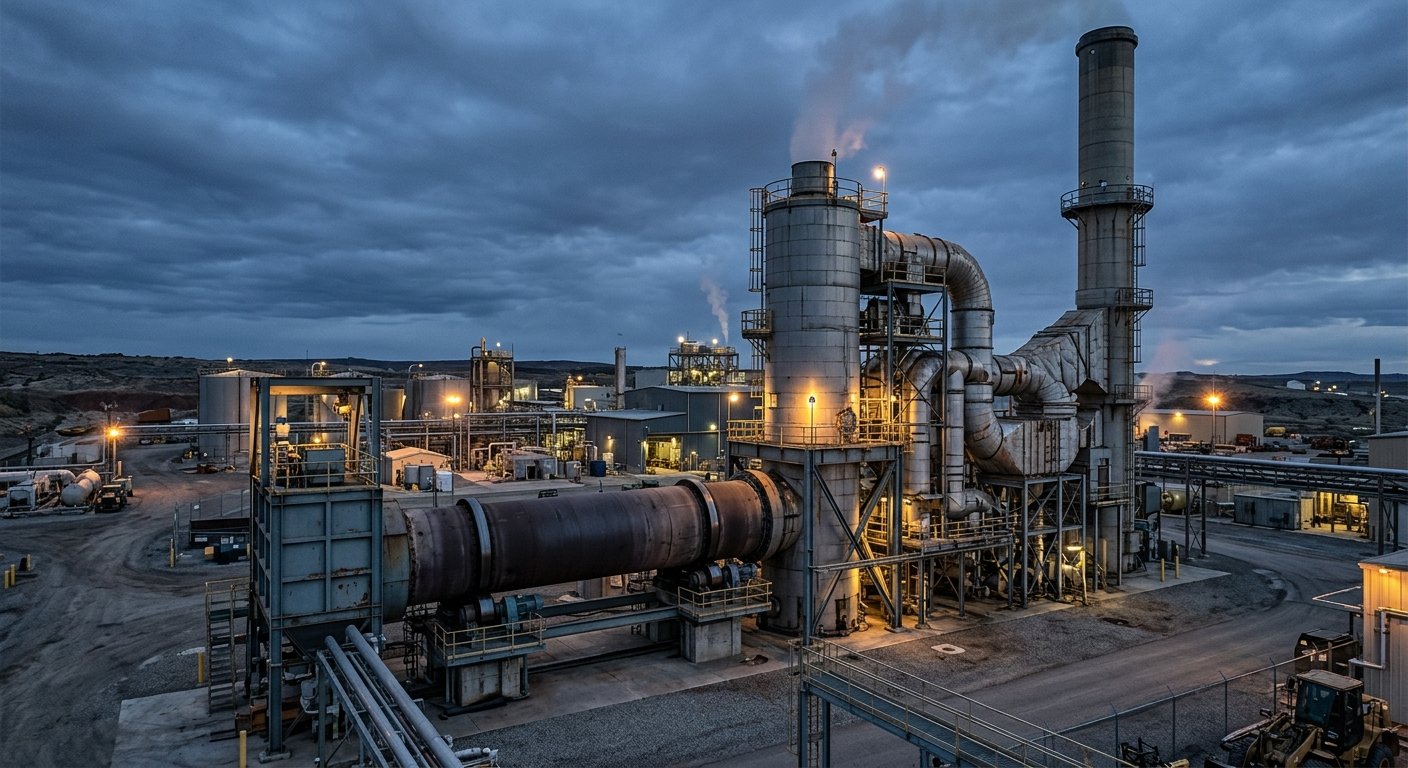
Hazardous Waste Incineration: Process and Compliance
Hazardous waste incineration destroys organic toxins in a rotary kiln plus secondary combustion chamber at 1,100-1,200 C, meeting 99.99% DRE.
Hazardous waste incineration is the controlled high-temperature thermal destruction of wastes that are toxic, flammable, reactive, or persistent, oxidising their organic content to carbon dioxide, water vapour, and inert ash so the hazard is destroyed rather than contained. The workhorse plant is a rotary kiln followed by a secondary combustion chamber, designed to hold flue gas above 1,100 C for at least two seconds and to demonstrate a destruction and removal efficiency of 99.99% or better. This piece covers the process, the destruction-efficiency standard, the air pollution control train, and the compliance frameworks that govern it on three continents.
What is hazardous waste incineration?
Hazardous waste incineration is a thermal treatment that destroys organic hazards by oxidation at 850-1,200 C, used for wastes that cannot be safely recycled or landfilled: persistent organic pollutants (POPs), polychlorinated biphenyls (PCBs), halogenated solvents, pesticides, pharmaceutical and laboratory waste, off-spec chemicals, and PCB- or dioxin-contaminated soils. The governing principle is destruction, not dilution; the organic molecule is broken down, not buried.
This piece is about purpose-built hazardous waste incinerators, which are distinct from two adjacent technologies that share the word "incineration." Municipal solid waste (MSW) mass-burn plants use moving-grate furnaces and recover energy from a high-volume, lower-hazard feed; that vertical is covered separately in waste-to-energy plants. Clinical and medical waste units handle a narrower, more uniform stream. Hazardous waste incineration is built around a heterogeneous, high-hazard feed and the strictest destruction requirements of the three.
Hazardous waste incineration: the controlled, high-temperature (typically 850-1,200 C) oxidation of toxic, flammable, reactive, or persistent waste to convert its organic hazardous content into carbon dioxide, water, and mineral ash, operated to a regulated destruction and removal efficiency rather than to a simple "burn it" standard.
The feed is diverse: drummed liquids, sludges, contaminated solids, soils, and packaged laboratory waste. That heterogeneity is why the rotary kiln, which tolerates mixed solid and liquid feed, is the dominant front-end technology rather than a fixed grate.
How a hazardous waste incinerator works
The standard configuration is a rotary kiln followed by a secondary combustion chamber (SCC): the kiln volatilises and partially burns the waste at 850-1,000 C, and the SCC completes oxidation of the off-gases at 1,100-1,200 C [1][2]. The kiln converts a difficult solid/sludge feed into a hot gas stream plus ash; the SCC guarantees the gas-phase organics are fully destroyed.
The rotary kiln is a refractory-lined steel cylinder, inclined a few degrees and rotating slowly so the waste bed tumbles toward the discharge end. Slow rotation exposes fresh surface to the flame, which is what lets the kiln handle drummed and packaged waste a grate cannot. Ash discharges at the lower end; the off-gases pass forward to the SCC, where over-fire air is injected tangentially to create a strong vortex and an auxiliary burner holds the chamber above its temperature floor regardless of the incoming gas's heating value [1]. The SCC is where dioxin and PCB destruction is actually secured, because it is the only place in the system where temperature, residence time, and turbulence are all controlled to specification.
Secondary combustion chamber (SCC): the afterburner downstream of the rotary kiln in which kiln off-gases are held above 1,100 C, with excess oxygen and forced turbulence, for a minimum gas residence time (commonly two seconds) to complete the destruction of organic hazards including dioxins and PCBs.
The three-T rule: temperature, time, turbulence
Complete destruction of organic hazards depends on three coupled parameters, the "three Ts": temperature, time, and turbulence. The widely applied design and permit anchor is a flue-gas temperature above 1,100 C held for a minimum residence time of two seconds in the high-temperature zone, with 6-10% excess oxygen to ensure complete oxidation [1][2].
- Temperature. SCC operating band 1,100-1,200 C. Below ~1,100 C, destruction of the most refractory organics (including dioxins and PCBs) becomes unreliable.
- Time. A minimum gas residence of 2 seconds in the high-temperature zone. The EU raises this floor to two seconds at 1,100 C for wastes containing more than 1% halogenated organics.
- Turbulence. Tangential secondary-air injection and 6-10% excess oxygen, so no pocket of gas escapes the flame envelope unmixed.
The "two-second, 1,100 C" rule is the regulatory backbone for POP and PCB destruction. It is not a comfort margin; it is the condition under which the destruction and removal efficiency standard below can actually be met.
Destruction and removal efficiency (DRE)
Destruction and removal efficiency (DRE) is the regulatory performance metric for organic destruction. US EPA RCRA requires a minimum DRE of 99.99% ("four nines") for each principal organic hazardous constituent (POHC) named in a unit's permit, rising to 99.9999% ("six nines") for dioxin-listed wastes (EPA waste codes F020, F021, F022, F023, F026, F027) and for PCBs above 50 mg/kg [3][4][5].
The formula is a simple mass balance across the incinerator:
DRE = (W_in - W_out) / W_in x 100%
Where:
- W_in. Mass feed rate of a principal organic hazardous constituent (POHC) into the incinerator (kg/h).
- W_out. Mass emission rate of that same POHC in the stack gas after the air pollution control train (kg/h).
- DRE. Destruction and removal efficiency for that POHC, expressed as a percentage.
Destruction and removal efficiency (DRE): the fraction of a principal organic hazardous constituent destroyed and removed between the waste feed and the stack, expressed as a percentage. 99.99% ("four nines") means one molecule emitted for every 10,000 fed; 99.9999% ("six nines") means one per million [4].
Principal organic hazardous constituent (POHC): a specific, hard-to-destroy organic compound named in an incinerator's permit and tracked during the trial burn as the surrogate for destruction performance. DRE is demonstrated against each POHC, not against the waste as a whole.
Worked example. A unit feeding a POHC at 100 kg/h at exactly 99.99% DRE may emit no more than 0.01 kg/h (10 g/h) in the stack. At the 99.9999% standard required for dioxin-listed wastes and high-concentration PCBs, the same feed permits only 0.0001 kg/h (0.1 g/h). The step from four nines to six nines is a hundredfold tightening, which is why six-nines duty drives both the SCC design and the air pollution control train below.
DRE is demonstrated during a trial burn, a witnessed campaign in which the unit burns a feed spiked with the permitted POHCs while the stack is sampled. The EPA mobile incinerator programme, used on PCB- and dioxin-contaminated Superfund sites, ran trial burns to demonstrate six-nines DRE before treating contaminated soils [4].
The air pollution control train
Destroying the organics is only half the job. The flue gas leaving the SCC still carries acid gases, particulate, volatile heavy metals (mercury, cadmium, lead), and trace dioxins that can re-form as the gas cools, so it passes through a multi-stage air pollution control (APC) train before the stack [6]. The order of the stages is deliberate: cool fast, neutralise acids, adsorb the toxics, then filter.
| APC stage | Pollutant targeted | Mechanism |
|---|---|---|
| Quench / rapid cooling | Dioxins/furans (suppresses re-formation) | Water spray or heat exchanger drops gas through the 200-450 C re-formation window quickly, minimising de novo synthesis |
| Acid-gas scrubber (wet or dry) | HCl, HF, SO2 | Alkaline reagent (lime, caustic) neutralises acid gases; wet scrubbers also cool and saturate the gas |
| Activated carbon injection | Mercury, dioxins/furans | Powdered carbon adsorbs gas-phase Hg and residual dioxins; carbon is later captured on the filter |
| Baghouse / fabric filter | Particulate, fly ash, spent carbon | Filter cake on the fabric removes fine particulate and the loaded carbon together |
| SCR / SNCR | NOx | Ammonia or urea reduces nitrogen oxides; SCR is catalytic, SNCR is non-catalytic in the furnace |
De novo synthesis: the re-formation of dioxins and furans from carbon, chlorine, and metal catalysts on fly-ash surfaces as flue gas cools through roughly 200-450 C. Rapid quenching through this window is the primary control, because dioxins destroyed at 1,100 C in the SCC can otherwise re-appear downstream.
Dry APC systems achieve their highest reduction of mercury, dioxins, and acid gases when the gas is cooled to about 150 C or below at the device inlet, which is why the quench step is sized to bring the gas down quickly rather than letting it dwell in the dioxin re-formation band [6]. The combination of high-temperature destruction in the SCC plus rapid quench plus activated carbon is what holds stack dioxin output to the regulatory limits below.
Compliance and emission limits
Hazardous waste incinerators operate under some of the tightest emission limits of any combustion source. The governing frameworks are the US EPA Resource Conservation and Recovery Act (RCRA) together with the Hazardous Waste Combustor MACT standards (40 CFR 63 Subpart EEE), the EU Industrial Emissions Directive (Directive 2010/75/EU, Annex VI), and, internationally, the Basel and Stockholm Conventions.
In the US, RCRA Subpart O sets the DRE standard and requires the unit to remove 99% of hydrogen chloride from the stack gas, or limit HCl to 1.8 kg/h (4 lb/h), whichever is less stringent [3]. The 2005 Hazardous Waste Combustor MACT rule added technology-based limits for dioxins, mercury, particulate, and metals that are in places tighter than RCRA, including a dioxin limit of 0.40 ng TEQ/dscm corrected to 7% oxygen for existing sources [7]. In the EU, Annex VI of the Industrial Emissions Directive sets harmonised daily-average limits for all waste incineration. Internationally, the Basel Convention (190+ parties as of 2024) controls transboundary movement of hazardous waste and publishes the D10 "incineration on land" guidelines [8], while the Stockholm Convention requires POP-containing waste to be destroyed or irreversibly transformed using best available techniques [9].
| Pollutant | Typical limit | Basis |
|---|---|---|
| Organic destruction (POHC) | 99.99% DRE (99.9999% for dioxin-listed wastes and PCB >50 mg/kg) | US EPA RCRA, 40 CFR 264.343 [3][5] |
| Total dust (particulate) | 10 mg/m3 (daily average) | EU IED 2010/75/EU, Annex VI [10] |
| Total organic carbon (TOC) | 10 mg/m3 (daily average) | EU IED Annex VI [10] |
| HCl | 10 mg/m3 (daily average); or 99% removal / 4 lb/h | EU IED Annex VI [10]; US RCRA [3] |
| HF | 1 mg/m3 (daily average) | EU IED Annex VI [10] |
| SO2 | 50 mg/m3 (daily average) | EU IED Annex VI [10] |
| NOx | 200 mg/m3 (daily average, new plants) | EU IED Annex VI [10] |
| CO | 50 mg/m3 (daily average) | EU IED Annex VI [10] |
| Mercury (Hg) | 0.05 mg/m3 | EU IED Annex VI [10] |
| Cadmium + thallium | 0.05 mg/m3 (total) | EU IED Annex VI [10] |
| Sum of other heavy metals (Sb, As, Pb, Cr, Co, Cu, Mn, Ni, V) | 0.5 mg/m3 (total) | EU IED Annex VI [10] |
| Dioxins and furans | 0.1 ng TEQ/m3 (EU); 0.40 ng TEQ/dscm @7% O2 (US existing) | EU IED Annex VI [10]; US MACT 40 CFR 63 Subpart EEE [7] |
EU values are daily averages from IED Annex VI; heavy-metal limits are averaged over a sampling period of 30 minutes to 8 hours. US DRE and MACT figures apply under their respective federal rules. Permit conditions on any specific unit may be stricter than the table.
Commercial operators run to these standards continuously. Clean Harbors operates a TSCA-permitted PCB incinerator at Deer Park, Texas, with trial-burn plans on file with EPA to demonstrate PCB destruction performance [11]; Veolia North America runs a network of commercial hazardous waste incinerators under the same MACT and RCRA frame [12]. The compliance burden is the reason a hazardous waste incinerator is a far more instrumented and controlled plant than an MSW unit of comparable throughput.
Why kiln sealing matters for hazardous waste incinerators
The rotary kiln in a hazardous waste incinerator runs a demanding duty cycle: cyclic reducing and oxidising atmospheres as batches of drummed and liquid waste are charged, 850-1,000 C wall temperatures, abrasive ash, and frequent thermal cycling. That stress concentrates at the seals on the rotating-to-stationary interface at the kiln inlet and outlet. For the full set of applications and sealing requirements across waste streams, see Oswal's waste management kiln sealing applications overview.
On a hazardous waste unit, seal integrity is a compliance issue, not only an efficiency one. False air drawn in through worn seals dilutes the combustion gas, lowers oxygen partial pressure where it is needed, and pulls heat out of the system, which can drop the SCC below its permitted temperature floor or push the unit outside its oxygen window. A unit that cannot hold 1,100 C for two seconds cannot demonstrate its DRE, so a seal problem can become a permit problem.
The abrasive, thermally cycling environment also accelerates wear; the signs of refractory wear operators watch for on cement and lime kilns appear faster on waste-incineration duty, which is why a disciplined kiln seal inspection cadence matters more here than almost anywhere else. Oswal's high-temperature radial seals are designed for this rotating-to-stationary interface under high-temperature, cyclic duty. The rotary kiln itself is covered in more depth in rotary kiln incinerators.
Assessing whether a rotary kiln incinerator is holding its sealing envelope under cyclic high-temperature duty, and quantifying the false-air contribution to a temperature or oxygen excursion, falls within the standard scope of Oswal's engineering consulting service. The methodology is the same on a waste-incineration kiln as on a cement or lime kiln.
Common questions about this topic
A hazardous waste incinerator operates in two stages: the rotary kiln runs at roughly 850-1,000 C to volatilise and partially burn the waste, and the secondary combustion chamber holds the off-gases at 1,100-1,200 C for a minimum residence time of two seconds to complete the destruction of organic hazards including dioxins and PCBs [1][2]. The two-second, 1,100 C condition is the regulatory anchor for persistent-organic-pollutant destruction. For the equipment that delivers this duty cycle, see [rotary kiln incinerators](/it/blog/rotary-kiln-incinerators).
DRE, or destruction and removal efficiency, is the regulated measure of how completely an incinerator destroys a specific organic constituent, calculated as the mass fed minus the mass emitted, divided by the mass fed. US EPA RCRA requires a minimum DRE of 99.99% for each principal organic hazardous constituent in a permit, rising to 99.9999% for dioxin-listed wastes and for PCBs above 50 mg/kg [3][5]. Four nines means one molecule emitted per 10,000 fed; six nines means one per million.
Hazardous waste incineration uses a rotary kiln plus a secondary combustion chamber to destroy toxic, persistent, or reactive wastes to a demonstrated 99.99% or better destruction and removal efficiency, while municipal solid waste (MSW) incineration typically uses a moving-grate mass-burn furnace optimised for energy recovery from a higher-volume, lower-hazard feed. Hazardous waste units carry tighter emission limits, a trial-burn requirement, and the DRE standard that MSW plants do not. The MSW route is covered in [waste-to-energy plants](/it/blog/waste-to-energy-plants).
Dioxins are controlled in two places: first by destruction in the secondary combustion chamber, where holding the flue gas above 1,100 C for two seconds breaks down dioxins and their precursors, and second by suppressing re-formation downstream through rapid quenching of the gas through the 200-450 C window and adsorption on injected activated carbon ahead of the baghouse [6]. The EU limit on stack dioxins is 0.1 ng TEQ/m3 [10]. Both the high-temperature destruction and the rapid cooling depend on the kiln holding its temperature, which is why seal-driven [false air](/it/blog/refractory-wear-signs) is treated as a dioxin-control risk on these units.
Sources
- GEMCO Energy, *Application of Rotary Kiln in Hazardous Waste Incineration*
- ScienceDirect Topics, *Rotary Kiln Incinerator (overview)*
- U.S. Code of Federal Regulations, *40 CFR Part 264 Subpart O, Incinerators (264.343 Performance standards)*
- U.S. EPA, *Hazardous Waste Incinerators* (DRE definition and trial-burn program), February 2000
- U.S. EPA / CLU-IN, *Hazardous Waste Incineration* technical summary (six-nines DRE for F020-F027 and PCB >50 mg/kg)
- National Academies / NCBI, *Waste Incineration and Public Health: Incineration Processes and Environmental Releases* (gas cooling, activated carbon, baghouse)
- U.S. Code of Federal Regulations, *40 CFR Part 63 Subpart EEE, NESHAP for Hazardous Waste Combustors* (MACT dioxin/metals limits)
- Secretariat of the Basel Convention, *The Convention: Overview* (190+ parties; D10 incineration on land)
- UNEP, *Unintentional POPs (UPOPs)* and Stockholm Convention Article 5 / Annex C BAT/BEP
- European Union, *Directive 2010/75/EU on Industrial Emissions, Annex VI* (waste incineration emission limit values)
- U.S. EPA, *Train I Incinerator System TSCA Trial Burn Plan, Clean Harbors Deer Park, LLC*, February 2026
- Veolia North America, *Incineration Services*
Articoli correlati
Discuss Your Sealing Requirements
Our engineering team can help identify the right sealing solution for your application.
Contact Engineering Team“Ovunque i forni rotanti ad alta temperatura operino in atmosfera controllata, i sistemi di tenuta Oswal garantiscono efficienza energetica e stabilità di processo.”