
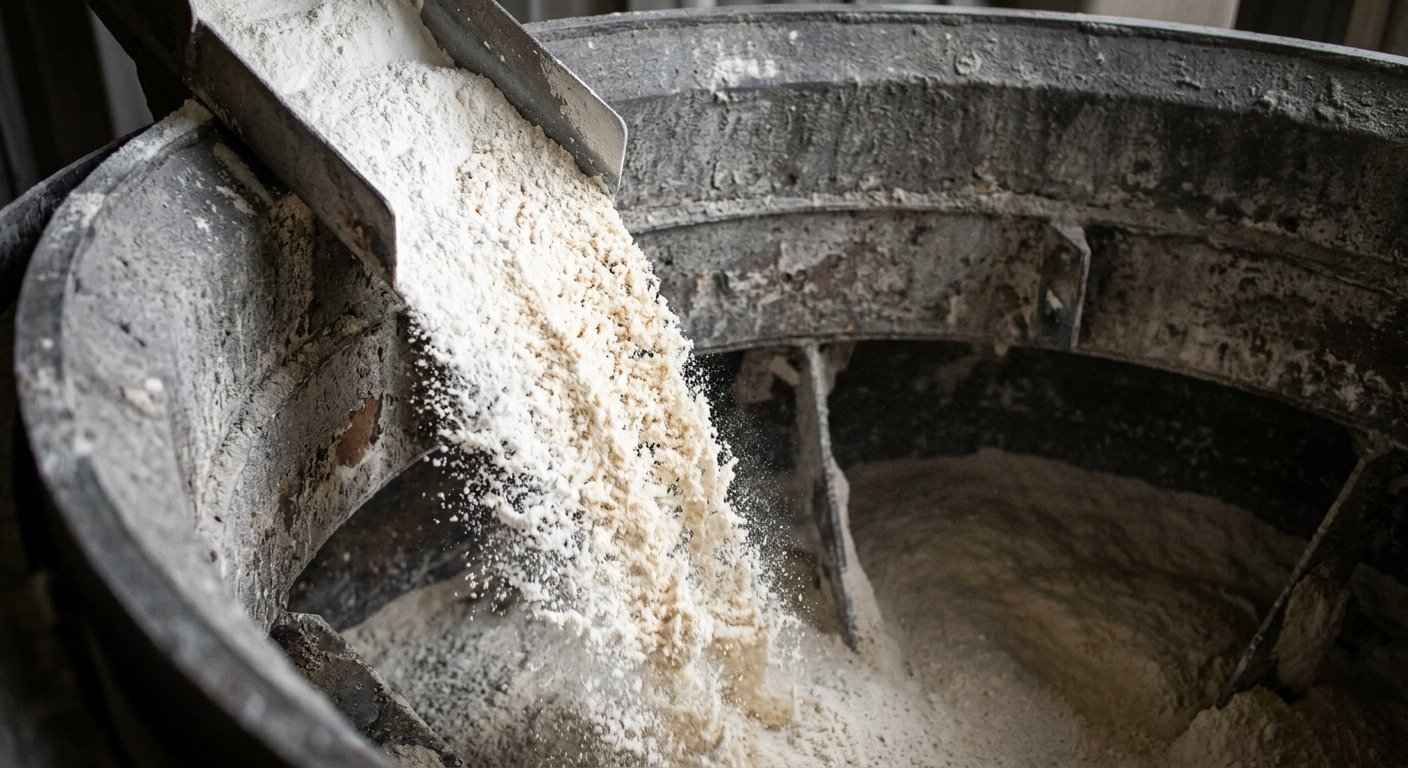
Kaolin Calcination: Process and Products
Kaolin calcination dehydroxylates kaolinite to metakaolin at 500-800 C, then to mullite above 950 C. Process routes, temperatures, and products.
Kaolin calcination is the controlled heating of kaolinite clay to drive off its chemically bound water and, depending on the peak temperature, produce either reactive metakaolin (heated to roughly 500-800 °C) or fully calcined pigment containing mullite (above 950 °C) [1][2]. The feedstock is refined kaolin, also called china clay, with the idealised formula Al₂Si₂O₅(OH)₄. What comes out of the calciner is set by how hot the clay gets, not simply by the act of heating, so kaolin calcination yields two distinct product families from one raw material.
One disambiguation worth making early: calcined kaolin is not calcined bauxite. Calcined kaolin is a refined, low-iron aluminosilicate; calcined bauxite retains the iron and titania of raw bauxite. It is also distinct from the alumina produced via the Bayer process; these minerals sit in adjacent corners of the same supply chain but do not interchange.
Kaolin calcination: the thermal treatment of kaolinite clay (Al₂Si₂O₅(OH)₄) above its dehydroxylation temperature to remove chemically bound water. Partial calcination (~500-800 °C) yields amorphous, reactive metakaolin; full calcination (above ~1,000 °C) yields a mullite-bearing, fully dehydroxylated pigment.
The calcination temperature stages
Kaolin passes through four thermal stages as temperature rises: free-moisture removal below 200 °C, endothermic dehydroxylation to metakaolin at roughly 500-800 °C, an exothermic transition to an aluminium-silicon spinel phase near 925-980 °C, and mullite crystallisation above 1,000 °C [2][3]. Each stage produces a structurally different material, which is why peak temperature is the controlling process variable.
Dehydroxylation is the reaction that makes metakaolin. The hydroxyl groups in the kaolinite lattice leave as water vapour, collapsing the ordered clay structure into an amorphous, highly reactive aluminosilicate:
Al₂Si₂O₅(OH)₄  →  Al₂Si₂O₇  +  2 H₂O
   kaolinite        metakaolin     water vapour
Where:
- Al₂Si₂O₅(OH)₄. Kaolinite, the hydrated aluminosilicate clay mineral that is the principal phase in refined kaolin.
- Al₂Si₂O₇. Metakaolin, the amorphous dehydroxylated phase. It carries no chemically bound water and is pozzolanically reactive.
- 2 H₂O. The chemically bound water removed, roughly 14% of the raw clay mass on full dehydroxylation [4].
Disordered kaolinite dehydroxylates between about 530 and 570 °C; well-ordered kaolinite between about 570 and 630 °C [1]. The most commonly quoted window for producing reactive metakaolin without over-firing is 650-750 °C [1]. Push past dehydroxylation and the metakaolin recrystallises: an exothermic event near 925-980 °C forms an Al-Si spinel phase, and continued heating above 1,000 °C drives the slow crystallisation of mullite (3Al₂O₃·2SiO₂), the stable, refractory end phase [3].
| Stage | Temperature range | Transformation | Product |
|---|---|---|---|
| Drying | below 200 °C | Free and adsorbed moisture removed | Dry kaolinite [2] |
| Dehydroxylation | ~500-800 °C (optimum 650-750 °C) | Endothermic loss of bound water; lattice collapses | Amorphous metakaolin (Al₂Si₂O₇) [1] |
| Spinel formation | ~925-980 °C | Exothermic recrystallisation | Al-Si spinel phase + amorphous silica [3] |
| Mullite formation | above ~1,000 °C | Crystallisation of stable phase | Mullite (3Al₂O₃·2SiO₂) + cristobalite [3] |
Mullite is the phase that gives fully calcined kaolin its hardness, opacity, and chemical inertness; it is also the phase that makes the product abrasive and pozzolanically dead. The metakaolin window and the mullite window therefore serve opposite purposes.
Soft-calcined vs hard-calcined kaolin
Soft-calcined (partially calcined) kaolin is heated to roughly 600-850 °C to make reactive metakaolin; hard-calcined (fully calcined) kaolin is taken to 1,000-1,150 °C to form a mullite-bearing pigment with maximum brightness and opacity [2]. The choice between them is a choice of end product, and the two are not substitutes.
Soft-calcined kaolin retains the amorphous metakaolin structure: reactive, lower in abrasion, valued for pozzolanic chemistry rather than optical performance. Hard-calcined kaolin has passed through the spinel and mullite transitions, so dehydroxylation is complete and brightness and opacity peak, but the harder mullite crystals raise abrasiveness [2]. Fully calcined pigments for low-wear uses are often caustic-leached to remove silica and bring abrasion back down [2].
| Type | Peak temperature | Dominant phase | Primary use |
|---|---|---|---|
| Soft-calcined (partial) | ~600-850 °C | Amorphous metakaolin | Pozzolanic SCM, geopolymer feed [2] |
| Hard-calcined (full) | ~1,000-1,150 °C | Mullite + amorphous silica | Pigment, functional filler, refractory grog [2] |
Calcination routes: rotary kiln vs flash calciner
Two industrial routes dominate kaolin calcination: the rotary kiln, a long soak with residence times measured in minutes to hours, and the flash calciner, where finely milled clay is heated in a hot gas stream for seconds. Flash calcination consumes less energy per tonne than rotary or soak calcination and yields metakaolin with higher reactivity and lower water demand, partly because 10-15% of the particles emerge as fused spheres and the product does not need post-calcination crushing [5].
The rotary kiln remains the established route for pigment-grade calcination, where long residence and controlled temperature profiles deliver consistent brightness. Flash calcination has taken share in the calcined-clay-for-cement market on reactivity and energy cost, and comparative concrete trials show flash-calcined metakaolin giving better workability and strength than rotary-calcined metakaolin at the same dosage [5]. Both routes run the same equipment class as a cement or lime kiln, which is why calciner seal integrity matters: false air drawn in at the inlet or outlet seal increases the gas volume the system must heat, raising specific fuel consumption. Oswal's mineral-processing kiln sealing work covers this equipment class, alongside the calciners used in alumina refinery operations.
Products and applications of calcined kaolin
Calcined kaolin serves two product families: fully calcined pigment used in paper, paint, fiberglass, plastics, and refractories; and metakaolin used as a pozzolanic supplementary cementitious material in concrete [2][6]. The split traces directly back to calcination temperature.
Fully calcined pigment is valued for brightness, opacity, and controlled particle structure. In paper it works as a coating and filler; in paint and plastics it extends titanium dioxide and improves opacity; in fiberglass and E-glass it supplies the alumina and silica of the glass batch; in refractories it serves as a low-iron grog. In the United States, kaolin uses split to roughly 52% fillers, extenders, and binders and 25% ceramics, with around 1.6 million tonnes exported in 2025 mainly as paper coating and filler [6].
Metakaolin, the soft-calcined product, is a high-reactivity pozzolan. It reacts with the calcium hydroxide (Ca(OH)₂) released during cement hydration to form additional calcium silicate hydrate (C-S-H), the phase that gives concrete strength [7]. Replacing 8-20% of Portland cement with metakaolin improves strength and durability and reduces permeability [7]. Metakaolin is one of the calcined clays behind LC³ (limestone calcined clay cement), and it sits in the broader family of supplementary cementitious materials used to cut the clinker fraction of concrete. For the parallel high-temperature aluminate product, see calcined alumina and the procurement-grade split in calcined alumina grades.
Oswal supplies kiln sealing systems for the rotary kilns and flash calciners used in kaolin and other mineral-processing operations. The same false air and refractory constraints that govern a cement kiln govern a clay calciner; for the alumina side of this supply chain, see calcined alumina uses and what is the Bayer process.
Common questions about this topic
Kaolin becomes metakaolin through dehydroxylation at roughly 500-800 °C, with 650-750 °C the most commonly quoted window for producing a reactive product without over-firing [1]. Disordered kaolinite dehydroxylates between about 530 and 570 °C and well-ordered kaolinite between about 570 and 630 °C [1]. Heat the clay much beyond 850-900 °C and it begins to recrystallise into an aluminium-silicon spinel phase and then mullite, which destroys the pozzolanic reactivity that defines metakaolin [3]. The temperature-vs-phase relationship is what the whole process turns on.
Metakaolin is the partially calcined, amorphous, pozzolanically reactive form of kaolin made at roughly 500-800 °C; fully calcined kaolin is the higher-temperature product (1,000-1,150 °C) whose value is optical and physical rather than chemical [2]. Metakaolin goes into concrete as a [supplementary cementitious material](/it/blog/supplementary-cementitious-materials); fully calcined kaolin goes into paper, paint, fiberglass, and refractories as a bright, opaque, inert pigment or filler. Both are "calcined kaolin," but they are made at different temperatures and do not substitute for each other.
No. Calcined kaolin is a refined, low-iron aluminosilicate made from china clay, used as a pigment, filler, or pozzolan. Calcined bauxite is a separate product made by heating raw bauxite ore; it retains the iron, titania, and silica of the ore and is used mainly as a high-alumina refractory aggregate and abrasive. The two share the broad mineral-processing supply chain Oswal serves through its [mineral-processing kiln sealing](/it/industries/mineral-processing) work, but their chemistry, properties, and applications do not overlap.
Metakaolin is used as a pozzolanic supplementary cementitious material, typically replacing 8-20% of Portland cement, where it reacts with the calcium hydroxide released during hydration to form additional calcium silicate hydrate (C-S-H) [7]. This raises compressive strength, improves durability, and reduces permeability and chloride ingress. It is also a primary clay behind LC³ (limestone calcined clay cement). Metakaolin sits alongside fly ash, slag, and silica fume in the family of [supplementary cementitious materials](/it/blog/supplementary-cementitious-materials) used to lower the clinker content, and therefore the carbon intensity, of concrete.
Sources
- Wikipedia, "Metakaolin" (dehydroxylation 530-630 °C; optimum 650-750 °C activation window)
- ShreeRam Kaolin, "Calcined Kaolin vs Kaolin: Understanding the Key Differences" (partial 600-850 °C metakaolin; full 1000-1200 °C mullite; brightness and abrasion)
- B. Sonuparlak, M. Sarikaya, I. A. Aksay, "Spinel Phase Formation in the Kaolinite-to-Mullite Reaction Series," Princeton Ceramic Materials Laboratory (spinel exotherm ~925-980 °C; mullite above ~1,000 °C)
- U.S. Geological Survey, *Mineral Commodity Summaries 2026: Clays* (calcining removes ~14% bound water; refined kaolin context)
- World Cement, "The Calcined Clay Way" (flash vs rotary calcination; lower energy, higher reactivity, 10-15% spherical particles)
- U.S. Geological Survey, *Mineral Commodity Summaries 2026: Clays* (US kaolin uses ~52% fillers/extenders/binders, ~25% ceramics; ~1.6 Mt exported as paper coating and filler, 2025)
- S. Wild, J. M. Khatib, A. Jones / Sabir et al., "Metakaolin and Calcined Clays as Pozzolans for Concrete: A Review," *Cement and Concrete Composites* (8-20% cement replacement; pozzolanic reaction with Ca(OH)₂ to form C-S-H)
Articoli correlati
Discuss Your Sealing Requirements
Our engineering team can help identify the right sealing solution for your application.
Contact Engineering Team“Ovunque i forni rotanti ad alta temperatura operino in atmosfera controllata, i sistemi di tenuta Oswal garantiscono efficienza energetica e stabilità di processo.”