
Waste-to-Energy Plants: Technology Overview
Waste-to-energy (WtE) plants recover power and heat from residual waste. Combustion technology, the energy train, efficiency, ash, and emissions.
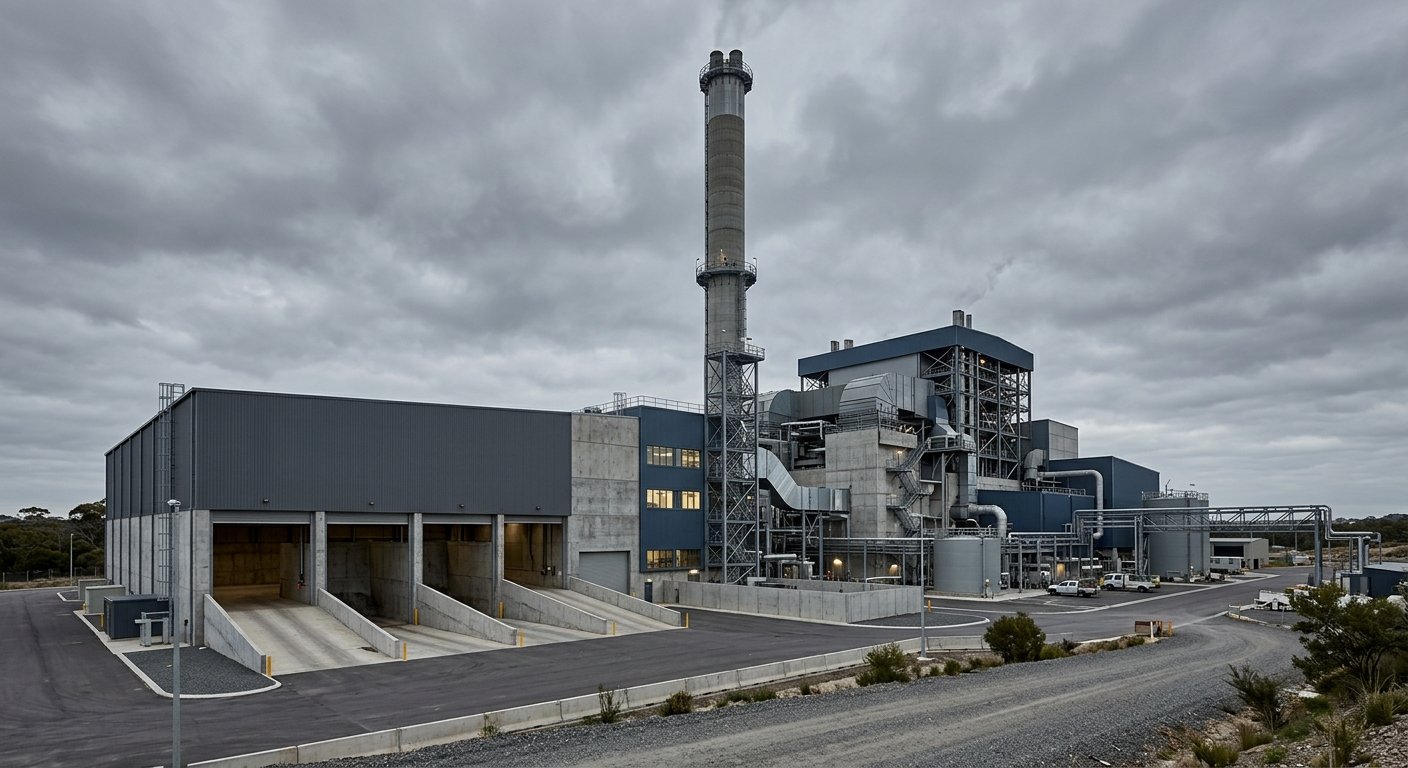
A waste-to-energy (WtE) plant recovers usable energy, electricity, heat, or both, from the thermal treatment of residual waste that cannot economically be reused or recycled. The dominant technology is mass-burn moving-grate combustion, where waste is burned on a slowly advancing grate, the released heat raises steam in a boiler, and the steam drives a turbine. This overview covers what a waste-to-energy plant is, how the energy recovery train works, how the main technologies compare, what comes out as ash, and how emissions, including dioxins, are controlled.
What is a waste-to-energy (WtE) plant?
A waste-to-energy plant is an industrial facility that converts residual waste into electricity, heat, or both, through controlled thermal treatment. The same facility type is written several ways: waste-to-energy, waste to energy, WtE, WTE, and, in UK and European usage, energy from waste (EfW). They all describe the same thing: recovering energy from the fraction of municipal or industrial waste that remains after reuse and recycling.
One distinction matters first. "Waste to energy" is occasionally used for anaerobic digestion, which produces biogas from wet organic waste. This piece covers thermal WtE (combustion, gasification, pyrolysis), the route that handles residual mixed waste at city scale; anaerobic digestion appears below as one alternative for a specific feedstock.
The demand driver is the volume of waste itself. The world generated about 2.01 billion tonnes of municipal solid waste in 2016, projected to reach 3.40 billion tonnes by 2050; roughly 11% is incinerated globally, rising to about 22% in high-income, land-constrained countries [1]. WtE sits between recycling and landfill in the waste hierarchy: it is applied to what is left after recyclables are removed. For the full set of waste streams and kiln applications, see the waste management industry overview.
Waste-to-energy (WtE): the recovery of energy in the form of electricity, heat, or fuel from the thermal or biological treatment of residual waste. Thermal WtE (combustion, gasification, pyrolysis) is the dominant route for mixed municipal solid waste; it reduces waste mass by roughly 70% and volume by roughly 90% while recovering energy that would otherwise be lost to landfill.
How a waste-to-energy plant works: the energy recovery train
A waste-to-energy plant burns residual waste in a furnace, transfers the released heat to a water-tube boiler to raise steam, and expands that steam through a turbine to generate electricity; combined heat and power (CHP) plants also extract steam or hot water for district heating. The sequence from tipping hall to stack is the energy recovery train.
The stages of a moving-grate plant:
- Reception and bunker. Collection vehicles tip waste into a sealed bunker. An overhead crane mixes the waste to even out its heating value and feeds the furnace.
- Grate furnace. Waste burns on a moving grate that advances it through drying, ignition, and burnout zones. EU law requires the combustion gases to be held above 850°C for at least 2 seconds after the last injection of combustion air, which is the condition that destroys dioxin precursors [2].
- Boiler. Hot flue gas passes over water-tube heat-exchange surfaces, raising high-pressure steam. Typical live-steam conditions are around 40 bar and 400°C, kept moderate to limit high-temperature chloride corrosion from the aggressive flue gas.
- Steam turbine and generator. Steam expands through a turbine coupled to a generator. In CHP mode, steam is bled off at intermediate pressure for heat supply.
- Flue-gas cleaning and stack. Acid gases, particulates, NOx, and dioxins are removed before the cleaned gas leaves the stack (covered below).
Net electrical efficiency for power-only plants is modest, typically 14-30%, because moderate steam conditions cap the thermodynamic ceiling. A typical plant generates about 550 kWh of electricity per tonne of waste burned [3]. CHP plants reach much higher total energy utilisation by selling heat, which is why energy-from-waste capacity in Europe concentrates where district-heating networks exist.
| Operating mode | Net electrical efficiency | Notes |
|---|---|---|
| Power-only (electricity) | ~14-30% | Limited by moderate steam conditions (chloride corrosion) [4] |
| Combined heat and power (CHP) | Total energy utilisation much higher | Sells heat to district networks; electrical share still ~14-25% [4] |
Net electrical efficiency is the share of the waste's energy content delivered as electricity to the grid. The EU Waste Framework Directive uses an energy-efficiency formula (the R1 index) to decide whether a plant counts as energy recovery rather than disposal [2].
WtE technologies compared: combustion, gasification, pyrolysis, AD
The dominant waste-to-energy technology worldwide is mass-burn moving-grate combustion; fluidised-bed combustion, refuse-derived fuel (RDF) firing, gasification, pyrolysis, and anaerobic digestion are alternatives matched to specific feedstocks or scales. Mass-burn and RDF account for most installed capacity; gasification, pyrolysis, and plasma routes remain comparatively immature for mixed waste despite long-standing interest [5]. The main routes:
- Mass-burn moving grate. Accepts raw residual MSW with no pre-treatment (no shredding, no RDF preparation). The workhorse of the sector [3].
- Fluidised-bed combustion. Burns waste in a bed of hot inert sand kept suspended by upward airflow. More efficient and more uniform than grate firing, but needs a relatively uniform, sized feed, so it usually requires RDF preparation [5].
- RDF firing. Mixed waste is shredded and sorted into refuse-derived fuel with a more consistent calorific value, then fired in a dedicated boiler or co-fired in cement kilns.
- Gasification. Thermal decomposition in a limited oxygen supply, producing a combustible synthesis gas (syngas) [5].
- Pyrolysis. Thermal decomposition in the near-absence of oxygen, producing syngas, oils, and a solid char [5].
- Anaerobic digestion (AD). Biological breakdown of wet biodegradable waste to biogas; suits source-separated food and agricultural waste, not mixed residual MSW.
Mass burn: combustion of raw, post-recycling municipal solid waste with no pre-treatment such as shredding or refuse-derived fuel production. It is the most common waste-to-energy combustion technology because it tolerates the heterogeneity of real residual waste.
| Technology | Feedstock | Typical scale | Output | Maturity |
|---|---|---|---|---|
| Mass-burn moving grate | Raw residual MSW, no pre-treatment | Large (city-scale, hundreds of kt/yr) | Electricity and/or heat | Mature, dominant [3][5] |
| Fluidised-bed combustion | Sized / RDF feed | Medium-large | Electricity and/or heat | Commercial; needs uniform feed [5] |
| RDF firing / co-firing | Shredded, sorted RDF | Medium; or co-fired in cement kilns | Electricity, heat, or kiln fuel | Commercial [5] |
| Gasification | MSW / RDF | Small-medium | Syngas → power | Limited commercialisation for mixed waste [5] |
| Pyrolysis | RDF, plastics, tyres | Small | Syngas, oil, char | Limited commercialisation for mixed waste [5] |
| Anaerobic digestion | Wet, source-separated organics | Small-medium | Biogas → power/heat | Mature for organic feedstock only |
| Rotary-kiln combustion | Hazardous / heterogeneous waste | Small-medium | Heat; destruction-led | Mature for hazardous streams [3] |
Rotary-kiln combustion is the standard furnace where the feed is hazardous or too heterogeneous for a grate, because the rotating cylinder tumbles and mixes liquids, sludges, drummed solids, and bulky items through a long, hot residence. That is the route used in hazardous waste incineration and the basis for rotary kiln incinerators.
Mass and volume reduction: what comes out of a WtE plant
Thermal waste-to-energy reduces the mass of incoming waste by roughly 70% and its volume by roughly 90%, leaving bottom ash, fly ash, and air-pollution-control (APC) residues [6][7]. The volume reduction is the headline benefit for land-constrained regions: what arrives as a bunker of mixed waste leaves as a much smaller stream of inert and treatable solids.
The ash leaving a US MSW combustion plant amounts to 15-25% of the input by weight and 5-15% by volume; of that ash, bottom ash makes up 80-90% by weight and fly ash 10-20% [3]. The two streams have very different handling requirements.
| Residue stream | Share of total ash | Typical composition | Fate |
|---|---|---|---|
| Bottom ash (IBA) | 80-90% by weight | Silica, calcium, iron and aluminium oxides, glass, grit, ferrous and non-ferrous metals | Metals recovered magnetically; remainder reused as construction aggregate or landfilled [3][8] |
| Fly ash + APC residue | 10-20% by weight | Fine particulates plus scrubber/sorbent residues; concentrated heavy metals, salts, dioxins | Hazardous; stabilised or solidified, then landfilled or used as a cement substitute after treatment [3][8] |
Bottom ash is the recyclable fraction: large magnets and eddy-current separators pull out ferrous and non-ferrous metals, and the residual mineral aggregate is used in road construction and bulk fill in many European markets [8]. Fly ash and the residues captured downstream concentrate the heavy metals, soluble salts, and any dioxins removed from the gas; this stream is classified as hazardous and is stabilised before disposal.
Emissions control and the dioxin question
Modern waste-to-energy plants control dioxins, acid gases, NOx, and particulates through multi-stage flue-gas cleaning, and EU regulation caps stack dioxin emissions at 0.1 ng I-TEQ/Nm3 [9]. Dioxins are the emission the public associates most with incineration, and the control strategy has two halves: prevent formation, then capture what remains.
Formation is suppressed by the combustion conditions. Holding the flue gas above 850°C for at least 2 seconds destroys the organic precursors, and rapid quenching through the window where dioxins re-form (the "de-novo" range around 200-450°C) limits reformation [2][9]. What survives is captured by activated-carbon injection followed by a bag filter. In practice plants run well below the limit: a small incinerator retrofitted with activated-carbon injection and a bag filter measured 0.042 ng I-TEQ/Nm3, against the 0.1 ng I-TEQ/Nm3 standard [10]. A typical cleaning train runs in sequence: NOx reduction (selective non-catalytic or catalytic reduction), acid-gas neutralisation (lime or sodium-bicarbonate scrubbing for HCl and SO2), activated-carbon injection for dioxins and mercury, and a fabric (bag) filter for particulates and the loaded sorbent.
The honest trade-off: waste-to-energy is contested because roughly half of mixed MSW is fossil-derived (plastics), so the CO2 from that fraction is not renewable. The biogenic half (paper, food, wood) is treated as renewable in most accounting. WtE diverts waste from landfill and recovers energy, but it is not carbon-free, and where strong recycling exists it competes with material recovery rather than replacing it. The case for any individual plant rests on the local waste hierarchy.
Where rotary-kiln sealing fits in waste-to-energy plants
Rotary-kiln combustion is the standard furnace for hazardous and heterogeneous waste within the waste-to-energy sector, and the rotating-to-stationary seal at each end of the kiln governs combustion control and false-air ingress. A waste rotary kiln has the same fundamental sealing challenge as a cement or lime kiln: a rotating cylinder meets a stationary hood, and the gap between them either is sealed or admits uncontrolled air.
On a waste kiln the stakes are specific. False air drawn in at the seal dilutes the combustion gas, raises induced-draught fan load, and pulls down furnace temperature. If ingress is bad enough to drop the gas below the 850°C / 2-second condition, the plant risks failing the dioxin-destruction requirement the whole emissions case depends on. The same false-air mechanism that costs a cement kiln fuel costs a waste kiln its combustion-temperature margin; the physics is identical, and is set out in false air in a rotary kiln.
The integrated false air control system and the kiln inlet sealing system are built for the rotating-to-stationary interface where ingress is largest, and the same engineering applies to the kilns used in rotary kiln incinerators. For the full set of waste-sector applications, see the waste management industry page.
Auditing combustion-temperature margin and false-air ingress on a waste rotary kiln, and confirming the seal is not putting the 850°C dioxin-destruction condition at risk, falls within the scope of Oswal's engineering consulting service. The methodology is the same on a waste kiln as on the cement and lime kilns covered elsewhere on this site.
Common questions about this topic
Waste-to-energy is incineration with energy recovery: the heat from burning waste is captured to make electricity or heat, rather than simply destroying the waste. Plain incineration without recovery counts as disposal. The EU Waste Framework Directive draws the line formally with its R1 energy-efficiency index; a plant that meets the threshold is classified as recovery, one that does not is classified as disposal [2]. In practice almost all modern thermal plants are built as energy-recovery facilities. For the regulatory framing of waste burning more broadly, see [hazardous waste incineration](/it/blog/hazardous-waste-incineration).
A power-only waste-to-energy plant typically delivers a net electrical efficiency of 14-30%, limited by the moderate steam conditions used to avoid chloride corrosion from the aggressive flue gas [4]. A typical plant produces about 550 kWh of electricity per tonne of waste [3]. Combined heat and power (CHP) plants reach much higher total energy utilisation by also selling heat to district-heating networks, which is why energy-from-waste capacity in Europe clusters where those networks exist.
Waste-to-energy is partly renewable: roughly half of mixed municipal waste is biogenic (paper, food, wood) and is counted as renewable, while the other half is fossil-derived plastic whose CO2 is not. It is not carbon-free. Emissions are tightly regulated, with EU stack dioxin limits set at 0.1 ng I-TEQ/Nm3 and modern plants typically measuring well below that [9][10]. WtE diverts waste from landfill and recovers energy, but it sits below reuse and recycling in the waste hierarchy and is applied to residual waste, not as a substitute for material recovery.
A tonne of mixed municipal solid waste yields roughly 500-600 kWh of electricity in a typical waste-to-energy plant, with the US EPA citing about 550 kWh per tonne [3]. The exact figure depends on the waste's calorific value, which varies with moisture and plastic content, and on whether the plant runs in power-only or combined heat and power mode. CHP operation recovers substantially more of the waste's total energy by capturing heat alongside electricity.
Sources
- World Bank, *What a Waste 2.0: A Global Snapshot of Solid Waste Management to 2050*, 2018
- European Union, *Directive 2008/98/EC on waste (Waste Framework Directive), Annex II (R1 energy-efficiency formula) and incineration conditions*
- U.S. Environmental Protection Agency, *Energy Recovery from the Combustion of Municipal Solid Waste (MSW)*
- CEWEP (Confederation of European Waste-to-Energy Plants), *What is Waste-to-Energy*
- WSP / Stanford PH240, *Waste Technologies: Waste to Energy Facilities* (technology maturity review)
- CEWEP, *Waste-to-Energy Plants in Europe in 2023* (fleet and volume-reduction data)
- Mukherjee et al., *Municipal solid waste management: A review of waste to energy (WtE) approaches*, BioResources
- This Is Eco, *What Happens To Waste To Energy Incineration Ash?* (bottom ash and fly ash handling)
- CEWEP, *Dioxins and WtE plants: State of the Art*, 2022 (EU 0.1 ng I-TEQ/Nm3 limit and control)
- PMC / peer-reviewed study, *Measurement of Dioxin Emissions from a Waste Incinerator with and without Air Pollution Controls* (measured 0.042 ng I-TEQ/Nm3 after activated-carbon + bag-filter retrofit)
Articoli correlati
Discuss Your Sealing Requirements
Our engineering team can help identify the right sealing solution for your application.
Contact Engineering Team“Ovunque i forni rotanti ad alta temperatura operino in atmosfera controllata, i sistemi di tenuta Oswal garantiscono efficienza energetica e stabilità di processo.”