
Duplex Kiln Seal Explained: How the Dual-Stage Hybrid Works
A duplex kiln seal pairs a lamella movement stage with a graphite thermal stage. How the dual-stage hybrid controls false air under real kiln movement.
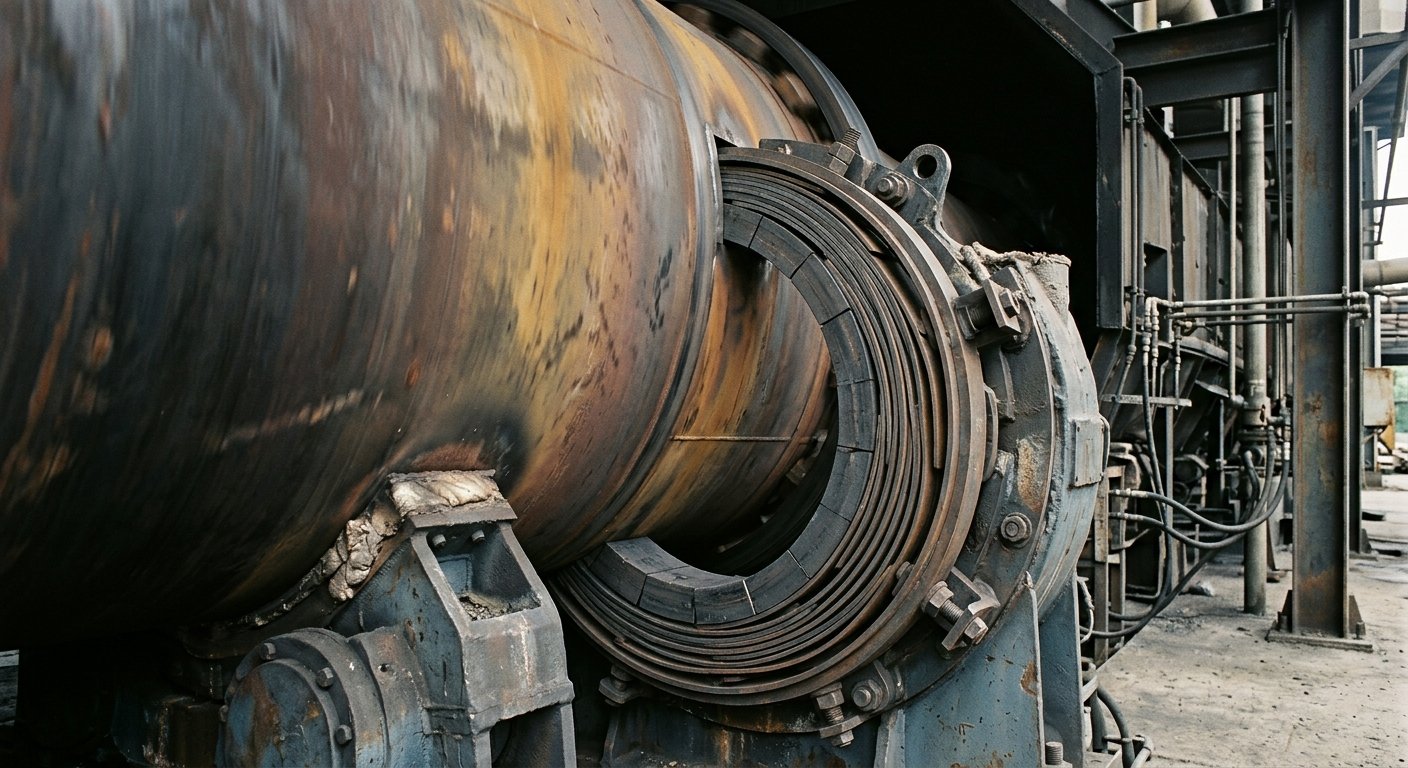
A duplex kiln seal is a dual-stage hybrid seal that combines a lamella (leaf) primary stage for movement and ovality compensation with a graphite secondary stage for high-temperature thermal sealing, so a single assembly can both follow a moving kiln shell and hold a tight seal against false air. It exists because a rotary kiln is never static: it walks axially, grows radially with heat, and runs out-of-round, and no single sealing principle handles all of that while also surviving clinker-discharge temperatures. This piece covers what a duplex kiln seal is, the problem a single seal cannot solve, how the two stages divide the work, why the hybrid wins, how it is retrofitted, and where the payback comes from.
What is a duplex (dual-stage) kiln seal?
A duplex kiln seal is a two-stage sealing assembly: a primary lamella stage absorbs the kiln's mechanical movement while a secondary graphite stage maintains continuous high-temperature sealing contact. The two stages sit in one housing at the kiln-to-hood interface and work together, so the seal adapts to the kiln rather than resisting it.
Duplex kiln seal: a dual-stage hybrid kiln seal in which a lamella (spring-steel leaf) primary stage compensates for axial, radial, and ovality movement, and a graphite secondary stage holds continuous high-temperature sealing contact, combining both principles in a single adaptive assembly.
The terms are interchangeable in practice. A duplex kiln seal is the same thing as a double kiln seal, a dual-stage kiln seal, a dual-layer kiln seal, or a hybrid kiln seal: all describe a seal built from two cooperating stages rather than one sealing principle. Oswal's product name for it is the Duplex kiln sealing system.
One disambiguation, because "duplex" is a busy word. This is a dual-stage rotary kiln seal. It is not duplex stainless steel (a steel grade), not a duplex apartment, and not a duplex mechanical seal in a pump or compressor. Everything below is about the seal at the interface where a rotating cement, lime, or mineral-processing kiln meets its stationary inlet or outlet hood.
The problem a single seal cannot solve
A single-stage kiln seal cannot do two opposed jobs at once: follow a kiln shell that is moving axially and running out-of-round, and at the same time hold a tight thermal seal against false air at clinker-discharge temperatures. The two requirements pull in different directions, so a one-principle seal is always compromised on one of them.
A rotary kiln presents four moving targets to any seal at the same time, per Oswal's Duplex catalogue [1]:
- Axial displacement. The shell walks back and forth along its axis as it heats, cools, and takes load.
- Radial shell expansion. The steel grows outward with temperature, opening or closing the gap to the seal.
- Thermal growth. Continuous expansion and contraction across the operating cycle.
- Shell ovality. The shell flexes out of round as it rotates, especially near the tyres.
Ovality: the cyclic out-of-round deformation of a rotary kiln shell as it rotates under its own weight and load, so the cross-section flexes between slightly oval and round once per revolution. It is one of the hardest movements for a seal to track.
Conventional seals are designed for static conditions, while a kiln runs under continuous movement, and that mismatch is what produces sealing failure and false air ingress [1]. The high operating temperature expands the shell while its weight and load distort the circular shape, which makes a perfect static seal close to impossible to hold [2]. So the industry uses one of two principles, and each has an inherent limit [3]:
- A lamella seal (overlapping spring-steel leaves) adapts well to movement, but spring steel loses temper and the leaves erode faster in the hottest, most abrasive zones.
- A graphite seal (segmented graphite blocks) is thermally durable and wears slowly under dust, but it handles large, fast movement excursions less gracefully than a flexing leaf pack.
Force a lamella to sit in sustained extreme heat, or force graphite to absorb large movement, and the single seal leaks. That leak is false air in cement kilns, and it is measurable and expensive; the full trade-off is in lamella vs graphite kiln sealing, and the measurement method in how false air is measured.
How the two stages divide the work
In a duplex kiln seal the two stages split the workload: the lamella stage handles all the movement (axial drift, radial expansion, ovality) so that the graphite stage can stay in steady high-temperature contact and do the actual thermal and dust sealing. The lamella layer absorbs movement variations; the graphite layer ensures consistent thermal sealing performance [3]. Neither stage is asked to do the job it is bad at.
The assembly is built from four cooperating parts, per Oswal's mechanical design architecture [1][3]:
| Component | Stage role | What it does | Source |
|---|---|---|---|
| Primary lamella interface | Movement compensation | Flexes with axial drift, radial expansion, and shell ovality so the seal tracks the moving shell | Oswal PDFs [1][3] |
| Secondary graphite interface | Thermal sealing | Maintains continuous high-temperature sealing contact and seals against dust at the interface | Oswal PDFs [1][3] |
| Structural housing | Stable mounting | Heavy-duty housing that holds both stages in position under load | Oswal PDFs [1][3] |
| Controlled pressure-distribution mechanism | Uniform contact | Keeps sealing pressure uniform across the interface as the kiln distorts | Oswal PDFs [1][3] |
Because the lamella stage takes the mechanical excursions, the graphite stage never chases a large movement target: it stays in close, steady contact and holds the thermal seal. Oswal builds the two interfaces from the same families it supplies as standalone elements, lamella-based sealing elements and graphite-based sealing elements, combined here into one dual-layer assembly with full-length sealing continuity and no dead zones [1].
Why the hybrid outperforms a single seal
The hybrid outperforms a single seal because it never forces one material to do a job it is poor at: movement is absorbed by the lamella leaf pack and heat is held by the graphite, so sealing pressure stays uniform across the interface even as the kiln distorts. The dual-layer configuration also creates redundancy and reliability that a single principle cannot offer [3].
The contrast is clearest set side by side.
| Challenge | Lamella alone | Graphite alone | Duplex (dual-stage) |
|---|---|---|---|
| Axial + radial movement | Tracks it well | Less graceful under large excursions | Lamella stage absorbs it [1][3] |
| Shell ovality | Flexes with it | Limited | Lamella stage flexes with it [1] |
| Sustained extreme temperature | Spring steel loses temper | Strong | Graphite stage holds it [3] |
| Abrasive dust at the face | Leaves erode faster | Long wear life | Graphite stage handles it [1][3] |
| Uniform sealing pressure under distortion | Degrades as leaves relax | Good, if movement is low | Maintained across the interface [1] |
The honest caveat: a duplex is not the automatic answer for every position. A movement-dominated kiln inlet, where the thermal load is high but not at the outlet extreme, may be well served by a lamella seal alone, and a cost-sensitive retrofit may not justify a dual-layer assembly where a single principle would hold. The duplex earns its place where one position genuinely sees both severe movement and extreme heat, which is exactly where a single seal is forced to compromise. For the full evaluation, see our guides to choosing a kiln seal and single vs double kiln seals.
Retrofit and the shutdown install
A duplex kiln seal is retrofit-compatible: it integrates with the existing kiln shell geometry, support-station configuration, axial-thrust systems, and inlet and outlet hood interfaces without excessive structural modification [3]. Its modular design is built for installation and service on an existing kiln, not just a new build [1].
That retrofit fit is what keeps the install inside a planned outage. The seal is typically fitted during a scheduled kiln shutdown, on the order of a 9-day install window for a full dual-stage assembly on an existing kiln; treat that as a typical scheduled-shutdown window to confirm against your own outage plan, not a fixed guarantee. (The day count is from Oswal's installation practice, not a published catalogue figure; the catalogue documents the retrofit compatibility and modular design.) Because the assembly mounts to existing interfaces, the work focuses on the seal area rather than on reworking the hood or support stations. The on-site sequencing is run by Oswal's installation and retrofit team, with the broader planning in kiln seal retrofit and shutdown.
The payback case: false air to fuel and ID fan power
The payback on a duplex kiln seal comes from cutting false air, which lowers fuel consumption, reduces ID fan power, and stabilises the process; Oswal's Duplex catalogue states a typical payback of 6 to 18 months from those three drivers [1]. The mechanism is direct: every cubic metre of unintended air entering the system has to be heated to process temperature, and the induced-draft (ID) fan has to move it, so leakage shows up as both wasted fuel and wasted fan power [3].
The size of that penalty is well established in the cement literature, independent of any supplier. As a general industry figure (not an Oswal product spec), each percentage point of false air above the optimum costs roughly 1.5 to 2.5 kcal/kg clinker in additional fuel [4][5], and the kiln inlet and outlet seals are among the dominant ingress points on the kiln line [6]. Reducing seal-related false air therefore acts on one of the highest-leverage items in the plant energy balance.
A worked illustration, using third-party typicals rather than guaranteed results: take a 5,000 t/day kiln. Cutting false air by 3 percentage points at the seals, at roughly 2 kcal/kg clinker per point, saves about 6 kcal/kg clinker, which across 5,000 t/day is on the order of 30 million kcal/day of fuel energy no longer wasted, plus a lower ID fan duty from moving less parasitic air. The exact figure depends on the kiln's baseline false air, fuel price, and load; the arithmetic is driven by measurable inputs, not a marketing claim. The catalogue's 6-to-18-month payback is a vendor-stated range: validate it against your own kiln's energy baseline before purchase.
This is why seal selection sits underneath so many cement plant energy decisions. On a kiln where false air is high, the seal is one of the cheapest interventions that moves specific fuel consumption.
If you are evaluating a duplex seal for a specific kiln position, our engineering team works through the movement and thermal profile of the inlet and outlet case by case and maps each to a single seal or a dual-stage hybrid. Contact us with your kiln's process and false air baseline.
Common questions about this topic
A duplex kiln seal combines two sealing principles in a single architecture: spring-loaded lamella elements for adaptive compliance to kiln motion, and graphite-based contact sealing for residual leakage control. The two principles work in series. The lamella section absorbs kiln motion and ovality; the graphite section provides the tight final seal against false air. Oswal's Duplex Kiln Sealing System is the flagship implementation of this design.
Lamella is preferred when the kiln has significant motion (large diameter kilns, pronounced ovality, axial drift) and the operating temperature is moderate. Graphite is preferred when the kiln is dimensionally stable and the operating temperature is at the high end of the kiln range. The Duplex hybrid combines both, which is why it outperforms either single-principle system under real-world kiln operating conditions. For specific plant selection guidance, the Oswal Engineering Consulting & Audit service is the right starting point.
Yes. The Duplex is engineered for retrofit installation on existing rotary kilns without structural modification of the kiln shell or hood. Typical retrofit install is approximately 9 days during a scheduled kiln shutdown. A pre-install dimensional survey confirms fit and identifies any interface adjustments needed before equipment ships.
A duplex kiln seal is a dual-stage hybrid seal that combines a lamella (spring-steel leaf) primary stage for movement and ovality compensation with a graphite secondary stage for high-temperature thermal sealing, so one assembly both follows a moving kiln shell and holds a tight seal against false air [1][3]. It is the design behind Oswal's Duplex kiln sealing system, and the terms double kiln seal, dual-stage kiln seal, and hybrid kiln seal all refer to the same two-stage approach.
A single kiln seal uses one principle, either a lamella leaf pack or a graphite block ring, and has to compromise when a position needs both movement compensation and extreme-temperature durability; a duplex kiln seal uses two stages, so the lamella handles movement and the graphite handles heat with neither asked to do the job it is poor at [3]. The two single principles are compared in lamella vs graphite kiln sealing, and the direct head-to-head in single vs double kiln seals.
Yes. A duplex kiln seal is engineered for retrofit and integrates with the existing kiln shell, support stations, axial-thrust systems, and hood interfaces without excessive structural modification, and is fitted during a scheduled kiln shutdown [1][3]. Oswal's installation and retrofit team handles the on-site work, and the shutdown planning is detailed in kiln seal retrofit and shutdown.
Oswal's Duplex catalogue states a typical payback of 6 to 18 months, driven by reduced fuel consumption, lower ID fan power, and improved process stability [1]. That is a vendor-stated range: the actual payback depends on the kiln's baseline false air level, fuel price, and load, so it should be validated against the plant's own energy baseline before purchase.
Sources
- Oswal Engineers, *Duplex Kiln Sealing System* (catalogue: engineering concept, mechanical design architecture, false air control performance, rapid payback period). `KilnSeal_DuplexType_OK_CAT.pdf`
- Kintek Furnace, *Why Does the Rotary Kiln / Lime Kiln Have Poor Sealing Performance, and What Are the Consequences?*
- Oswal Engineers, *Kiln Sealing Systems* (product catalogue: Duplex hybrid lamella + graphite technology, engineering background, operational integration). `OSWAL_kilnseal.pdf`
- European Cement Research Academy (ECRA) / Cembureau, *Best Available Techniques and energy efficiency in cement manufacture* (false air and specific fuel consumption). As cited in our [false air cornerstone](/en/blog/understanding-false-air-in-cement-kilns).
- VDZ (Verein Deutscher Zementwerke), *Environmental Data of the German Cement Industry* (kiln gas balance and false air). As cited in our [false air cornerstone](/en/blog/understanding-false-air-in-cement-kilns).
- Oxmaint, *Kiln Inlet and Outlet Seal Maintenance for Cement Plants*
Related Articles
Discuss Your Sealing Requirements
Our engineering team can help identify the right sealing solution for your application.
Contact Engineering Team“Wherever high-temperature rotary kilns operate under controlled atmosphere, Oswal sealing systems ensure energy efficiency and process stability.”