
Raw Meal Preparation in a Cement Plant
Raw meal is the homogenised, chemistry-controlled kiln feed of ground limestone, clay, iron ore, and sand. LSF, SM, AM targets and the VRM vs ball mill choice.
Raw meal is the homogeneous, fine powder of limestone, clay (or shale), iron ore, and silica sand that feeds the preheater tower of a cement kiln. Raw meal preparation is the upstream stage of the cement manufacturing process where these raw materials are crushed, ground, and proportioned to a chemistry target defined by three control moduli: the Lime Saturation Factor (LSF), Silica Modulus (SM), and Alumina Modulus (AM).
The piece below walks through the raw materials and their oxide roles, the formulas a process engineer uses to set the raw mix chemistry, the choice between a vertical roller mill (VRM) and a ball mill, continuous blending, and the economics of buying corrective materials when the on-site quarry falls short.
What is raw meal?
Raw meal is the fine, homogenised powder that results from grinding the proportioned raw mix to a controlled fineness before it is fed to the preheater tower. Typical raw meal fineness in modern dry-process cement plants is 10-15% residue on a 90 micron sieve and 1-2% residue on a 200 micron sieve (Labahn and Kohlhaas, Cement Engineers' Handbook, 7th ed., 1983, the long-standing reference text used in cement-plant training corpora).
Raw meal (synonyms: kiln feed, cement raw mix). The homogenised, fine powder of limestone, clay or shale, iron ore, and silica sand, ground and proportioned to a target chemistry, that is fed into the preheater tower of a cement kiln. Strictly: "raw mix" is the formulated blend before grinding, "raw meal" the ground product, "kiln feed" the meal as it enters the preheater. In practice the three terms are used interchangeably on most plants.
Note that "raw mix" also appears in food and animal-feed contexts with unrelated meanings; in the cement context it specifically denotes the chemistry-controlled mineral blend that becomes clinker.
The four raw materials and their oxide roles
Four raw materials supply the four oxides that make up over 95% of Portland cement clinker: limestone (CaO), clay or shale (SiO₂ and Al₂O₃), iron ore (Fe₂O₃), and silica sand (additional SiO₂). The dominant component by mass is limestone.
| Raw material | Typical mass share | Oxide contribution |
|---|---|---|
| Limestone (CaCO₃) | 75-80% | CaO (after calcination) |
| Clay or shale | 15-20% | SiO₂, Al₂O₃ |
| Iron ore (laterite, mill scale, low-grade ore) | 1-3% | Fe₂O₃ |
| Silica sand | 1-5% | SiO₂ (correction) |
Source: Labahn and Kohlhaas, Cement Engineers' Handbook; Cembureau industry baseline. https://cembureau.eu/
Clay supplies most of the silica and alumina. Iron ore and silica sand are corrective materials, added when the limestone-plus-clay base does not hit chemistry on its own. On many plants, fly ash, blast-furnace slag, or red mud substitutes in for part of the corrective stream, both to close the chemistry gap and to reduce the per-tonne cost and CO₂ footprint of the raw mix.
The chemistry control moduli (LSF, SM, AM)
Raw mix chemistry is controlled by three dimensionless ratios: the Lime Saturation Factor (LSF), the Silica Modulus (SM), and the Alumina Modulus (AM). Together they determine clinker burnability, the four-phase composition of the resulting clinker, and the downstream performance of the cement.
The formulas:
LSF = (100 × CaO) / (2.8 × SiO2 + 1.18 × Al2O3 + 0.65 × Fe2O3)

SM  = SiO2 / (Al2O3 + Fe2O3)

AM  = Al2O3 / Fe2O3
Where:
- CaO, SiO₂, Al₂O₃, Fe₂O₃. Mass percentages of the four major oxides in the raw mix on a loss-on-ignition-free basis.
- LSF. Lime Saturation Factor. The ratio of CaO present to the CaO that can stoichiometrically combine with SiO₂, Al₂O₃, and Fe₂O₃ to form the four clinker phases. Above 100, excess free lime; below an effective minimum, low alite (C₃S) and weak cement.
- SM. Silica Modulus (sometimes "silica ratio"). Sets the balance between silicate phases and the aluminate-ferrite liquid phase that mineralises burning in the kiln.
- AM. Alumina Modulus (sometimes "alumina ratio" or "iron modulus"). Sets the C₃A:C₄AF ratio in clinker, which in turn affects setting time and sulphate resistance.
Target ranges for Ordinary Portland Cement (OPC) clinker, per Labahn / Kohlhaas and Cembureau industry conventions:
| Modulus | Typical OPC range | What it controls |
|---|---|---|
| LSF | 92-98 | Free lime risk, alite content, clinker burnability |
| SM | 2.2-2.6 | Burnability, coating in the burning zone, liquid-phase ratio |
| AM | 1.3-1.6 | C₃A : C₄AF ratio, setting time, sulphate resistance |
A plant operating outside these ranges is not necessarily off-spec, but each drifting modulus adds either a fuel penalty (low SM, coating-zone problems), a quality penalty (low LSF, weaker clinker), or a service-life penalty (high AM, longer setting time and weaker sulphate resistance).
Grinding: vertical roller mill vs ball mill
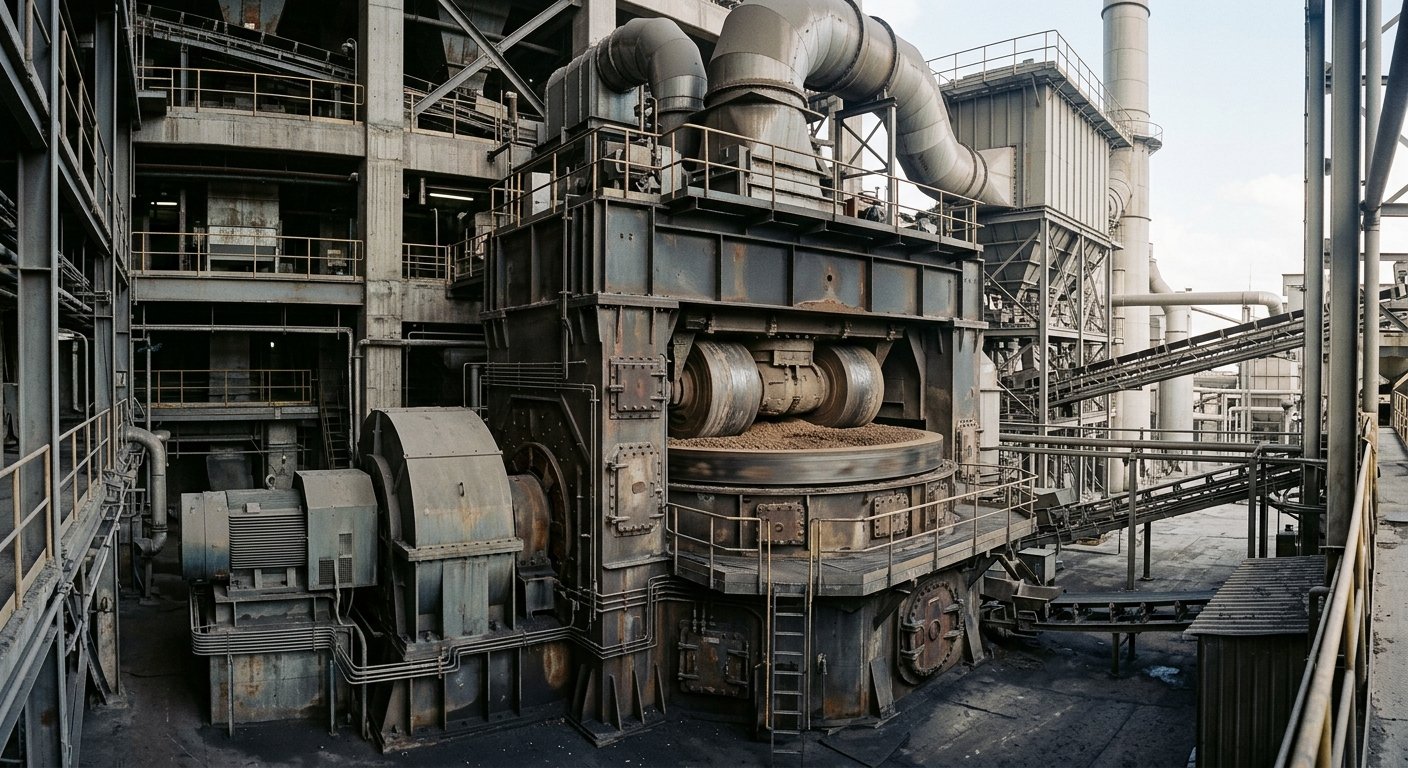
Raw materials are ground to raw meal in either a vertical roller mill (VRM) or a ball mill. VRMs dominate new installations because of their lower specific power consumption (typically 12-18 kWh/t depending on limestone grindability, versus 20-25 kWh/t for a ball mill circuit, per Loesche and FLSmidth published mill data and NCB India census figures for the Indian fleet, which place VRM raw meal SPC at 8-14 kWh/t for soft to hard limestone). VRMs hold the largest share of raw meal grinding capacity in India per NCB plant census data; ball mills remain on older brownfield raw grinding circuits and are still widely used for finish grinding, but new raw meal lines are almost universally specified as VRMs.
| Parameter | Vertical roller mill (VRM) | Ball mill |
|---|---|---|
| Specific power consumption | 12-18 kWh/t raw meal | 20-25 kWh/t raw meal |
| Maximum throughput (single mill) | up to ~1,200 t/h (Gebr. Pfeiffer MVR 6000 R-6, ordered 2025 for JK Cement, Jaisalmer); ~420-580 t/h class for Loesche LM 69.6 | up to ~250-350 t/h |
| Fineness control | Tighter, integrated dynamic classifier | Looser, separate classifier required |
| Moisture handling | Up to ~15-20% feed moisture, integrated drying | Up to ~5-6% without external dryer |
| Wear and maintenance | Roller and table refacing; specialist | Liner and ball replacement; robust, simple |
| Capital cost | Higher | Lower |
| Footprint | Smaller | Larger |
Sources: Loesche LM-series technical data, FLSmidth OK Raw Mill product literature, KHD Humboldt Wedag and Gebr. Pfeiffer MPS series data sheets; ECRA bulletins on cement grinding energy. https://www.loesche.com/ , https://www.flsmidth.com/ , https://ecra-online.org/
A VRM saves 20-30% of grinding power versus a ball mill of equivalent capacity (FLSmidth and Loesche published figures, consistent across ECRA bulletins). It handles wet raw materials better, which matters because limestone fresh from the quarry can carry 8-12% moisture before any drying. The downside is the higher capital outlay and the more specialised wear-part workflow: a ball mill is easier to operate, easier to maintain, and more forgiving to a less-experienced shift crew. For a new line, the VRM is almost always the right choice on power-cost grounds alone; for a brownfield retrofit, the answer depends on the remaining life of the existing ball mill and the local power tariff.
Blending and homogenisation
After grinding, raw meal is blended in a continuous mass-flow blending silo before it is fed to the preheater. Modern continuous blending silos reduce the standard deviation of LSF in the kiln feed by a factor of 7 to 10 versus the input raw meal stream (Holderbank Cement Course training material, the Holcim-published reference set used across the industry). This standard-deviation reduction is what makes consistent clinker chemistry possible in a continuously operating kiln.
The dominant upstream source of LSF variance is the limestone quarry itself: geology is not uniform, and the CaCO₃ content of a face can swing several percentage points over a working week. Online X-ray fluorescence (XRF) analysers at the raw mill outlet and at the kiln feed close the loop, adjusting the corrective-material feeders in real time. Plants without online XRF run a lab composite every shift, which works but always lags upstream variance by hours.
Raw mix design and the economics of corrective materials
Raw mix design is the optimisation problem of hitting target LSF, SM, and AM using available raw materials at minimum delivered cost. When on-site limestone is low-grade or off-specification (high silica, high MgO, high alkalis), plants buy corrective materials, typically iron ore, bauxite, or silica sand, to close the chemistry gap.
Two levers exist: blend the quarry more carefully (selective extraction, pre-blending stockpiles, multi-face working) or buy in correctives. Selective quarrying is cheap per tonne but operationally inflexible; bought correctives are expensive per tonne but let the plant hit chemistry within hours rather than weeks. Most plants use both, with the balance set by the quality of the on-site reserves and the local price of the corrective stream.
Alternative raw materials (fly ash from coal-fired power, blast-furnace slag, mill scale, red mud from alumina refineries) substitute in for part of the corrective stream when chemistry allows. They reduce both delivered cost and the per-tonne CO₂ footprint of the raw mix, since they avoid the calcination CO₂ that would otherwise come from additional limestone.
Why raw meal preparation matters for kiln operation
Variability in raw meal chemistry is one of the biggest upstream causes of unstable kiln operation. An LSF swing of more than ±2 percentage points at the kiln feed is typically enough to push free lime, fuel consumption, and refractory wear out of their target ranges, per VDZ kiln operations guidance. This is why the blending silo and online XRF are not optional: they are the difference between a stable kiln and a kiln that fights its operators every shift.
Raw meal moisture is a second-order driver of fuel consumption: every percentage point in the kiln feed adds measurable kcal/kg to specific fuel consumption because the same fuel has to evaporate that water before doing useful calcination work. VRM-equipped lines, with their integrated drying capacity, can run wetter quarry stocks without paying that penalty.
For the kiln operator, raw meal chemistry sets the floor on what is achievable downstream. A well-prepared raw meal is the precondition for stable pyroprocessing in the calciner and the rotary kiln; a poorly prepared raw meal multiplies every other problem, from false air ingress to refractory campaign length.
Oswal's engineering-consulting team audits raw mix design and chemistry control as part of broader kiln-performance reviews on cement plant operations; the LSF / SM / AM targets and the blending silo SD reduction are the standard diagnostic baseline.
Sources
- Labahn, O. and Kohlhaas, B. (eds.), *Cement Engineers' Handbook*, 7th edition (Bauverlag, 1983). The classic plant-engineering reference; the source for fineness, raw mix composition, and the LSF / SM / AM formulas as used in industry practice.
- Cembureau, *Activity Report 2023* and earlier baselines, European cement industry association
- European Cement Research Academy (ECRA), bulletins on cement grinding energy and best available techniques
- Holderbank Group / Holcim, *Cement Manufacturing: Process Technology* (Holderbank Cement Course), training corpus. Standard reference for blending-silo standard-deviation reduction factors and broader plant-engineering practice.
- Loesche GmbH, LM-series vertical roller mill technical data (LM 60.4, LM 69.6 raw meal throughputs; LM 69.6 reported as the largest raw meal mill class in the 6-roller series at ~420-580 t/h depending on grindability)
- FLSmidth, OK Raw Mill product literature (OK 54-6 cited as the largest installed OK raw mill, at Semen Padang's Indarung VI line)
- KHD Humboldt Wedag, raw grinding mill data sheets
- Gebr. Pfeiffer SE, MPS-series and MVR-series vertical roller mill data; MVR 6000 R-6 (1,200 t/h raw meal capacity) ordered by JK Cement for the Jaisalmer greenfield line, December 2025, per *World Cement* trade press. https://www.gebr-pfeiffer.com/ ;
- National Council for Cement and Building Materials (NCB India), grinding-technology census of the Indian cement industry; published in *ZKG International* as "Overview of energy consumption and attributes of grinding technologies in the Indian cement industry."
- Verein Deutscher Zementwerke (VDZ), *VDZ Activity Report* (annual). https://www.vdz-online.de/ --- *Raw mix chemistry control and the VRM-versus-ball-mill decision are two of the recurring scopes for the engineering-consulting team. If you are sizing a raw meal preparation upgrade or auditing LSF variance against kiln stability, the [engineering-consulting service](/en/services/engineering-consulting) works the methodology above on-site.*
Related Articles
Discuss Your Sealing Requirements
Our engineering team can help identify the right sealing solution for your application.
Contact Engineering Team“Wherever high-temperature rotary kilns operate under controlled atmosphere, Oswal sealing systems ensure energy efficiency and process stability.”