
Kiln Seal Materials: Steel Lamellae vs Graphite vs Composite
Kiln seal materials compared by family: spring-steel lamellae for movement, graphite for heat and dust, composite hybrids for both. Where each material wins.
Kiln seals are built from three material families: spring-steel lamellae, segmented graphite, and composite hybrids that combine the two. Each family is chosen for a different dominant stressor at the kiln-to-hood interface: spring steel for shell movement, graphite for sustained heat and abrasive dust, and a composite hybrid for a position that sees both at once. This piece sets out what each material is, why it behaves the way it does, and how to match a material to a seal position rather than picking one in the abstract.
A note on terms first. A kiln seal here is the element that closes the gap where a rotating kiln shell meets its stationary inlet or outlet hood. Graphite in this context is the segmented-block seal at that interface, not a graphite mechanical face seal in a pump or turbine, and lamella refers to spring-steel leaf elements, not to lamella clarifier plate packs in water treatment.
What kiln seal materials have to survive
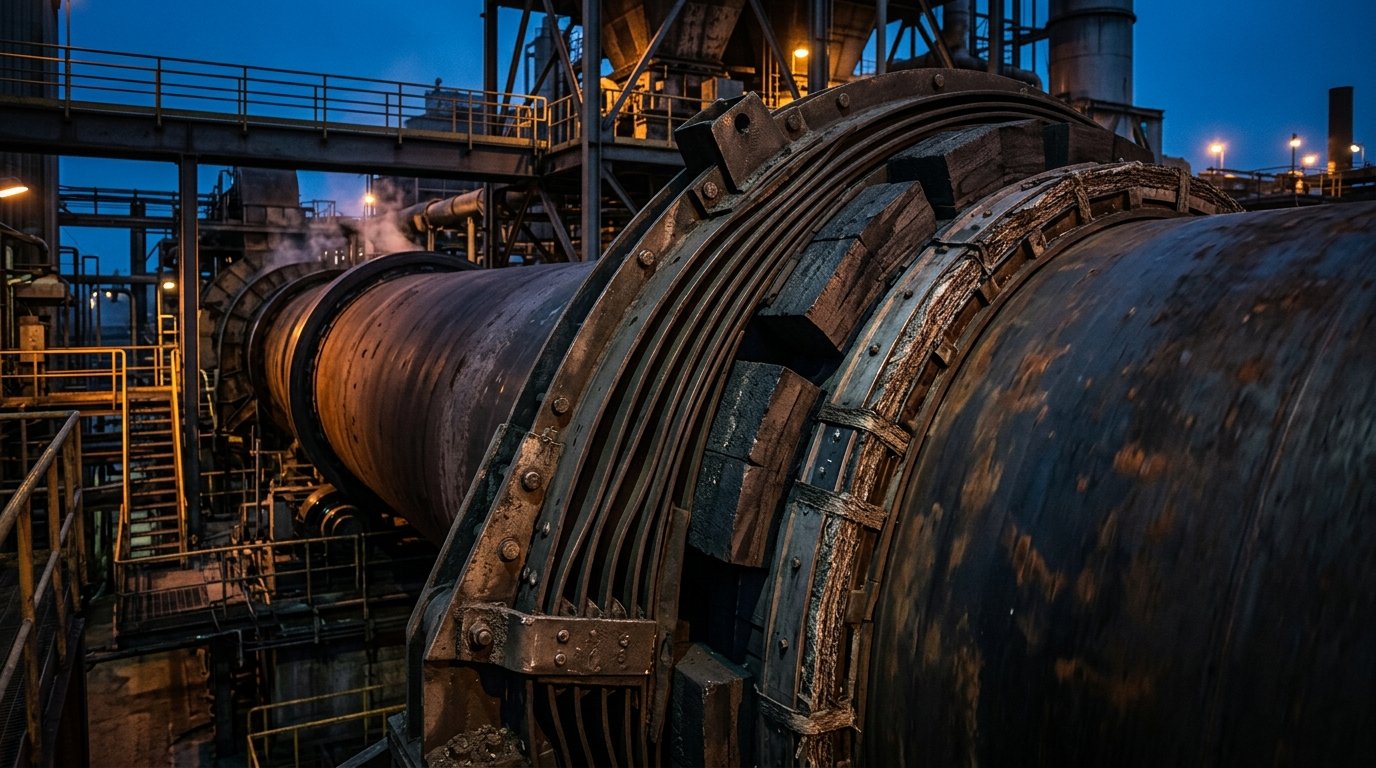
The kiln is a dynamically expanding structure, so any sealing material has to hold contact against a shell that never holds still while resisting the heat and dust around it. The shell expands radially with temperature, walks axially (float) under load, and runs slightly out of round (ovality) on every revolution, all while the seal face sees extreme temperatures, abrasive dust, and continuous 24x7 duty [1]. The material choice comes down to which of those stressors dominates at a given seal position.
The stakes are false air. False air is air drawn into a rotary kiln through unintended openings (seals, hood interfaces, inspection ports) rather than through the controlled combustion-air path.
False air: air drawn into a rotary kiln system through unintended openings such as worn or open seals, hood interfaces, and inspection ports, rather than through the controlled combustion-air path. It is quantified as a percentage of total combustion air.
A seal material that holds contact closes the leakage path; one that erodes, oxidises, or loses tension opens it. The leverage is large: the kiln inlet and outlet seals together account for roughly 60-75% of total false air in a cement plant [2][3], and each 1% of false air above baseline adds on the order of 3 kcal/kg clinker in wasted fuel [2]. The fuel and draft cost of that leakage is covered in false air in cement kilns. Four stressors decide the material: movement, temperature, abrasion, and duty cycle. The sections below take the three material families against them.
Spring-steel lamellae: the movement material
Spring-steel lamellae are overlapping sprung leaves that flex continuously with shell movement, so the material is specified for resilience rather than heat resistance. A typical inlet lamella seal uses two sets of spring-steel lamellae with a layer of heat-resistant fabric between them; the spring effect forces the inner set against a wear ring on the shell, and the fabric layer protects the outer set so it keeps its resilience [4]. Because the leaves are sprung rather than rigid, the pack holds a continuous sealing line that tracks the shell instead of leaving a fixed clearance.
The material property that matters is spring temper. Spring steel is heat-treated, typically tempered in roughly the 300-500C range, and it loses load-bearing capacity if its service temperature climbs into or past that tempering range [5]. That is the honest material limit on a leaf pack: at the hottest seal positions the spring steel softens and the leaves relax, which is why lamellae are the mainstream form at the cooler kiln inlet and not the extreme outlet. Within that envelope, spring steel is the right material where the dominant problem is movement: it follows radial expansion, axial float, and ovality continuously and re-seats every revolution.
Oswal specifies its lamella-based sealing elements for "flexible adaptation to shell movement, controlled contact pressure, and mechanical resilience under dynamic conditions" [6]. The leaf pack is near maintenance-free, needs no greasing, and is quick to install or replace, which is why it carries a lower installed cost than a machined graphite block seal at a movement-dominated position. Oswal's kiln inlet sealing system is built around this family, engineered for retrofit onto existing inlet hood geometries with axial and radial compensation [6]. The full material and wear treatment is in lamella kiln seals.
Graphite: the heat-and-abrasion material
Graphite is self-lubricating, dimensionally stable under heat, and abrasion-resistant, so it slides against a hot rotating shell at low, stable friction and wears slowly under dust. A graphite kiln seal is a ring of segmented graphite blocks, each held against the shell by its own spring or thrust element so the blocks track kiln movement individually while closing the leakage path [7]. The material does the work that spring steel cannot at the hottest, dustiest positions.
The behaviour follows from the crystal structure. Graphite's layers shear easily over one another, giving a low, stable coefficient of friction, typically around 0.17-0.22 for pretreated graphite as a general material figure [8][9]. It also has a low coefficient of thermal expansion and high thermal conductivity, which help the seal face hold geometry and shed frictional heat, and it is hard-wearing under continuous dust. The trade-off is mechanical: graphite is brittle, high in compressive strength but low in tensile and shear, so blocks are loaded in compression against the shell rather than asked to flex [10].
The one material limit is oxidation in air. Above roughly 450C in an oxidising atmosphere, bare graphite begins technically relevant oxidative decay, with common sealing grades rated for long-term air service to about 450C and toward roughly 525C with an oxidation inhibitor; in inert atmospheres graphite tolerates far higher temperatures [11][12]. That is a bare-material reference, not the service rating of a finished seal: in service the graphite grade, any oxidation-inhibiting impregnation, and the geometry manage oxidation, which is why a graphite seal is specified by its supplier for the position rather than read off a raw-material datasheet. Oswal's graphite-based sealing elements are specified for "high-temperature resistance, continuous sealing contact, stable friction characteristics, and long wear life under dust exposure" [6], and the kiln outlet sealing system applies them at the discharge end, which the Oswal literature describes as one of the harshest mechanical and thermal environments in the plant [6]. The material science is covered in full in graphite kiln seals.
Composite hybrids: when one material is not enough
A composite hybrid combines a primary lamella interface for movement with a secondary graphite interface for high-temperature sealing, so the assembly adapts to kiln distortion rather than forcing one material to do both jobs. Where a single seal position sees both severe movement and sustained heat, neither spring steel nor graphite alone is the clean answer: spring steel relaxes in the heat, and brittle graphite handles large, fast movement excursions less gracefully than a sprung leaf pack. The composite places each material where it is strongest.
Oswal's Duplex kiln sealing system is the worked example of this material family. It runs a primary lamella interface that absorbs axial and radial movement and a secondary graphite interface that maintains continuous high-temperature sealing contact, providing radial and axial compensation in high-dust zones [13]. The system is retrofittable onto existing kiln geometries [13]. A composite is not the default for every position: a movement-dominated inlet is often well served by spring-steel lamellae alone, and a hot, abrasive outlet by graphite alone. The composite earns its place where one location genuinely combines both stressors. Tracking seal condition and false-air measurement together across all three interfaces is the principle behind Oswal's integrated false air control.
Kiln seal material comparison
The table below compares the three material families across the stressors that decide a seal position. Cells are qualitative where no published numeric spec exists; numeric entries are general material figures, inline-cited, not Oswal product specifications.
| Property | Spring-steel lamellae | Graphite | Composite hybrid |
|---|---|---|---|
| Working principle | Overlapping sprung leaves flexing against the shell [4][6] | Segmented blocks pressed against the shell by individual springs [7] | Primary lamella interface + secondary graphite interface [13] |
| Dominant stressor it suits | Movement (expansion, float, ovality) | Sustained heat + abrasive dust | Both movement and heat at one position |
| Movement compensation | Strong: continuous flex [6] | Moderate: blocks track individually but are brittle [7][10] | Strong: lamella interface absorbs radial + axial movement [13] |
| Temperature suitability | Limited by spring temper (~300-500C range) [5] | High; bounded by air oxidation (~450C, ~525C with inhibitor) [11][12] | High: graphite interface carries the heat [13] |
| Abrasion / dust | Erodes faster under heavy dust | High wear resistance under dust [6][10] | High: graphite interface handles dust [13] |
| Friction behaviour | Sprung-leaf contact | Self-lubricating, low stable friction ~0.17-0.22 (general) [8][9] | Combined |
| Typical kiln position | Mainstream at the inlet [4] | Common at the hot, dusty outlet [6] | Positions needing both [13] |
| Relative first cost | Lower (leaf pack) | Higher (machined blocks + thrust modules) | Highest (dual interface) |
| Retrofit | Quick, low-disruption [6] | Position-specified | Retrofittable onto existing geometry [13] |
How to pick the material for a seal position
Match the material to the dominant stressor at the specific seal position, then validate against temperature, dust, movement, and cost. The decision is per position, not per kiln: a single kiln can run spring-steel lamellae at a movement-dominated inlet and graphite at a hot, abrasive outlet, with a composite reserved for any position that combines both.
The short logic: if the position is dominated by shell movement and runs cooler, spring-steel lamellae are usually the best value; if it is hot and dusty with continuous contact, graphite wins on wear life; if one location sees both severe movement and extreme heat, a composite hybrid beats either material alone. For the two-way material decision in detail, see lamella vs graphite kiln seals. For the full position-by-position decision tree that maps every seal location to a material, work through the guide to choosing a kiln seal, the selection hub these material explainers feed into.
If you are choosing a sealing material for a specific kiln position, our engineering team works through the temperature, dust, and movement profile of each seal location and maps it to spring-steel lamellae, graphite, or a composite hybrid against your kiln's process data. Contact us to walk through your configuration.
Common questions about this topic
Kiln seals are made from three material families: spring-steel lamellae, segmented graphite, and composite hybrids that combine the two. Spring-steel lamellae are overlapping sprung leaves chosen for flexibility against shell movement; graphite is a ring of segmented self-lubricating blocks chosen for sustained heat and abrasive dust; a composite hybrid runs both interfaces together for a position that sees both stressors. Each material is selected for the dominant stressor at a specific seal position rather than picked in the abstract, as set out across Oswal's lamella-based and graphite-based sealing elements.
Neither is universally better; they suit different stressors. A spring-steel lamella seal is the stronger choice where shell movement, ovality, and lower installed cost dominate, typically the cooler kiln inlet, because spring steel flexes continuously but loses temper at the hottest positions [5]. A graphite seal is better where sustained high temperature and abrasive dust dominate, typically the kiln outlet, because graphite is self-lubricating and slow-wearing but brittle and bounded by air oxidation [6][11]. The right comparison is per seal position, detailed in lamella vs graphite kiln seals.
A composite kiln seal combines two sealing materials in one assembly: a primary spring-steel lamella interface that absorbs radial and axial shell movement, and a secondary graphite interface that maintains high-temperature sealing contact. It is built for a seal position that sees both severe movement and sustained heat, where neither material alone is a clean answer. Oswal's Duplex kiln sealing system is the worked example, providing radial and axial compensation in high-dust zones and retrofittable onto existing kiln geometry [13].
Wear life is position-dependent, not a property of one material in isolation. Graphite lasts longest under sustained heat and heavy abrasive dust, because it is self-lubricating and slow-wearing in exactly the conditions that erode a spring-steel leaf pack [6][10]. Spring-steel lamellae last well at cooler, movement-dominated positions where their continuous flex avoids the cracking a brittle material would suffer [4]. Where one position combines both stressors, a composite hybrid places each material where it wears slowest. Match the material to the dominant stressor using the kiln seal comparison guide.
Sources
- Oswal Engineers, *Kiln Sealing Systems* (product catalogue: the kiln as a dynamically expanding structure; lamella-based, graphite-based, and Duplex sealing elements; inlet and outlet sealing systems). `OSWAL_kilnseal.pdf`
- Oxmaint, *Kiln Inlet and Outlet Seal Maintenance for Cement Plants*
- Cement-Plants.com, *Kiln Seal: Kiln Inlet Seal and Kiln Outlet Seal Rotary Kiln Sealing System*
- INFINITY FOR CEMENT EQUIPMENT, *Kiln Inlet Lamella Seal*
- Lesjofors, *Heat Treatment for Spring Steel* (tempering range and high-temperature loss of strength, general material reference)
- Oswal Engineers, *Kiln Sealing Systems* (product catalogue: lamella-based, graphite-based sealing elements; kiln inlet and kiln outlet sealing systems). `OSWAL_kilnseal.pdf`
- Fuller Technologies, *Spring-tensioned Kiln Graphite Seal*
- JST Sealing Technologies, *Application of Carbon Graphite Seals*
- Star Graphite, *Uses of Graphite in Lubrication and Sealing Solutions*
- SealFAQs, *Materials: Carbon-Graphite Seal Faces*
- SGL Carbon, *SIGRAFLEX Thermal Stability* (technical information)
- NeoGraf Solutions, *GraFoil Flexible Graphite*
- Oswal Engineers, *Duplex Kiln Sealing System* (catalogue). `KilnSeal_DuplexType_OK_CAT.pdf`
Verwandte Artikel
Discuss Your Sealing Requirements
Our engineering team can help identify the right sealing solution for your application.
Contact Engineering Team“Überall dort, wo Hochtemperatur-Drehrohröfen unter kontrollierter Atmosphäre betrieben werden, sorgen Oswal-Dichtungssysteme für Energieeffizienz und Prozessstabilität.”