
Choosing a Kiln Seal: Lamella vs Graphite vs Duplex
Compare lamella, graphite, and Duplex kiln seals across movement, temperature, wear life, and cost. A selection framework for choosing a kiln seal.
Choose a kiln seal by the dominant failure mode at the seal position: lamella when movement and shell ovality dominate, graphite when sustained high temperature and abrasive dust dominate, and a Duplex (hybrid lamella plus graphite) seal when a single position suffers both at once. Most plants do not pick one seal type in the abstract. They pick per position, because the kiln inlet and the kiln outlet fail for different reasons. This guide gives the selection framework: the three seal types, a quantified comparison table, how to read it by failure mode, how to refine the choice by kiln position, and what the decision is worth in fuel terms.
A note on terms first. In this context, lamella and graphite refer to sealing elements at a rotary kiln shell, not to lamella clarifier plates in water treatment or graphite mechanical seals in pumps and turbines. Everything below is about the seal that sits where the rotating kiln meets the stationary inlet or outlet hood.
The three kiln seal types, in one paragraph
Three sealing principles cover almost every rotary kiln seal position: lamella (overlapping spring-steel leaves), graphite (segmented self-lubricating blocks), and Duplex (a hybrid that combines both in one assembly). They are not ranked best to worst. Each is the right answer for a different load case, and Oswal manufactures all three.
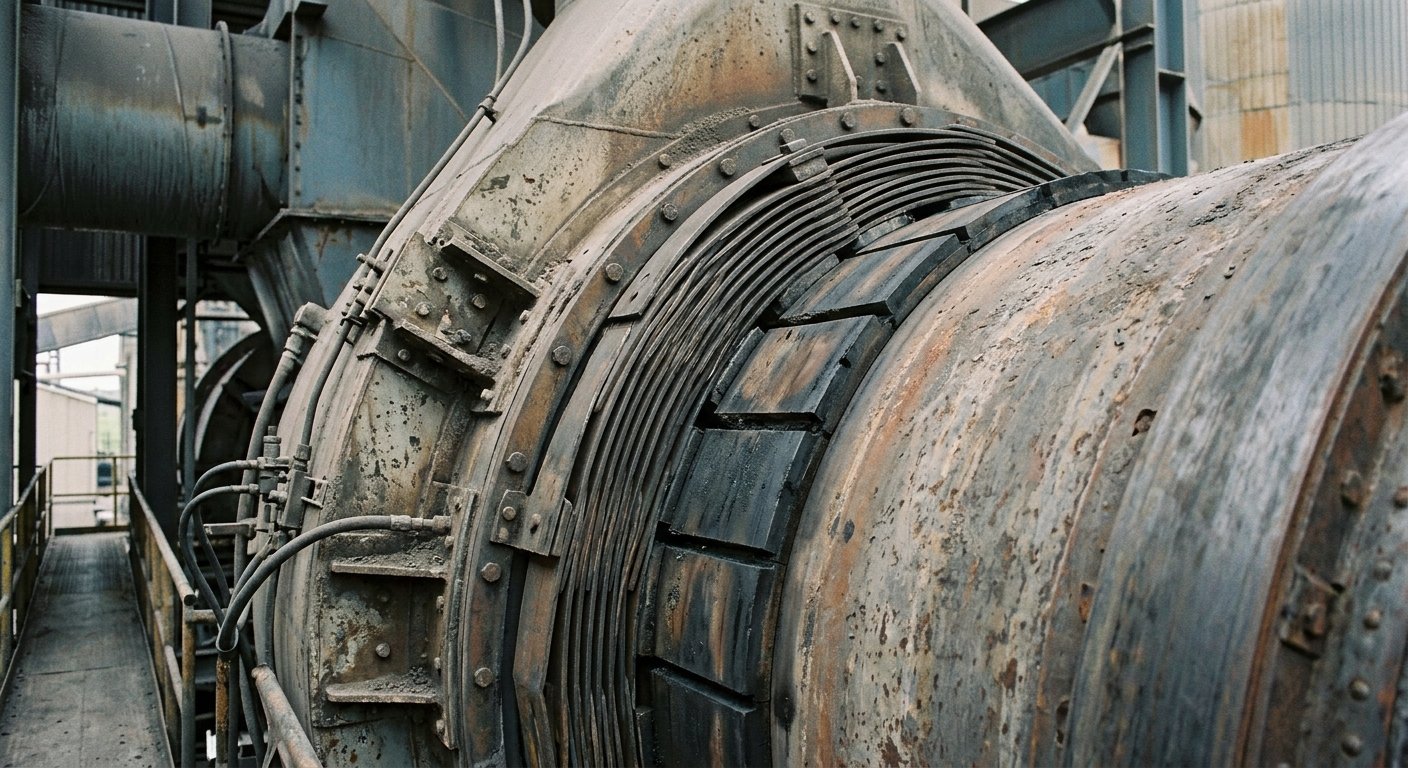
Lamella kiln seal: a seal that closes the kiln-to-hood gap using overlapping spring-steel leaves (lamellae) pressed against the rotating shell, which flex as the kiln expands, walks axially, and runs out of round.
Graphite kiln seal: a seal that closes the gap using a ring of segmented graphite blocks, each pressed against the rotating shell by its own spring or thrust module, so the self-lubricating blocks track kiln movement individually and tolerate high temperature.
Duplex (hybrid) kiln seal: a seal that combines a primary lamella interface for movement compensation with a secondary graphite interface for high-temperature sealing, in a single assembly, so one position can handle both severe movement and extreme heat.
The product lines are the lamella kiln seal, the graphite kiln seal, and the Duplex kiln sealing system. For the deep two-way head-to-head between the first two, see the dedicated lamella vs graphite comparison. This page is the broader hub: it adds the Duplex third option and frames the whole decision.
The selection table: lamella vs graphite vs Duplex
The table below compares the three kiln seal types across the eight criteria that actually decide a seal selection: sealing principle, movement and ovality tolerance, temperature suitability, wear life, maintenance interval, retrofit complexity, relative cost band, and best-fit use case. The numeric cells are general industry typicals with inline citations, not Oswal product specifications; cells are qualitative where no published numeric figure exists, and we do not assign temperature or leakage numbers that the source material does not support.
| Criterion | Lamella seal | Graphite seal | Duplex (hybrid) seal |
|---|---|---|---|
| Sealing principle | Overlapping spring-steel leaves sprung against the shell [1][2] | Segmented graphite blocks, each individually actuated against the shell [3][4] | Primary lamella interface plus secondary graphite interface in one assembly [2][5] |
| Movement / ovality tolerance | Strong: leaves flex continuously with radial expansion, axial walk, and ovality [2] | Moderate: blocks track movement individually but with less continuous flex than a leaf pack [3] | Strong: lamella layer absorbs movement so the graphite layer holds contact through distortion [2][5] |
| Temperature suitability | Good, limited by spring-steel tempering at the hottest positions [1] | Stronger: graphite holds properties at high temperature, with cooling to stay below its oxidation point [3][4] | Stronger: graphite layer carries the thermal duty while the lamella layer carries movement [2][5] |
| Wear life (industry typical) | Wear parts commonly 10,000-20,000 service hours, process-dependent [1] | Graphite block seals commonly 3-5 years in service [3] | Vendor-positioned for long operational life and lower seal-replacement frequency [5] |
| Maintenance interval | Periodic leaf-pack and spring-tension checks [1] | Periodic block-face and thrust-module checks; cooling-air system to verify [4] | Periodic checks on both interfaces; positioned for reduced maintenance frequency [5] |
| Retrofit complexity | Low: established mainstream form, simple to install [1] | Moderate: machined blocks, thrust modules, and cooling provisions [3][4] | Moderate: modular design for retrofit onto existing kiln geometries [5] |
| Relative cost band | Lower installed cost | Higher (machined blocks plus thrust modules) | Highest (dual-layer assembly), offset by wear life and fuel savings |
| Best-fit use case | Movement-dominated positions, typically the kiln inlet | Sustained high-temperature, high-dust positions, typically the kiln outlet | Positions that see both severe movement and extreme heat at once |
The pattern in the table is the whole selection logic in miniature: lamella buys movement tolerance and low cost, graphite buys heat and dust durability, and Duplex buys both at a higher first cost. The next two sections turn that into a decision.
How to read the table: pick by dominant failure mode first
Start the selection by naming the dominant failure mode at the seal position, not by comparing brands: movement-dominated positions point to lamella, heat-and-dust-dominated positions point to graphite, and positions that suffer both point to a Duplex hybrid. The honest framing is that the seal types are not competitors so much as fits for different load cases on the same kiln.
Choose lamella when:
- Shell movement, axial walk, or ovality is the main sealing problem; the leaf pack flexes to track it continuously [2].
- The position runs hot but not at the outlet extreme.
- First cost and ease of installation weigh heavily in the decision.
Choose graphite when:
- The seal sits in a sustained high-temperature, abrasive-dust stream where a spring-steel leaf pack would lose temper and erode [3][4].
- Long wear life between replacements matters more than first cost; graphite block seals commonly run 3-5 years [3].
- Stable, self-lubricating friction against the shell over long campaigns is a priority.
Choose Duplex when:
- A single position genuinely sees both severe movement and extreme heat, so neither single principle is sufficient on its own [2][5].
- The cost of recurring seal failure or false-air drift outweighs the higher first cost of a dual-layer assembly.
The trade-off is real and worth stating plainly. Lamella is cheaper and excels at movement but is more exposed to heat and abrasion; graphite costs more and holds up in the harshest thermal and dust conditions but flexes less; Duplex removes that either-or at the cost of being the most expensive of the three to supply.
Then pick by kiln position: inlet vs outlet
After the failure mode, the second filter is position: the kiln inlet (feed end) is movement-sensitive and runs hot but not extreme, while the kiln outlet (discharge end) is the harshest thermal and abrasion zone in the plant. The two interfaces fail for different reasons, so a single kiln often carries two different seal choices.
| Position | Dominant challenge | Leaning seal family |
|---|---|---|
| Kiln inlet (feed end) | Axial walk, radial expansion, ovality; high but not extreme heat | Lamella, or Duplex where heat is also significant |
| Kiln outlet (discharge end) | Extreme temperature, heavy abrasive dust | Graphite, or Duplex where movement is also severe |
The kiln inlet sealing system is the feed-end interface, where false air ingress disturbs flame shape, temperature profile, and calcination stability, which is why movement compensation and a tight inlet seal matter most there. The kiln outlet sealing system sits in one of the harshest mechanical and thermal environments in the plant, where abrasion resistance and thermal-shock tolerance dominate. A common, defensible configuration is lamella-leaning at the inlet and graphite or Duplex at the outlet. The position decision, and the related question of whether a position needs one seal stage or two, are covered in kiln inlet vs outlet seals and single vs double kiln seals.
Why the Duplex hybrid exists: when one principle is not enough
A Duplex seal exists for the position that suffers both severe movement and extreme heat at once, where forcing a single principle to do both jobs leaves a compromise. The Oswal Duplex Kiln Sealing System pairs a primary lamella interface for movement compensation with a secondary graphite interface for high-temperature sealing, so the assembly adapts to kiln distortion rather than resisting it [2][5]. Per the Duplex catalogue, the lamella layer absorbs axial and radial variation while the graphite layer maintains thermal sealing contact, and pressure distribution stays uniform across the interface [5].
The hybrid is not the default for every kiln. A movement-dominated inlet may be well served by lamella alone, and a cost-sensitive retrofit may not justify a dual-layer system. It earns its place where a position is both movement-severe and heat-severe, the case a single family handles only by compromise. The system is designed for retrofit onto existing kiln geometries with a modular layout for installation and service [5], and the catalogue positions its payback at typically 6 to 18 months from reduced fuel consumption, lower ID fan power, and improved process stability [5]; treat that as a vendor-stated range to validate against your own kiln's energy baseline before purchase. The mechanism is covered in more depth in Duplex sealing technology explained, and the physical swap is scoped through installation and retrofit.
What a seal swap is worth in fuel terms
The reason seal selection is worth getting right: the kiln inlet and outlet seals together account for roughly 60-75% of total false air in a cement plant, and every 1% of false air above baseline costs on the order of 1.5-3 kcal/kg clinker in wasted fuel [6][7][8]. False air is uncontrolled ambient air drawn into the kiln through unintended openings rather than through the controlled combustion-air path; the seal you choose is one of the highest-leverage levers on it.
The arithmetic compounds quickly. A kiln running five percentage points of false air above baseline carries roughly 7.5-15 kcal/kg clinker of avoidable fuel penalty before counting the additional ID-fan electrical load, which on a 5,000 t/day kiln runs into hundreds of thousands of dollars a year at typical coal prices. The full worked example, with coal price, lower heating value, and ID-fan load, is in false air in cement kilns. The point for seal selection is narrower: a seal chosen for the wrong failure mode does not hold its design-intent reduction, the false air drifts back, and the savings leak away. Choosing for the right load case, and then tracking the result on a consistent kiln seal inspection cadence, is what makes the saving stick.
If you are choosing a seal for a specific kiln, our engineering team works the inlet and outlet positions case by case, mapping each to lamella, graphite, or a Duplex hybrid against its movement and thermal profile. Contact us with your kiln's process and movement data.
Common questions about this topic
There is no single best kiln seal; the best choice is the one matched to the dominant failure mode at the seal position. Lamella is best where shell movement and ovality dominate, graphite is best where sustained high temperature and abrasive dust dominate, and a [Duplex hybrid seal](/en/products/duplex-kiln-sealing-system) is best where a single position suffers both at once. Because the kiln inlet and outlet fail for different reasons, most plants end up with different seal types at the two ends rather than one universal winner.
A lamella seal uses overlapping spring-steel leaves that flex with kiln movement, while a graphite seal uses segmented self-lubricating blocks that tolerate high temperature and abrasive dust. Lamella favours movement compensation and lower first cost; graphite favours heat and wear resistance, with graphite block seals commonly lasting 3-5 years in service [3]. The full side-by-side, including sealing performance and lifecycle cost, is in the [lamella vs graphite comparison](/en/blog/lamella-vs-graphite-sealing).
Yes. Kiln seals are designed to retrofit onto existing kiln geometries, so the seal can be replaced without touching the kiln shell or hoods structurally [5]. The mechanical swap of an inlet or outlet seal typically takes about 3 to 7 days of kiln stop and is usually scheduled into a planned refractory campaign so the kiln does not have to stop for sealing alone. Oswal's [installation and retrofit](/en/services/installation-retrofit) team scopes the position, the movement envelope, and the seal selection as one engagement.
Sources
- INFINITY FOR CEMENT EQUIPMENT, *Information about Kiln Inlet Lamella Seal*. Source for lamella sealing principle and the 10,000-20,000 service-hour wear-part range (general industry figure)
- Oswal Engineers, *Kiln Sealing Systems: Global Benchmark in False Air Control* (product catalogue: lamella-based, graphite-based, and Duplex sealing elements). Source for product descriptions and the lamella-flexibility / graphite-durability framing. `OSWAL_kilnseal.pdf`
- Rotary Kiln Factory, *Rotary Kiln Sealing System: Kiln Inlet and Outlet Graphite Seal*. Source for the graphite block seal 3-5 year service-life figure (general industry figure)
- Fuller Technologies, *Spring-tensioned Kiln Graphite Seal*. Source for individually actuated graphite blocks and the cooling-to-stay-below-oxidation-temperature point (general industry figure)
- Oswal Engineers, *Duplex Kiln Sealing System* (catalogue). Source for the hybrid lamella-plus-graphite architecture, retrofit compatibility, modular install, and the vendor-stated 6-18 month payback range. `KilnSeal_DuplexType_OK_CAT.pdf`
- Oxmaint, *Cement Kiln Energy Optimization: Reducing Fuel Consumption*. Source for the ~3 kcal/kg clinker per 1% false air figure (general industry figure)
- Cement-Plants.com, *Kiln Seal: Kiln Inlet Seal and Kiln Outlet Seal Rotary Kiln Sealing System*. Source for the inlet-plus-outlet share of total false air (general industry figure)
- Holderbank Group / Holcim, *Cement Manufacturing: Process Technology*, Volume 2 (Holderbank Cement Course). Canonical training reference for the 1.5-2.5 kcal/kg-per-% false-air SFC penalty convention.
Verwandte Artikel
Discuss Your Sealing Requirements
Our engineering team can help identify the right sealing solution for your application.
Contact Engineering Team“Überall dort, wo Hochtemperatur-Drehrohröfen unter kontrollierter Atmosphäre betrieben werden, sorgen Oswal-Dichtungssysteme für Energieeffizienz und Prozessstabilität.”