
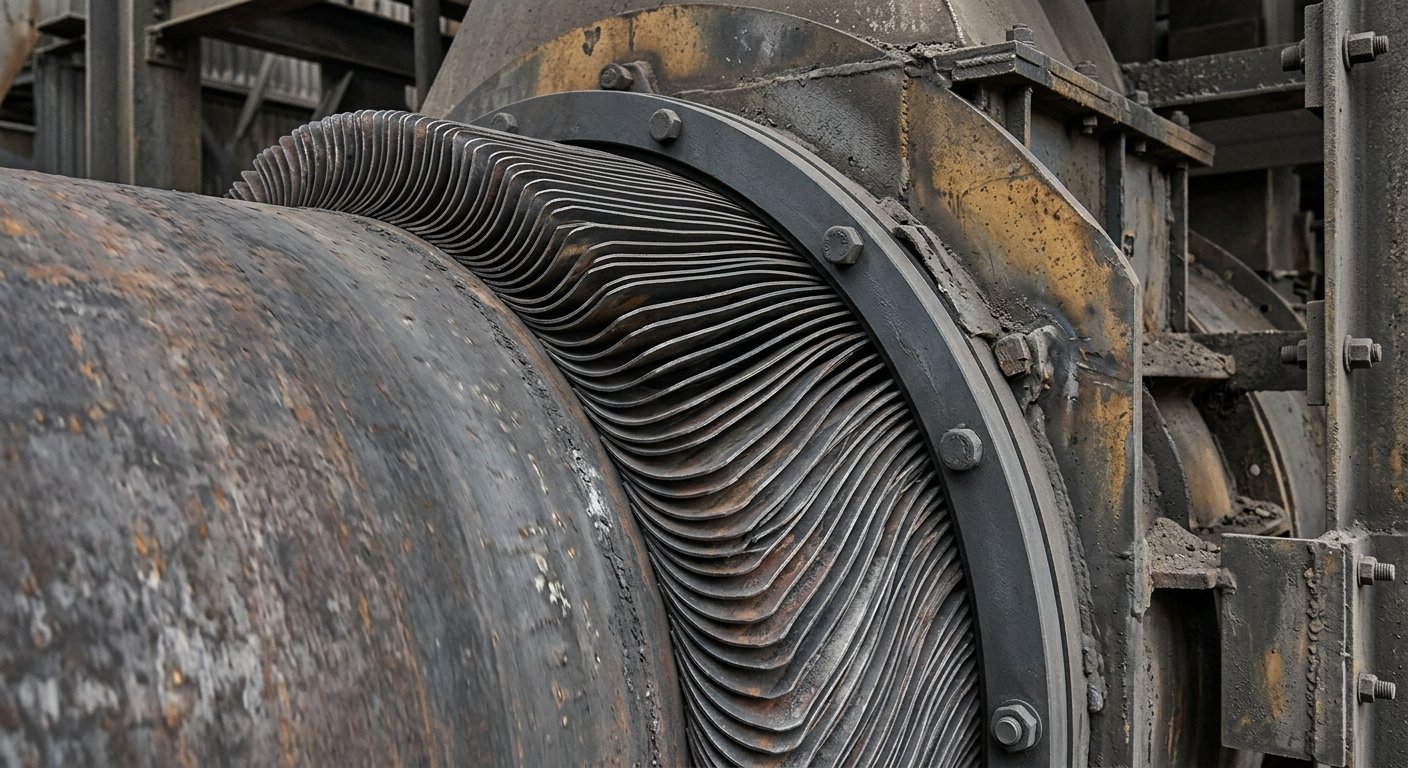
Lamella Kiln Seals: Sealing Against Shell Movement
Lamella kiln seals use overlapping spring-steel leaves to seal a moving, out-of-round rotary kiln shell. How leaf seals work and when to specify them.
A lamella kiln seal closes the gap between a rotating kiln shell and its stationary hood using overlapping spring-steel leaves (lamellae) that press against the shell and flex as it moves. It is the mainstream sealing form at the kiln inlet because its defining property is flexibility: it follows a shell that expands, walks, and runs out of round rather than fighting it. This piece covers how a leaf seal works, the kiln-movement problem it is built for, where it wins, where graphite or a hybrid is better, and how the leaf pack wears.
A note on the term: in this context, lamella refers to the spring-steel leaf elements at a rotary kiln shell, not to lamella clarifier plate packs in water treatment.
What a lamella kiln seal is and how it works
A lamella kiln seal seals the kiln-to-hood gap with overlapping spring-steel leaves (lamellae) that are sprung against the rotating shell and flex as it moves. A typical inlet lamella seal uses two sets of spring-steel lamellae with a layer of heat-resistant fabric between them; the spring effect forces the inner set against the cooling mantle around the shell, and the fabric layer protects the outer set so it keeps its resilience [1].
Lamella kiln seal: a kiln seal that closes the gap between a rotating kiln shell and its stationary hood using overlapping spring-steel leaves (lamellae) pressed against the shell, which flex to follow shell movement and maintain contact.
The leaves overlap around the full circumference, each spring-loaded so the pack rides on a wear ring (cooling mantle) on the rotating drum [2]. Because the leaves are sprung rather than rigid, the contact pressure is controlled and continuous: the pack holds a sealing line against the shell instead of leaving a fixed clearance that air can leak through. Oswal specifies its lamella elements for "flexible adaptation to shell movement, controlled contact pressure, and mechanical resilience under dynamic conditions" [3].
The point of this is to keep false air out. False air is air drawn into the kiln through unintended openings (seals, hood interfaces, inspection ports) rather than through the controlled combustion-air path. A leaf pack in good contact closes the seal-face leakage path; one that wears or relaxes opens it. The fuel and draft cost of that leakage is covered in false air in cement kilns; the full product family is on the lamella sealing elements page.
The kiln-movement problem a lamella seal is built for
A lamella seal exists to keep contact with a kiln shell that never holds still: the shell expands radially with heat, walks axially (float) under load, and runs slightly out of round (ovality) on every revolution. A rigid seal opens a leakage gap the moment the shell moves away from it; the lamellae deflect and submerge to follow the shell instead [4]. Three movement modes drive the requirement:
Shell ovality: the cyclic out-of-round deformation of a rotary kiln shell as it rotates, usually largest near the tyres. It is measured as a percentage of kiln diameter; acceptable limits are typically 0.5 to 1.5% depending on diameter and design (for example, about 0.46% maximum for a 3.6 m kiln) [5]. These are general industry figures, not an Oswal product spec.
Each mode draws a different response from the pack. Under radial expansion, the leaves deflect outward and stay sprung against the larger shell diameter. Under axial float, the contact line slides along the wear ring within tolerance. Under ovality, each leaf submerges and re-extends per revolution to track the changing radius [4][5]. Where a rigid plate would crack or open a gap under cyclic ovality, a sprung leaf pack flexes with it; Oswal's positioning is exactly this, that "their flexibility ensures sealing continuity despite shell deformation" [3]. For the axial component specifically, lamella is often paired with axial compensation seals so the axial float is absorbed by a dedicated element rather than the leaf pack alone.
Lamella seal at a glance
The table below summarises the working principle, movement handling, position, wear life, and maintenance profile of a lamella kiln seal. Cells are qualitative where no published numeric spec exists; numeric entries are general industry typicals, inline-cited, not Oswal product specifications.
| Property | Lamella kiln seal |
|---|---|
| Working principle | Overlapping spring-steel leaves (lamellae) sprung against the rotating shell [1][3] |
| Construction | Two sets of spring-steel lamellae with a heat-resistant fabric layer between them, riding on a wear ring / cooling mantle [1] |
| Movement compensation | Strong: leaves flex continuously with radial expansion, axial float, and ovality [3][4] |
| Typical kiln position | Mainstream at the kiln inlet; usable at moderate-temperature positions [1] |
| Sealing performance | Low seal-face leakage when contact pressure is maintained; degrades as leaves wear or relax [1][2] |
| Temperature suitability | Good at moderate-to-high temperatures; limited by spring-steel tempering at the hottest positions |
| Wear-part service life | Commonly 10,000-20,000 hours depending on process conditions (general) [1] |
| Maintenance | Near maintenance-free under normal operation; no greasing; quick to install or replace [6] |
| Relative first cost | Lower installed cost than a machined-block graphite seal |
Where lamella seals win
Lamella seals are the right call where the dominant sealing challenge is movement rather than sustained extreme heat. Four conditions favour them:
- Movement and ovality dominate. When the main problem is shell expansion, axial walk, or ovality, the continuous flex of a sprung leaf pack tracks it better than a stiffer arrangement. This is the lamella seal's home ground [3][4].
- Retrofit. A lamella seal is quick to install or replace and integrates with existing hood geometry, a low-disruption retrofit on an in-service kiln [6]. Oswal's inlet sealing systems are engineered for retrofit onto existing kiln geometries and various inlet hood configurations [3].
- Cooler-to-moderate temperatures. The inlet runs hot but not at the outlet extreme, so the spring-steel leaves hold their temper and last.
- Cost and maintenance simplicity. Lower installed cost than a machined graphite block seal, no greasing, and near maintenance-free operation under normal conditions [6]. For a movement-dominated position, that is usually the best value.
Limitations, and when graphite or the Duplex hybrid is the better call
Lamella seals are weakest in sustained extreme heat and heavy abrasive dust: spring steel loses temper at the hottest positions, and the leaves erode faster than graphite under continuous dust loading. That is why hot, abrasive positions such as the kiln outlet often favour graphite or a hybrid rather than a leaf pack.
The honest trade-off is heat and abrasion versus movement and cost. A lamella seal excels at movement and costs less to install, but it is more sensitive to sustained high temperature and heavy dust than graphite-based sealing elements, which are self-lubricating, hold stable friction against the shell, and wear slowly under dust exposure [3]. For the full head-to-head, see lamella vs graphite kiln seals and the dedicated graphite kiln seals explainer.
Where a single position genuinely needs both movement flexibility and high-temperature durability, the answer is not to force one family to do both jobs. Oswal's Duplex kiln sealing system combines a primary lamella interface for adaptive movement compensation with a secondary graphite interface for continuous high-temperature sealing, so the assembly adapts to kiln distortion instead of resisting it [7]. The Duplex is not the default for every position; a movement-dominated inlet may be well served by lamella alone. For the full lamella-graphite-hybrid evaluation, work through the guide to choosing a kiln seal.
Maintenance, leaf wear, and inspection
A lamella seal is near maintenance-free under normal operation, but the leaf pack still wears, so it needs a defined inspection cadence rather than annual-only checks. The leaves erode at the contact edge, lose spring tension over time, and can droop or go missing; uneven wear across the pack often points to kiln ovality or misalignment rather than the seal itself [2][6].
Wear parts commonly run 10,000 to 20,000 service hours depending on process conditions, and replacement is quick because the leaf pack is a modular, boltable element [1][6]. With no greasing required, the practical task is condition monitoring: catching lost tension or edge erosion before it becomes a measurable false-air rise. A graded inspection on a fixed cadence (daily visual, weekly logged, hands-on at every planned shutdown), tied to a four-stage wear-grading framework, is set out in kiln seal inspection cadence and methodology. Tracking seal condition and false-air measurement together is the principle behind Oswal's integrated false air control system.
If you are specifying a seal for a movement-dominated kiln position, our engineering team works through the inlet and outlet positions case by case, mapping each to lamella, graphite, or a hybrid against your kiln's process and movement profile. Contact us to walk through your configuration.
Common questions about this topic
A lamella kiln seal is a rotary kiln seal that closes the gap between the rotating shell and the stationary hood using overlapping spring-steel leaves (lamellae) pressed against the shell. The leaves are spring-loaded so they flex to follow shell movement and hold a continuous sealing line, keeping false air out of the kiln. A typical inlet design uses two sets of spring-steel lamellae with a heat-resistant fabric layer between them [1], as documented on Oswal's [lamella sealing elements](/en/products/lamella-based-sealing-elements) page.
A lamella seal handles movement because its leaves are sprung against the shell and deflect to follow it: they extend with radial expansion, slide along the wear ring with axial float, and submerge then re-extend each revolution to track ovality [4]. Shell ovality is typically held in the range of 0.5 to 1.5% of kiln diameter (a general industry figure), and the leaf pack flexes within that cyclic deformation rather than opening a fixed leakage gap [5]. For larger axial excursions, lamella is often paired with [axial compensation seals](/en/products/axial-compensation-seals).
Neither is universally better; they suit different conditions. A lamella seal is the stronger choice where movement, ovality, and first cost dominate, typically the kiln inlet, while a graphite seal is better in sustained extreme heat and heavy abrasive dust, typically the kiln outlet [3]. The right comparison is per seal position, not seal type in the abstract. The full head-to-head is in [lamella vs graphite kiln seals](/en/blog/lamella-vs-graphite-sealing).
Lamella seal wear parts commonly last 10,000 to 20,000 service hours depending on process conditions, and the seal is near maintenance-free under normal operation, with no greasing required and quick replacement of the leaf pack [1][6]. The practical task is condition monitoring: a graded inspection on a daily, weekly, and shutdown cadence catches lost spring tension and edge erosion before they cause a measurable false-air rise, as set out in the [kiln seal inspection cadence](/en/blog/kiln-seal-inspection-cadence-methodology).
Sources
- INFINITY FOR CEMENT EQUIPMENT, *Kiln Inlet Lamella Seal*
- ProcessBarron, *Kiln Seals & Seal Leaves*
- Oswal Engineers, *Kiln Sealing Systems* (product catalogue: lamella-based and graphite-based sealing elements, kiln inlet sealing systems). `OSWAL_kilnseal.pdf`
- EagleBurgmann, *DRO Rotary Kiln Sealing System*
- INFINITY FOR CEMENT EQUIPMENT, *Kiln Shell Ovality Measurement (Shelltest) Procedure*
- Fuller Technologies, *Kiln Inlet and Outlet Lamella Seals*
- Oswal Engineers, *Duplex Kiln Sealing System* (catalogue). `KilnSeal_DuplexType_OK_CAT.pdf`
Verwandte Artikel
Discuss Your Sealing Requirements
Our engineering team can help identify the right sealing solution for your application.
Contact Engineering Team“Überall dort, wo Hochtemperatur-Drehrohröfen unter kontrollierter Atmosphäre betrieben werden, sorgen Oswal-Dichtungssysteme für Energieeffizienz und Prozessstabilität.”