
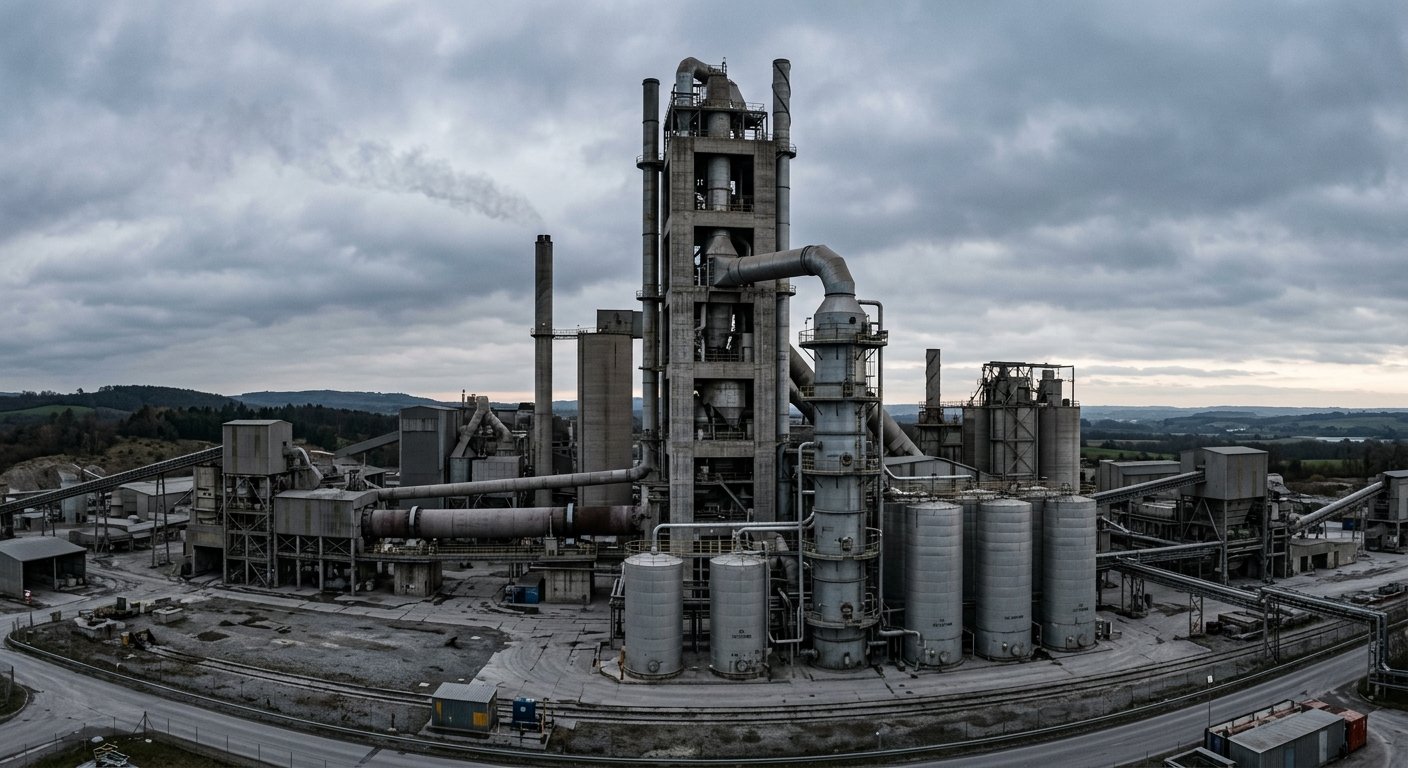
Carbon Capture in Cement: A Practitioner's Read
Carbon capture in the cement industry targets the 60% of emissions from calcination. The four CCS pathways, costs, and what to do today.
Carbon capture in the cement industry is the set of technologies that separate CO2 from the kiln gas stream so it can be stored or used, rather than vented; it matters because roughly 60% of cement's CO2 comes from chemistry that fuel switching cannot touch [1]. Cement accounts for approximately 7-8% of global CO2 emissions, and most of that is structural, locked into the act of turning limestone into clinker [1][2]. This piece is a practitioner's read on carbon capture and storage (CCS) for cement: why the industry is hard to decarbonise, the four capture pathways under development, how false air control sits upstream of capture economics, the projects actually running today, the current cost band, and what a plant engineer can do now to prepare.
Why cement is hard to decarbonise
Cement is hard to decarbonise because roughly 60% of its CO2 comes from the chemical decomposition of limestone, not from burning fuel, so switching to a cleaner fuel removes only part of the problem [1]. When limestone is heated in the kiln, calcium carbonate breaks down into lime and CO2:
CaCO3 -> CaO + CO2
Where:
- CaCO3. Calcium carbonate, the main mineral in limestone raw feed.
- CaO. Calcium oxide (lime), the reactive intermediate that goes on to form clinker minerals.
- CO2. Carbon dioxide, released to the gas stream as a direct product of the reaction.
This reaction, calcination, releases approximately 0.53 tonnes of CO2 for every tonne of clinker produced, regardless of fuel or kiln efficiency [1][3]. These are process emissions, and they are why cement cannot follow the same decarbonisation path as a power station.
Process emissions. CO2 released by a chemical reaction in the production process itself, separate from CO2 produced by burning fuel. In cement, process emissions come from limestone calcination and account for roughly 60% of total CO2; fuel-combustion emissions account for the rest [1].
The remaining roughly 40% comes from fuel burned to reach the ~1,450 C clinkering temperature inside the pyroprocessing line. That share can be reduced through thermal efficiency, alternative fuels, and electrification. The process share cannot. Current global average intensity is approximately 0.6 t CO2 per tonne of cement [1]. To get the process emissions out of the cement manufacturing process, the CO2 has to be physically captured, or the clinker chemistry has to be replaced entirely. Capture is the lever this piece covers.
The four CCS pathways for cement
Four carbon-capture pathways are being developed for cement: post-combustion amine capture, oxy-fuel combustion, calcium looping, and direct separation. They differ in where they sit on the kiln, how much energy they cost, what fraction of CO2 they capture, and how close they are to commercial deployment.
CCS vs CCUS. CCS (carbon capture and storage) captures CO2 and stores it permanently underground. CCUS (carbon capture, utilisation and storage) captures CO2 and either stores it or uses it as a feedstock, for example mineralised into building products or converted to e-fuels. Cement projects span both.
| Pathway | Mechanism | Energy penalty | Capture rate | Commercial readiness |
|---|---|---|---|---|
| Post-combustion (amine) | Solvent scrubs CO2 from kiln flue gas after combustion; bolt-on, no kiln redesign | High: ~3-4 GJ/t CO2 of thermal regeneration energy [4] | ~90% (up to ~95%) [4] | First industrial scale: Brevik, operating 2025 [5] |
| Oxy-fuel | Burns fuel in near-pure oxygen, producing a concentrated CO2 flue gas that is easier to purify; requires a new or rebuilt kiln line | Moderate-high: dominated by air-separation-unit power [6] | Up to ~100% [6] | Demonstration to first commercial; Lägerdorf line targeted ~2029 [6] |
| Calcium looping | A second CaO loop captures CO2 from flue gas, then releases it concentrated; integrates with cement chemistry because the spent sorbent is usable raw meal | Lower than amine per tonne, but roughly doubles to triples plant fuel use; heat recoverable as power [7][8] | >90% [7] | Pilot to demonstration: CLEANKER, Vernasca [8] |
| Direct separation | Indirectly heats the calciner so the process CO2 leaves as a pure stream, with no combustion gas mixed in | Low: little additional energy versus an unabated calciner [9] | ~85% (the process-emission fraction) [9] | Pilot to demonstration: LEILAC, Calix [9] |
Post-combustion capture is the most proven and the most energy-hungry: an amine solvent absorbs CO2 from the flue gas after the burner, then heat strips it back out for compression. Oxy-fuel attacks the problem at the source by removing nitrogen from combustion air, so the flue gas is already CO2-rich, but it demands a rebuilt kiln and a large air-separation unit. Calcium looping and direct separation both exploit cement chemistry: the sorbent and the feed are the same family of minerals, which is why their energy penalties can be lower than a bolt-on solvent plant.
How false air control is upstream of CCS economics
False air control is upstream of carbon-capture economics: every cubic metre of unintended air drawn into the kiln dilutes the CO2 in the flue gas and inflates the gas volume the capture plant has to process, so sealing the kiln pays before any capture equipment is bought. Capture cost scales with the volume of gas treated and falls as the CO2 concentration in that gas rises. False air pushes both variables the wrong way.
False air. Air drawn into a kiln system through unintended openings (seals, hood interfaces, inspection ports) rather than through the controlled combustion-air path. In cement it is conventionally quantified as a percentage of total gas flow. See false air in cement kilns for the full treatment.
Here is the mechanism in numbers. A kiln flue gas might carry roughly 14-18% CO2 by volume when the system is well sealed. Suppose false air ingress adds 20% extra gas volume to that stream. The same mass of CO2 is now spread through 1.2 times the gas, so the concentration drops to roughly 12-15%, and the absorber, fan, and compression train all have to handle 20% more flow for the same captured tonnage. A solvent plant sized on flue-gas volume therefore costs more to build and more to run, purely because the kiln was leaking.
Worked example. Take a 5,000 t/day kiln. If the gas stream entering a future capture unit is running at, say, 8% false air above a tight baseline, that is roughly 8% of excess gas volume the absorber and ID fan must move continuously. The same 8% shows up today as wasted fan power and degraded specific fuel consumption; tomorrow it shows up again as oversized capture kit and a lower flue-gas CO2 concentration. Sealing the kiln is the same intervention paying twice. This is why a false air audit and a sealing retrofit belong on the decarbonisation roadmap, not just the efficiency one. Oswal's integrated false air control productises the sealing, monitoring, and retrofit workflow that gets a kiln to a low, stable false air figure, which is the condition a capture plant wants to be designed against.
Notable cement-CCS projects globally
The most advanced cement carbon-capture project in the world is Heidelberg Materials' Brevik plant in Norway, which became the first industrial-scale cement CCS facility when it opened in 2025; several other routes are in demonstration or early commercial stages.
| Project | Pathway | Capacity / figure | Status | Source |
|---|---|---|---|---|
| Brevik (Heidelberg Materials, Norway) | Post-combustion amine | ~400,000 t CO2/yr, ~50% of plant emissions | Operating since 2025 | [5] |
| Lägerdorf / Carbon2Business (Holcim, Germany) | 2nd-gen oxy-fuel | >1.2 Mt CO2/yr | New kiln line, targeted ~2029 | [6] |
| Vernasca / CLEANKER (Buzzi Unicem, Italy) | Calcium looping | Pilot-scale demonstration | Demonstration | [8] |
| Fortera ReCarb, Redding (USA) | CO2 mineralisation (CCUS) | ~6,600 t CO2/yr captured into ~15,000 t/yr cement | Operating since 2024 | [10] |
| Sublime Systems, Holyoke (USA) | Electrochemical (avoids calcination) | Up to ~30,000 t/yr cement | First commercial plant, from 2026 | [11] |
| Carbon Re Delta Zero | AI kiln/preheater optimisation | ~10% fuel and CO2 reduction per plant | Deployed at pilot plants | [12] |
Brevik captures around 400,000 tonnes of CO2 per year, roughly half the plant's emissions, using an amine post-combustion unit, and is the reference case for what bolt-on capture costs and delivers at scale [5]. Holcim's Carbon2Business line at Lägerdorf is the headline oxy-fuel project: more than 1.2 million tonnes per year from a rebuilt kiln, with the captured CO2 routed to utilisation, targeted for late this decade [6].
Two of the named projects are not capture-on-a-kiln at all; they sidestep the process emissions. Fortera's ReCarb plant in Redding mineralises kiln CO2 into a calcium-carbonate cement, capturing around 6,600 tonnes per year while producing roughly 15,000 tonnes of low-carbon cement [10]. Sublime Systems is building a plant in Holyoke, Massachusetts, to make cement electrochemically at ambient temperature, avoiding the calciner entirely, at up to 30,000 tonnes per year from 2026 [11]. Carbon Re's Delta Zero software optimises the preheater and kiln to cut fuel and CO2 by around 10% without new hardware [12]. The field splits three ways: capture the CO2, replace the chemistry that makes it, or burn less fuel to begin with.
The cost trajectory
Capturing a tonne of CO2 from a cement kiln currently costs roughly USD 40-120, with the spread driven by the capture technology, the flue-gas concentration, and local energy prices [13]. Cement sits at the higher end of the industrial capture-cost range because kiln flue gas is comparatively dilute, which is precisely the variable false air control influences.
These costs are expected to fall as the technology matures toward routine deployment. The GCCA's 2050 Net Zero Roadmap assigns CCUS the single largest share of the industry's projected emissions reductions, around 36% of total abatement by 2050, which makes the cost curve a central question for the sector, not a niche one [14]. On current pipelines, the IEA estimates industrial facilities such as cement and steel could be capturing on the order of 50 Mt CO2 per year by 2030 [15]. That is a small fraction of cement's footprint, which is the honest framing: capture is real and now operating, but early, and the unit economics still depend on subsidy, carbon price, and how cheaply the kiln presents its CO2 to the capture plant.
What plant operators should be doing today
Plant operators cannot deploy capture overnight, but they can prepare the kiln for it now by maximising thermal efficiency, minimising false air, and characterising their flue-gas streams. None of these moves is wasted if capture arrives later, and all of them save money today. They are no-regret actions.
The practical near-term checklist:
- Cut false air to a low, stable baseline. Lower ingress means a more concentrated, lower-volume flue gas, which is cheaper to capture and cheaper to run through the ID fan right now. Audit it, seal it, monitor it.
- Reduce specific fuel consumption. Every kcal/kg saved shrinks the combustion-emission share and the energy a future capture plant has to share the site's heat balance with. See specific fuel consumption in cement kilns.
- Lower the clinker factor. Substituting clinker with supplementary cementitious materials reduces both process emissions and the tonnage of CO2 any capture plant would ever need to handle. This is the demand-side half of the decarbonisation argument; the low-clinker-cement story is covered in low-clinker cement.
- Characterise the flue gas. Know the actual CO2 concentration, volume, and contaminant profile of the stream a capture vendor would design against. This is the data a feasibility study starts from.
The thread running through all four is that decarbonisation readiness and operational efficiency are the same engineering work seen from two angles. A plant that has sealed its kiln, trimmed its fuel, and knows its gas streams is both cheaper to run today and cheaper to capture from tomorrow. That is the frame Oswal's engineering-consulting line works through with cement plants, and the same frame behind the company's sustainability positioning: own the upstream wins first, because they pay regardless of how the capture market develops.
If you are sizing a decarbonisation roadmap for a specific kiln, the upstream wins (false air control, fuel consumption, clinker factor) are the ones that pay before any capture commitment. Oswal's engineering-consulting team works through that sequence on-site: contact us.
Common questions about this topic
Carbon capture in the cement industry refers to the technologies that separate CO2 from a cement kiln's gas stream so it can be stored underground or used as a feedstock, instead of being vented to the atmosphere. It targets the roughly 60% of cement CO2 that comes from limestone calcination, a chemical reaction that fuel switching alone cannot eliminate [1]. The four pathways under development are post-combustion amine capture, oxy-fuel combustion, calcium looping, and direct separation, which differ in energy penalty, capture rate, and commercial readiness. The first industrial-scale facility, Heidelberg Materials' Brevik plant in Norway, began operating in 2025 [5].
Cement produces so much CO2 because around 60% of its emissions come from calcination, the chemical breakdown of limestone (CaCO3) into lime (CaO) and CO2 inside the kiln, which releases roughly 0.53 tonnes of CO2 per tonne of clinker no matter what fuel is used [1][3]. The other roughly 40% comes from the fuel burned to reach clinkering temperature. Because the larger share is locked into the chemistry, cement cannot decarbonise simply by changing fuels; it needs carbon capture or a different binder chemistry. The fuel share can be reduced through efficiency and false air control, which is covered in [pyroprocessing](/en/blog/cement-pyroprocessing-explained).
Heidelberg Materials' Brevik plant in Norway is the first industrial-scale cement carbon-capture project in operation, having opened in 2025 with the capacity to capture around 400,000 tonnes of CO2 per year, roughly half the plant's emissions, using post-combustion amine technology [5]. Holcim's oxy-fuel line at Lägerdorf in Germany is the next major project, designed for more than 1.2 million tonnes per year and targeted for the late 2020s [6]. Earlier-stage routes include calcium-looping demonstration at Vernasca in Italy and mineralisation and electrochemical approaches from Fortera and Sublime Systems [8][10][11].
Carbon capture in cement currently costs roughly USD 40-120 per tonne of CO2, placing it at the higher end of industrial capture because kiln flue gas is relatively dilute [13]. The cost depends on the capture technology, the CO2 concentration in the flue gas, and energy prices, and it is expected to fall as the technology scales. A practical lever plant operators control is the flue-gas concentration itself: reducing [false air ingress](/en/blog/how-is-false-air-measured-cement-kiln) raises CO2 concentration and lowers gas volume, both of which reduce the cost of any future capture plant. The GCCA expects CCUS to deliver around 36% of the industry's emissions abatement by 2050 [14].
Sources
- International Energy Agency (IEA), *Cement* (energy system analysis page), 2024
- Global Cement and Concrete Association (GCCA), *Concrete Future: The GCCA 2050 Net Zero Roadmap*, 2021
- U.S. Geological Survey (USGS), *Mineral Commodity Summaries 2025: Cement*, January 2025
- Clean Air Task Force, *Recasting the Future: Policy Approaches to Drive Cement Decarbonization*, 2024
- Heidelberg Materials, *World premiere: CCS cement facility opens in Norway*, press release, 18 June 2025
- Holcim, *Carbon2Business CCUS project (Lägerdorf)*, 2024
- R. Industrial & Engineering Chemistry Research, *CO2 Capture by Calcium Looping at Relevant Conditions for Cement Plants: Experimental Testing in a 30 kWth Pilot Plant*, 2017
- CLEANKER project, *Calcium Looping technology demonstration at the Buzzi Unicem Vernasca cement plant*, 2024
- Calix / LEILAC, *Capturing CO2 in Cement Precalciners: Direct Separation*, 2023
- Fortera, *ReCarb Plant, Redding, CA*, 2024
- Sublime Systems, *Sublime Cement: Holyoke, Massachusetts commercial plant*, 2024-2026
- Carbon Re, *Delta Zero: AI decarbonisation technology for cement*, 2024
- International Energy Agency (IEA), *Is carbon capture too expensive?*, commentary, 2021
- Global Cement and Concrete Association (GCCA), *2050 Net Zero Roadmap: CCUS Progress*, 2023
- International Energy Agency (IEA), *Carbon Capture, Utilisation and Storage*, energy system page, 2024
Related Articles
Discuss Your Sealing Requirements
Our engineering team can help identify the right sealing solution for your application.
Contact Engineering Team“Wherever high-temperature rotary kilns operate under controlled atmosphere, Oswal sealing systems ensure energy efficiency and process stability.”