
What Are Supplementary Cementitious Materials (SCMs)?
Supplementary cementitious materials (SCMs) are fly ash, slag, silica fume, and calcined clay used to replace clinker. Types, replacement rates, CO₂ savings.
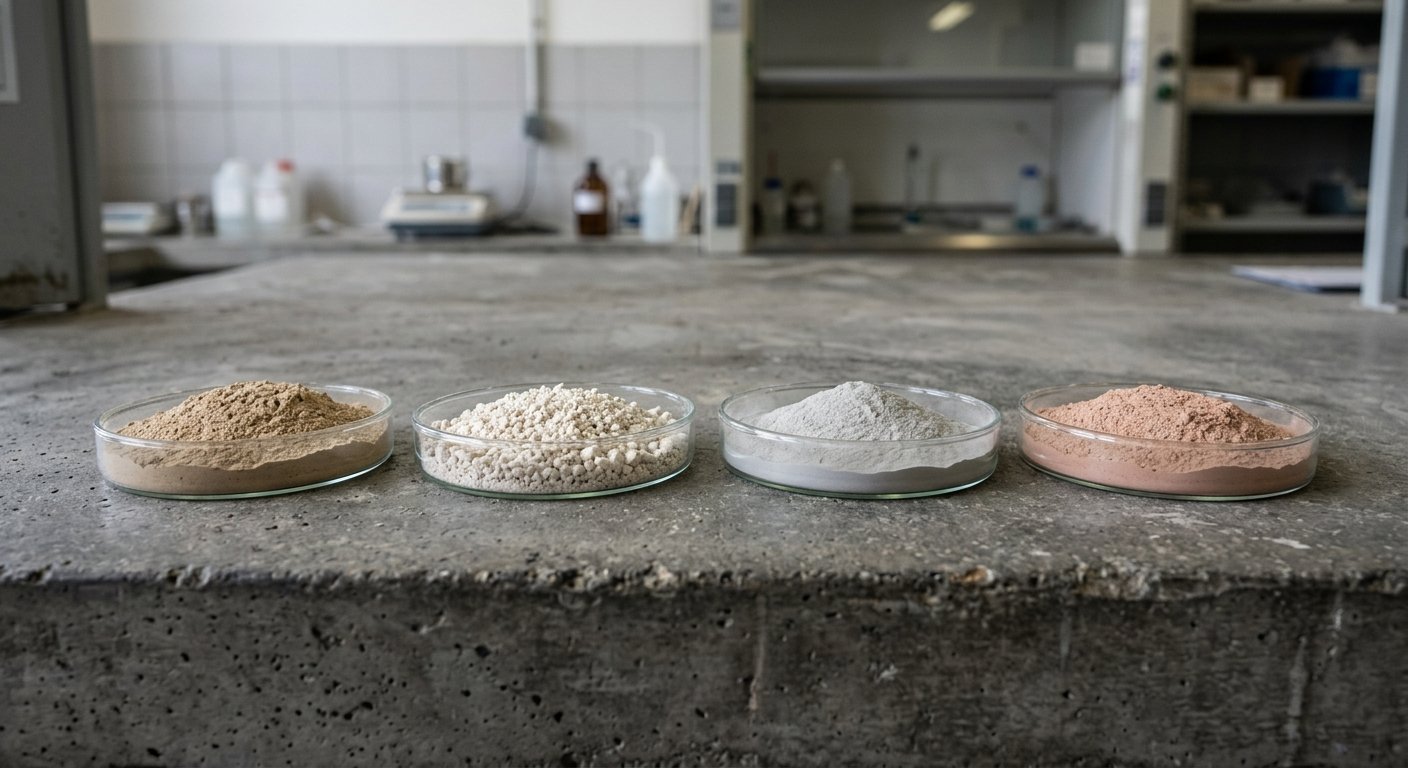
Supplementary cementitious materials (SCMs) are industrial byproducts or processed natural materials that partially replace Portland cement clinker in concrete, contributing to strength through pozzolanic or latent hydraulic reactions with the calcium hydroxide released during cement hydration. The four mainstream SCMs are fly ash, ground granulated blast furnace slag (GGBS), silica fume, and calcined clay; natural pozzolans (volcanic ash, opaline shale) make up a fifth category. Most blended cements (PPC, PSC: see OPC vs PPC vs PSC) are built on them.
The two chemistry families
SCMs work through one of two mechanisms. Pozzolanic materials (fly ash, silica fume, calcined clay, natural pozzolans) need the calcium hydroxide (Ca(OH)₂) released by Portland cement hydration to form additional calcium silicate hydrate (C-S-H). Latent hydraulic materials, GGBS being the type case, slowly self-hydrate once activated by the alkaline OPC environment. Both routes reduce the clinker factor of the finished binder.
Pozzolanic reaction. The reaction between a siliceous or alumino-siliceous material and calcium hydroxide in the presence of water, producing additional C-S-H. Named after the Roman volcanic pozzolana from Pozzuoli, Italy.
The difference matters for mix design. A pozzolanic SCM cannot react until alite has produced free lime, so its strength contribution arrives in a second wave, typically from 14 days onward and continuing through 90-180 days. A latent-hydraulic SCM begins to hydrate once the pore solution pH climbs above about 12, within hours of mixing, and so contributes to strength on a curve that lags OPC by a day or two rather than by weeks.
The four (plus one) SCMs
| SCM | Type | Replacement % | Primary benefit | CO₂ savings vs OPC | Source standard |
|---|---|---|---|---|---|
| Fly ash, Class F | Pozzolanic | 15-35% | Long-term strength, durability | 15-30% | ASTM C618 [3]; ACI 232.2R [4] |
| Fly ash, Class C | Pozzolanic + mild cementitious | 15-40% | Early-age strength | 15-35% | ASTM C618 [3] |
| GGBS | Latent hydraulic | 30-70% (up to 95% in CEM III/C) | Low heat of hydration, sulphate resistance | 40-65% | ACI 233R [5]; EN 197-1 [8] |
| Silica fume | Highly reactive pozzolan | 5-12% | High strength, low permeability | 5-10% | ACI 234R [6]; ASTM C1240 [7] |
| Calcined clay (LC³-50) | Pozzolanic | up to 50% (with limestone) | Lowest-CO₂ SCM at scale | 30-40% | ASTM C618 [3]; emerging LC³ standards |
| Natural pozzolan | Pozzolanic | 10-25% | Regional availability | 10-25% | ASTM C618 Class N [3]; EN 197-1 [8] |
Ranges per cited ACI committee reports and standard practice. CO₂ savings are binder-level; project-level savings depend on mix design.
- Fly ash is the coal power station byproduct collected from precipitators or fabric filters. Class F (typically less than around 18% CaO, bituminous/anthracite) is the global workhorse; Class C (typically more than 18-20% CaO, lignite/sub-bituminous) is mildly self-cementing. A typical Class F particle is a hollow glass cenosphere 1-100 µm across with a Blaine surface around 300-450 m²/kg, finer than ordinary OPC and contributing a measurable workability benefit at 25-30% replacement [4].
- GGBS is blast-furnace molten slag rapid-quenched in water and ground to cement fineness, typically 400-500 m²/kg Blaine. Up to 95% replacement is permitted in CEM III/C per EN 197-1 [8], with the European CEM III/A (36-65% slag) and CEM III/B (66-80% slag) classes serving as the workhorses for marine and mass-concrete works.
- Silica fume is condensed SiO₂ fume from silicon and ferrosilicon electric-arc furnaces. Very fine (BET 15-30 m²/g, particles 0.1-0.3 µm), highly reactive, used at 7-10% doses for high strength or low permeability. A 90 MPa concrete typically carries 8% silica fume by binder mass, and the same mix densified for a 120 MPa target may carry 10-12% [6].
- Calcined clay (metakaolin and broader kaolinitic clays) is the emerging fourth pillar. Clay calcined at 700-850 °C in a flash calciner or rotary kiln; the cement industry already operates that equipment, and the cement pyroprocessing hardware translates directly to calcination. Standalone at 5-20%, or up to 50% clinker replacement in LC³-50 [9].
- Natural pozzolans (volcanic ash, opaline shale, calcined diatomaceous earth) are the regional fallback where industrial SCMs are scarce. Roman concrete was 100% natural-pozzolan binder, the Pantheon dome being the longest-running performance test on record.
Performance trade-offs in practice
SCMs are not interchangeable. A Class F fly ash at 30% replacement typically reduces 1-day strength by 15-25% versus an OPC control of equal binder content, recovers parity at 28 days, and outperforms by 90 days. A 50%-slag GGBS mix tracks closer to OPC at 7 days but releases roughly half the heat of hydration. Silica fume at 8% can lift 28-day compressive strength by 20-30% and cut chloride permeability by an order of magnitude, but it stiffens the mix and almost always requires a superplasticiser. Calcined clay pairs synergistically with limestone fines: the metakaolin alumina and the carbonate co-react to form carboaluminate phases that densify the pore structure, which is the chemistry letting LC³-50 hold 28-day strength against a 43-grade OPC at half the clinker factor [9].
Why SCMs matter for decarbonisation
SCMs are the largest near-term lever for cutting cement CO₂. Cement emits roughly 2.4 Gt CO₂/yr, about 7-8% of global anthropogenic emissions [1]. Around 60% of that is process CO₂ from limestone calcination; every kg of clinker substituted by an SCM is a kg of process CO₂ avoided. The GCCA Net Zero Roadmap (2021) targets a global clinker-to-cement ratio of 0.52 by 2050, down from around 0.72 in 2020 [2]. The relationship between phase chemistry and the embodied CO₂ of the clinker being substituted is laid out in the chemical composition of clinker piece.
Two supply constraints matter: fly ash supply is declining as coal power plants retire, with global availability projected to peak before 2030; GGBS supply is bounded by global steel tonnage at roughly 350-400 million tonnes per year, less than 10% of cement's annual binder demand. The scale-up path therefore depends on calcined clay and natural pozzolans, both of which require new processing capacity rather than a recovered byproduct stream. The global cement majors are now retrofitting flash calciners onto existing kiln lines, while the upstream efficiency of any remaining clinker is optimised through tighter control of specific fuel consumption on the kiln line.
Common questions about this topic
Pozzolans are one of the two chemistry families within SCMs, but the terms are not interchangeable. Pozzolans (fly ash, silica fume, calcined clay, natural pozzolans) react with calcium hydroxide from cement hydration to form additional C-S-H. GGBS, by contrast, is latent hydraulic: it self-hydrates once alkali-activated. So GGBS is an SCM but not a pozzolan. ACI 232 covers fly ash; ACI 233 covers slag.
The split is by calcium content under ASTM C618. In practice Class F is the low-calcium pozzolan (typically less than around 18% CaO, from bituminous or anthracite coal); it is purely pozzolanic and contributes to long-term strength and durability. Class C is the high-calcium ash (typically above 18-20% CaO, from lignite or sub-bituminous coal) and is mildly self-cementing in addition to pozzolanic. Class C improves early-age strength but can show variable performance with sulphate exposure; mix qualification matters. ASTM C618 itself differentiates the classes primarily by the minimum sum of SiO₂ + Al₂O₃ + Fe₂O₃ (70% for Class F, 50% for Class C).
No. LC³ (Limestone Calcined Clay Cement) is a blended-cement system, not a single material. LC³-50 combines around 50% clinker, 30% calcined clay, 15% limestone, and 5% gypsum. Calcined clay is the SCM; the limestone is a fine filler that interacts synergistically with the calcined clay alumina, allowing 50% clinker replacement without strength loss (Scrivener et al., 2018).
Sources
- IEA, *Cement, Tracking Industry 2023*. International Energy Agency
- Global Cement and Concrete Association, *Concrete Future, The GCCA 2050 Cement and Concrete Industry Roadmap for Net Zero Concrete*, 2021
- ASTM International, *ASTM C618-23, Standard Specification for Coal Ash and Raw or Calcined Natural Pozzolan for Use in Concrete*
- American Concrete Institute, *ACI 232.2R, Report on the Use of Fly Ash in Concrete* (current edition).
- American Concrete Institute, *ACI 233R, Guide to the Use of Slag Cement in Concrete and Mortar* (current edition).
- American Concrete Institute, *ACI 234R, Guide for the Use of Silica Fume in Concrete* (current edition).
- ASTM International, *ASTM C1240, Standard Specification for Silica Fume Used in Cementitious Mixtures*
- European Committee for Standardization, *EN 197-1, Cement, Part 1: Composition, specifications and conformity criteria for common cements*.
- Scrivener, K., Martirena, F., Bishnoi, S., Maity, S., *Calcined clay limestone cements (LC3)*, *Cement and Concrete Research*, 114, 49-56 (2018)
- EPFL LC³ Project. https://lc3.ch/ --- *If you are sizing a clinker-substitution or calcined-clay project on an existing kiln line, the [engineering-consulting team](/en/services/engineering-consulting) works through the process, equipment, and false-air implications on-site.*
Related Articles
Discuss Your Sealing Requirements
Our engineering team can help identify the right sealing solution for your application.
Contact Engineering Team“Wherever high-temperature rotary kilns operate under controlled atmosphere, Oswal sealing systems ensure energy efficiency and process stability.”