
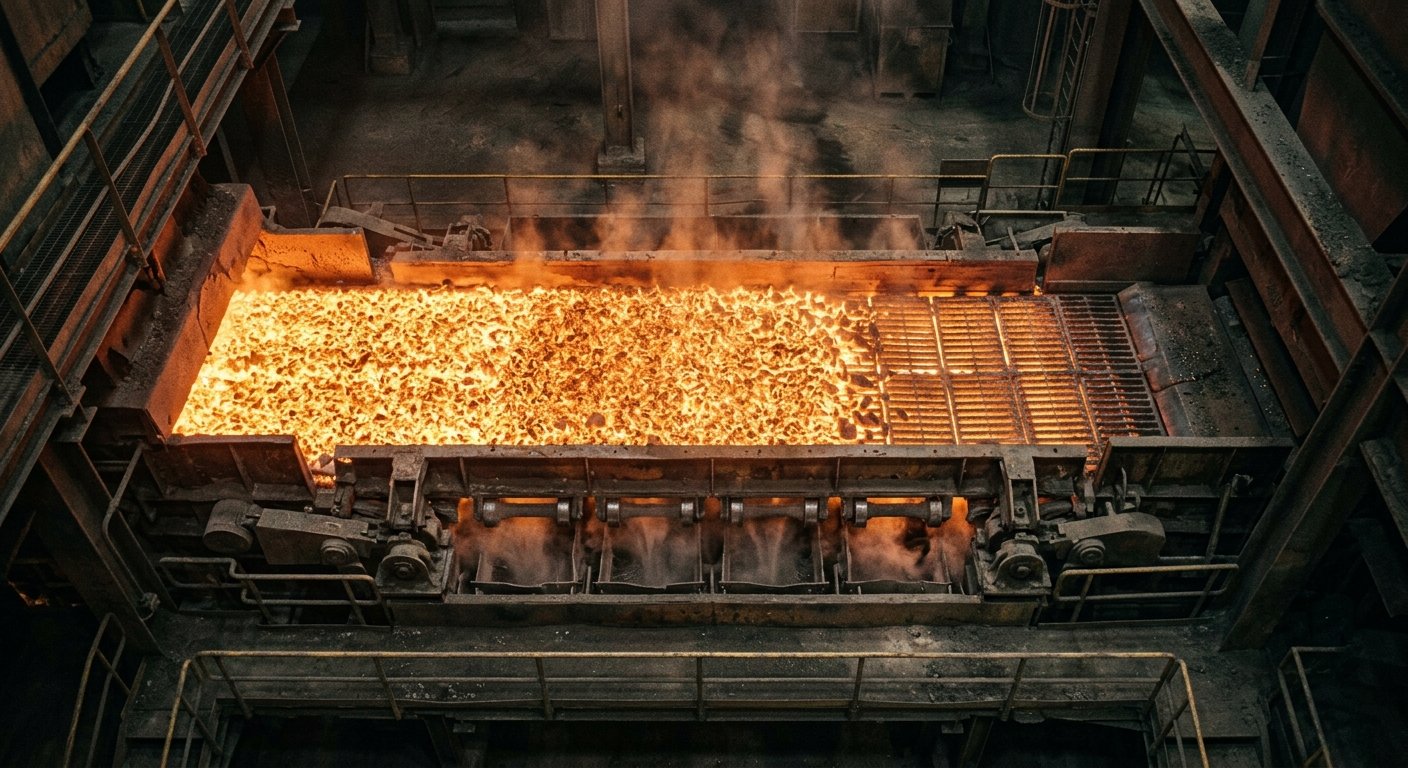
How Does a Clinker Cooler Work?
A clinker cooler quenches kiln-exit clinker from ~1,400°C to ~100°C using counter-current air, recovering heat as secondary and tertiary combustion air.
A clinker cooler quenches clinker leaving the rotary kiln at roughly 1,400°C down to a transport temperature of 100-150°C by passing counter-current ambient air through the clinker bed, and recovers the absorbed heat by routing the now-hot air back into the kiln main burner (secondary air) and the precalciner (tertiary air). Below: the function, the three cooler designs, the efficiency comparison, and the kiln-cooler sealing interface.
The function of a clinker cooler
The cooler does two jobs at once: it freezes the clinker mineralogy and it recovers heat. Rapid cooling through the 1,250 to 1,200°C window locks in alite (C3S), the principal strength-giving phase in Portland cement clinker; slow cooling lets alite revert to belite and free lime, lowering 28-day strength [1]. The hot cooling air leaves the cooler at 800-1,100°C and is split between secondary air to the kiln burner and, on precalciner-equipped lines, tertiary air to the calciner. A modern cooler returns roughly 1,000-1,200 kJ/kg clinker as combustion air, about 30-40% of the kiln's specific fuel consumption [2].
The thermal profile through the cooler bed is steep and worth pinning down. Clinker enters the cooler at 1,400-1,450°C, drops through roughly 1,000°C within the first two metres of the bed under the recuperation zone fans, and continues to 200-300°C through the aftercooling zone before discharge at 100-150°C to the clinker conveyor. Undergrate static pressure on modern reciprocating coolers sits at 70-110 mbar in the recuperation zone (the high-pressure compartmental fans) and drops to 30-50 mbar across the aftercooling zone, where lower-pressure fans handle the diminishing thermal load. Bed depth is the primary process control: 600-800 mm is typical, with deeper beds raising recuperation efficiency by extending gas-solid contact time but also raising the pressure drop the fans have to overcome, which is why bed depth is closed-loop controlled against grate speed and clinker discharge rate. The link from cooling rate to clinker quality runs through the aluminate phase as well: a fast quench preserves the glassy, less reactive C3A morphology preferred for sulfate resistance, where slow cooling crystallises C3A and raises early hydration heat.
Clinker cooler: the heat-exchange unit immediately downstream of the rotary kiln that quenches clinker with ambient air, then returns the heated air to the pyroprocess as secondary and tertiary combustion air.
The three main types of clinker cooler
Three cooler designs are in industrial use: reciprocating grate coolers (dominant on modern lines), satellite (planetary) coolers attached to the kiln discharge, and standalone rotary coolers.
In a grate cooler, clinker travels horizontally on a reciprocating grate while ambient air is blown up through the bed from compartmental fans below. Third- and fourth-generation grate coolers (FLSmidth Cross-Bar, KHD PYROFLOOR², IKN Pendulum) recover 75-80% of clinker heat [3]. In a satellite (planetary) cooler, 8-12 tubes are bolted around the kiln discharge and rotate with the kiln; the design is compact but recuperation tops out at 55-65% and there is no tertiary-air offtake [4]. Rotary coolers are a separate rotary drum after the kiln, mechanically simple, with efficiency similar to satellites; marginal in cement, common in lime and DRI.
The absence of a tertiary-air offtake on satellite and rotary coolers is the structural reason precalciner lines have moved almost exclusively to grate coolers: without a hot tertiary duct feeding the calciner, the precalciner has to draw its combustion air through the kiln, raising kiln-gas velocities and tending to push the burning zone out of position. For the same reason, grate-cooler recuperation efficiency directly lifts overall thermal efficiency in the cement preheater and calciner circuit. Every percentage point of cooler recuperation efficiency translates to roughly 8-12 kcal/kg clinker on a typical precalciner line, which is why fourth-generation cooler retrofits keep showing up in plant capex programmes despite the cooler being mechanically the simplest unit on the kiln line.
Cooler comparison
| Cooler type | Principle | Recuperation efficiency | Capacity range | Typical use case |
|---|---|---|---|---|
| Reciprocating grate (3rd / 4th gen) | Clinker bed on grates, cross-counter air from below | 75-80% | 1,500-12,000 t/day | Modern cement lines, precalciner-equipped |
| Satellite (planetary) | Tubes around kiln discharge, rotate with kiln | 55-65% | 500-3,000 t/day | Older small-to-medium cement kilns, no precalciner |
| Rotary | Separate rotary drum after kiln | 55-65% | 200-2,000 t/day | Lime, DRI, niche cement |
Efficiency ranges per Madlool et al. [3], ECRA Technology Papers [2], and OEM specifications. Upgrading an older grate cooler (60-70%) to a modern one (75-80%) typically cuts SFC by 30-50 kcal/kg clinker in published case studies. See clinker cooler design and operation for the full retrofit frame, and the specific heat consumption breakdown for how cooler gains compound with preheater-side improvements.
The kiln-cooler interface
The kiln hood, the stationary enclosure between the rotating kiln discharge and the cooler inlet, is one of the highest false-air ingress points on a modern line. The interface is hot (1,400°C on the kiln side), abrasive, thermally cycled, and spans a rotating-to-stationary boundary. False air drawn in here lowers secondary-air temperature, raises SFC, and can destabilise the burning zone. A 50°C drop in secondary-air temperature, the kind of penalty caused by 8-10% false air at the hood, costs roughly 12-18 kcal/kg clinker on a typical precalciner line, on top of the ID-fan load the additional gas mass imposes. The geometry of the offtake also matters: see kiln hood inlet and outlet configurations for how the hood-to-cooler transition is laid out across OEM designs. The kiln outlet sealing system and the broader integrated false air control target this interface; the same logic applies to the lime and DRI lines covered via the cement industry page.
Common questions about this topic
A grate cooler moves clinker horizontally on a reciprocating grate with cross-counter cooling air blown up from compartmental fans below; a satellite (planetary) cooler uses 8-12 tubes bolted around the rotating kiln discharge. Grate coolers reach 75-80% recuperation efficiency and supply both secondary air to the kiln burner and tertiary air to the precalciner. Satellite coolers top out at 55-65% and supply secondary air only, which is why they are uncommon on new precalciner lines [3][4].
A modern grate cooler at 75-80% recuperation efficiency returns roughly 1,000-1,200 kJ/kg clinker as combustion air, about 30-40% of the kiln's specific fuel consumption [2]. Replacing an older grate cooler with a fourth-generation design typically reduces SFC by 30-50 kcal/kg clinker, scaling with kiln capacity and fuel price.
Sources
- H. F. W. Taylor, *Cement Chemistry*, 2nd edition, Thomas Telford, 1997. Standard reference for clinker phase formation and the effect of cooling rate on alite stability.
- European Cement Research Academy (ECRA), *State of the Art Cement Manufacturing: Current Technologies and their Future Development*, ECRA Technology Papers
- N. A. Madlool, R. Saidur, M. S. Hossain, N. A. Rahim, "A critical review on energy use and savings in the cement industries", *Renewable and Sustainable Energy Reviews*, 15(4): 2042-2060, 2011
- IEA and Cement Sustainability Initiative, *Cement Technology Roadmap: Carbon Emissions Reductions up to 2050*. International Energy Agency
- FLSmidth, KHD Humboldt Wedag, and IKN technical brochures for the Cross-Bar, PYROFLOOR², and Pendulum cooler families respectively. Cited for design-specification ranges only, not for performance marketing claims. --- *If you are evaluating a cooler retrofit or auditing the kiln-hood interface on a specific line, the [engineering-consulting team](/en/services/engineering-consulting) works through the cooler heat balance and the sealing-interface methodology above on-site.*
Related Articles
Discuss Your Sealing Requirements
Our engineering team can help identify the right sealing solution for your application.
Contact Engineering Team“Wherever high-temperature rotary kilns operate under controlled atmosphere, Oswal sealing systems ensure energy efficiency and process stability.”