
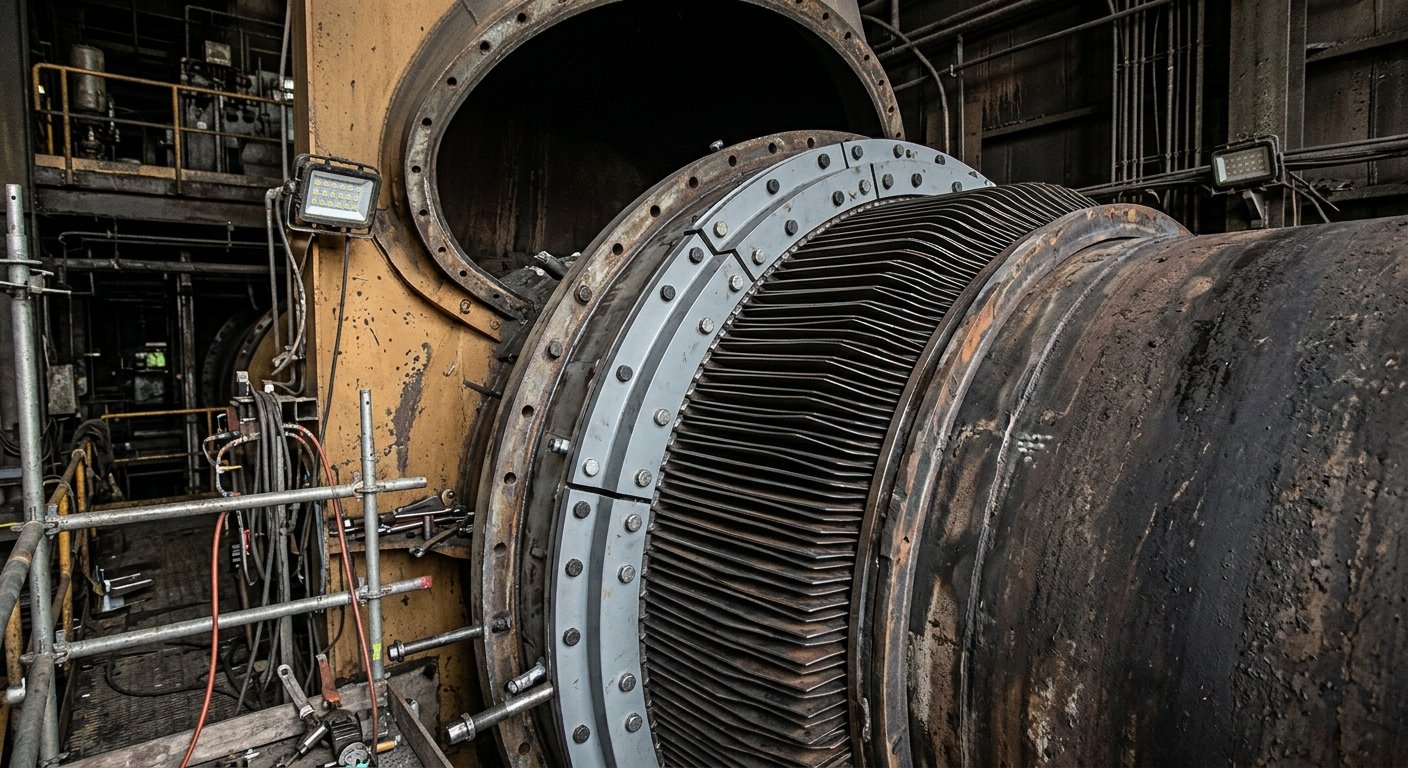
Kiln Seal Retrofit: Upgrading to a Duplex Seal in a Stop
A practitioner guide to a kiln seal retrofit: why operators upgrade, when to do it in a scheduled shutdown, the install sequence, and the payback case.
A kiln seal retrofit replaces a worn or rigid seal at the rotating kiln-to-hood interface with a seal engineered for the kiln's actual movement, and it is almost always done inside an already-planned shutdown. This guide covers rotary process kilns in cement, lime, and DRI: why operators retrofit a kiln seal, when to schedule it, why the Duplex system is retrofit-friendly, a realistic install timeline, and how to build the payback case. It is a planning reference, not a case study; figures are either Oswal's published product positioning or inline-cited industry typicals labelled as general.
Why operators retrofit kiln seals
Operators retrofit kiln seals because seals wear in service, and as the contact face degrades, false air creeps up, raising specific fuel consumption, loading the ID fan, and making the kiln harder to drive. A seal designed for static geometry cannot follow the kiln as it expands and moves, so the leakage path widens over a campaign until a replacement returns more value than it costs.
False air: uncontrolled ambient air drawn into a kiln system through unintended openings (worn seals, hood interfaces, inspection ports) rather than through the controlled combustion-air path. Quantified as a percentage of total kiln gas flow, conventionally at the ID fan inlet. Covered in depth in false air in cement kilns.
The economics are direct. The kiln inlet and outlet seals account for roughly 60-75% of total false air infiltration in a cement plant, and each 1% of false air above baseline adds approximately 1.5-2.5 kcal/kg clinker in wasted fuel plus 0.3-0.5 kWh/t in additional ID-fan electrical load [1][3]. Older plants routinely baseline at 12-20% false air, against 6-10% on a well-sealed modern line; that gap is the case for almost every kiln-seal retrofit in the industry [3].
The reason rigid seals fail is mechanical. The rotary kiln is a dynamically expanding structure: it grows radially, displaces axially under thermal growth, carries residual shell ovality, and runs under heavy dust loading at high temperature, 24x7. Oswal's product literature states the failure mode plainly: "Conventional rigid sealing systems fail under dynamic conditions" [4]. A seal that cannot follow that movement opens a clearance gap, and the gap is where the false air enters.
When to do it: inside a scheduled shutdown
The right time to retrofit a kiln seal is inside an already-planned shutdown, scheduled alongside refractory and inspection work, because seal replacement requires a cold, stationary kiln and the cool-down is the single most expensive part of any stop. A kiln is not stopped for sealing alone; the seal change is batched into a window the plant is already paying for.
Scheduled (planned) shutdown: a controlled, pre-planned cool-down of a rotary kiln for maintenance, inspection, or refractory work, as distinct from a crash stop forced by a fault. The cool-down to hands-on access typically takes 72-120 hours, governed by the refractory cool-rate limit. Walked through step by step in the kiln shutdown procedure.
Dry-process cement kilns typically plan a major stop every 12-18 months; DRI and lime kilns on shorter campaigns may stop every 6-12 months [5]. A major refractory reline shutdown commonly runs 12-18 days, shorter mechanical stops 5-8 days, and lost production costs on the order of $350,000-500,000 per day for a large kiln [6]. Against that daily cost, the marginal time to change a seal that has already been flagged is small, which is why a retrofit overlaps the cool-down and refractory stages rather than adding to the critical path.
The trigger comes from inspection. A seal graded Stage C (clearance gaps visible, 4-6% false air from the seal alone) should have a replacement work order raised for the next planned stop; a Stage D seal (dust escape, audible in-rush, false air above 7%) is replaced at the first opportunity [7]. The grading framework is set out in kiln seal inspection cadence. The practical sequence: inspection flags the seal, a work order is raised, parts and labour are staged, and the change is executed inside the next shutdown the cement plant has scheduled.
What a Duplex retrofit involves, and why it is retrofit-friendly
A Duplex retrofit replaces a worn or rigid kiln seal with Oswal's hybrid lamella and graphite Duplex system, which is engineered to fit existing kiln-end geometry without major structural modification, so it drops into the same inlet or outlet hood interface during a stop. The system combines two sealing principles: lamella elements absorb mechanical movement, and graphite elements maintain thermal sealing contact, so the seal adapts to kiln distortion rather than resisting it [4][8].
Duplex kiln seal: a hybrid sealing system that combines lamella-based flexibility for axial and radial movement compensation with graphite-based durability for high-temperature sealing, in a dual-layer architecture. Described as "a proprietary Oswal innovation developed to combine the advantages of two sealing principles into a unified solution" [4]. How the two stages work together is covered in the Duplex sealing technology explained.
The retrofit-friendliness is a documented design property. Oswal's catalogue states that "installation does not require excessive structural modification and can be engineered for retrofit applications," that the system suits "adaptation to existing kiln geometries," and that it fits "various inlet hood configurations, different kiln diameters, and dry and preheater-precalciner systems" [4][8]. The mechanical design is modular, "designed for easy installation and service" [8]. In practice the retrofit reuses the existing hood and support-station interfaces wherever possible, which is what keeps the install inside a normal shutdown rather than turning it into a structural project.
Selecting Duplex over a single-technology seal is a movement decision. A lamella-dominant seal flexes to follow shell movement but is more sensitive to thermal cycling; a graphite-dominant seal is durable at high temperature but stiffer. For kilns with pronounced ovality or frequent thermal cycling, the hybrid is usually the better fit; for kilns running steady at high temperature, a graphite-dominant configuration may suffice. The full trade-off is in the kiln seal comparison guide. The retrofit is delivered through Oswal's installation and retrofit service, which scopes the survey, seal selection, and install crew against the specific kiln.
A realistic retrofit timeline inside a shutdown
A Duplex seal retrofit for a single inlet or outlet seal is typically scoped as a work package of about 9 days inside a longer scheduled shutdown, with the survey done while the kiln still runs and the mechanical change executed against a cold, locked-out kiln. The 9-day figure is a representative planning window for one seal, not a guaranteed duration; the purely mechanical portion is commonly 3-7 days [3], and the surrounding days cover survey, staging, cool-down overlap, and commissioning.
The sequence below maps the work package onto a shutdown. The pre-shutdown phase runs in parallel with normal operation, so it consumes no downtime; the mechanical phase overlaps the cool-down and refractory work the stop was planned for anyway.
| Phase | Day window | Activity | Kiln state |
|---|---|---|---|
| Pre-shutdown engineering | Days -14 to -1 | Survey shell ovality and axial-movement envelope; pull O2 baseline; confirm hood geometry and diameter; manufacture/stage seal kit | Running |
| Access and isolation | Days 1-2 | Cool-down overlaps refractory stage; lockout/tagout; safe-entry gas test; remove old seal and access panels | Cooling to cold, locked out |
| Mechanical install | Days 3-6 | Fit Duplex housing to existing hood interface; install lamella and graphite stages; set contact pressure and compensation | Cold, locked out |
| Alignment and check | Day 7 | Verify circumferential contact; check axial and radial compensation travel; confirm against hood casting | Cold, locked out |
| Commissioning | Days 8-9 | Re-measure O2 at kiln inlet/outlet on heat-up; confirm false-air reduction against pre-shutdown baseline | Heat-up, returning to service |
The lockout, confined-space entry, and safe-access conditions that govern the access phase (shell below roughly 70 deg C, oxygen 19.5-23.5%, CO below 35 ppm) are the same ones in the kiln shutdown procedure; the seal crew works to the plant's existing isolation plan. Because the mechanical phase overlaps the refractory window, a seal change planned this way does not usually extend the shutdown's critical path; it does so only when the seal work is the last activity to clear before heat-up.
How to build the payback case
The payback case for a kiln seal retrofit is built by converting the recovered false air into avoided fuel and avoided ID-fan electrical load, then setting that annual saving against the seal capex and install labour. The fuel term dominates; the fan and process-stability terms are additive.
The annual fuel saving:
Annual fuel saving = dFA x k x m_clinker x days x cost_fuel
Where:
- dFA. False air recovered by the retrofit (percentage points), from the difference between the pre- and post-retrofit O2-derived false-air figures
- k. Fuel penalty per point of false air (kcal/kg clinker per 1%); industry-typical 1.5-2.5, mid-range ~2.0 [1][3]
- m_clinker. Daily clinker output (kg/day)
- days. Annual operating days
- cost_fuel. Delivered fuel cost per kcal (derived from fuel price and lower heating value)
Worked example (illustrative inputs). A 5,000 t/day dry-process kiln where a Stage C seal pair is recovering 5 percentage points of false air, at 2.0 kcal/kg per point, recovers 10 kcal/kg clinker, or 50 million kcal/day. Over a year that is roughly 3,000 tonnes of coal avoided at a 6,000 kcal/kg lower heating value, on the order of $400,000-700,000 in fuel at typical coal prices, plus $30,000-80,000 in avoided ID-fan load [1][3]. These inputs are illustrative, chosen to mirror the worked case in false air in cement kilns; a real case is sized from the kiln's own measured baseline.
| Payback driver | Mechanism | Typical magnitude | Source |
|---|---|---|---|
| Reduced fuel | Recovered false air no longer has to be heated to process temperature | ~1.5-2.5 kcal/kg clinker per 1% false air recovered | Holderbank / Madlool et al. [1][3] |
| Lower ID-fan power | Fan moves less parasitic air volume | ~0.3-0.5 kWh/t clinker per 1% false air recovered | VDZ / ECRA [1] |
| Process stability | Steadier draft and flame; fewer off-spec excursions; longer refractory campaign | Qualitative; site-specific | Oswal product literature [4][8] |
Oswal positions the Duplex system as delivering payback "typically within 6 to 18 months," driven by reduced fuel consumption, lower ID-fan power usage, and improved process stability [8]. That is the manufacturer's positioning, not an independently audited result; the actual payback depends on the false air recovered, the kiln size, and the local fuel price, so the case should be built from the plant's own measured baseline before the retrofit is committed.
Retrofit planning checklist
A kiln-seal retrofit succeeds or fails on pre-shutdown preparation: the seal must be specified against the kiln's actual movement envelope, and parts, access, and labour staged before the kiln cools. The minimum to clear before the stop:
- Characterise the movement envelope. Measure shell ovality and the axial-movement range before selecting the seal; a seal specified against ideal static geometry repeats the original failure [4].
- Pull the O2 baseline. Record the 72-hour O2 trend at kiln inlet and outlet before the stop; this is the number the post-retrofit result is measured against [7].
- Confirm the interface geometry. Verify hood configuration and kiln diameter so the retrofit reuses the existing mechanical interfaces [8].
- Stage the seal kit and consumables. Manufacture and deliver the Duplex kit, gaskets, and fasteners so nothing is on the critical path during the stop.
- Book the install crew into the shutdown plan. Schedule the mechanical phase to overlap the cool-down and refractory window, not after it.
- Agree the isolation and safe-entry plan. Use the plant's existing lockout/tagout and confined-space entry procedure for the seal area [O1.3].
- Plan the post-install verification. Re-measure O2 on heat-up and confirm the false-air reduction against the pre-shutdown baseline before signing the work package off.
Oswal's installation and retrofit service runs this preparation as part of scoping a Duplex Kiln Sealing System retrofit, so the survey, seal selection, and crew booking are completed before the shutdown rather than discovered inside it.
Sizing a kiln-seal retrofit for a specific kiln starts with a measured false-air baseline and a movement survey. Oswal's installation and retrofit service scopes the survey, the Duplex Kiln Sealing System configuration, and the install crew against the kiln's next scheduled shutdown.
Common questions about this topic
A single-seal Duplex retrofit is typically scoped as a work package of about 9 days inside a scheduled shutdown, of which the purely mechanical change is commonly 3-7 days and the remainder covers survey, staging, cool-down overlap, and commissioning [3]. Because the work overlaps the cool-down and refractory stages of a stop the plant is already taking, it does not usually extend the critical path. The 9-day figure is a representative planning window for one seal, not a guaranteed duration; actual time depends on kiln size, access, and whether one or both seals are changed. The shutdown sequence is in the [kiln shutdown procedure](/en/blog/kiln-shutdown-procedure).
Yes. The Duplex Kiln Sealing System is engineered for retrofit: per Oswal's product literature, "installation does not require excessive structural modification," the system suits "adaptation to existing kiln geometries," and it fits various inlet hood configurations, kiln diameters, and dry and preheater-precalciner systems [4][8]. The modular design, "designed for easy installation and service," lets it reuse the existing hood and support-station interfaces during a stop. The retrofit is delivered through Oswal's [installation and retrofit service](/en/services/installation-retrofit), which selects the seal configuration against the kiln's actual movement envelope.
Oswal positions the Duplex system as paying back typically within 6 to 18 months, driven by reduced fuel consumption, lower ID-fan power usage, and improved process stability [8]. The fuel term dominates: each 1% of false air recovered avoids roughly 1.5-2.5 kcal/kg clinker, plus 0.3-0.5 kWh/t in ID-fan load [1][3]. The actual payback depends on the false air recovered, the kiln size, and the local fuel price, so the case should be built from the plant's own measured O2 baseline. The full economics are worked through in [false air in cement kilns](/en/blog/understanding-false-air-in-cement-kilns).
A seal graded Stage C (clearance gaps visible, 4-6% false air from the seal alone) should have a replacement work order raised for the next planned shutdown; a Stage D seal (dust escape, audible in-rush, false air above 7%) is replaced at the first opportunity and not deferred [7]. Earlier findings, such as sagging counter-weights or minor edge wear, can often be corrected by re-tensioning without a full replacement, so the decision depends on the graded inspection, not on age alone. The grading framework is in [kiln seal inspection cadence](/en/blog/kiln-seal-inspection-cadence-methodology).
Sources
- Seal Plus, *False Air in the Cement Manufacturing Process*, 2024. Technical white paper on false-air sources, the proportional contribution of kiln inlet and outlet seals (60-75% of plant total), the energy penalty (~3 kcal/kg per 1% false air), and the ID-fan electrical load
- INFINITY for Cement Equipment, *Kiln Inlet & Outlet Seal, Kiln Thrust Roller & Kiln Maintenance Check*. Holderbank-derived training corpus on seal inspection practice and false-air contribution by source
- Holderbank Group / Holcim, *Cement Manufacturing: Process Technology*, Volume 2 (Holderbank Cement Course), and Madlool et al., "A critical review on energy use and savings in the cement industries," *Renewable and Sustainable Energy Reviews* 15(4), 2011. Source for the 1.5-2.5 kcal/kg-per-% false-air penalty convention, the 12-20% older-plant baseline, and the 3-7 day per-seal mechanical change
- Oswal Engineers, *Kiln Sealing Systems: Global Benchmark in False Air Control* (product catalogue, OSWAL_kilnseal.pdf). Source for the Duplex hybrid lamella + graphite description, the "conventional rigid sealing systems fail under dynamic conditions" framing, retrofit compatibility, no excessive structural modification, and adaptation to existing kiln geometries and inlet hood configurations.
- INFINITY for Cement Equipment, *Mechanical Kiln Inspection: Systematic Condition Monitoring for Rotary Kilns*. Major-stop interval guidance for dry-process and shorter-campaign kilns
- Oxmaint / MaintWiz, *Cement Plant Shutdown Maintenance Planning*. Major reline shutdown duration (12-18 days), minor mechanical stops (5-8 days), and lost-production cost per day. https://oxmaint.com/industries/cement-plant/cement-plant-shutdown-maintenance-planning ;
- Oxmaint, *Kiln Inlet and Outlet Seal Maintenance for Cement Plants*. Four-stage wear-grading framework, false-air thresholds per stage, and the replace-vs-monitor decision
- Oswal Engineers, *Duplex Kiln Sealing System* (product catalogue, KilnSeal_DuplexType_OK_CAT.pdf). Source for the hybrid adaptive sealing architecture, modular design "for easy installation and service," reduced ID-fan load and fuel consumption, and the "typically within 6 to 18 months" payback positioning.
Related Articles
Discuss Your Sealing Requirements
Our engineering team can help identify the right sealing solution for your application.
Contact Engineering Team“Wherever high-temperature rotary kilns operate under controlled atmosphere, Oswal sealing systems ensure energy efficiency and process stability.”