
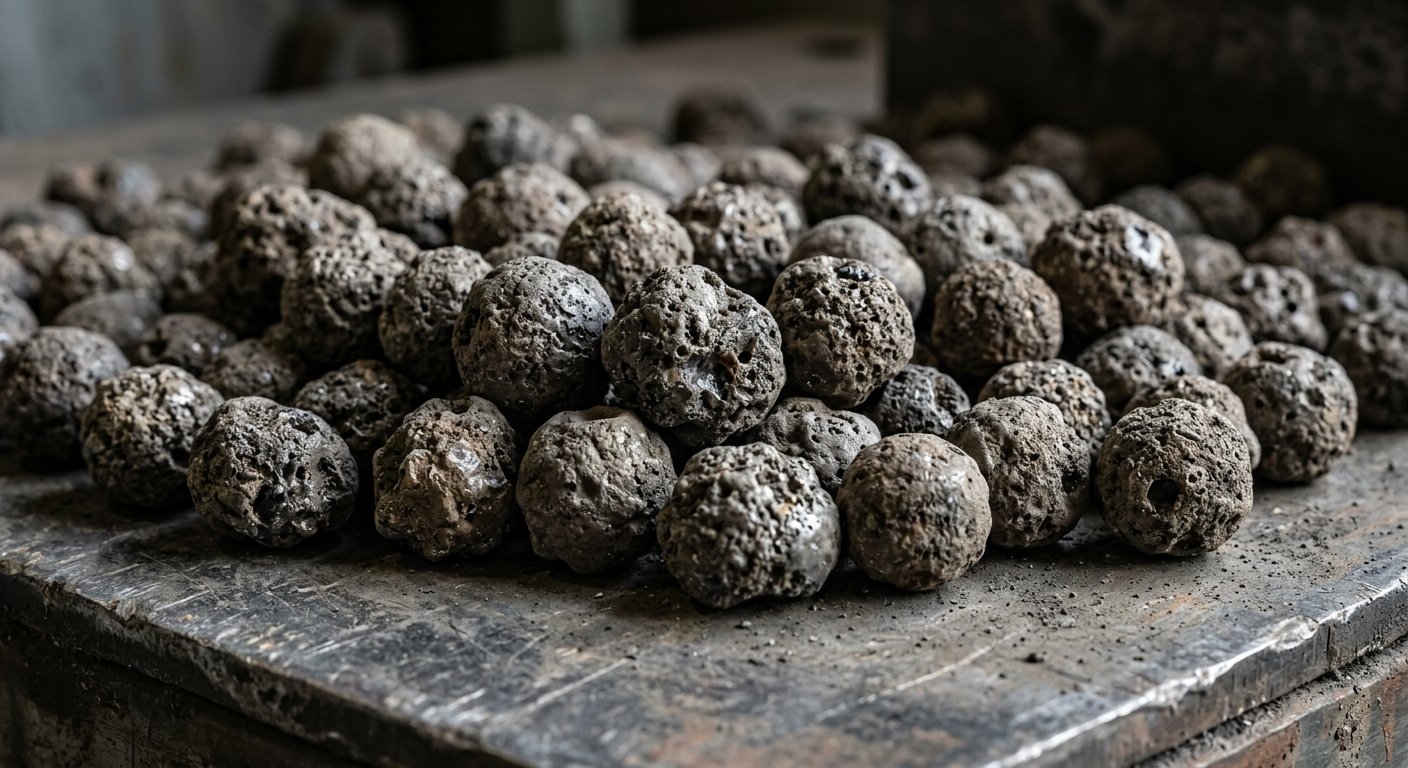
What Is the Chemical Composition of Clinker?
The chemical composition of clinker: alite, belite, aluminate, ferrite. Cement-chemistry notation, typical mass percentages, and the Bogue calculation.
Portland cement clinker is composed of four crystalline phases, formed at sintering temperature (around 1,450 °C) from the CaO-SiO₂-Al₂O₃-Fe₂O₃ system: alite (C₃S), belite (C₂S), aluminate (C₃A), and ferrite (C₄AF). The four phases account for 90-95% of clinker mass; the balance is minor phases (free lime, periclase, alkali sulphates). For the definition, see what clinker is.
The 4 main clinker phases
Clinker chemistry uses a shorthand: C = CaO, S = SiO₂, A = Al₂O₃, F = Fe₂O₃, H = H₂O. So C₃S means 3CaO·SiO₂. The four phases and their hydration role:
- Alite, C₃S = 3CaO·SiO₂. Dominant strength phase; rapid hydration; controls 1-28 day strength.
- Belite, C₂S = 2CaO·SiO₂. Slow hydration; contributes late-age strength (28-90 days+).
- Aluminate, C₃A = 3CaO·Al₂O₃. Very fast hydration; controls early setting (regulated by gypsum at grinding).
- Ferrite, C₄AF = 4CaO·Al₂O₃·Fe₂O₃. Slow hydration; acts as flux during burning and gives clinker its grey colour.
Each phase is the subject of a dedicated treatment: alite, belite, the aluminate phase, and the ferrite phase. Their distinct hydration kinetics are why two clinkers with similar bulk oxide chemistry can still produce cements that behave very differently in the first 24 hours, the first 28 days, and beyond.
Typical clinker composition (mass %)
Modern Portland cement clinker typically falls in the following ranges by mass: alite 50-70%, belite 15-30%, aluminate 5-10%, ferrite 5-15%.
| Phase | Notation | Formula | Typical mass % |
|---|---|---|---|
| Alite | C₃S | 3CaO·SiO₂ | 50-70% |
| Belite | C₂S | 2CaO·SiO₂ | 15-30% |
| Aluminate | C₃A | 3CaO·Al₂O₃ | 5-10% |
| Ferrite | C₄AF | 4CaO·Al₂O₃·Fe₂O₃ | 5-15% |
Ranges per Taylor, Cement Chemistry, 2nd edition (Thomas Telford, 1997).
High-alite clinker (>65% C₃S) gives high early strength but raises fuel use and process CO₂ in the cement manufacturing process. High-belite clinker is identified by the GCCA Net Zero Roadmap as a composition-side decarbonisation lever for the cement industry [5].
The underlying oxide composition
Behind the four phases is an oxide chemistry that is what the XRF analyser actually measures. Ordinary Portland cement clinker typically reports CaO at 63-67%, SiO₂ at 19-23%, Al₂O₃ at 4-7%, and Fe₂O₃ at 2-4%, with minor MgO at 1-4%, SO₃ around 0.5-1.5% from sulphur in the fuel and raw mix, and combined Na₂O + K₂O (alkalis) usually under 1.2% [1]. Loss on ignition on a well-burned clinker is typically below 0.5%, reflecting residual carbonate or hydration in storage. The CaO-SiO₂-Al₂O₃-Fe₂O₃ system accounts for 88-94% of the oxide mass, and that is the system the Bogue calculation operates on; everything outside it is either a minor phase or an impurity tracked separately.
Steering composition with the raw-meal moduli
Plants do not target phase percentages directly; they target three moduli calculated from the raw-meal oxide analysis, and let the kiln chemistry resolve them into phases. The Lime Saturation Factor (LSF), defined as 100·CaO / (2.8·SiO₂ + 1.2·Al₂O₃ + 0.65·Fe₂O₃), governs how much lime is available to combine into alite versus belite; it is held in the 0.66-1.02 window and is typically run at 0.92-0.98 for a high-alite OPC clinker [1]. The Silica Modulus (SM), SiO₂ / (Al₂O₃ + Fe₂O₃), usually held at 2.0-3.0, sets the ratio of silicate phases to the molten flux phase that forms in the burning zone. The Alumina Modulus (AM), Al₂O₃ / Fe₂O₃, usually 1.0-4.0, sets the C₃A-to-C₄AF balance: a low AM yields a sulphate-resisting clinker, a high AM yields a more reactive but sulphate-vulnerable cement [1].
Composition is therefore steered upstream of the kiln through quarry blending and the raw-meal preparation stage. Limestone provides CaO; clay or shale provides SiO₂ and Al₂O₃; iron-rich correctives (laterite, mill scale) bring Fe₂O₃ into target. A 1% drift in raw-meal LSF can shift the finished clinker by 5-8 percentage points of alite, which is why raw-meal X-ray analysers loop into the proportioning station on a minute-scale time constant.
The Bogue calculation
The Bogue calculation is the standard method for back-estimating clinker phase composition from an oxide analysis (typically XRF) of CaO, SiO₂, Al₂O₃, and Fe₂O₃, assuming stoichiometric distribution into the four main phases. Developed by R. H. Bogue in 1929 [3]; codified in ASTM C150 as the "potential compound composition" of Portland cement [2]. The standard equations (oxide values as mass %):
C₃A  = 2.650 × Al₂O₃ − 1.692 × Fe₂O₃
C₄AF = 3.043 × Fe₂O₃
C₃S  = 4.071 × CaO − 7.600 × SiO₂ − 6.718 × Al₂O₃ − 1.430 × Fe₂O₃ − 2.852 × SO₃
C₂S  = 2.867 × SiO₂ − 0.7544 × C₃S
Bogue is an estimate, not a measurement. Statistical comparisons of Bogue against quantitative XRD with Rietveld refinement (QXRD) on more than 190 commercial cements show that Bogue tends to understate alite (C₃S) and overstate aluminate (C₃A) relative to direct measurement, with reported uncertainty bounds of about ±9-10 wt.% for alite and belite, because real clinker phases are non-ideal solid solutions [4]. Bogue is fine for plant QC; QXRD is the reference for research-grade work.
Minor phases and impurities
Clinker also contains 1-5% minor phases affecting cement quality:
- Free lime (CaO): unreacted lime. Target <1.5%; >2-3% risks unsoundness (ASTM C150) [2].
- Periclase (MgO): hydrates slowly and expansively; ASTM C150 caps total MgO at 6% [2].
- Alkali sulphates (K₂SO₄, Na₂SO₄, occasionally calcium langbeinite): contribute to ring formation and preheater buildup; influence setting time.
These minors are the diagnostic indicators on the kiln floor. Free lime is sampled hourly because it tracks burnability; a rising trend signals an under-burned clinker before the bulk chemistry catches up. The relationship between clinker composition and the finished product families is set out in the OPC, PPC, and PSC comparison, and the substitution of clinker mass by supplementary cementitious materials is the largest near-term lever the industry has to cut the embodied CO₂ that this chemistry carries.
Common questions about this topic
It is a shorthand: cement chemists abbreviate the common oxides (CaO = C, SiO₂ = S, Al₂O₃ = A, Fe₂O₃ = F, H₂O = H) so multi-phase reactions fit on a single line. The notation is universal in Taylor's Cement Chemistry and Lea's Chemistry of Cement and Concrete; both forms appear interchangeably in plant documentation.
Iron oxide acts as a flux during burning: it lowers the temperature at which the melt phase forms, and the melt is essential for alite and belite crystallisation. Without 2-4% Fe₂O₃ in the raw mix, the kiln runs materially hotter, raising fuel use and stressing refractory life. White cement (Fe₂O₃ <0.5%) is correspondingly more energy-intensive and more sensitive to false air in cement kilns than grey cement.
Sources
- Taylor, H. F. W. *Cement Chemistry*, 2nd edition. Thomas Telford, 1997. The canonical reference for clinker phase composition and the Bogue calculation.
- ASTM International. *ASTM C150/C150M-24 Standard Specification for Portland Cement*. Codifies the Bogue equations as potential compound composition; current MgO cap 6.0%
- Bogue, R. H. "Calculation of the Compounds in Portland Cement." *Industrial and Engineering Chemistry, Analytical Edition*, 1929.
- Stutzman, P., Bullard, J. W., Feng, P. *Phase Analysis of Portland Cement by Combined Quantitative X-Ray Powder Diffraction and Scanning Electron Microscopy*. NIST
- Global Cement and Concrete Association (GCCA). *Net Zero Roadmap*
- Cembureau. *Activity Report*, 2023. https://cembureau.eu/ --- *Clinker composition is set upstream of the kiln seal, but false air control at the kiln inlet and outlet affects the burning conditions that produce a target composition. Oswal's [engineering-consulting team](/en/services/engineering-consulting) covers that sealing side.*
Related Articles
Discuss Your Sealing Requirements
Our engineering team can help identify the right sealing solution for your application.
Contact Engineering Team“Wherever high-temperature rotary kilns operate under controlled atmosphere, Oswal sealing systems ensure energy efficiency and process stability.”