
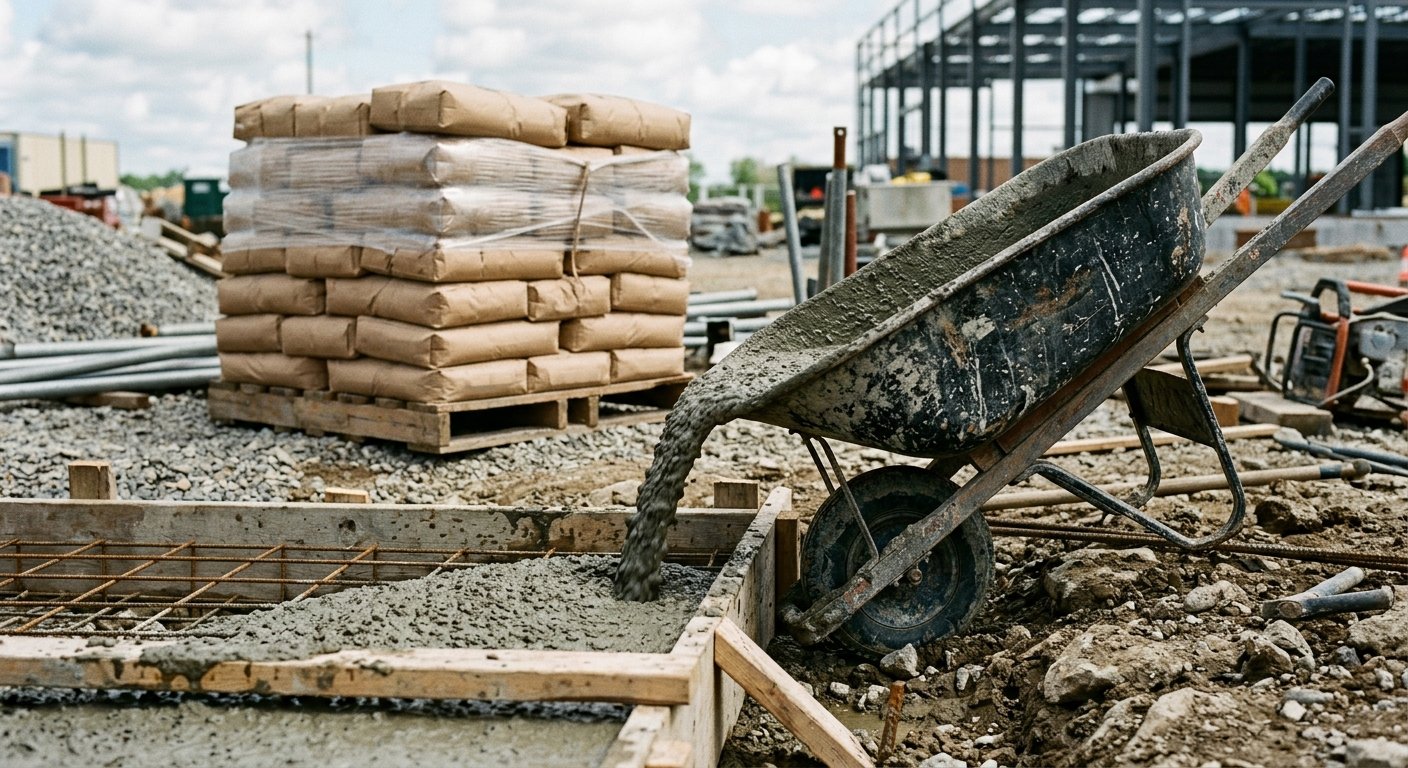
What's the Difference Between Cement and Concrete?
Cement is the binder powder. Concrete is cement + water + aggregates. The compositional, chemical, and use-case differences explained.
Cement is a fine grey powder that acts as a binder. Concrete is the hardened composite material made by mixing cement with water, sand, and coarse aggregate. The words are used interchangeably in everyday speech (a "cement truck" actually delivers concrete), but in engineering and standards they mean different things.
The short answer
Cement is an ingredient; concrete is the finished material. A typical concrete mix is roughly 10-15% cement, 60-75% aggregate, and 15-20% water by volume [1]. Cement is the smallest component by mass and the only one that chemically reacts.
What cement is
Cement is a hydraulic binder, a powder produced by heating limestone with clay or shale to roughly 1,450 degrees Celsius in a rotary kiln, then grinding the resulting clinker with about 5% gypsum [2]. "Hydraulic" means it sets by reacting with water, not by drying.
Portland cement clinker contains four mineral phases [3]: C3S (alite, early-age strength), C2S (belite, later-age strength), C3A (early reaction kinetics), and C4AF (colour and minor strength). The mineralogy is covered in the chemical composition of clinker piece. Clinker is produced through the cement manufacturing process; the kilns where it is made are the equipment Oswal builds kiln sealing systems for.
Hydraulic binder: a material that sets and gains strength through a chemical reaction with water, and remains stable underwater after hardening.
Cement is supplied to site in two physical forms. Bagged cement is typically 50 kg in India and 25-42.5 kg elsewhere; bulk cement is delivered by tanker to silos at ready-mix plants and precast works. In either case the binder leaving the cement plant is the same fine powder with a Blaine specific surface of around 300-400 m²/kg for ordinary Portland cement and 350-450 m²/kg for blended cements [2]. Without water it is inert; once mixed it begins to set within an hour and continues to gain strength for months.
What concrete is
Concrete is a composite of cement paste and aggregate. The cement and water form a paste that coats the aggregate particles and binds them into a rock-like solid as the cement hydrates [4]. Aggregates make up 60-75% of concrete by volume and act as the inert load-bearing skeleton [5]. The water-to-cement ratio (typically 0.4-0.6 by mass for structural concrete) is the most important variable for strength [1].
A representative M30 structural mix runs roughly 320-360 kg/m³ of cement, 180-200 litres of water (giving a w/c of about 0.50), 700-750 kg/m³ of fine aggregate (sand), and 1,150-1,250 kg/m³ of coarse aggregate (10-20 mm crushed stone), plus 0.5-1.5% chemical admixtures by binder mass. Lowering the w/c from 0.55 to 0.40 with a superplasticiser can lift 28-day cube strength from around 30 MPa to over 50 MPa on the same binder content, because strength is dominated by the porosity of the hardened paste, and porosity is largely a function of how much water has to be accommodated before hydration consumes it.
Side-by-side comparison
| Property | Cement | Concrete |
|---|---|---|
| What it is | Fine powder (binder) | Composite (binder + aggregate + water) |
| Main ingredients | Clinker (~95%) + gypsum (~5%) | Cement (10-15%), aggregate (60-75%), water (15-20%) |
| Bulk density | ~1,440 kg/m3 (loose powder) | 2,200-2,500 kg/m3 (hardened, normal-weight) |
| Initial setting time | 45 min minimum (ASTM C150, Type I) [6] | 1-3 hours after mixing, mix-dependent |
| Typical 28-day strength | Not used structurally on its own | 20-50 MPa general construction; 100+ MPa high-strength (ACI 318 sets a 17 MPa floor for structural concrete; high-strength is conventionally 41 MPa / 6,000 psi and above) |
| Where it's used | An ingredient, never used alone | Foundations, slabs, columns, pavements, dams |
The USGS reports that 70-75% of US cement sales go to ready-mixed concrete producers, a useful sanity check on which material does the structural work [7]. The remainder is split between precast operations, soil stabilisation, oil-well cementing, and the bagged retail market.
How cement makes concrete: the hydration timeline
Concrete gains strength because cement reacts with water in a sequence called hydration, producing calcium silicate hydrate (C-S-H) gel that locks the aggregate into a continuous solid [3]. C-S-H is the primary load-bearing phase, accounting for roughly 50-60% of the volume of fully hydrated cement paste. The sequence has well-defined milestones. In the first 15 minutes, C₃A reacts almost instantly with water, but gypsum interferes to throttle that reaction and preserve workability through what is called the dormant period. Initial set occurs around 45-90 minutes after mixing, final set around 6-10 hours. By 24 hours, alite hydration has produced enough C-S-H to give a typical M30 mix 8-12 MPa of compressive strength. By 7 days the mix reaches 65-75% of its 28-day strength; by 28 days, the conventional design strength is reached. C₂S then continues to contribute slowly, lifting strength by a further 10-20% between 28 and 90 days, and incrementally beyond if moist conditions persist.
Why the confusion is expensive
The everyday slippage between cement and concrete is harmless on a site visit and costly in procurement. A spec that calls for "cement" when it means concrete cannot be priced or tested; a delivery ticket that lists concrete when the buyer expected cement powder fails on arrival. ACI 318 and IS 456 keep the two terms strictly distinct in design codes, and ready-mix delivery notes carry mix-design parameters (binder content, w/c, slump, admixtures) that have no meaning at the cement-plant gate. For plant-side context on the upstream end, the cement is the product of a kiln line whose phase chemistry is set in the chemical composition of clinker, and increasingly that binder is itself a blend with supplementary cementitious materials substituted for part of the clinker before it ever reaches the concrete plant.
Common questions about this topic
No. Cement plus water alone is cement paste, which hardens but lacks the bulk and load-bearing structure that aggregates provide. Concrete adds fine aggregate (sand) and coarse aggregate (gravel or crushed stone); the aggregates account for 60-75% of the volume [5].
Cement is the binder powder. Concrete uses both fine and coarse aggregate and is designed to carry structural load. Mortar uses cement, water, and only fine aggregate (sand), giving a workable paste used to bond bricks or blocks rather than to carry primary load. Grout is similar to mortar but with higher water content for flowability into joints.
It is a linguistic shortcut. Cement is the recognisable named ingredient, so "cement truck", "cement floor", and "cement mixer" became everyday shorthand for concrete. In ASTM specifications, ACI design codes, and procurement documents the two terms are kept strictly distinct.
Sources
- American Cement Association (formerly Portland Cement Association), *Cement & Concrete FAQ*, 2025
- Global Cement and Concrete Association (GCCA), *About Cement & Concrete*, 2024
- American Cement Association / MIT Concrete Sustainability Hub, *Concrete Science Platform White Paper* (cement chemists' notations and C-S-H hydration product reference). http://www2.cement.org/exec2/pdfs/sn3228.pdf and
- American Concrete Institute (ACI), *Definition of Portland Cement* (ACI FAQ)
- American Concrete Institute (ACI), *What is aggregate?* (ACI FAQ): aggregates comprise 60-75% of total concrete volume
- ASTM International, *ASTM C150/C150M Standard Specification for Portland Cement* (current edition): minimum 45-minute initial setting time (Vicat) for Type I cement
- U.S. Geological Survey, *Mineral Commodity Summaries 2026: Cement*
- National Ready Mixed Concrete Association (NRMCA), *About Concrete*. https://www.nrmca.org/about-nrmca/about-concrete/ --- *If you operate a cement plant and want to dig into the kiln side of the process, [false air control in cement kilns](/en/blog/understanding-false-air-in-cement-kilns) is the operational lever with the largest fuel-economy upside on most lines.*
Related Articles
Discuss Your Sealing Requirements
Our engineering team can help identify the right sealing solution for your application.
Contact Engineering Team“Wherever high-temperature rotary kilns operate under controlled atmosphere, Oswal sealing systems ensure energy efficiency and process stability.”