
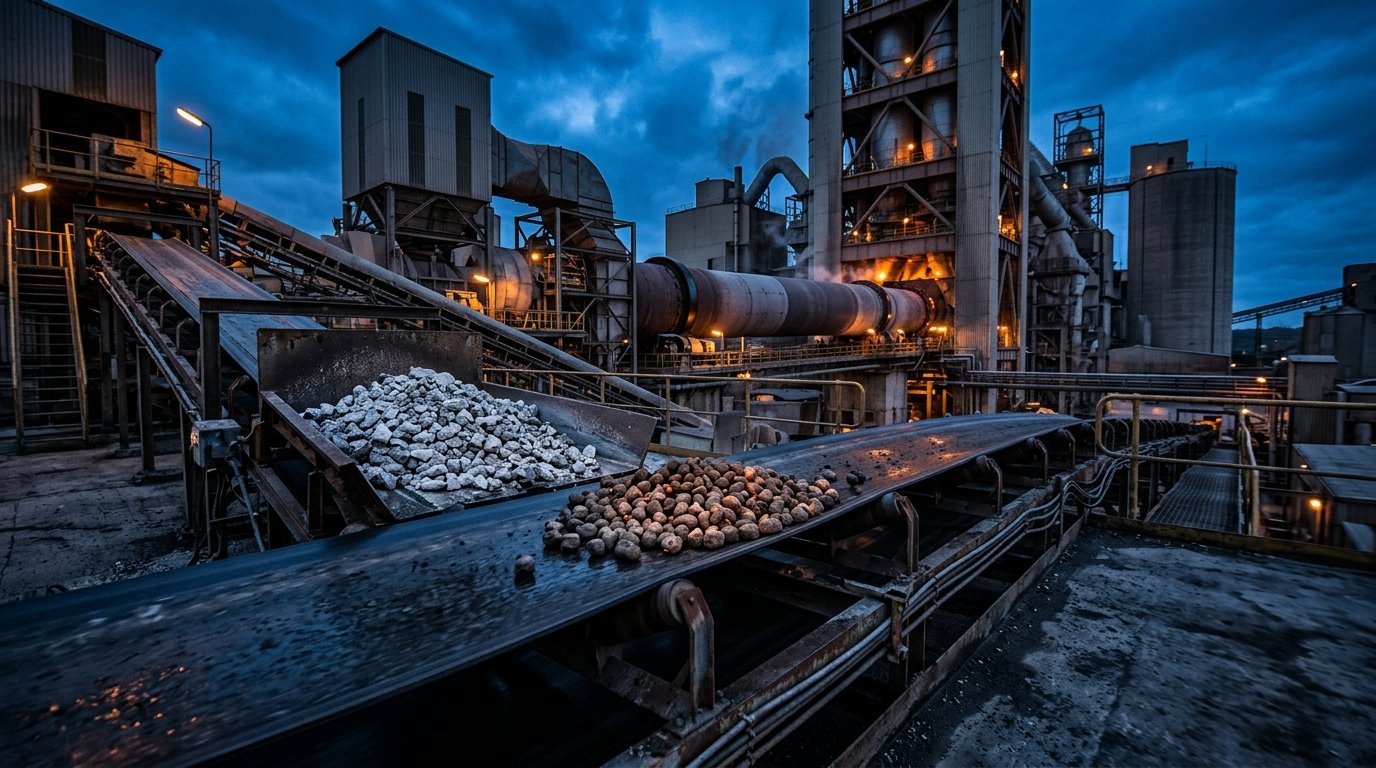
The Calcium Carbonate Problem: Why Cement Is Hard to Decarbonise
Cement CO2 splits roughly 60% process (calcination) and 40% fuel. The 60% is chemistry, not energy, which is why cement is hard to decarbonise.
Cement is hard to decarbonise because roughly 60% of its CO2 comes not from burning fuel but from the limestone itself: heating calcium carbonate to make clinker drives off carbon dioxide as a chemical reaction, and no change of fuel removes it. The cement industry is responsible for around 7-8% of global CO2 emissions [1][2]. This piece sets out the process-versus-fuel split, explains why the calcination CO2 is unavoidable as a matter of stoichiometry, and shows where the abatement levers (and kiln sealing) actually fit.
One disambiguation up front: this piece is about cement clinker. The same calcination reaction releases CO2 in lime and alumina calciners, but the numbers and the decarbonisation context here are specific to cement.
What are cement process emissions?
Cement process emissions are the CO2 released by the chemical decomposition of limestone (calcium carbonate) into lime during clinker production, separate from the CO2 released by burning fuel to heat the kiln. They are the larger of the two CO2 sources in cement manufacture, at roughly 60% of the total, with fuel combustion making up the remaining 40% [3]. This split is why cement sits alongside steel as a hard-to-abate sector: most industries decarbonise by changing their energy source, but more than half of cement's CO2 is locked into the raw material chemistry.
Process emissions: CO2 released by a chemical reaction in the raw material rather than by combustion of fuel. In cement, process emissions come from the calcination of limestone (CaCO3) into lime (CaO), which liberates CO2 regardless of how the heat is supplied.
Calcination: the thermal decomposition of a carbonate mineral. For cement, calcium carbonate (CaCO3) is heated until it splits into calcium oxide (CaO) and carbon dioxide (CO2), the first major reaction on the way to clinker.
The scale is large because cement volume is large. Global cement emissions intensity has held just under 0.6 tonne of CO2 per tonne of cement produced for several years [2]. Multiplied across billions of tonnes of annual production, that puts cement at the 7-8% share of global CO2 noted above [1][2]. For the full breakdown of cement's emissions footprint, see cement industry emissions.
The calcination reaction: why the CO2 is unavoidable
The CO2 is unavoidable because it is bound inside the limestone itself, and heating drives it off as a matter of stoichiometry, not combustion. When calcium carbonate is heated past roughly 850 °C in the kiln system, it decomposes into calcium oxide and carbon dioxide [4]:
CaCO3 -> CaO + CO2
- CaCO3 is calcium carbonate (limestone), molar mass 100.09 g/mol.
- CaO is calcium oxide (lime), molar mass 56.08 g/mol.
- CO2 is carbon dioxide, molar mass 44.01 g/mol.
The mass balance is fixed by the molar masses. Decomposing 100.09 g of CaCO3 yields 56.08 g of CaO and releases 44.01 g of CO2 [4][5]. That gives a process emission factor of 0.44 kg of CO2 per kg of calcium carbonate calcined, independent of the fuel, the kiln type, or the country [5]. You cannot burn a cleaner fuel and avoid it; the carbon comes out of the rock.
Lime is the dominant constituent of clinker, so the per-tonne process emission is substantial. The IPCC default, assuming clinker is about 65% CaO sourced from carbonate, is approximately 0.52 tonne of CO2 per tonne of clinker from calcination alone, before any fuel is counted [5]. The clinker phases that this lime goes on to form (alite, belite, aluminate, ferrite) are covered in clinker chemistry; the point for emissions is that getting to any of them requires releasing the carbonate CO2 first.
Process vs fuel: the 60/40 split
Roughly 60% of the CO2 from making cement comes from calcination and roughly 40% from the fuel burned in the kiln and preheater [3]. The two shares behave differently, which is the heart of the decarbonisation problem.
| Emission source | Share of cement CO2 | Cause | Primary abatement lever |
|---|---|---|---|
| Process (calcination) | ~60% | CO2 chemically bound in limestone, released as CaCO3 -> CaO [3][5] | Use less clinker (SCMs); capture the residual CO2 |
| Fuel (combustion) | ~40% | Burning fuel to reach ~1,450 °C clinkering temperature [3] | Alternative fuels; thermal efficiency; false air control |
The fuel share is the more tractable one. It varies with the fuel mix, the process generation (dry preheater-precalciner kilns burn far less than older wet kilns), and how much parasitic heat the kiln loses, a function partly tracked by specific heat consumption. Switch from coal to lower-carbon fuels, recover more heat, and that 40% falls.
The process share is far more rigid. It scales with how much clinker is in the cement and almost nothing else. This is why electrifying the kiln or running it on renewables, on its own, does not decarbonise cement: clean energy can shrink the 40%, but it leaves the 60% untouched. The carbon in that fraction is in the feedstock, not the flame.
The levers, and why none fully closes the gap
Three levers reduce cement CO2 (using less clinker, burning cleaner fuel, and capturing the CO2), but only the last addresses the calcination CO2 directly, which is why carbon capture sits at the centre of every cement net-zero roadmap.
Use less clinker. The most effective near-term lever is lowering the clinker-to-cement ratio by blending in supplementary cementitious materials such as slag, fly ash, calcined clay, and limestone filler. Less clinker per tonne of cement means proportionally less calcination CO2. The global clinker-to-cement ratio was around 0.71-0.72 in 2022, and the Global Cement and Concrete Association targets an 18% reduction in average clinker content by 2050 [2][6]. SCM use was already around 1,160 million tonnes in 2020 [7]. This shrinks the process emissions, but the clinker that remains still carries its full calcination burden; substitution has practical and standards-driven limits.
Burn cleaner fuel and waste less heat. Alternative fuels (waste-derived fuels, biomass), oxygen enrichment, and tighter thermal efficiency cut the combustion 40%. These do not touch the process 60% at all.
Capture the CO2. Carbon capture is the only lever that addresses the calcination CO2 directly, by removing it from the flue gas after it has been released. That is why it is unavoidable in any genuine cement net-zero plan, not an optional extra. The pathways, costs, and named projects are covered in carbon capture in cement.
The honest summary: clinker substitution and fuel switching shrink the problem, but they cannot eliminate the process fraction. As long as cement is made from limestone, the calcination CO2 is there, and only capture removes it.
Where false air control fits in
Sealing and false air control do not touch the process CO2, but they cut the fuel CO2 by reducing the parasitic heat lost to unintended air ingress, which makes every downstream decarbonisation step cheaper. False air is ambient air drawn into the kiln system through worn seals, hood gaps, and inspection ports rather than through the controlled combustion-air path. It has to be heated to process temperature for no benefit, raising specific heat consumption and, with it, the combustion CO2.
The decarbonisation argument is twofold. First, less false air means less fuel burned, which lowers the 40% combustion share at the source. Second, less false air means a smaller, more concentrated flue-gas volume, which lowers the cost of any future carbon-capture plant bolted onto the same kiln, because capture cost scales with the gas volume treated. Controlling false air is therefore an upstream efficiency move that improves both halves of the emissions picture without changing the chemistry. The mechanism and measurement are set out in false air in cement kilns, and tracking seal condition and false air together is the principle behind Oswal's integrated false air control system.
If you are weighing decarbonisation options for a cement plant, the fuel side of the equation starts with how much heat the kiln is losing to false air. Our engineering team maps seal condition and false air across the kiln inlet and outlet, sizing the fuel-and-emissions saving before recommending a sealing configuration. Contact us to walk through your kiln.
Common questions about this topic
Process emissions in cement production are the CO2 released when limestone (calcium carbonate, CaCO3) is heated and decomposes into lime (calcium oxide, CaO) during clinker manufacture. They are distinct from fuel emissions, which come from burning fuel to heat the kiln, and they account for roughly 60% of the total CO2 from making cement [3]. Because this CO2 is chemically bound in the raw material rather than produced by combustion, it is released regardless of which fuel the kiln burns.
Cement cannot be decarbonised by clean energy alone because roughly 60% of its CO2 comes from calcination, a chemical reaction in the limestone, not from the fuel [3]. Renewable electricity or low-carbon fuel can reduce the combustion share (about 40% of the total), but they leave the calcination CO2 untouched, since that carbon comes out of the calcium carbonate itself as it converts to lime [4][5]. Removing the process CO2 requires either using less clinker or capturing the CO2 from the flue gas.
Calcination releases approximately 0.52 tonne of CO2 per tonne of clinker from the process reaction alone, before any fuel combustion is counted, based on the IPCC default that clinker is about 65% calcium oxide sourced from limestone [5]. The underlying stoichiometry is fixed: decomposing 100.09 g of calcium carbonate yields 56.08 g of lime and 44.01 g of CO2, an emission factor of 0.44 kg of CO2 per kg of CaCO3 calcined [4][5].
Yes. Process emissions scale with the amount of clinker in the cement, so lowering the clinker-to-cement ratio by blending in supplementary cementitious materials reduces calcination CO2 proportionally [2][6]. The global clinker ratio was around 0.71-0.72 in 2022, and industry roadmaps target further reductions [2][6]. The limit is that the clinker that remains still carries its full calcination burden, and substitution is bounded by performance standards and SCM availability, so it shrinks the process emissions but cannot eliminate them.
Sources
- World Economic Forum / Global Cement and Concrete Association, *Net Zero Industry Tracker: Cement* (cement ~7-8% of global CO2)
- International Energy Agency, *Cement* (emissions intensity just under 0.6 tCO2/t cement; clinker-to-cement ratio ~0.71-0.72 in 2022)
- Cembureau, *Our 2050 Roadmap: The 5C Approach (Clinker)* (process ~60% / fuel ~40% split of cement CO2)
- U.S. EPA / GHG Protocol, *Calculating CO2 Process Emissions from Cement Production* (CaCO3 -> CaO + CO2; calcination reaction and stoichiometry)
- IPCC, *CO2 Emissions from Cement Production*, Good Practice Guidance (mass balance, 0.44 kg CO2/kg CaCO3, ~0.52 tCO2/t clinker on 65% CaO basis)
- Global Cement and Concrete Association, *Concrete Future: 2050 Net Zero Roadmap* (18% clinker-content reduction target)
- Alliance for Low Carbon Cement & Concrete, *Clinker Substitution in the EU Cement Sector: Methodology Report* (~1,160 Mt SCM in 2020)
Articoli correlati
Discuss Your Sealing Requirements
Our engineering team can help identify the right sealing solution for your application.
Contact Engineering Team“Ovunque i forni rotanti ad alta temperatura operino in atmosfera controllata, i sistemi di tenuta Oswal garantiscono efficienza energetica e stabilità di processo.”