
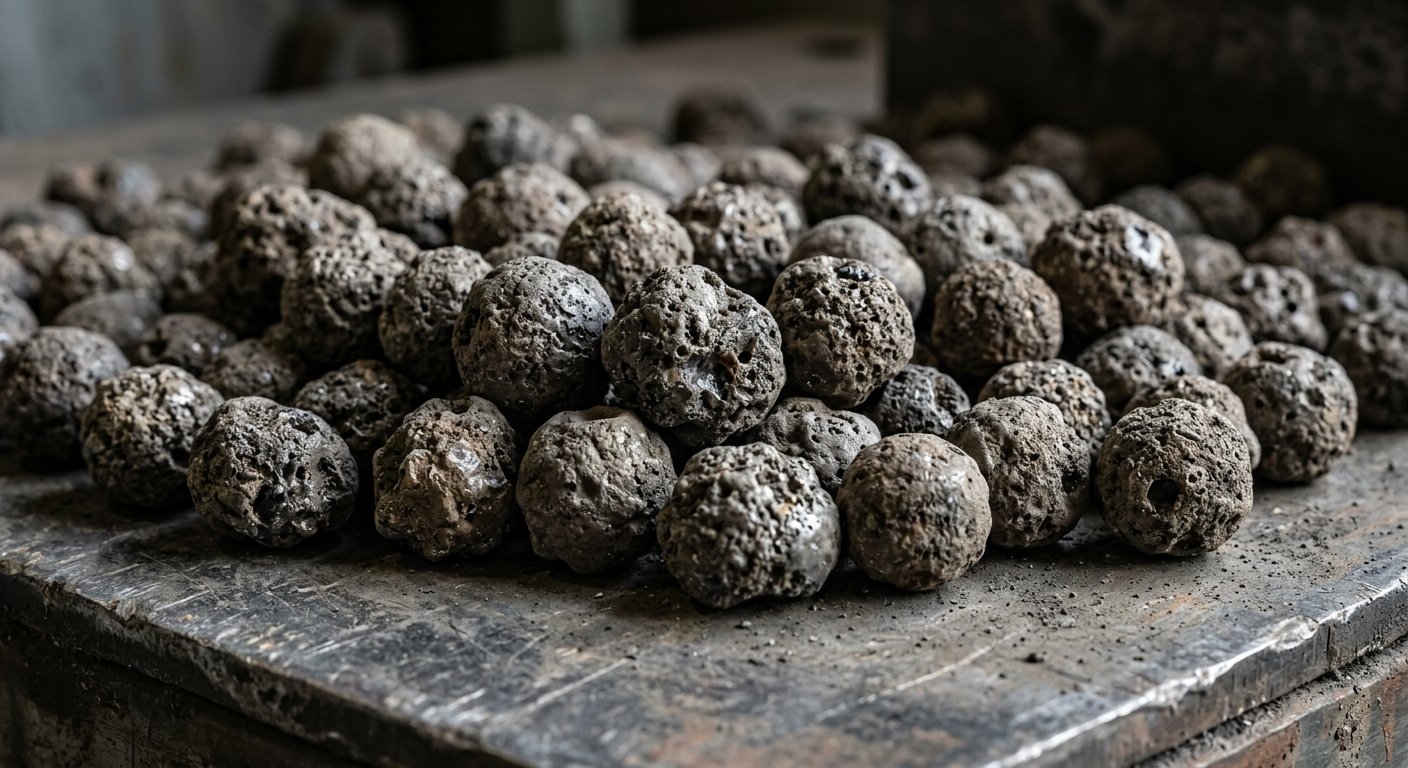
Qual è la composizione chimica del clinker?
Composizione chimica del clinker: alite, belite, alluminato, ferrite. Notazione chimica del cemento, percentuali in massa tipiche e calcolo di Bogue.
Il clinker di cemento Portland è composto da quattro fasi cristalline, formate a temperatura di sinterizzazione (circa 1.450 °C) dal sistema CaO-SiO₂-Al₂O₃-Fe₂O₃: alite (C₃S), belite (C₂S), alluminato (C₃A) e ferrite (C₄AF). Le quattro fasi rappresentano il 90-95% della massa del clinker; il resto è costituito da fasi minori (calce libera, periclase, solfati alcalini). Per la definizione, vedere cos'è il clinker.
Le 4 principali fasi del clinker
La chimica del clinker utilizza una notazione abbreviata: C = CaO, S = SiO₂, A = Al₂O₃, F = Fe₂O₃, H = H₂O. Quindi C₃S significa 3CaO·SiO₂. Le quattro fasi e il loro ruolo nell'idratazione:
- Alite, C₃S = 3CaO·SiO₂. Fase dominante per la resistenza; idratazione rapida; controlla la resistenza a 1-28 giorni.
- Belite, C₂S = 2CaO·SiO₂. Idratazione lenta; contribuisce alla resistenza a lungo termine (28-90 giorni+).
- Alluminato, C₃A = 3CaO·Al₂O₃. Idratazione molto rapida; controlla la presa iniziale (regolata dal gesso durante la macinazione).
- Ferrite, C₄AF = 4CaO·Al₂O₃·Fe₂O₃. Idratazione lenta; agisce come fondente durante la cottura e conferisce al clinker il suo colore grigio.
Ciascuna fase è oggetto di un trattamento dedicato: alite, belite, la fase alluminatica e la fase ferritica. Le loro distinte cinetiche di idratazione spiegano perché due clinker con una chimica ossidica complessiva simile possono comunque produrre cementi che si comportano in modo molto diverso nelle prime 24 ore, nei primi 28 giorni e oltre.
Composizione tipica del clinker (massa %)
Il clinker di cemento Portland moderno rientra tipicamente nei seguenti intervalli in massa: alite 50-70%, belite 15-30%, alluminato 5-10%, ferrite 5-15%.
| Fase | Notazione | Formula | Massa % tipica |
|---|---|---|---|
| Alite | C₃S | 3CaO·SiO₂ | 50-70% |
| Belite | C₂S | 2CaO·SiO₂ | 15-30% |
| Alluminato | C₃A | 3CaO·Al₂O₃ | 5-10% |
| Ferrite | C₄AF | 4CaO·Al₂O₃·Fe₂O₃ | 5-15% |
Intervalli secondo Taylor, Cement Chemistry, 2a edizione (Thomas Telford, 1997).
Il clinker ad alto tenore di alite (>65% C₃S) conferisce un'elevata resistenza iniziale ma aumenta il consumo di combustibile e la CO₂ di processo nel processo di produzione del cemento. Il clinker ad alto tenore di belite è identificato dalla Roadmap Net Zero della GCCA come una leva di decarbonizzazione lato composizione per l'industria del cemento [5].
La composizione ossidica sottostante
Dietro le quattro fasi si cela una chimica ossidica che è ciò che l'analizzatore XRF misura effettivamente. Il clinker di cemento Portland ordinario riporta tipicamente CaO al 63-67%, SiO₂ al 19-23%, Al₂O₃ al 4-7% e Fe₂O₃ al 2-4%, con MgO minore all'1-4%, SO₃ intorno allo 0,5-1,5% proveniente dallo zolfo nel combustibile e nella miscela cruda, e Na₂O + K₂O combinati (alcali) solitamente inferiori all'1,2% [1]. La perdita al fuoco su un clinker ben cotto è tipicamente inferiore allo 0,5%, riflettendo carbonato residuo o idratazione durante lo stoccaggio. Il sistema CaO-SiO₂-Al₂O₃-Fe₂O₃ rappresenta l'88-94% della massa ossidica, ed è il sistema su cui opera il calcolo di Bogue; tutto ciò che ne è al di fuori è una fase minore o un'impurità tracciata separatamente.
Gestione della composizione con i moduli della farina cruda
Gli impianti non mirano direttamente alle percentuali di fase; mirano a tre moduli calcolati dall'analisi ossidica della farina cruda e lasciano che la chimica del forno li risolva in fasi. Il Fattore di Saturazione della Calce (LSF), definito come 100·CaO / (2.8·SiO₂ + 1.2·Al₂O₃ + 0.65·Fe₂O₃), governa quanta calce è disponibile per combinarsi in alite rispetto alla belite; è mantenuto nell'intervallo 0.66-1.02 ed è tipicamente gestito a 0.92-0.98 per un clinker OPC ad alto tenore di alite [1]. Il Modulo Silicico (SM), SiO₂ / (Al₂O₃ + Fe₂O₃), solitamente mantenuto a 2.0-3.0, stabilisce il rapporto tra le fasi silicatiche e la fase fondente che si forma nella zona di cottura. Il Modulo Alluminico (AM), Al₂O₃ / Fe₂O₃, solitamente 1.0-4.0, stabilisce l'equilibrio C₃A-C₄AF: un AM basso produce un clinker resistente ai solfati, un AM alto produce un cemento più reattivo ma vulnerabile ai solfati [1].
La composizione viene quindi gestita a monte del forno attraverso la miscelazione in cava e la fase di preparazione della farina cruda. Il calcare fornisce CaO; l'argilla o lo scisto forniscono SiO₂ e Al₂O₃; i correttivi ricchi di ferro (laterite, scaglia di laminazione) portano Fe₂O₃ al valore target. Una deriva dell'1% nell'LSF della farina cruda può spostare il clinker finito di 5-8 punti percentuali di alite, motivo per cui gli analizzatori a raggi X della farina cruda sono collegati alla stazione di dosaggio con una costante di tempo su scala di minuti.
Il calcolo di Bogue
Il calcolo di Bogue è il metodo standard per la stima retroattiva della composizione delle fasi del clinker da un'analisi ossidica (tipicamente XRF) di CaO, SiO₂, Al₂O₃ e Fe₂O₃, assumendo una distribuzione stechiometrica nelle quattro fasi principali. Sviluppato da R. H. Bogue nel 1929 [3]; codificato nell'ASTM C150 come "composizione potenziale dei composti" del cemento Portland [2]. Le equazioni standard (valori degli ossidi in massa %):
C₃A  = 2.650 × Al₂O₃ − 1.692 × Fe₂O₃
C₄AF = 3.043 × Fe₂O₃
C₃S  = 4.071 × CaO − 7.600 × SiO₂ − 6.718 × Al₂O₃ − 1.430 × Fe₂O₃ − 2.852 × SO₃
C₂S  = 2.867 × SiO₂ − 0.7544 × C₃S
Il calcolo di Bogue è una stima, non una misurazione. Confronti statistici di Bogue rispetto alla XRD quantitativa con raffinamento di Rietveld (QXRD) su oltre 190 cementi commerciali mostrano che Bogue tende a sottostimare l'alite (C₃S) e a sovrastimare l'alluminato (C₃A) rispetto alla misurazione diretta, con limiti di incertezza riportati di circa ±9-10% in peso per alite e belite, poiché le fasi reali del clinker sono soluzioni solide non ideali [4]. Bogue è adeguato per il controllo qualità degli impianti; la QXRD è il riferimento per lavori di ricerca.
Fasi minori e impurità
Il clinker contiene anche l'1-5% di fasi minori che influenzano la qualità del cemento:
- Calce libera (CaO): calce non reagita. Target <1,5%; >2-3% comporta rischi di instabilità (ASTM C150) [2].
- Periclase (MgO): si idrata lentamente ed espansivamente; l'ASTM C150 limita il MgO totale al 6% [2].
- Solfati alcalini (K₂SO₄, Na₂SO₄, occasionalmente langbeinite di calcio): contribuiscono alla formazione di anelli e incrostazioni nel preriscaldatore; influenzano il tempo di presa.
Queste fasi minori sono gli indicatori diagnostici sul piano del forno. La calce libera viene campionata ogni ora perché traccia la bruciabilità; una tendenza in aumento segnala un clinker sottocotto prima che la chimica complessiva si adegui. La relazione tra la composizione del clinker e le famiglie di prodotti finiti è illustrata nel confronto tra OPC, PPC e PSC, e la sostituzione della massa di clinker con materiali cementizi supplementari è la più grande leva a breve termine che l'industria ha per ridurre la CO₂ incorporata che questa chimica comporta.
Common questions about this topic
Si tratta di una notazione abbreviata: i chimici del cemento abbreviano gli ossidi comuni (CaO = C, SiO₂ = S, Al₂O₃ = A, Fe₂O₃ = F, H₂O = H) in modo che le reazioni multifase possano essere riportate su una singola riga. Tale notazione è universale nel Cement Chemistry di Taylor e nel Chemistry of Cement and Concrete di Lea; entrambe le forme compaiono in modo intercambiabile nella documentazione di impianto.
L'ossido di ferro agisce come fondente durante la calcinazione: abbassa la temperatura alla quale si forma la fase fusa, e la fase fusa è essenziale per la cristallizzazione dell'alite e della belite. Senza il 2-4% di Fe₂O₃ nella farina cruda, il forno opera a temperature significativamente più elevate, aumentando il consumo di combustibile e sollecitando la vita utile dei refrattari. Il cemento bianco (Fe₂O₃ <0,5%) è conseguentemente più energivoro e più sensibile all'aria parassita nei forni da cemento rispetto al cemento grigio.
Sources
- Taylor, H. F. W. *Cement Chemistry*, 2nd edition. Thomas Telford, 1997. The canonical reference for clinker phase composition and the Bogue calculation.
- ASTM International. *ASTM C150/C150M-24 Standard Specification for Portland Cement*. Codifies the Bogue equations as potential compound composition; current MgO cap 6.0%
- Bogue, R. H. "Calculation of the Compounds in Portland Cement." *Industrial and Engineering Chemistry, Analytical Edition*, 1929.
- Stutzman, P., Bullard, J. W., Feng, P. *Phase Analysis of Portland Cement by Combined Quantitative X-Ray Powder Diffraction and Scanning Electron Microscopy*. NIST
- Global Cement and Concrete Association (GCCA). *Net Zero Roadmap*
- Cembureau. *Activity Report*, 2023. https://cembureau.eu/ --- *Clinker composition is set upstream of the kiln seal, but false air control at the kiln inlet and outlet affects the burning conditions that produce a target composition. Oswal's [engineering-consulting team](/en/services/engineering-consulting) covers that sealing side.*
Articoli correlati
Discuss Your Sealing Requirements
Our engineering team can help identify the right sealing solution for your application.
Contact Engineering Team“Ovunque i forni rotanti ad alta temperatura operino in atmosfera controllata, i sistemi di tenuta Oswal garantiscono efficienza energetica e stabilità di processo.”