
What Is C4AF (Ferrite Phase) in Cement?
C4AF (ferrite phase) is 8-15% of Portland cement clinker. It fluxes the kiln burn, lowers heat of hydration, and gives cement its grey colour.
C4AF (tetracalcium aluminoferrite, 4CaO·Al2O3·Fe2O3) is typically 8-15% of Portland cement clinker by mass and serves two distinct functions: as a flux that lowers the liquid-phase formation temperature during kiln burning (enabling alite and belite to form at practical kiln temperatures), and as the phase responsible for the grey colour of Portland cement [1]. Note: this article covers the ferrite phase in cement chemistry, which is distinct from iron ferrite in steelmaking. For the full four-phase context, see what the chemical composition of clinker is.
Formation in the kiln: flux behaviour and the liquid phase
The ferrite phase is not a single stoichiometric compound. In real clinker it is a member of a continuous solid-solution series running from C2F (dicalcium ferrite) to C2A (dicalcium aluminate); the C4AF stoichiometry is the midpoint and is used as the standard composition in the Bogue calculation [1]. In the crystallographic literature the mineral is called brownmillerite. Most of the phase crystallises from the melt during cooling rather than forming solid-state at peak temperature.
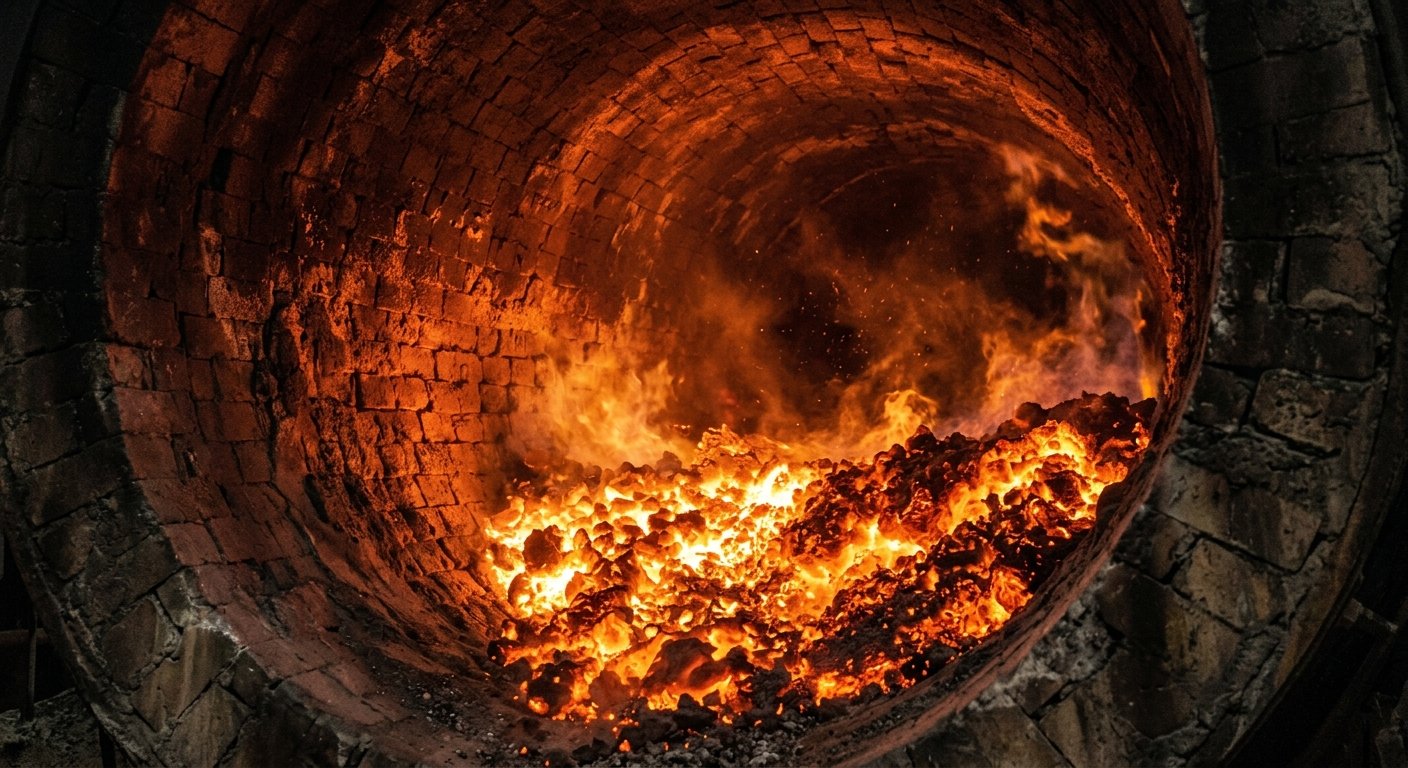
The role of C4AF in the kiln is structural to the entire clinkering process. Together with C3A (aluminate), C4AF begins to melt at around 1,280-1,300 °C, generating a liquid phase that reaches roughly 20-30% of the clinker charge at peak burning temperature near 1,450 °C [2]. The silicate reactions that build alite (C2S + CaO → C3S) proceed through that melt: free lime and dicalcium silicate dissolve at the grain surface, diffuse through the liquid, and re-precipitate as alite. Without the ferrite-aluminate flux, the reaction would still proceed but only at materially higher temperatures, perhaps 1,550 °C and above, and the residence time would have to be extended well beyond the few minutes industrial rotary kilns can offer. The fuel and refractory penalties would both be substantial. The liquid phase is also what binds the meal into nodules. The wider thermal economy is covered in the cement pyroprocessing and specific heat consumption pieces, both of which assume the flux fraction is doing its job.
Why clinker is grey: the chromophore
Iron oxide (Fe2O3) in the C4AF lattice is the chromophore that gives ordinary Portland cement and concrete their characteristic grey to grey-brown colour. The iron sits in octahedral coordination in the brownmillerite structure, and the electronic transitions of that Fe(III) centre absorb across most of the visible spectrum, transmitting only the grey-to-brown tail. Cooling regime matters: a fast quench traps iron in the high-temperature crystal form and gives a darker, more uniform grey; slow cooling gives a lighter, more variable colour. This is one of the reasons the clinker cooler is tuned for thermal shock, even when colour is not a contract requirement.
White cement is produced by removing the chromophore. The raw mix is sourced from very low-iron limestone and kaolin, and Fe2O3 is held below 0.5%; the result is a clinker with essentially no C4AF [1]. Because the flux fraction is now almost entirely C3A, the liquid phase is thinner and more viscous, and the kiln has to run materially hotter. White-cement plants consume roughly 20-40% more fuel per tonne than grey-cement plants and are constrained to a narrow geography of low-iron raw materials. A reducing atmosphere or water quench at the kiln exit is sometimes used to prevent residual iron from re-oxidising and tinting the product. The fuel penalty quantifies the structural role of C4AF in grey cement: removing it has real cost.
Hydration: slow, cool, and sulfate-tolerant
C4AF hydrates more slowly than C3A and with a substantially lower heat of hydration, approximately 420 kJ/kg against 840-870 kJ/kg for C3A [1]. The reaction products are calcium aluminoferrite hydrates, chemically similar to the calcium aluminate hydrates produced by C3A but containing iron in the lattice and less expansive on sulfate exposure. The strength contribution is modest and largely complete within a few weeks. The cooler hydration profile is part of why high-C4AF clinkers run lower adiabatic temperature rise, which feeds into mass-concrete thermal calculations alongside the high-belite lever.
The sulfate-resistance story is the practical consequence. Sulfate attack on hardened paste is principally the reaction of late sulfate ingress with hydrated C3A to form expansive ettringite inside an already-rigid paste. C4AF participates in the analogous reaction but the iron-substituted hydrates are slower to form and less expansive, so the disruption is materially smaller. ASTM C150 Type V (sulfate-resistant) cement caps C3A at 5% and, by holding the alumina modulus at 0.6-1.0, effectively pushes the available alumina into C4AF [3]. In compositional terms, the cement is a low-C3A high-C4AF clinker, and the higher iron content is part of the design specification, not a side effect.
Raw-mix control and the practical floor
C4AF content is governed by the alumina modulus (AM = Al2O3/Fe2O3), set during raw-meal preparation. Lowering AM, typically by adding iron ore or mill scale, shifts the C3A-C4AF balance toward ferrite. Standard OPC targets AM at 1.5-2.5; sulphate-resistant grades hold AM at 0.6-1.0; white cement runs iron below 0.5% and removes C4AF altogether. There is a practical floor for grey cement: reducing C4AF much below 8% thins the liquid phase, raises burning-zone temperature, and shows up in the fuel bill and in increased refractory wear.
Bogue vs QXRD for C4AF
The Bogue calculation reports potential C4AF by assigning all Fe2O3 in the XRF oxide analysis to the assumed 4CaO·Al2O3·Fe2O3 stoichiometry [5]. The bias is the variable stoichiometry of the real solid-solution phase: where ferrite sits closer to the C2F end, Bogue understates C4AF; closer to C6AF2, it overstates. Substituent ions (Mg, Mn, Ti, Cr) further blur the stoichiometry. Quantitative X-ray diffraction with Rietveld refinement measures the ferrite phase directly through the brownmillerite reflections and resolves its composition within the solid-solution series, which is the right method where C4AF is being used to qualify a sulfate-resisting clinker or audit a colour-controlled product. For routine plant work, the Bogue C4AF trend is adequate, with the understanding that the absolute fraction can sit a few percent off the true value.
Common questions about this topic
C4AF is tetracalcium aluminoferrite, written 4CaO·Al2O3·Fe2O3 in oxide notation and abbreviated C4AF in cement-chemist shorthand (where C = CaO, A = Al2O3, F = Fe2O3). It constitutes 8-15% of ordinary Portland cement clinker by mass and crystallises from the melt phase during kiln cooling (Taylor, Cement Chemistry, 2nd ed., Thomas Telford, 1997) [1]. In the crystallographic literature it is also called brownmillerite. C4AF in clinker is technically a mid-point in a solid-solution series ranging from C2F (dicalcium ferrite) to C2A (dicalcium aluminate); the C4AF stoichiometry is the standard approximation used in the Bogue calculation.
C4AF and C3A (the aluminate phase) are together called the flux phases. They begin to melt at approximately 1,280-1,300 °C, forming a liquid phase that reaches roughly 20-30% of the clinker charge at peak burning temperature (~1,450 °C) [2]. This liquid phase is essential: alite (C3S) and belite (C2S) form primarily through solid-state dissolution and re-precipitation reactions that require the liquid medium to proceed at commercially viable rates. Without the ferrite and aluminate flux, achieving equivalent clinker quality would demand materially higher kiln temperatures, raising fuel consumption and refractory wear.
The iron oxide (Fe2O3) in C4AF is the chromophore that gives Portland cement and concrete their characteristic grey to grey-brown colour. White cement is produced by reducing Fe2O3 in the raw mix to below 0.5% and using a reducing atmosphere or rapid water quench at the kiln exit to prevent iron from re-oxidising; the result is a clinker with essentially no C4AF [1]. White cement production is consequently more energy-intensive: without the ferrite-aluminate flux, the kiln must run hotter to achieve comparable clinker quality, and the raw mix must be sourced from very low-iron materials, which limits raw material geography.
C4AF hydrates more slowly than C3A and with a substantially lower heat of hydration (approximately 420 kJ/kg vs 840-870 kJ/kg for C3A, per Taylor, 1997) [1]. In sulfate-bearing environments, C4AF-derived hydrates are less expansive than C3A-derived ettringite, making high-C4AF clinkers intrinsically more sulfate-tolerant. ASTM C150 Type V (sulfate-resistant) cement caps C3A at 5% and effectively increases C4AF by requiring a higher Fe2O3 content in the raw mix [3].
C4AF content is governed by the alumina modulus (AM = Al2O3/Fe2O3). Lowering AM (by increasing Fe2O3 via iron ore or mill-scale additions to the raw mix) shifts the C3A-C4AF balance toward ferrite. Standard OPC targets AM at 1.5-2.5; sulphate-resistant grades hold AM at 0.6-1.0. This is a kiln-feed chemistry decision coordinated during raw-meal preparation. Reducing C4AF below a practical minimum is counterproductive: the flux phase is load-bearing for clinkering efficiency, and its elimination (as in white cement) carries the fuel-cost penalty described above.
Sources
- Taylor, H. F. W. *Cement Chemistry*, 2nd edition. Thomas Telford, 1997. Canonical reference for C4AF phase composition, heat of hydration, and colour mechanism
- Northwestern/ITI. "3.4, Burning in a kiln: clinker formation." Describes the melt-phase role of flux phases and liquid-phase proportion at peak temperature
- ASTM International. *ASTM C150/C150M-24 Standard Specification for Portland Cement*. Defines C3A and composition limits for Type V sulfate-resistant cement
- Wikipedia. "Calcium aluminoferrite." Overview of C4AF crystal chemistry, colour, and hydration
- Understanding Cement. "Bogue calculation." C4AF percentage ranges in OPC clinker
Related Articles
Discuss Your Sealing Requirements
Our engineering team can help identify the right sealing solution for your application.
Contact Engineering Team“Wherever high-temperature rotary kilns operate under controlled atmosphere, Oswal sealing systems ensure energy efficiency and process stability.”