
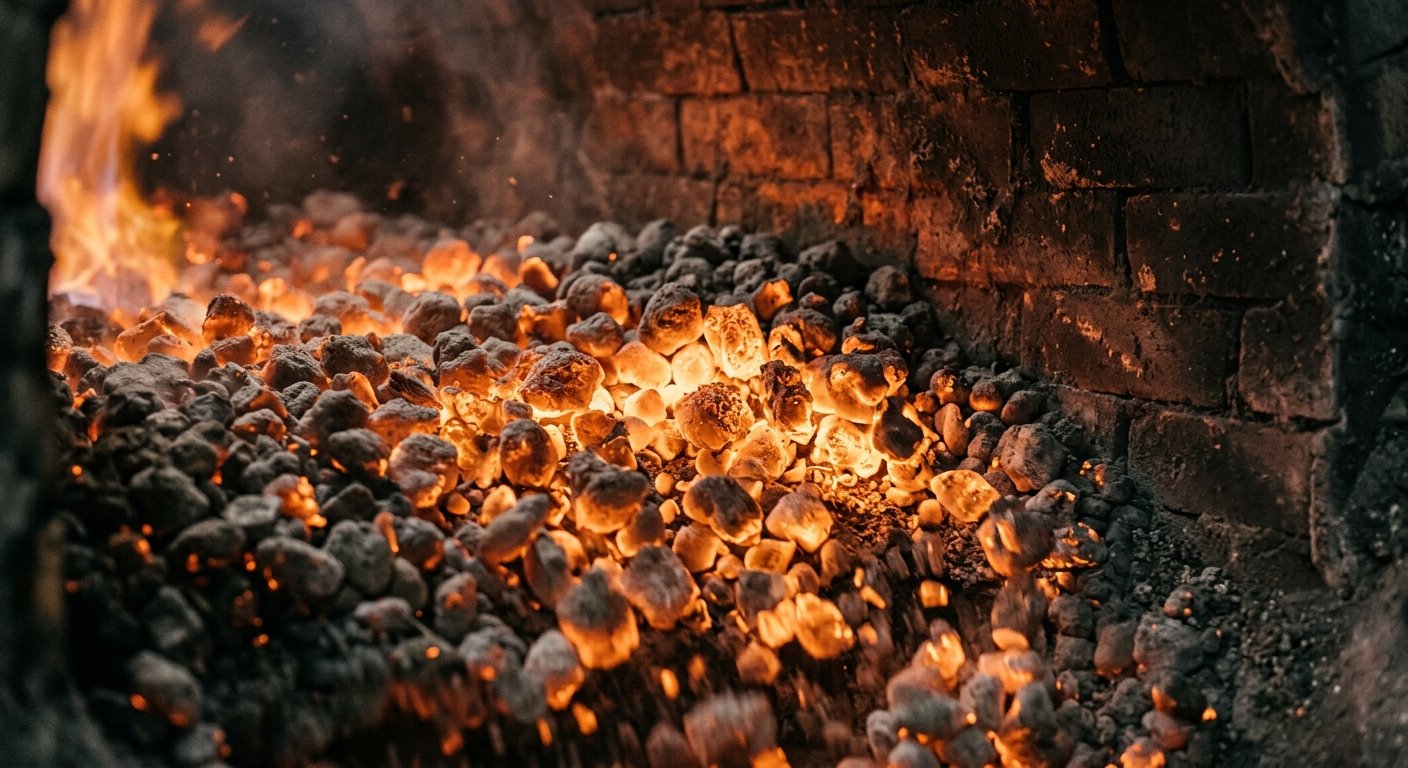
What Is C3S (Alite) in Cement Chemistry?
C3S (alite) is the dominant phase in Portland cement clinker at 50-70% by mass. It drives early strength via rapid hydration to C-S-H gel.
C3S (alite) is the dominant crystalline phase in Portland cement clinker, typically comprising 50-70% of clinker mass, and is the primary source of early compressive strength in hardened cement [1]. It forms at sintering temperature (around 1,450 °C) in the rotary kiln from lime (CaO) and silica (SiO2) and is the phase that most determines how quickly a concrete structure gains load-bearing capacity in its first 28 days. For the full four-phase picture, see what the chemical composition of clinker is.
Formation in the kiln: lime saturation, liquid phase, and burnability
Alite is thermodynamically stable only above roughly 1,250 °C, and below about 1,200 °C it tends to decompose back into belite (C2S) and free lime. A high-C3S clinker is therefore a clinker that has been held in the burning zone long enough, and quenched fast enough, that the alite formed at temperature is preserved into the cold product. The reaction that builds alite is the uptake of free CaO into existing C2S grains through the liquid phase: C2S + CaO → C3S, proceeding by solution-precipitation across the melt that the aluminate and ferrite phases together provide at 1,280-1,300 °C [1]. Without that 20-30% liquid fraction at peak temperature, the reaction is solid-state, slow, and not viable at industrial residence times of a few minutes.
The raw-meal chemistry that drives the balance is captured in three moduli, calculated from the XRF oxide analysis. The Lime Saturation Factor (LSF), held typically at 0.92-0.98 for high-alite OPC clinker, sets how much of the available lime can be taken up by the silicates: an LSF near 1.0 saturates the system with lime and pushes the equilibrium toward C3S; an LSF near 0.85 leaves more silica unsatisfied and stalls the system at C2S. The silica modulus (SM, usually 2.0-3.0) governs how much melt is available for the reaction to proceed through, and the alumina modulus (AM, usually 1.0-4.0) tunes the viscosity of that melt. A higher LSF clinker is harder to burn: it consumes more fuel per tonne of clinker and is less forgiving of upsets in raw-meal preparation or kiln-feed uniformity. This is why the specific fuel consumption of a high-C3S line is structurally above that of a high-belite line.
Polymorphs and what "alite" really is
Pure tricalcium silicate has seven recognised polymorphs across three structural families (triclinic, monoclinic, trigonal). Real industrial alite is almost never the pure phase. It is an impure solid solution carrying 3-4% of substituent oxides (Al2O3, MgO, Fe2O3, alkali oxides), and these substitutions stabilise the monoclinic M1 and M3 forms at room temperature; the M3 polymorph is the one most commonly found in commercial Portland clinker [1]. The substituent ions distort the silicate framework slightly, which raises the lattice energy and tends to increase the early hydration rate relative to the unsubstituted compound. This is one reason real alite outperforms the textbook C3S in C-S-H formation rate during the first 24 hours.
Hydration: the first day and the next year
When water meets ground clinker, C3S enters solution within seconds, and the dissolved Ca, Si, and OH species supersaturate the pore solution and precipitate calcium silicate hydrate (C-S-H) gel together with calcium hydroxide (portlandite). The kinetics follow the characteristic five-stage curve: an initial dissolution spike, an induction period of roughly 1-3 hours where the surface is passivated by an early C-S-H layer, an acceleration period peaking at 6-12 hours during which most of the early strength develops, a deceleration phase as the reaction becomes diffusion-controlled through the thickening hydrate shell, and a long diffusion-limited tail that runs for months. By 28 days, around 70-80% of the alite has typically reacted in a well-cured paste; the remainder continues to contribute slowly thereafter. The heat of hydration of C3S sits around 500 kJ/kg [1], which is part of why high-alite cements raise mass-concrete thermal risk and why mass pours favour the high-belite alternative covered in C2S (belite).
C3S in modern cement design: low-clinker and blended systems
The decarbonisation trajectory of the cement industry pulls in two directions on C3S. On one hand, the world clinker factor is being driven down by supplementary cementitious materials such as slag, fly ash, calcined clay, and limestone filler, which replace clinker in finished cements like PPC and PSC. When the clinker fraction in cement falls, each tonne of remaining clinker has to do more work, which favours keeping alite high to sustain early strength. On the other hand, lowering the LSF to make a high-belite clinker cuts the lime demand and the process CO2 per tonne of clinker, an explicit composition-side lever in the GCCA Net Zero Roadmap [4]. The practical compromise is a moderate-alite, moderate-belite clinker blended at low clinker factor with a reactive SCM such as calcined clay-limestone (LC3), which preserves usable 7-28 day strength without holding LSF at the upper bound.
Bogue vs QXRD: what the numbers actually mean
Plant labs almost universally report C3S as a "potential C3S" derived from the Bogue calculation, which solves a four-equation linear system over the XRF oxide analysis to allocate CaO, SiO2, Al2O3, and Fe2O3 to the four ideal phases [2]. The Bogue answer is fast and cheap, but it carries a systematic bias: it assumes ideal stoichiometry and that all the lime is available to the silicates, neither of which holds in real clinker. Bogue typically understates alite by 4-8 percentage points and overstates belite by a similar margin, because the substituent oxides in real alite are not accounted for and free lime, alkali sulfates, and periclase (MgO) consume oxides the calculation assigns to the silicate phases. Quantitative X-ray diffraction with Rietveld refinement (QXRD) measures the phases directly through their crystallographic signatures and is the reference method where alite content is contractually load-bearing, for instance auditing a sulfate-resisting product against ASTM C150 limits [5]. The shorthand on most plant dashboards (potential C3S = 58%, say) is best read as a process-control trend line rather than a true phase fraction.
Common questions about this topic
C3S is tricalcium silicate, written 3CaO·SiO2 in oxide notation and abbreviated C3S in cement-chemist shorthand (where C = CaO, S = SiO2). It forms during sintering in the rotary kiln and constitutes 50-70% of ordinary Portland cement clinker by mass (Taylor, Cement Chemistry, 2nd ed., Thomas Telford, 1997) [1]. In plant documentation, C3S and alite are used interchangeably. Real alite is not stoichiometrically pure C3S; it is an impure solid solution containing 3-4% substituent oxides (Al2O3, MgO, Fe2O3), which modify its crystal structure and hydration kinetics relative to the synthetic compound.
C3S reacts rapidly with water to produce calcium silicate hydrate (C-S-H) gel and calcium hydroxide (Ca(OH)2, portlandite). The C-S-H gel is the principal strength-giving product in hardened cement paste. The reaction:
OPC clinker targets 50-65% C3S for standard early and long-term strength balance. High-early-strength cement (ASTM C150 Type III) pushes toward 60-70% C3S to accelerate strength gain for fast-track construction. Sulphate-resistant and low-heat cements deliberately reduce C3S below 50% and shift the balance toward C2S, which hydrates more slowly and generates less heat [3].
Higher C3S targets require a more lime-rich raw mix, meaning a higher lime saturation factor (LSF). This makes the raw mix harder to burn: the kiln needs a hotter burning zone and more residence time to drive the CaO-SiO2 reaction to completion. The result is higher specific fuel consumption and higher process CO2 per tonne of clinker. The Global Cement and Concrete Association (GCCA) Net Zero Roadmap identifies high-belite (low-C3S) clinker as one of the composition-side levers for cement decarbonisation [4]. False air ingress at the kiln inlet and outlet compounds the problem by diluting combustion gases and lowering effective burning temperature; controlling this is the subject of false air in cement kilns.
C3S is routinely estimated using the Bogue calculation applied to XRF oxide data. The Bogue equation gives the "potential C3S," but it tends to understate alite relative to direct measurement because real clinker phases are non-ideal solid solutions. Quantitative XRD (QXRD) with Rietveld refinement provides a direct phase measurement and is the reference method for research-grade work (Stutzman et al., NIST) [5]. For plant quality control, Bogue is adequate; for research or litigation-level accuracy, QXRD is required. The full Bogue equations are covered in what is the chemical composition of clinker.
Sources
- Taylor, H. F. W. *Cement Chemistry*, 2nd edition. Thomas Telford, 1997. Canonical reference for clinker phase composition, typical mass percentages, and heat of hydration values
- Understanding Cement. "Bogue calculation."
- ASTM International. *ASTM C150/C150M-24 Standard Specification for Portland Cement*. Defines Type I-V cement classifications and C3S-related composition requirements
- Global Cement and Concrete Association (GCCA). *Concrete Future: The GCCA 2050 Cement and Concrete Industry Roadmap for Net Zero Concrete*
- Stutzman, P., Bullard, J. W., Feng, P. *Phase Analysis of Portland Cement by Combined Quantitative X-Ray Powder Diffraction and Scanning Electron Microscopy*. NIST
Related Articles
Discuss Your Sealing Requirements
Our engineering team can help identify the right sealing solution for your application.
Contact Engineering Team“Wherever high-temperature rotary kilns operate under controlled atmosphere, Oswal sealing systems ensure energy efficiency and process stability.”