
Graphite Kiln Seals: Design, Materials, Where They Win
Graphite kiln seals use segmented graphite blocks for high-temperature false-air control. How they work, the material science, and when to specify them.
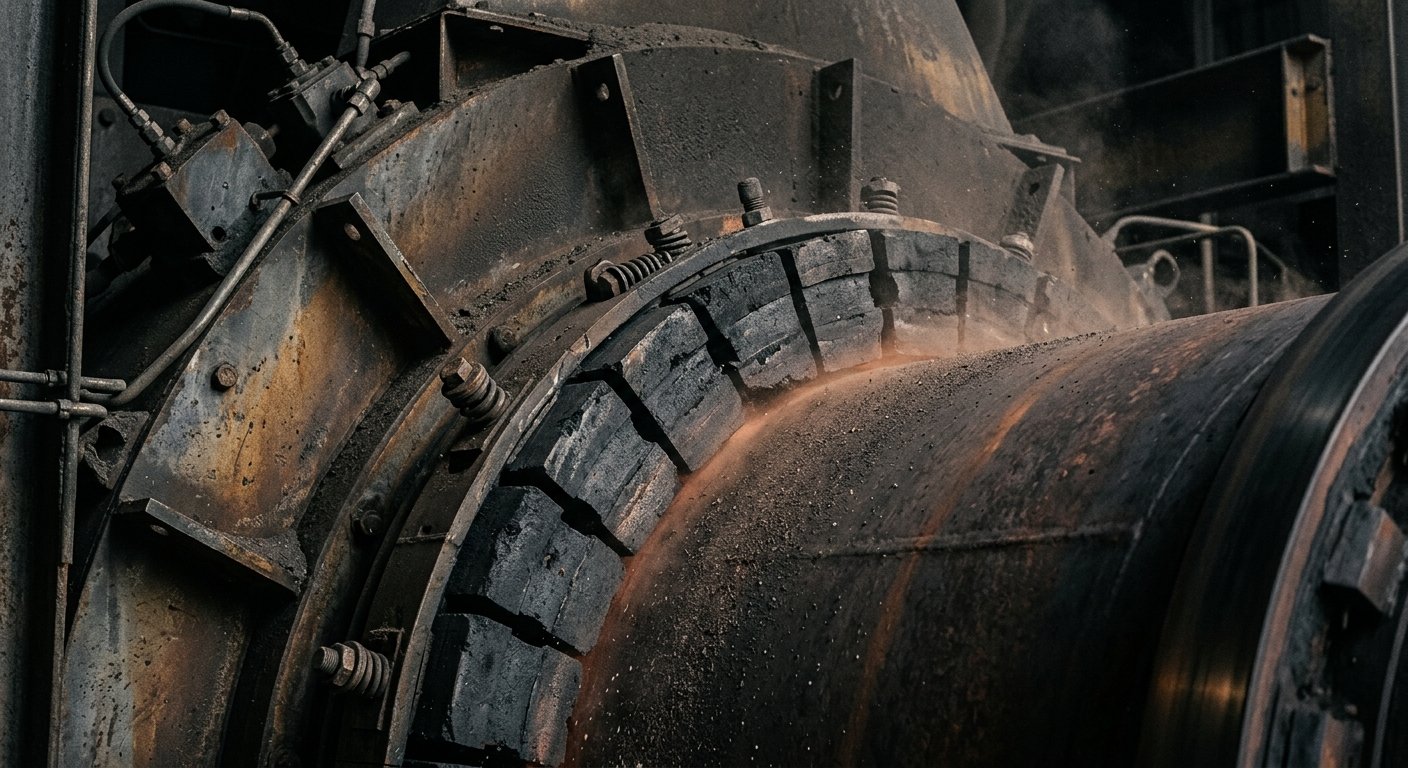
A graphite kiln seal closes the gap between a rotating kiln shell and its stationary inlet or outlet hood using a ring of segmented graphite blocks held in continuous contact against the shell. It is built for the hottest, dustiest seal positions on a rotary kiln, where the job is to keep false air out for long campaigns without the seal face eroding or losing contact.
One disambiguation first. A graphite kiln seal here is the segmented-block seal at a rotary kiln shell, not a graphite mechanical face seal in a pump or turbine, and not a flexible-graphite gasket tape for a flange.
What is a graphite kiln seal?
A graphite kiln seal is a sealing system that closes the kiln-to-hood gap with a ring of segmented graphite blocks, each held against the rotating shell by its own spring or thrust element so the blocks track kiln movement individually. Because each block is loaded and moves on its own, the kiln can expand, walk, and distort while the blocks follow the shell rather than one block jamming or shearing the assembly [1].
It is the material of choice for the harshest positions. Oswal's graphite-based sealing elements are specified for "high-temperature resistance, continuous sealing contact, stable friction characteristics, and long wear life under dust exposure" [2]. The form is established across the industry; major kiln OEMs supply segmented graphite seals as well (for example the polysius graphite seal) [3].
Graphite kiln seal: a rotary-kiln sealing system that closes the gap between the rotating shell and the stationary hood using a ring of segmented graphite blocks, each pressed against the shell by an individual spring or thrust element so the blocks maintain continuous contact while tracking kiln movement.
How a graphite kiln seal works
It works by pressing self-lubricating graphite blocks against the rotating shell with controlled, even pressure so the blocks ride the moving steel while closing the leakage path. Each block's own spring or thrust module keeps contact pressure roughly uniform around the full circumference even as the kiln grows radially, walks axially, or runs out of round [1], and because the face shears easily along graphite's layered crystal structure, the blocks slide at low, stable friction instead of stick-slipping.
That continuous contact drives false air down, and the leverage is large. The kiln inlet and outlet seals together account for roughly 60-75% of total false air in a cement plant [4][5], and each 1% of false air above baseline adds on the order of 3 kcal/kg clinker in wasted fuel [4]. Holding a graphite block ring in contact at a hot, leaky position is one of the higher-leverage moves on the false air in cement kilns problem.
The material science: why graphite seals at high temperature
Graphite makes a good high-temperature seal because it is self-lubricating, dimensionally stable under heat, and abrasion-resistant, so it slides against a hot steel shell at low, stable friction and wears slowly. The properties below are general material data for carbon-graphite, used to explain why graphite suits hot sealing duty; they are not Oswal product ratings.
Self-lubricity comes from the crystal structure: the layers slip easily over one another in the presence of adsorbed gases, giving a low, stable coefficient of friction, typically 0.17-0.22 for pretreated graphite as a general figure [6][7]. Graphite also has a low coefficient of thermal expansion, high thermal conductivity, and good chemical stability, which help a seal face hold geometry and shed frictional heat [7][8]. It machines into precise block shapes but is brittle, high in compressive strength yet low in tensile and shear, which is why blocks are loaded in compression against the shell rather than asked to flex [8].
The oxidation caveat
The one honest limit on graphite is oxidation in air. Above roughly 450 C, graphite in an oxidising atmosphere begins technically relevant oxidative decay, and the rate rises with temperature [9][10]. As a general material reference, common flexible and sealing graphite grades are rated for long-term air service to about 450 C, extendable toward roughly 525 C with an oxidation inhibitor; in inert atmospheres graphite tolerates far higher temperatures [9][10].
Read that carefully: it is a bare-material air-oxidation reference, not the service rating of a finished seal. In a seal, the graphite grade, any oxidation-inhibiting impregnation, and the geometry manage oxidation in service, which is why a graphite seal is specified by its supplier for the position rather than read off the raw-material datasheet. Oxidation is the property that sets where and how graphite is applied, the reason the element is engineered and graded rather than dropped in raw.
Graphite seal at a glance
| Property | Typical behaviour or value (general material) | Why it matters at the seal | Source type |
|---|---|---|---|
| Self-lubrication | Low, stable dry friction; coeff ~0.17-0.22 | Blocks slide on hot steel without stick-slip [6][7] | General |
| Thermal expansion | Low coefficient of thermal expansion | Block face holds geometry as it heats [7] | General |
| Thermal conductivity | High | Sheds frictional heat at the contact face [7] | General |
| Abrasion / wear | High wear resistance | Long wear life under continuous dust [2][8] | General + Oswal |
| Mechanical | High compressive, low tensile/shear; brittle | Loaded in compression, not flexed [8] | General |
| Oxidation in air | Onset ~450 C; service ~450 C, ~525 C with inhibitor; far higher in inert gas | Sets where/how graphite is applied; managed by grade + geometry [9][10] | General |
| Oswal element spec | High-temperature resistance, continuous sealing contact, stable friction, long wear life under dust | Vendor positioning for the hot, dusty position | Oswal [2] |
Where graphite kiln seals win
Graphite kiln seals win where temperature is high and steady, dust loading is heavy and abrasive, and the duty is continuous contact, conditions that erode a spring-steel leaf pack but suit graphite's slow-wearing, self-lubricating faces. The classic position is the kiln outlet (discharge end), which the Oswal literature describes as "one of the harshest mechanical and thermal environments in the plant," calling for abrasion-resistant construction and continuous sealing under heavy dust load [2].
Three conditions point to graphite:
- Sustained high temperature. Steady extreme heat is where graphite's thermal stability and self-lubricity hold up and a spring-steel leaf pack loses temper.
- Abrasive clinker dust. Heavy continuous dust erodes leaf packs faster than it wears graphite blocks; the wear resistance buys longer campaigns.
- Continuous contact duty. 24x7 sliding contact suits a self-lubricating face that holds stable friction over long runs.
Where the position is hot and dusty and wear life matters more than first cost, graphite is usually the defensible choice. For the side-by-side against the main alternative, see lamella vs graphite kiln seals.
Limitations: where lamella or a duplex hybrid is the better call
Graphite is not the right answer everywhere. Where the dominant challenge is large, fast kiln movement rather than heat, a lamella seal flexes better; and where a single position sees both severe movement and extreme heat, a duplex hybrid beats either family alone.
The limits follow from the material. Graphite is brittle, so it handles large, fast movement excursions less gracefully than the continuous flex of a sprung leaf pack; for a movement-dominated position such as many kiln inlets, lamella-based sealing elements track the shell more forgivingly. It also carries a higher first cost, because machined blocks with individual thrust modules cost more to supply and install than a leaf pack, and the air-oxidation behaviour above sets an applied limit the grade and geometry must manage.
When one position needs both movement flexibility and high-temperature durability, the answer is not to force one family to do both. Oswal's Duplex kiln sealing system combines them: a primary lamella interface absorbs axial and radial movement while a secondary graphite interface maintains high-temperature sealing contact, so the assembly adapts to kiln distortion rather than resisting it [11]. The catalogue positions the system for a payback of typically 6 to 18 months from reduced fuel consumption, lower ID fan power, and improved process stability [11]; treat that as a vendor-stated range to validate against your own energy baseline. For the full evaluation, see the planned choosing a kiln seal guide and the companion lamella kiln seals deep-dive.
Maintenance and wear life
Maintaining a graphite kiln seal means periodically checking block-face wear and thrust-module tension so the blocks stay in even, continuous contact. Replace blocks before the face wears or the spring tension relaxes enough to open a leakage gap, because a relaxed graphite ring leaks false air the same way a worn leaf pack does.
Wear life is position-dependent. It is driven by temperature, dust loading, and how steady the kiln runs, not by a single rated number, so manage it with a consistent inspection cadence on each seal rather than a fixed replacement interval. The Oswal element is specified qualitatively for "long wear life under dust exposure" [2]; the actual hours depend on your kiln. Where a hybrid is in use, the Duplex catalogue lists reduced maintenance frequency, lower seal replacement cost, extended refractory life, and increased availability as lifecycle outcomes [11], each a vendor-stated benefit to measure against your own baseline.
If you are specifying a seal for a hot, dusty position, our engineering team works through the temperature, dust, and movement profile of each seal location and maps it to graphite, lamella, or a hybrid. Contact us with your kiln's process data.
Common questions about this topic
The temperature a graphite kiln seal can handle depends on the graphite grade, any oxidation-inhibiting impregnation, and the sealing geometry, not on a single bare-material number. As a general material reference, graphite in air begins technically relevant oxidative decay from roughly 450 C upward, with common sealing grades rated for long-term air service to about 450 C and toward roughly 525 C with an inhibitor; in inert atmospheres it tolerates far higher temperatures [9][10]. For a specific position, the service rating comes from the supplier's specification of the [graphite-based sealing elements](/en/products/graphite-based-sealing-elements), not the raw-material figure.
Graphite is used for kiln seals because it is self-lubricating, dimensionally stable under heat, and abrasion-resistant, so it slides against a hot rotating shell at low, stable friction and wears slowly under dust. Its layered crystal structure shears easily, giving a low coefficient of friction (typically around 0.17-0.22 for pretreated graphite as a general material figure), while its low thermal expansion and high thermal conductivity help the seal face hold geometry and shed frictional heat [6][7].
Choose a graphite kiln seal when the position is dominated by sustained high temperature and abrasive dust, typically the kiln outlet, and a lamella seal when the position is dominated by movement, typically the kiln inlet; when one position sees both, a duplex hybrid is usually the better answer. The full side-by-side is in [lamella vs graphite kiln seals](/en/blog/lamella-vs-graphite-sealing), and the combined option is Oswal's [Duplex kiln sealing system](/en/products/duplex-kiln-sealing-system).
Yes. A graphite kiln seal reduces false air by holding a ring of graphite blocks in continuous, full-circumference contact against the rotating shell, which closes the leakage path that would otherwise let cold air into the kiln. This matters because the kiln inlet and outlet seals together account for roughly 60-75% of total false air in a cement plant, and each 1% of false air adds on the order of 3 kcal/kg clinker in wasted fuel [4][5]. Sealing those positions well is one of the highest-leverage interventions on [false air in cement kilns](/en/blog/understanding-false-air-in-cement-kilns).
Sources
- Fuller Technologies, *Spring-tensioned Kiln Graphite Seal*
- Oswal Engineers, *Kiln Sealing Systems* (product catalogue: graphite-based, lamella-based, and Duplex sealing elements). `OSWAL_kilnseal.pdf`
- ZKG International, *polysius graphite seal: Sealing every rotary kiln effectively*
- Oxmaint, *Kiln Inlet and Outlet Seal Maintenance for Cement Plants*
- Cement-Plants.com, *Kiln Seal: Kiln Inlet Seal and Kiln Outlet Seal Rotary Kiln Sealing System*
- JST Sealing Technologies, *Application of Carbon Graphite Seals*
- Star Graphite, *Uses of Graphite in Lubrication and Sealing Solutions*
- SealFAQs, *Materials: Carbon-Graphite Seal Faces*
- SGL Carbon, *SIGRAFLEX Thermal Stability* (technical information)
- NeoGraf Solutions, *GraFoil Flexible Graphite*
- Oswal Engineers, *Duplex Kiln Sealing System* (catalogue). `KilnSeal_DuplexType_OK_CAT.pdf`
Articoli correlati
Discuss Your Sealing Requirements
Our engineering team can help identify the right sealing solution for your application.
Contact Engineering Team“Ovunque i forni rotanti ad alta temperatura operino in atmosfera controllata, i sistemi di tenuta Oswal garantiscono efficienza energetica e stabilità di processo.”