
Lamella vs Graphite Kiln Sealing: A Buyer's Comparison
Lamella vs graphite kiln seals compared: how each works, sealing performance, temperature and wear tolerance, cost, and when to choose which.
Lamella and graphite are the two main kiln seal types used to control false air at the rotary kiln-to-hood interface. A lamella seal uses overlapping spring-loaded steel leaves that flex with kiln movement; a graphite seal uses segmented graphite blocks held against the shell for high-temperature durability. This piece compares how each works, how they perform on sealing, temperature, wear, dust, and cost, and gives a clear "choose lamella when, choose graphite when" decision frame for a buyer shortlisting a kiln-sealing solution.
A note on terms first: in this context, lamella and graphite both refer to sealing elements at a rotary kiln shell, not to lamella clarifier plates in water treatment or graphite mechanical seals in pumps and turbines. Everything below is about the seal that sits where the rotating kiln meets the stationary inlet or outlet hood.
Lamella vs graphite kiln seals: the short answer
Lamella seals favour dynamic movement, ovality, and lower installed cost; graphite seals favour sustained extreme temperature, abrasive dust, and long wear life. Most plants do not pick one in the abstract. They pick per kiln position: lamella is the mainstream form at the kiln inlet, graphite is common at the hotter, more abrasive outlet, and a hybrid covers positions that need both.
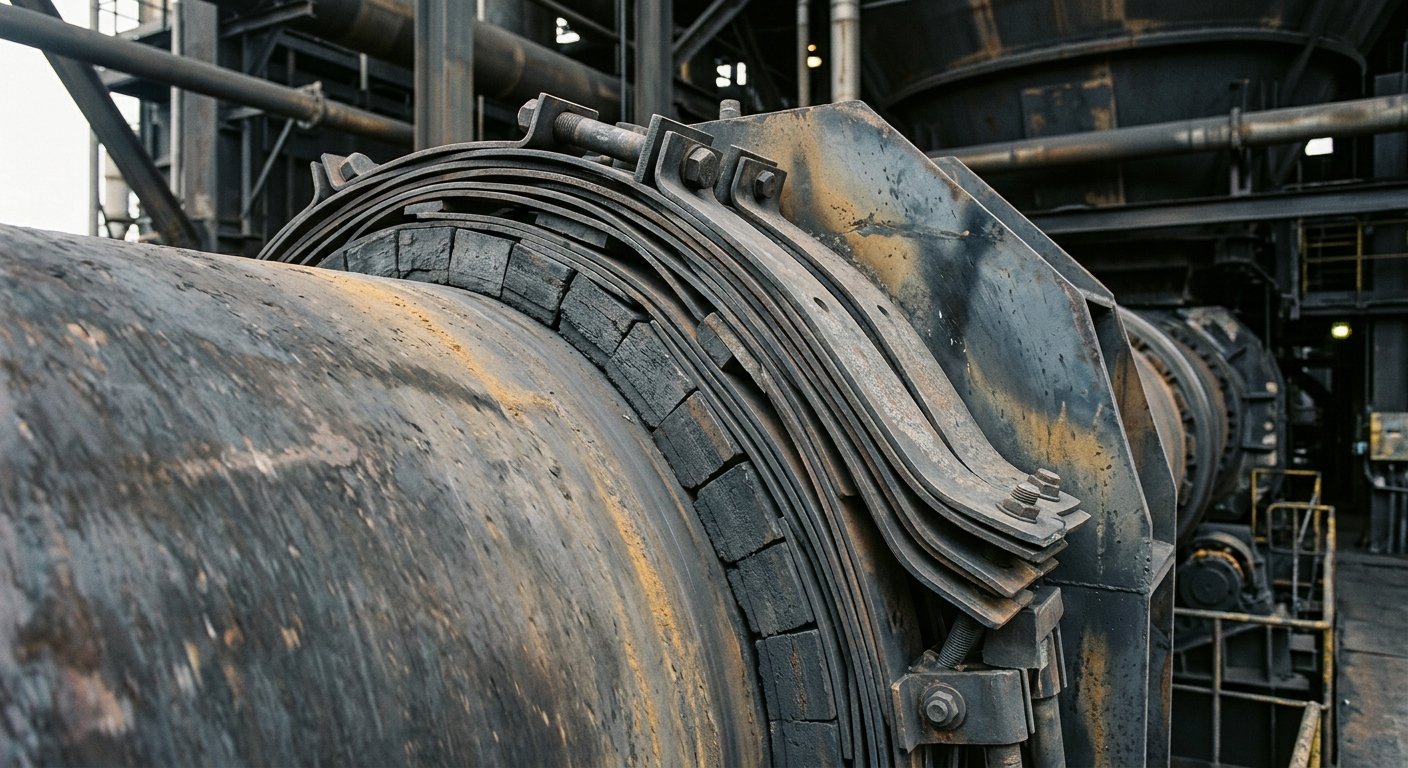
Lamella seal: a kiln seal that closes the kiln-to-hood gap using two sets of overlapping spring-steel leaves (lamellae) that press against the rotating shell and flex as it expands and moves.
Graphite seal: a kiln seal that closes the gap using a ring of segmented graphite blocks, each pressed against the rotating shell by its own spring or thrust module so the blocks track kiln movement individually.
Both are families Oswal manufactures: lamella-based sealing elements and graphite-based sealing elements. They can also be combined, which is the hybrid case covered at the end.
How a lamella seal works
A lamella seal seals the kiln-to-hood gap with overlapping spring-steel leaves (lamellae) that press against the rotating shell and flex as it moves. A typical inlet lamella seal uses two sets of spring-steel lamellae with a layer of heat-resistant fabric between them, so the leaf packs maintain contact while the kiln expands radially and walks axially [1].
The defining property is flexibility. The leaves are sprung against the shell, so as the kiln grows with temperature, walks axially under load, or runs slightly out of round (ovality), the lamellae deflect and keep contact rather than opening a leakage gap. Oswal's lamella elements are specified for "flexible adaptation to shell movement, controlled contact pressure, and mechanical resilience under dynamic conditions" [2]. Lamella is the current mainstream sealing form for cement rotary kilns, with wear-part service life commonly in the 10,000 to 20,000 hour range depending on process conditions [1].
What lamella does not do well is sit in a sustained, very high-temperature, heavily abrasive stream: spring steel loses temper and the leaves erode under continuous dust loading faster than graphite does. That is the trade-off graphite addresses.
How a graphite seal works
A graphite seal seals the gap with a ring of segmented graphite blocks, each pressed against the rotating shell by its own spring or thrust module so the blocks track kiln movement individually. The individual actuation matters: because each block moves on its own, the kiln can distort and the blocks follow it without one block jamming or shearing the assembly [3].
Graphite's advantage is material. It is self-lubricating, holds stable friction characteristics against a moving steel shell, tolerates high temperature, and wears slowly even under continuous dust exposure. Oswal's graphite elements are specified for "high-temperature resistance, continuous sealing contact, stable friction characteristics, and long wear life under dust exposure" [2]. That makes graphite the natural choice in the hottest, most abrasive seal positions, typically the kiln outlet, where a steel leaf pack would degrade quickly.
The trade-offs are first cost and movement range. Machined graphite blocks with individual thrust modules cost more to supply and install than a leaf pack, and graphite handles large, fast movement excursions less gracefully than the continuous flex of a lamella pack. For a kiln dominated by movement rather than heat, that flexibility is what you are buying.
Head-to-head: lamella vs graphite
The two families differ most on temperature tolerance, dust and abrasion handling, movement compensation, wear life, and cost. The table below is grounded in the Oswal product specifications and the cited general kiln-sealing references; cells are qualitative where no published numeric spec exists, and we do not assign temperature or leakage numbers that the source material does not support.
| Criterion | Lamella seal | Graphite seal |
|---|---|---|
| Working principle | Overlapping spring-steel leaves sprung against the shell [1][2] | Segmented graphite blocks, each individually actuated against the shell [2][3] |
| Movement compensation | Strong: leaves flex continuously with radial expansion, axial walk, and ovality [2] | Good: blocks track movement individually, but less continuous flex than a leaf pack [3] |
| High-temperature tolerance | Good, limited by spring-steel tempering | Stronger: graphite holds properties in the hottest seal zones [2] |
| Dust / abrasion handling | Moderate: leaves erode under heavy continuous dust | Stronger: long wear life under dust exposure [2] |
| Sealing / leakage performance | Low leakage when contact pressure is maintained; degrades as leaves wear or relax [1] | Low leakage; stable contact via self-lubricating block faces [2] |
| Wear-part service life | Commonly 10,000-20,000 h depending on process [1] | Long wear life in high-heat / dust zones [2] |
| Maintenance | Periodic leaf-pack and spring-tension checks; see kiln seal inspection cadence | Periodic block-face and thrust-module checks |
| Relative first cost | Lower installed cost | Higher (machined blocks + thrust modules) |
Both families, kept in good contact, drive false air down. That matters because the kiln inlet and outlet seals together account for roughly 60-75% of total false air infiltration in a cement plant, and each 1% of false air above baseline adds on the order of 3 kcal/kg clinker in wasted fuel [4][5]. The seal you choose is one of the highest-leverage levers on the false air in cement kilns problem.
When to choose lamella, when to choose graphite
Choose lamella when the dominant challenge is movement and cost; choose graphite when the dominant challenge is sustained extreme temperature and abrasive dust. The two are not competitors so much as fits for different positions on the same kiln.
Choose lamella when:
- Kiln movement, axial walk, or shell ovality is the main sealing problem; leaf flex tracks it continuously.
- The position is the kiln inlet, where temperature is high but not at the outlet extreme.
- First cost and ease of installation weigh heavily in the decision.
- The kiln runs reasonably steady campaigns without unusually severe dust loading.
Choose graphite when:
- The seal sits in a sustained high-temperature, high-abrasion stream, typically the kiln outlet.
- Long wear life between replacements matters more than first cost.
- Dust loading at the seal face is severe and would erode a leaf pack quickly.
- Stable friction against the shell over long campaigns is a priority.
The honest trade-off: lamella reduces installed cost and excels at movement but is more sensitive to heat and abrasion; graphite costs more up front but holds up in the harshest thermal and dust conditions. A common, defensible configuration is lamella at the inlet and graphite (or a hybrid) at the outlet. For movement-dominated positions, pairing either family with axial compensation seals handles the axial component separately. For the full multi-way evaluation including hybrid options, see our guide to choosing a kiln seal.
When one seal is not enough: the hybrid case
When a single kiln position needs both movement flexibility and high-temperature durability, the answer is a hybrid that combines lamella and graphite rather than choosing one family. Oswal's Duplex kiln sealing system does exactly this: a primary lamella interface absorbs axial and radial movement, while a secondary graphite interface maintains high-temperature sealing contact, so the assembly adapts to kiln distortion instead of resisting it [2][6].
The hybrid is not the default answer for every kiln. A movement-dominated inlet may be well served by lamella alone, and a cost-sensitive retrofit may not justify a dual-layer system. But where a position genuinely sees both severe movement and extreme heat, a hybrid avoids the compromise of forcing one family to do a job it is not suited for. Per Oswal's Duplex catalogue, the system is positioned for a payback of typically 6 to 18 months from reduced fuel consumption, lower ID fan power, and improved process stability [6]; treat that as a vendor-stated range to validate against your own kiln's energy baseline before purchase.
This is the decision that sits underneath the cement kiln sealing question for most buyers: not "lamella or graphite" as a universal winner, but which family, or combination, fits each position on your specific kiln.
If you are choosing a seal for a specific kiln configuration, our engineering team works through the inlet and outlet positions case by case, mapping each to lamella, graphite, or a hybrid. Contact us with your kiln's process and movement profile.
Common questions about this topic
Graphite seals generally last longer in high-temperature, high-dust positions because graphite is self-lubricating and wears slowly under dust exposure, while lamella spring-steel leaves erode and lose temper faster in the harshest zones [2]. Lamella wear parts commonly run 10,000 to 20,000 hours depending on process conditions [1]. Wear life is position-dependent, so the right comparison is per seal location, not seal type in the abstract; track it with a consistent [kiln seal inspection cadence](/en/blog/kiln-seal-inspection-cadence-methodology).
Yes. A hybrid seal combines a lamella interface for movement compensation with a graphite interface for high-temperature sealing in a single assembly, which is the principle behind Oswal's [Duplex kiln sealing system](/en/products/duplex-kiln-sealing-system) [6]. Combining the two is the usual answer when one kiln position sees both severe movement and extreme heat, rather than forcing a single family to handle both.
Graphite seals typically carry a higher first cost than lamella seals because they use machined graphite blocks with individual thrust modules, whereas a lamella seal is a sprung leaf pack with lower installed cost [1][3]. The right comparison is lifecycle cost, not first cost: in a hot, abrasive position graphite's longer wear life can offset its higher purchase price, while in a movement-dominated, cost-sensitive position lamella is usually the better value.
Graphite (or a hybrid) is usually better for the kiln outlet because the outlet runs at extreme temperature with heavy dust loading, conditions where graphite's high-temperature tolerance and wear life hold up better than a spring-steel leaf pack [2]. Lamella seals are more commonly used at the kiln inlet, where movement compensation matters and the thermal and abrasion load is less severe than at the discharge end.
Sources
- INFINITY FOR CEMENT EQUIPMENT, *Kiln Inlet Lamella Seal*
- Oswal Engineers, *Kiln Sealing Systems* (product catalogue: lamella-based, graphite-based, and Duplex sealing elements). `OSWAL_kilnseal.pdf`
- Fuller Technologies, *Spring-tensioned Kiln Graphite Seal*
- Oxmaint, *Kiln Inlet and Outlet Seal Maintenance for Cement Plants*
- Cement-Plants.com, *Kiln Seal: Kiln Inlet Seal and Kiln Outlet Seal Rotary Kiln Sealing System*
- Oswal Engineers, *Duplex Kiln Sealing System* (catalogue). `KilnSeal_DuplexType_OK_CAT.pdf`
Articoli correlati
Discuss Your Sealing Requirements
Our engineering team can help identify the right sealing solution for your application.
Contact Engineering Team“Ovunque i forni rotanti ad alta temperatura operino in atmosfera controllata, i sistemi di tenuta Oswal garantiscono efficienza energetica e stabilità di processo.”