
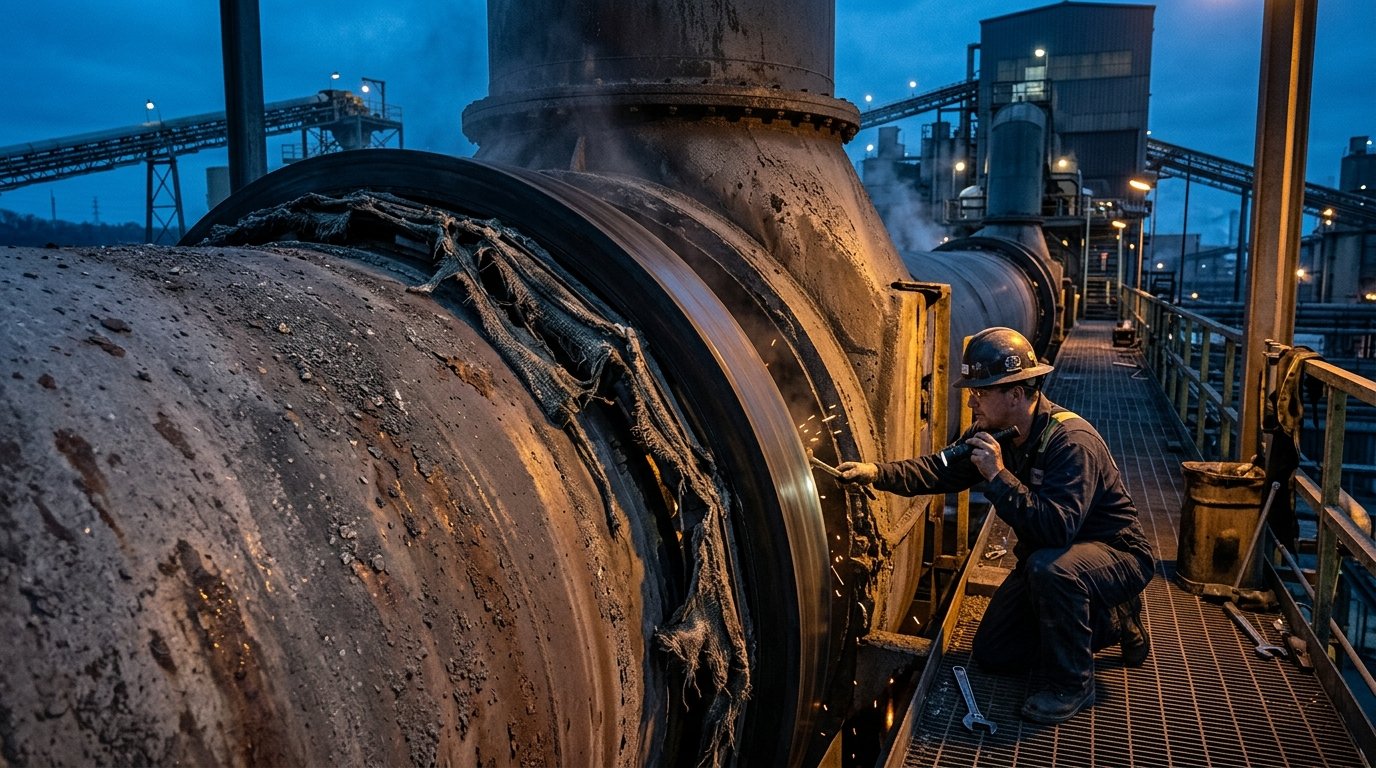
Repair vs Replace a Kiln Seal: A Decision Guide
When to repair, replace, or upgrade a kiln seal. Wear-stage thresholds, the false-air and fuel test, and when an upgrade to a Duplex seal pays back.
Repair a kiln seal when the wear is local and the seal type still suits the position; replace it like for like when the contact face is worn across more than a fifth of the circumference or the leakage fails the false-air fuel test; upgrade to a different seal technology when the seal keeps failing because it is the wrong design for the kiln's movement, heat, or dust. The decision is not a judgement call. It is driven by two readings taken together: the visual wear stage of the contact face and the false air the seal is admitting. This guide covers rotary process kilns in cement, lime, and DRI. Figures here are either Oswal's published product positioning or inline-cited industry typicals labelled as general; they are not numeric product specifications.
The three outcomes: repair, replace, upgrade
A worn kiln seal resolves to one of three actions, and they are not interchangeable. Repair restores a seal that is fundamentally sound. Replace swaps a same-type seal that has reached end of life. Upgrade changes the seal technology because the existing one is the wrong fit for the kiln. Choosing the wrong one wastes a shutdown window: a like-for-like replacement on a mis-specified seal just resets the clock on the same failure.
Kiln seal repair: restoring a serviceable kiln seal by correcting or renewing wear components (individual lamella leaves, fabric layers, counter-weights, spring tension, a single graphite segment) without changing the seal type or removing the full assembly.
Kiln seal replacement: fitting a new seal of the same type to a position whose existing seal has reached end of life, but where the seal technology still suits the kiln's movement, temperature, and dust profile.
Kiln seal upgrade: changing the seal to a different technology (for example from a rigid or single-element seal to a lamella, graphite, or hybrid Duplex seal) because the existing design cannot follow the kiln's actual operating conditions.
The distinction between replace and upgrade matters most. A seal that wears out on schedule for its type is a replacement. A seal that wears out repeatedly and early is a candidate for an upgrade, because the short life is a symptom of mis-specification, not bad luck.
The decision test: read wear stage, then false air
Two readings drive the action: the visual wear stage of the contact face and the false-air figure the seal is admitting. Take them together. Visual wear tells you the mechanism; the false-air figure tells you whether the leakage is yet costing enough fuel to act on. Neither alone is sufficient: a seal can look worn and still seal acceptably, and a seal can look intact while admitting measurable air through a relaxed contact line.
The visual side uses the four-stage wear grading set out in the kiln seal inspection cadence (Stage A intact, through Stage D failed). As a working threshold from that methodology, clearance gaps present across more than 20% of the circumference indicate Stage C or beyond and should trigger a replacement plan. That 20% figure is an Oswal maintenance heuristic, not a cited OEM tolerance; confirm it against the seal manufacturer's specification for your installation.
The quantitative side is the false-air fuel test. The kiln inlet and outlet seals account for roughly 60-75% of total false air infiltration in a cement plant, and each 1% of false air above baseline adds approximately 3 kcal/kg clinker in wasted fuel [1][2]. False air is air drawn into the kiln through unintended openings (worn seals, hood interfaces, inspection ports) rather than through the controlled combustion-air path; it is covered in depth in false air in cement kilns. Pull the O2 trend at the kiln inlet against its baseline before the shutdown. If the seal-attributable rise is small and the wear is local, repair. If it is large and the wear is advanced, replace or upgrade.
The table below maps the combined reading to an action.
| Wear stage | What you see | Action | Typical window |
|---|---|---|---|
| A (intact) | Uniform contact, baseline false air | Monitor; no action | Routine inspection |
| B (early wear) | Lost spring tension, a few worn leaves, loose counter-weights, slight O2 rise | Repair | Next planned stop or sooner if trending |
| C (advanced wear) | Gaps over more than 20% of circumference, clear false-air rise past the fuel test | Replace (or upgrade if recurring) | Next planned shutdown |
| D (failed) | Visible dust escape, audible in-rush, large false-air contribution | Replace urgently; review for upgrade | Earliest accessible stop |
When to repair
Repair when the seal is the right type for the position and the wear is local, recent, or correctable: lost spring tension, a few worn or missing leaves, loose counter-weights, or a single worn graphite segment. At Stage A and B, repair is the default; the seal is doing its job and a component renewal restores it without the cost or disruption of a full replacement.
Lamella seals are well suited to component-level repair. The leaves can be replaced one at a time, externally, as they wear, without removing the rest of the seal [3][4]. Lost contact pressure is often a counter-weight or spring-tension correction rather than a worn contact face, and catching it early is the difference between a Stage B repair and a Stage C replacement. Oswal's lamella sealing elements are specified for flexible adaptation to shell movement and controlled contact pressure, both of which a tension correction restores [5]. The practical discipline is the graded inspection cadence: a seal inspected daily, weekly, and at every shutdown is caught at the repairable stage rather than the replacement stage.
When to replace
Replace, like for like, when the seal has reached end of life but the seal type still fits the position: clearance gaps across more than 20% of the circumference, Stage C or D wear, or a false-air contribution that fails the fuel test. At this point the contact face is consumed and component repair no longer holds a sealing line; the wear parts have done their service and a new same-type seal is the correct action.
Wear-part service life is process-dependent. Lamella seal wear parts commonly run 10,000 to 20,000 service hours [3], with whole lamella seals lasting on the order of 2-3 years and graphite seals on the order of 4-5 years in cement-plant service [6]. These are general industry typicals, not Oswal product specs. A like-for-like replacement is batched into an already-planned shutdown, because seal work needs a cold, stationary kiln and the cool-down is the most expensive part of any stop; the sequencing is set out in the kiln seal retrofit in a shutdown guide. Replacement differs from upgrade in one respect only: the seal type stays the same because it still suits the kiln.
When to upgrade (and to what)
Upgrade when the seal keeps failing for the same reason, because the failure is telling you the seal technology is wrong for the kiln's movement, dust, or temperature, not that the part was defective. A seal that reaches Stage C or D well inside its expected life, repeatedly, is mis-specified for its position. Replacing it like for like resets the same failure; changing the technology removes the cause.
The position tells you the target. A movement-dominated inlet, where shell expansion, axial float, and ovality are the main challenge, points to a lamella seal. A hot, abrasive discharge end points to graphite, which holds stable friction and wears slowly under continuous dust [5]. Where a single position genuinely needs both movement flexibility and high-temperature durability, the answer is a hybrid. Oswal's Duplex Kiln Sealing System combines a primary lamella interface for movement compensation with a secondary graphite interface for high-temperature sealing, provides both radial and axial compensation, and is engineered to retrofit onto existing kiln geometries [5][7]. The kiln is a dynamically expanding structure (radial expansion, axial movement, shell ovality, heavy dust, extreme temperature, 24x7 operation), and a hybrid adapts to that distortion rather than resisting it. To match a seal technology to a position before committing to an upgrade, work through the kiln seal comparison guide, the product-selection hub for this cluster; the graphite option is detailed on the graphite sealing elements page.
Side-by-side decision summary
The table below maps the observed seal condition to the recommended action.
| Observed condition | Recommended action |
|---|---|
| Local wear, lost tension, a few leaves, single graphite segment; seal type fits | Repair |
| End-of-life contact face, gaps over more than 20% of circumference, Stage C-D; seal type still fits | Replace like for like |
| Repeated early failures; seal cannot follow the kiln's movement, heat, or dust | Upgrade to the right technology (lamella, graphite, or Duplex hybrid) |
| Single position needs both movement flexibility and high-temperature durability | Upgrade to the Duplex hybrid |
If you are weighing a kiln seal repair, replacement, or upgrade, our engineering team works through the inlet and outlet positions case by case, reading the wear stage and false-air figure against your kiln's movement, temperature, and dust profile to map each seal to repair, like-for-like replacement, or a hybrid upgrade. Contact us to walk through your configuration.
Common questions about this topic
Replace a kiln seal instead of repairing it when the contact face has reached end of life: clearance gaps across more than 20% of the circumference, Stage C or D wear on the four-stage grading scale, or a false-air contribution that fails the fuel test (each 1% of false air above baseline adds roughly 3 kcal/kg clinker in wasted fuel) [1][2]. Below that threshold, if the seal type still suits the position, repair is the correct action: renew the worn leaves, correct counter-weight or spring tension, or replace a single graphite segment. The 20% circumference figure is an Oswal maintenance heuristic; confirm it against your seal manufacturer's specification.
Yes, in part. Lamella seal leaves can be replaced one at a time, externally, as they wear, without removing the rest of the seal assembly [3][4], so component-level repair of a lamella seal does not require full disassembly. However, any work on the contact geometry, counter-weights, or seal housing needs a cold, stationary kiln, so even partial repairs are normally batched into an already-planned shutdown rather than done on a running kiln. The cool-down is the expensive part of a stop, which is why seal work is sequenced alongside refractory and inspection tasks, as set out in the kiln seal retrofit guide.
Upgrading to a Duplex seal is worth it over a like-for-like replacement when the existing seal keeps failing early for the same reason, which means it is the wrong technology for the position rather than a defective part. The Duplex Kiln Sealing System combines a primary lamella interface for movement compensation with a secondary graphite interface for high-temperature sealing, provides radial and axial compensation, and is retrofittable onto existing kiln geometries [5][7]. It is the right call for a position that needs both movement flexibility and high-temperature durability; a movement-dominated inlet may be well served by lamella alone. Match the seal to the position using the kiln seal comparison guide.
A kiln seal's service life is process-dependent: lamella seal wear parts commonly run 10,000 to 20,000 service hours [3], with whole lamella seals lasting on the order of 2-3 years and graphite seals on the order of 4-5 years in cement-plant service [6]. These are general industry typicals, not product specifications, and a seal in a hotter, dustier, or more movement-prone position will wear faster. The practical signal for replacement is not the calendar but the condition reading: Stage C-D wear, gaps over more than 20% of the circumference, or a false-air rise that fails the fuel test, caught through a graded inspection cadence.
Sources
- INFINITY FOR CEMENT EQUIPMENT, *Everything you need to know about Thermal Energy Efficiency in Cement Industry*
- INFINITY FOR CEMENT EQUIPMENT, *Kiln Inlet Lamella Seal*
- Fuller Technologies, *Kiln Inlet and Outlet Lamella Seals*
- ProcessBarron, *Kiln Seals & Seal Leaves*
- Oswal Engineers, *Kiln Sealing Systems* (product catalogue: lamella-based and graphite-based sealing elements, Duplex kiln sealing system). `OSWAL_kilnseal.pdf`
- Oxmaint, *Kiln Inlet and Outlet Seal Maintenance for Cement Plants*
- Oswal Engineers, *Duplex Kiln Sealing System* (catalogue). `KilnSeal_DuplexType_OK_CAT.pdf`
Related Articles
Discuss Your Sealing Requirements
Our engineering team can help identify the right sealing solution for your application.
Contact Engineering Team“Wherever high-temperature rotary kilns operate under controlled atmosphere, Oswal sealing systems ensure energy efficiency and process stability.”