
Single vs Double Kiln Seals: When One Stage Fails
Single vs double kiln seal compared: why one stage leaks under kiln movement, how a two-stage (duplex) seal holds tighter, and when to step up.
A single kiln seal uses one sealing interface to control false air; a double (duplex) kiln seal uses two stages in series, one that follows kiln movement and one that holds the thermal and dust seal. Choose a single seal for smaller, well-aligned, lower-duty kilns; step up to a double seal where shell ovality, axial float, and high temperature load the same interface at once. This is a decision about sealing architecture, not sealing material, and it sits underneath most kiln-seal procurement calls.
A note on terms first: here, "double" and "single" refer to the number of sealing stages at a rotary kiln shell, not to dual mechanical seals in pumps (API 682) or double-glazed door and window seals. Everything below is about the seal where the rotating kiln meets the stationary inlet or outlet hood. This piece is the single-stage versus two-stage architecture decision; for the separate question of which sealing material to use, see lamella vs graphite kiln sealing.
Single-stage vs double (duplex) kiln sealing: what the terms mean
Single-stage sealing closes the kiln-to-hood gap with one sealing interface; double or duplex sealing splits the job across two stages in series, a movement stage and a thermal/dust stage. The difference is how many interfaces stand between the kiln gas path and the outside air.
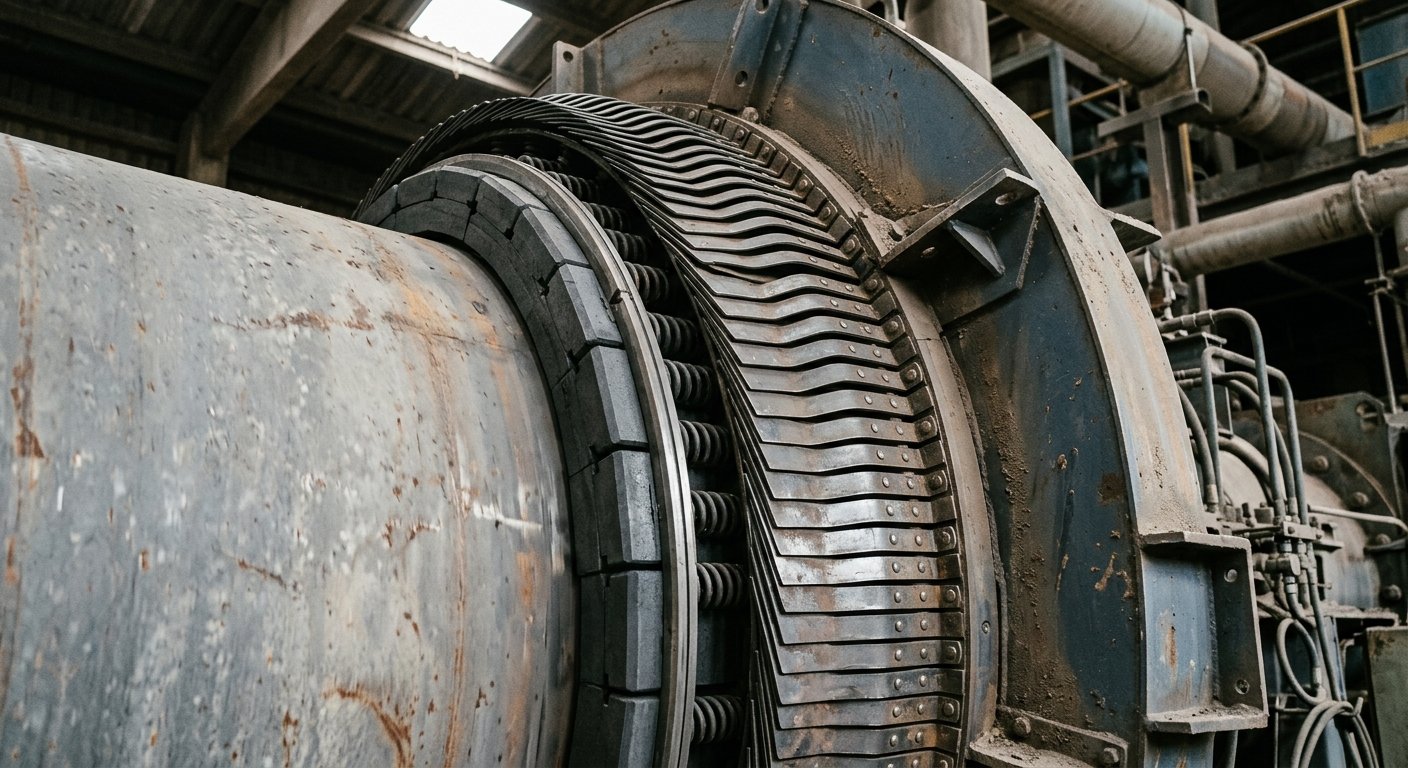
A single-stage seal is one sealing element doing the whole job: a spring-steel lamella leaf pack, or a ring of segmented graphite blocks, pressed against the rotating shell. It is the mainstream form, and on many kilns it is the right form.
A double or duplex seal puts two interfaces in series. In Oswal's Duplex kiln sealing system the primary stage is a lamella interface that absorbs movement and the secondary stage is a graphite interface that holds the high-temperature seal [1]. The two stages do different jobs, so neither has to compromise.
Single-stage kiln seal: a kiln seal that controls false air with one sealing interface (one lamella leaf pack or one graphite block ring) at the kiln-to-hood gap.
Double (duplex) kiln seal: a kiln seal with two sealing stages in series, a movement stage and a thermal/dust stage, so each stage handles one duty rather than trading them off.
Running more than one stage is established practice, not a novelty. Heavy-duty kiln seal assemblies have long been built as primary, secondary, and sometimes tertiary stages with controlled pressure between them [2]. The duplex form applies the same logic to the cement and pyroprocessing case.
Why a single seal leaks over time
A single seal leaks over time because one interface must simultaneously follow kiln movement and hold a tight thermal and dust seal, and those two duties pull the design in opposite directions. To track movement, the element wants to be compliant; to hold a tight seal against hot abrasive dust, it wants to be stiff and high-contact. One element cannot maximise both at once.
The movement is continuous and unavoidable. The seal has to allow axial and radial displacement and still maintain a positive seal under the dynamic motion and thermal expansion of the kiln shell [3]. Shell ovality, distortion, and mechanical runout act on the interface every revolution [4]. A rigid element set tight enough to seal well does not follow that movement; it erodes, jams, or shears. A compliant element set loose enough to follow the movement opens a leakage path as wear relaxes its contact. Either way, the single interface is trading one duty against the other, and the trade-off shows up as drifting false air.
This is why seals are the dominant false-air source on a kiln. The kiln inlet and outlet seals are the largest single false-air intake on the gas path, because of their large diameter and continuous rotation; degraded seals commonly account for around 6-10% combined false air, with roughly 3 kcal/kg clinker wasted per 1% of false air as a general industry figure [5]. The cement-specific convention runs 1.5-2.5 kcal/kg per 1% [6]. Whichever figure you use, a seal that has quietly given up half its sealing is an expensive component to leave in service. Oswal's own catalogue puts it plainly: conventional sealing systems are designed for static conditions, while rotary kilns run under continuous axial movement, thermal expansion, and shell ovality, and that mismatch leads to sealing failure and false air ingress [1].
How a two-stage (duplex) seal splits the duties
A two-stage (duplex) seal splits the work: a primary lamella stage absorbs axial and radial movement, while a secondary graphite stage maintains the high-temperature, low-leakage sealing contact, so neither stage has to compromise. The compliant duty and the tight-seal duty are assigned to different interfaces.
In the Duplex architecture, the primary lamella interface handles movement compensation, absorbing axial displacement, radial shell expansion, and ovality fluctuation; the secondary graphite interface handles continuous high-temperature contact with long wear life under dust [1]. A controlled pressure-distribution mechanism keeps contact uniform across the interface, so the assembly "adapts dynamically rather than resists movement" [1]. The catalogue frames the result as stable sealing performance independent of kiln distortion, with the dual-layer configuration providing redundancy [1]. Third-party practice agrees with the principle: composite sealing integrates multiple sealing methods specifically to overcome the limitations of a single-component seal [2].
This is an architecture point, not a material point. The two stages here happen to be lamella and graphite, but the reason the double seal holds tighter for longer is that the movement duty and the thermal/dust duty no longer share one interface. The material choice within each stage is the separate decision covered in lamella vs graphite kiln sealing and in the deeper duplex sealing technology explainer.
When a single seal is enough vs when to step up to a double
A single seal is genuinely sufficient on smaller, well-aligned, lower-duty kilns where movement and temperature are both moderate; step up to a double (duplex) seal when ovality, axial float, and high temperature act on the same interface at once. The decision is per seal position, not per plant.
Choose a single seal when:
- The kiln is small or short, with low ovality and a well-aligned shell.
- The position is moderate-temperature, often the kiln inlet rather than the hot outlet.
- Campaigns are steady, without frequent stop-start thermal cycling.
- Dust loading at the seal face is not severe.
- First cost and installation simplicity weigh heavily.
Step up to a double (duplex) seal when:
- Shell ovality or axial walk is pronounced, so a single element cannot stay both compliant and tight.
- The seal sits in a sustained high-temperature, abrasive stream, typically the outlet.
- The kiln cycles or stops frequently, repeatedly relaxing and reloading the seal.
- The plant already runs high false air, so every percentage point recovered is worth real money.
- It is a retrofit where re-work and downtime cost more than the seal itself.
| Factor | Single-stage seal | Double (duplex) seal |
|---|---|---|
| Sealing interfaces | One | Two in series (movement + thermal/dust) |
| Handles ovality + axial float | Compromised: one element trades movement against tightness [3][4] | Stage-separated: lamella stage absorbs movement [1] |
| High-temperature / abrasive position | Workable with the right material, less margin | Stronger: dedicated graphite thermal stage [1] |
| Behaviour under thermal cycling | Contact relaxes as it wears; leakage drifts up | Redundant stages hold seal through distortion [1] |
| Relative first cost | Lower | Higher (two interfaces + housing) |
| Best fit | Smaller, well-aligned, lower-duty kilns / inlet | High-ovality, hot, cycling kilns / outlet / retrofit |
The honest trade-off: a double seal is not the default answer for every position. On a quiet, well-aligned inlet running steady campaigns, a single stage seals well and costs less, and over-specifying a duplex there just spends capex you did not need. The double seal earns its place where one interface genuinely cannot do both jobs. For the full multi-way evaluation across materials and architectures, see the kiln seal comparison guide.
The cost and false-air payback trade-off
A double seal carries higher first cost than a single stage, but on a high-ingress kiln the false-air fuel saving usually repays the difference quickly; on a low-duty kiln it may not, which is why the decision is per position, not per plant. The capex gap is real; whether it pays back depends on how much false air the single seal is leaking.
The payback driver is false air, and false air is dominated by the seals: the kiln inlet and outlet seals together account for the majority of plant false air, and each percentage point above optimum costs fuel and ID-fan power [5][6]. The full energy math, with a worked example, is in false air in cement kilns, and the benchmark thresholds for what counts as too much are in acceptable false air percentage. The short version: if a single seal has drifted to 8-10% combined ingress, the fuel it wastes per year is often larger than the price difference between a single and a double seal.
Oswal's Duplex catalogue states a typical payback of 6 to 18 months, driven by reduced fuel consumption, lower ID-fan power, and improved process stability; the system is modular and retrofit-compatible, and a retrofit is commonly scheduled into a planned shutdown window of roughly nine days [1]. Treat those figures as vendor-stated, and validate the payback against your own kiln's measured false-air and energy baseline before committing. The number that matters is your kiln's, not a brochure's. If you want that worked through on a specific configuration, the engineering-consulting team scopes the baseline audit, the false-air profile, and the single-versus-double decision position by position.
If you are deciding between a single and a double seal for a specific kiln, our engineering team works through it position by position, mapping each interface to a single stage or a duplex configuration against your measured movement and false-air profile. Contact us with your kiln's process and movement data.
Common questions about this topic
No. A double (duplex) kiln seal is better only where one sealing interface faces severe movement and high temperature at the same time; on a small, well-aligned, lower-duty kiln a single stage seals well and costs less. The right question is per seal position, not per plant: the hot, abrasive, high-ovality outlet often justifies a [double seal](/en/products/duplex-kiln-sealing-system), while a steady, moderate-temperature inlet may be well served by a single [lamella](/en/products/lamella-based-sealing-elements) or [graphite](/en/products/graphite-based-sealing-elements) stage.
A duplex kiln seal is a two-stage seal that combines a lamella movement stage with a graphite thermal stage in series, so the assembly follows kiln distortion while still holding a tight seal. The primary lamella interface absorbs axial and radial movement; the secondary graphite interface maintains high-temperature sealing contact, and the dual-layer configuration provides redundancy [1]. It is the architecture Oswal's [Duplex kiln sealing system](/en/products/duplex-kiln-sealing-system) implements.
A single kiln seal is not enough when shell ovality, axial float, and high abrasive-dust temperature load the same interface simultaneously, because one element cannot stay compliant enough to follow the movement and tight enough to hold the seal at the same time. As wear relaxes the contact, the single interface opens a leakage path, which is why seals are the dominant source of [false air in cement kilns](/en/blog/understanding-false-air-in-cement-kilns) [3][5].
Yes, on a kiln with significant movement, because each stage holds its own duty instead of trading off, so the seal stays tighter for longer. The saving shows up as lower false air, lower fuel, and reduced ID-fan load. Oswal's Duplex catalogue states a 6 to 18 month payback on that basis, which should be read as a vendor-stated range and validated against your own energy baseline [1]. For the side-by-side across all seal options, see the [kiln seal comparison guide](/en/blog/kiln-seal-comparison-guide).
Sources
- Oswal Engineers, *Duplex Kiln Sealing System* and *Kiln Sealing Systems* (product catalogues: Duplex hybrid lamella + graphite architecture, lamella-based and graphite-based sealing elements, payback and retrofit framing). `KilnSeal_DuplexType_OK_CAT.pdf`, `OSWAL_kilnseal.pdf`
- *Rotary kiln seal*, US Patent US5106105A (multi-stage primary/secondary/tertiary seal arrangement with controlled inter-stage pressure); PREPP rotary kiln seal program (composite multi-method sealing to overcome single-component limits). https://patents.google.com/patent/US5106105A/en ;
- *Rotary kiln seal* patent literature: the seal must provide for axial and radial movement relative to the rotating kiln and still maintain a positive seal under dynamic motion and thermal expansion
- FEECO International, *Rotary Kiln Maintenance* (shell ovality, distortion, and runout acting on the kiln interface)
- Oxmaint, *Kiln Inlet and Outlet Seal Maintenance for Cement Plants* (inlet/outlet seals as the largest single false-air intake; degraded seals ~6-10% combined; ~3 kcal/kg per 1% false air, general industry figure)
- Holderbank Cement Course / Madlool et al. (2011), *A critical review on energy use and savings in the cement industries*, via the companion false-air reference (cement-specific 1.5-2.5 kcal/kg per 1% false air)
Related Articles
Discuss Your Sealing Requirements
Our engineering team can help identify the right sealing solution for your application.
Contact Engineering Team“Wherever high-temperature rotary kilns operate under controlled atmosphere, Oswal sealing systems ensure energy efficiency and process stability.”