
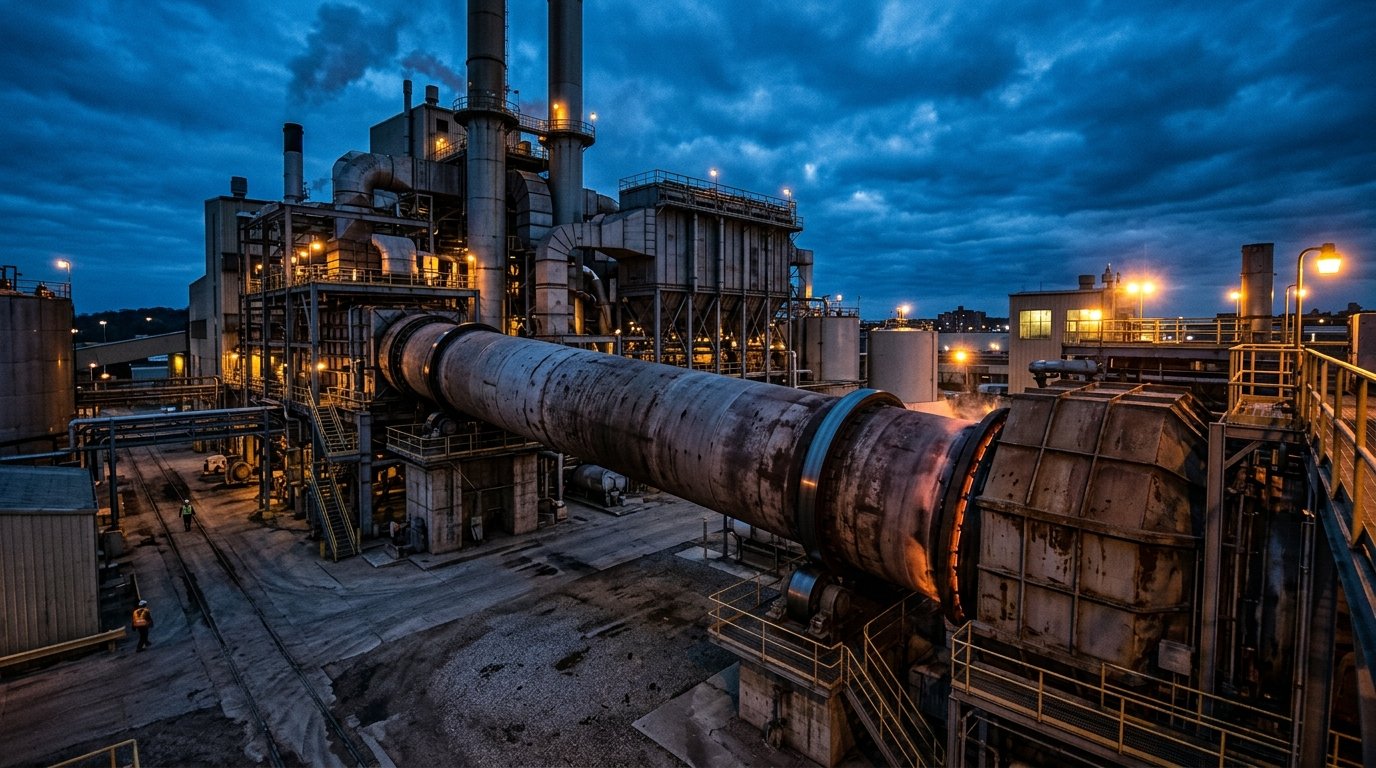
Kiln Seals for Waste Incinerators and Waste-to-Energy Plants
Sealing is mission-critical in rotary-kiln waste incinerators and WTE plants. Which Oswal seal fits the inlet, the hot discharge, and the hybrid case.
The seal at a waste-incineration kiln does two opposing jobs at once: it keeps uncontrolled false air out, so combustion stays stable and emissions stay compliant, and it keeps toxic, corrosive flue gas in, so nothing leaks to the operating floor. On a waste rotary kiln this is harder than on a cement or lime kiln, because the seal sits in a chlorine-rich, acidic, dust- and slag-laden gas stream that swings through a wide temperature band. This piece covers why sealing is mission-critical in rotary kiln incinerators and waste-to-energy plants, the atmosphere the seal has to survive, the dual sealing duty, and which Oswal seal fits each position.
One disambiguation first. "Rotary kiln" also names the process kilns used in cement, lime, and direct-reduced iron plants. This piece is about the incinerator configuration, where the goal is waste destruction. The sealing engineering at the kiln-to-hood interface is common to both, which is where Oswal's products apply.
Why sealing is mission-critical in a waste-incineration kiln
Sealing is mission-critical because three plant outcomes ride on it at once: combustion efficiency, emissions compliance, and operator safety on the floor. The seal closes the gap between the rotating kiln shell and the stationary inlet and outlet hoods, the single largest uncontrolled opening in the gas path.
False air: air drawn into a kiln system through unintended openings (seals, hood interfaces, inspection ports) rather than through the controlled combustion-air path. It is parasitic: every cubic metre must be heated to process temperature, and it dilutes and cools the combustion zone.
On a cement kiln, false air mainly costs fuel and throughput. On a waste kiln the same leakage threatens the burnout condition the plant's whole emissions case depends on, and the seal is also the barrier between a toxic, odorous flue gas and the people on the kiln floor. That raises the stakes from an efficiency problem to a compliance-and-safety problem. The fuel-and-draft mechanics are the same as the false air problem on a cement kiln; the consequences are more severe.
The aggressive atmosphere a waste-kiln seal lives in
A waste-incineration kiln seal sits in a chlorine-rich, acidic, dust- and slag-laden gas stream that swings through a wide temperature band, far more aggressive than the atmosphere on a cement or lime kiln. The feed is heterogeneous by definition: solids, liquids, sludges, and drummed wastes of variable composition enter the same kiln, so the gas chemistry and the heat release shift from hour to hour.
Three conditions make the duty hard. First, corrosion. Halogenated wastes release HCl and chlorine; the feed also carries alkali and sulphur. HCl content in municipal-waste incineration flue gas typically runs in the range of 500 to 1,000 ppm, and HCl is more corrosive than SO2 in an oxidising atmosphere, with corrosion rate rising as HCl concentration rises [1]. These acid gases attack sealing materials that a clean cement kiln never exposes. Second, slag and dust. The discharge end carries abrasive ash and, in slagging service, sticky molten slag particles that erode and foul a sealing face. Third, temperature swings: variable feed drives the kiln through a wide thermal band, and the seal has to hold contact as the shell expands and contracts with it. A seal specified for a clean kiln can fail quickly here. The process and regulatory framing of this feed is covered in hazardous waste incineration.
This is why a waste-kiln hood is sealed with movement-tolerant, corrosion- and abrasion-resistant elements rather than a rigid plate.
The dual sealing job: false air out, flue gas in
The seal has to do two opposing things in one element: block air ingress that destabilises combustion, and contain flue gas that would otherwise escape to the operating floor under the plant's negative-pressure regime. A waste incinerator runs under induced draught, so the system sits below atmospheric pressure and most of the gas path pulls air in. That makes false air the dominant ingress mode, but it does not eliminate the containment job: pressure excursions, hot spots, and local positive zones at the hood can push fugitive flue gas and odour out toward the kiln floor. The seal is the barrier for both directions.
Keeping false air out matters because it protects the burnout condition. Excess air dilutes and cools the combustion gas, raises induced-draught fan load, and disturbs the downstream air-pollution-control (APC) train that depends on a predictable gas volume and temperature. The European Union's waste-incineration rules require the combustion gases to be held at a minimum of 850 C for at least 2 seconds; for hazardous waste containing more than 1% of halogenated organic substances expressed as chlorine, that minimum rises to 1,100 C for at least 2 seconds [2]. False air eats into the temperature margin that keeps the kiln above that line. If ingress is bad enough to drop the gas below the required condition, the plant risks failing the destruction requirement the emissions case is built on.
Keeping flue gas in matters because the gas is toxic, acidic, and odorous, and the operating floor is occupied. A leak path that opens at a worn seal is a fugitive-emission and an occupational-exposure route, not just an efficiency loss. Both halves of the duty point to the same requirement: a seal that holds continuous contact against a moving shell under heat, dust, and corrosion. The framing Oswal uses for this is integrated false air control: treat sealing as an energy- and atmosphere-control discipline, not a maintenance afterthought.
Matching the Oswal seal to the duty
The right seal is chosen per kiln position, not per kiln: lamella for the movement-dominated inlet, graphite for the hot abrasive discharge, and a Duplex hybrid where one position needs both. A rotary kiln is a dynamically expanding structure; the seal at each end has to handle radial expansion, axial movement, shell ovality, high dust loading, extreme temperatures, and continuous 24x7 operation [3]. The dominant challenge differs end to end, and so does the seal that fits.
The table maps position and dominant challenge to the Oswal product family. Cells are qualitative; the catalogue carries no numeric product specifications, and any numeric here is a general industry figure, inline-cited.
| Kiln position | Dominant challenge | Oswal seal family | Why it fits |
|---|---|---|---|
| Inlet (feed end) | Shell movement, axial float, ovality | Lamella sealing elements | Flexible adaptation to shell movement, controlled contact pressure, mechanical resilience under dynamic conditions [3] |
| Discharge (hot end) | Sustained heat, abrasion, heavy dust | Graphite sealing elements and the kiln outlet sealing system | High-temperature resistance, continuous sealing contact, stable friction, long wear life under dust exposure [3] |
| Either end where one position needs both | Movement and high-temperature dust together | Duplex kiln sealing system | Primary lamella interface plus secondary graphite interface; radial and axial compensation; retrofittable [4] |
| Whole interface, as a system | False-air ingress and flue-gas containment across both hoods | Integrated false air control | Combines duplex, radial, axial, graphite/lamella, hood-interface and duct-transition sealing into one architecture [3] |
For the full head-to-head on these families, work through the selection hub, the guide to choosing a kiln seal.
Inlet, discharge, and the hybrid case
At the feed end, shell movement dominates, so a lamella interface is the default; at the hot discharge end, sustained heat and abrasion dominate, so graphite is the default; where one position needs both, the Duplex combines them. Picking by position, rather than forcing one family to do every job, is the principle behind the whole selection.
At the inlet, the kiln runs hot but not at the discharge extreme, and the seal's main task is following a shell that expands radially, walks axially, and runs out of round. Oswal's lamella elements give flexible adaptation to shell movement and controlled contact pressure, holding a continuous sealing line where a rigid plate would open a gap [3]. The inlet sealing systems are built to minimise air ingress and stabilise the combustion profile, with axial and radial compensation, and to retrofit onto existing inlet geometries [3]. For larger axial excursions the lamella interface is often paired with dedicated axial compensation seals and high-temperature radial seals that maintain continuous contact with the rotating shell and compensate shell expansion.
At the discharge, the duty is heat, abrasion, and heavy dust, sustained around the clock. Graphite sealing elements provide high-temperature resistance, continuous sealing contact, and long wear life under dust exposure, with the self-lubricating, stable friction that lets them ride a hot shell without galling [3]. The kiln outlet sealing system adds abrasion-resistant construction, thermal-shock tolerance, and structural reinforcement for one of the harshest positions in the plant [3].
Duplex kiln sealing system: an Oswal hybrid that combines a primary lamella interface for movement adaptation with a secondary graphite interface for high-temperature sealing, providing radial and axial compensation in one assembly. Designed for high-dust environments and retrofittable onto existing kilns [4].
The hybrid case arises where a single position genuinely needs both movement flexibility and high-temperature durability, which is common on heterogeneous waste feeds that load the discharge with both ovality and dust. The Duplex puts a primary and a secondary barrier at the same position, so atmosphere control holds even as the primary element wears [4]. It is not the default for every position; a movement-dominated inlet may be well served by lamella alone, and a clean hot end by graphite alone. The Duplex is the answer when the duty doubles up. Specifying these positions, on a new incinerator or as a retrofit, is within the standard scope of Oswal's work for the waste-management industry.
If you are specifying a seal for a waste-incineration or waste-to-energy kiln, our engineering team works through the inlet and discharge positions case by case, mapping each to lamella, graphite, or a Duplex hybrid against your kiln's atmosphere, dust load, and movement profile. Contact us to walk through your configuration.
Common questions about this topic
There is no single best seal; the right choice is per kiln position. A lamella seal suits the movement-dominated inlet, where the shell expands, walks, and runs out of round; a graphite seal suits the hot, abrasive discharge end, where sustained heat and heavy dust dominate; and a Duplex hybrid suits any position that needs both movement flexibility and high-temperature durability at once [3][4]. The selection is made per hood, against the kiln's process and movement profile, as set out in the guide to choosing a kiln seal.
False air matters because it cools and dilutes the combustion gas, raises induced-draught fan load, and disturbs the air-pollution-control train, all of which threaten the burnout condition the emissions case depends on. The European Union requires the combustion gases to be held at least 850 C for 2 seconds, rising to 1,100 C for 2 seconds for hazardous waste with more than 1% halogenated organics expressed as chlorine [2]. False air eats the temperature margin above that line, so a leaking seal can put the destruction requirement at risk while also wasting auxiliary fuel.
A correctly specified kiln seal is built for it, which is why a waste-kiln hood is sealed with movement-tolerant, corrosion- and abrasion-resistant elements rather than a rigid plate. Halogenated wastes release HCl and chlorine, with HCl in incineration flue gas typically in the 500 to 1,000 ppm range and more corrosive than SO2 in an oxidising atmosphere [1]. Graphite elements carry the hot, abrasive discharge end, lamella elements carry shell movement, and the Duplex provides a redundant secondary barrier where the duty is most severe [3][4].
Yes. The seal does a dual job: it blocks false-air ingress that destabilises combustion, and it contains toxic, acidic, odorous flue gas that would otherwise escape to the operating floor. A waste incinerator runs under negative-pressure induced draught, so air ingress is the dominant mode, but pressure excursions and local hot spots at the hood can still push fugitive gas and odour out toward the kiln floor [2]. A seal that holds continuous contact against the moving shell is the barrier for both directions, which is the basis of Oswal's integrated false air control approach.
Sources
- Cao et al., *Study of Corrosion Kinetic Measurement and Morphology Observation of Superheater Tube 12Cr1MoV Alloy in Simulated MSWI Flue Gas Containing Varied HCl or SO2 Concentrations*, ACS Omega, 2022
- European Union, *Waste incineration* (summary of Directive 2010/75/EU on industrial emissions: 850 C / 2 s general, 1,100 C / 2 s for >1% halogenated organics as chlorine)
- Oswal Engineers, *Kiln Sealing Systems* (product catalogue: lamella-based and graphite-based sealing elements, kiln inlet and outlet sealing systems, axial compensation and high-temperature radial seals, integrated false air control). `OSWAL_kilnseal.pdf`
- Oswal Engineers, *Duplex Kiln Sealing System* (catalogue). `KilnSeal_DuplexType_OK_CAT.pdf`
Articoli correlati
Discuss Your Sealing Requirements
Our engineering team can help identify the right sealing solution for your application.
Contact Engineering Team“Ovunque i forni rotanti ad alta temperatura operino in atmosfera controllata, i sistemi di tenuta Oswal garantiscono efficienza energetica e stabilità di processo.”