
Kiln Seals for Lime and Alumina Calciners
Why false air matters in rotary lime kilns and Bayer alumina calciners, and which Oswal seal fits each duty: lamella at the inlet, graphite at the hot end.
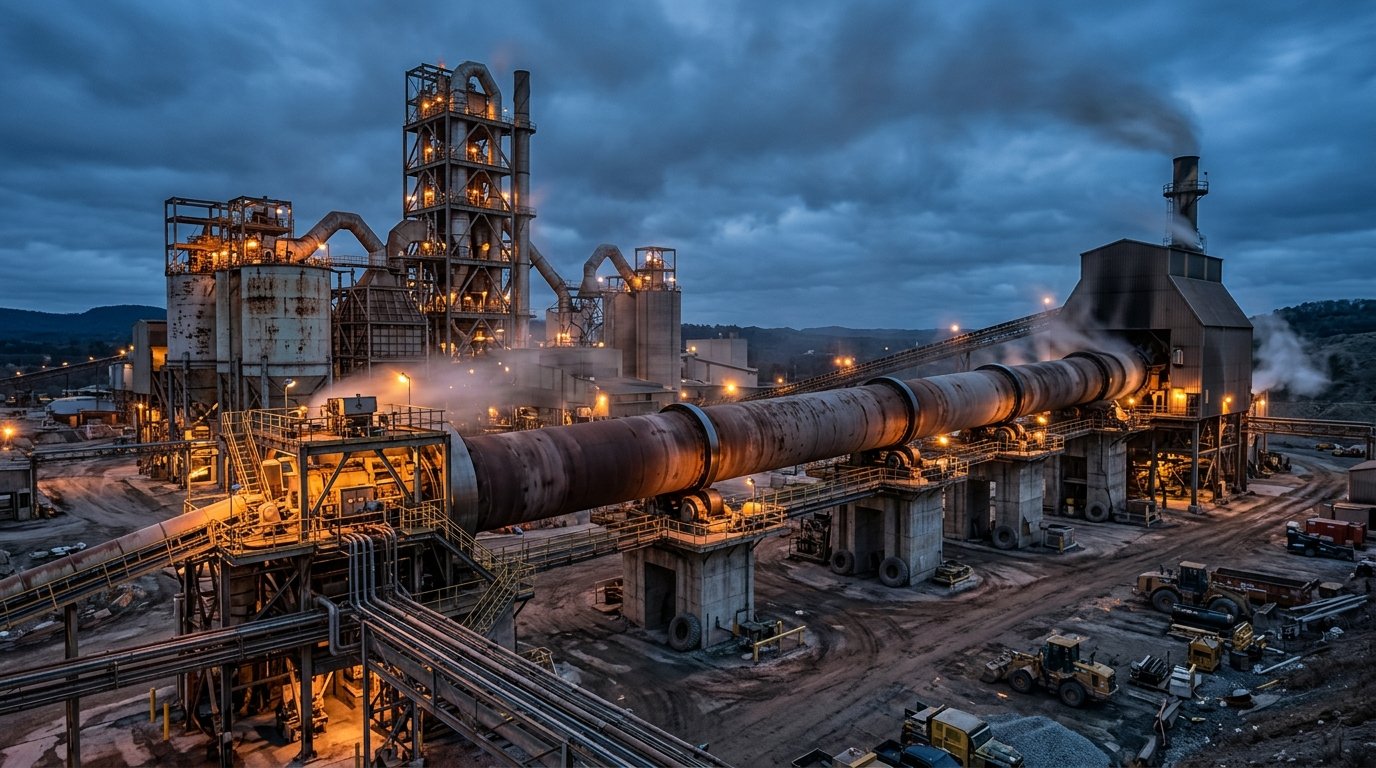
Rotary lime kilns and rotary alumina (Bayer) calciners are high-temperature rotary calcination processes, and their shells expand, float, and run out of round exactly as a cement kiln shell does. That movement opens a leakage gap at the inlet and outlet seals, where false air costs fuel and shifts the temperature profile that sets product quality: lime reactivity and burn grade in one case, calcination degree and alpha-phase control in the other. This piece covers why false-air sealing matters in these two duties and which Oswal seal family fits each position.
One scope note up front: sealing in this sense applies to rotary kilns and calciners, the ones with a shell that rotates against a stationary hood. Vertical-shaft lime kilns are a different mechanical class with static process interfaces, covered separately below.
Why false air matters in rotary lime kilns and alumina calciners
False air is unmetered ambient air drawn into a rotary kiln through unintended openings such as worn seals and hood interfaces; it dilutes the combustion gas, forces the induced-draft fan to move more volume, and raises fuel consumption per tonne of product. In a calcination process it does a second kind of damage: the leaked cold air cools the gas and distorts the temperature profile that the product quality depends on.
False air: air drawn into a rotary kiln system through unintended openings (seals, hood interfaces, inspection ports) rather than through the controlled combustion-air path. Quantified as a percentage of total combustion or process gas.
In a rotary lime kiln, limestone is calcined to quicklime at roughly 900-1,100 °C (the National Lime Association puts the calcining zone around 1,100 °C plus or minus 50 °C; these are general industry figures, not an Oswal spec) [1]. Modern rotary lime kilns with a preheater consume roughly 4.5-6.0 GJ per tonne of CaO [1][2]. Temperature control inside that band sets the burn: too cool or too short a residence and the stone is under-burned with a carbonate core; too hot and the lime is over-burned, dense, and slow to slake. False air pulls the gas temperature around and widens the spread between the two failure modes, so it is a reactivity problem, not only a fuel problem. The chemistry and reactivity grades are covered in quicklime production, and the energy case for the lime industry is set out on the industry page.
In a rotary alumina calciner, the final Bayer-process stage heats aluminium hydroxide to roughly 1,000-1,100 °C to drive off bound water and produce anhydrous alumina [3]. Here the temperature profile sets the calcination degree and therefore the crystal phase: smelter-grade alumina is held deliberately short of full conversion to keep its surface area, while special and refractory grades are pushed past roughly 1,150-1,200 °C into dense alpha-Al₂O₃ [3]. Air leaking in through a worn calciner seal raises the gas volume the calciner must heat and shifts that profile, which is exactly what grade control cannot tolerate. The grade framework is in calcined alumina grades; the upstream chemistry is in the Bayer process and bauxite refining, and the end uses in what calcined alumina is used for.
The penalty is the same mechanism in both duties: each unit of false air is gas the system heats but never uses for calcination, treated as a general industry reference as a direct, additive heat loss on top of the kiln-type fuel baseline [4]. The full fuel-and-draft accounting is laid out in false air in cement kilns.
Rotary versus vertical-shaft: where a kiln seal applies
A rotary kiln or calciner needs an inlet and outlet seal because its shell rotates continuously against stationary hoods, which is an inherently leaky interface. Vertical-shaft lime kilns are essentially static at their process interfaces, so air ingress at feed and discharge gates is a minor issue by comparison and a rotating-shell seal does not apply [5]. The two are different mechanical classes, and the comparison is worked through in vertical shaft versus rotary lime kilns.
Rotary calciner: a horizontal rotating cylinder in which feed is calcined as it tumbles toward the discharge end, sealed against stationary inlet and outlet hoods. The rotating-to-stationary interface is the location a kiln seal exists to close.
The rotary interface is hard to seal because the shell never holds still. It expands radially with heat, walks axially under load (float), and runs slightly out of round (ovality) on every revolution, all under heavy dust loading, extreme temperature, and continuous 24x7 operation [6]. A rigid seal opens a gap the moment the shell moves away from it, so the design problem is to hold a sealing line against a structure that is constantly changing shape, the same trade-off a cement kiln seal solves.
Mapping Oswal seals to each calciner duty
The seal selection follows the position, not the industry: lamella at the inlet where movement dominates, graphite at the hot calcination or discharge end where heat and abrasion dominate, a Duplex hybrid where a single position needs both, and integrated false-air control as the system that ties them together. The table below maps each duty to the Oswal family and the property that drives the choice. Cells are qualitative; numeric entries are general industry typicals, inline-cited, not Oswal product specifications.
| Duty / position | Dominant challenge | Oswal seal family | Why it fits |
|---|---|---|---|
| Rotary lime kiln inlet (feed end) | Shell movement: radial expansion, axial float, ovality | Lamella-based sealing elements | Flexible adaptation to shell movement, controlled contact pressure, mechanical resilience [6] |
| Hot calcination / discharge end (lime and alumina) | Sustained extreme temperature (~1,000-1,200 °C [1][3]) and abrasive dust | Graphite-based sealing elements | High-temperature resistance, continuous contact, stable friction, long wear life under dust [6] |
| Alumina calciner inlet / feed hood | Air ingress that disturbs the calcination temperature profile | Kiln inlet sealing system | Minimises air ingress, stabilises the combustion profile, axial plus radial compensation, retrofittable [6] |
| Any position needing both movement and heat | Movement and high temperature at the same interface | Duplex Kiln Sealing System | Primary lamella interface for movement plus secondary graphite interface for high-temperature sealing [7] |
The selection logic across all four positions, with the lamella-versus-graphite split and the hybrid case, is gathered in the kiln seal comparison guide, which is the hub for this decision.
Selecting the seal for each position
Choose the seal per position, not per kiln: the inlet and the hot end of the same calciner have opposite requirements, so they often take different seals. The right question is what dominates at that interface, movement or heat.
The inlet (feed end) is movement-dominated. It runs hot but not at the discharge extreme, and the main job is to follow a shell that expands, floats, and goes oval without opening a leakage gap. Lamella-based sealing elements are the mainstream choice here because their defining property is flexibility: they adapt to shell movement with controlled contact pressure and mechanical resilience rather than fighting the distortion [6]. Oswal's kiln inlet sealing systems are built for the feed end specifically, minimising air ingress, stabilising the combustion profile, and providing axial plus radial compensation, and they retrofit onto existing inlet geometries [6]. The detailed lamella-graphite comparison is in lamella versus graphite sealing.
The hot calcination or discharge end is heat- and abrasion-dominated. Spring-steel leaves lose temper at sustained extreme temperature and erode faster under continuous dust, so this position favours graphite. Oswal's graphite-based sealing elements are specified for high-temperature resistance, continuous sealing contact, stable friction, and long wear life under dust, which is what the discharge of a lime kiln or the hot end of an alumina calciner demands [6]. They maintain continuous radial contact with the rotating shell and compensate its expansion, working alongside axial compensation that absorbs the float.
Where a single position genuinely needs both movement flexibility and high-temperature durability, the answer is not to force one family to do both. The Duplex Kiln Sealing System combines a primary lamella interface for adaptive movement compensation with a secondary graphite interface for continuous high-temperature sealing, handles radial plus axial compensation in high-dust environments, and is retrofittable onto an in-service unit [7]. Whichever family a position takes, the seal still wears, so it needs a defined inspection cadence rather than annual-only checks; the graded framework is in kiln seal inspection cadence and methodology.
Integrated false-air control as the system view
Integrated false-air control treats sealing as an energy-control discipline rather than a maintenance item: it combines the inlet, outlet, and intermediate interfaces into a single sealing architecture and pairs the seals with false-air measurement so degradation is caught before it shows up as a fuel or quality penalty. The seal at one interface is only as useful as the weakest interface on the same gas circuit, which is why the system view matters more than any single element.
For a rotary lime kiln or an alumina calciner, that means specifying the inlet and discharge seals together against the kiln's movement and temperature profile, then tracking seal condition and false-air percentage as one number. Oswal's integrated false air control productises this across the lime and mineral-processing duties, where the same calcination logic governs both lime kilns and alumina calciners.
If you are specifying seals for a rotary lime kiln or an alumina calciner, our engineering team works through the inlet and discharge positions case by case, mapping each to lamella, graphite, or a Duplex hybrid against your unit's movement, temperature, and dust profile, then ties seal condition to a false-air target. Contact us to walk through your configuration.
Common questions about this topic
A rotary lime kiln needs seals matched to position: a movement-tolerant lamella-based seal at the inlet (feed end), where shell expansion, axial float, and ovality dominate, and a high-temperature graphite-based seal at the hot discharge end, where sustained heat and abrasive dust dominate [6]. Oswal's kiln inlet sealing systems are engineered for the feed-end interface and retrofit onto existing geometry; where a position needs both movement and heat tolerance, a Duplex hybrid combines the two [7]. The point is to select per interface, not per kiln, because the inlet and the hot end have opposite requirements.
The mechanics are the same and the stakes are different. A rotary alumina (Bayer) calciner has the same rotating-shell-against-stationary-hood interface as a cement kiln, with the same radial expansion, axial float, and ovality to follow, so the same lamella-at-the-inlet, graphite-at-the-hot-end logic applies [6]. What differs is the product-quality sensitivity: alumina calcination at roughly 1,000-1,100 °C sets the calcination degree and crystal phase that distinguishes smelter grade from special grade, so false air that disturbs the temperature profile is a grade-control problem as well as a fuel one [3]. The grade framework is in calcined alumina grades.
No, not in the rotary-seal sense. Vertical-shaft lime kilns are static at their process interfaces, so they do not have the continuously rotating shell-to-hood gap that a kiln inlet or outlet seal exists to close; air ingress at their feed and discharge gates is a comparatively minor issue [5]. Kiln seals of the kind Oswal supplies apply to rotary lime kilns and rotary calciners, where the shell rotates against stationary hoods. The mechanical comparison between the two kiln classes is set out in vertical shaft versus rotary lime kilns.
False air cools and dilutes the process gas, which shifts the calcination temperature profile that both lime reactivity and alumina grade depend on. In a lime kiln, an unstable profile widens the gap between under-burning (a carbonate core, low yield) and over-burning (dense, slow-slaking lime), so reactivity drifts off target [1]. In an alumina calciner, the same profile shift moves the calcination degree and alpha-phase conversion that separate smelter-grade from special-grade product [3]. In both cases the leaked air also raises fuel use per tonne, so sealing protects quality and energy together; the fuel-and-draft accounting is detailed in false air in cement kilns.
Sources
- National Lime Association, *How Lime is Made* (rotary lime kiln calcining around 1,100 °C; modern preheater kiln fuel use ~4.5-6.0 MJ/kg)
- European Lime Association (EuLA), *Kiln Types* (rotary kiln with preheater fuel consumption range)
- SpringerLink, "Production of Smelter Grade Alumina (SGA) by Calcination," in *Proceedings of the 50th Annual Conference of Metallurgists* (alumina calcination ~1,000-1,100 °C; alpha-Al₂O₃ conversion above ~1,150-1,200 °C)
- INFINITY FOR CEMENT EQUIPMENT, *False Air in Pyroprocessing* (false air treated as additive heat loss on the kiln gas circuit)
- European Lime Association (EuLA), *Production* (rotary versus shaft kiln process interfaces)
- Oswal Engineers, *Kiln Sealing Systems* (product catalogue: lamella-based and graphite-based sealing elements, kiln inlet and outlet sealing systems, axial compensation and high-temperature radial seals, integrated false air control). `OSWAL_kilnseal.pdf`
- Oswal Engineers, *Duplex Kiln Sealing System* (catalogue). `KilnSeal_DuplexType_OK_CAT.pdf`
Articoli correlati
Discuss Your Sealing Requirements
Our engineering team can help identify the right sealing solution for your application.
Contact Engineering Team“Ovunque i forni rotanti ad alta temperatura operino in atmosfera controllata, i sistemi di tenuta Oswal garantiscono efficienza energetica e stabilità di processo.”