
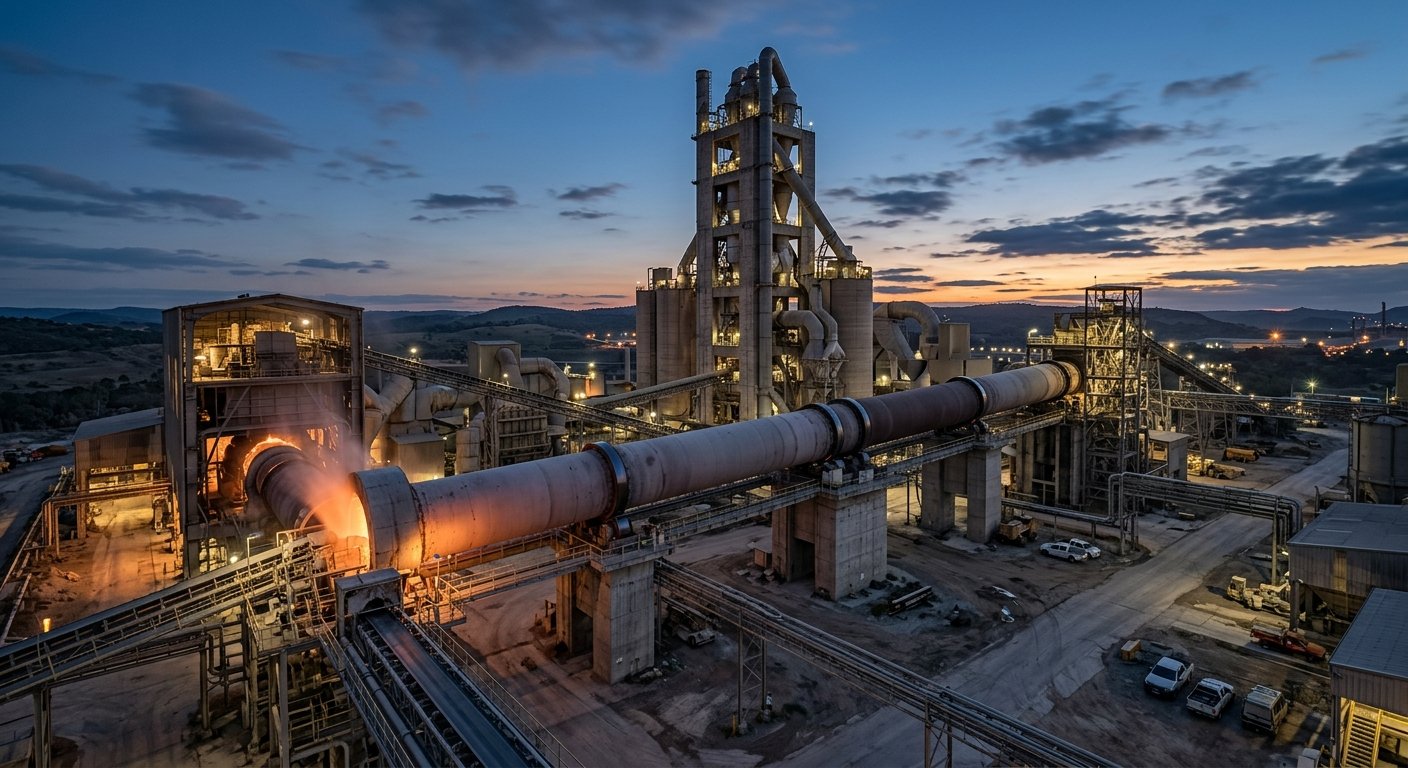
Pirolisi: all'interno della fase più calda dell'impianto cementiero
Il processo di pirolisi trasforma la farina cruda in clinker attraverso il preriscaldatore, il calcinatore, il forno rotante e il raffreddatore a temperature fino a 1.450 °C. Fasi, temperature, energia e KPI.
Il piroprocesso è la fase ad alta temperatura della produzione del cemento in cui la farina cruda viene riscaldata a circa 1.450 °C per innescare le reazioni chimiche che formano il clinker, il minerale sintetico che conferisce al cemento le sue proprietà leganti [1][2]. Si tratta della parte più energivora e tecnologicamente complessa di qualsiasi cementeria: quasi tutta l'energia termica dell'impianto viene consumata in questa fase, e quasi ogni perdita di efficienza su cui valga la pena intervenire, inclusa l'aria parassita, si concentra qui. Questa guida definisce il piroprocesso, analizza i quattro componenti che costituiscono la linea, illustra la sequenza di reazione dalla farina cruda al clinker in base alla temperatura, quantifica l'intensità energetica per tipo di processo, mostra dove l'aria parassita degrada l'efficienza, tratta le moderne pratiche di utilizzo di combustibili alternativi e arricchimento con ossigeno ed elenca i KPI monitorati dagli operatori.
Cos'è il piroprocesso?
Il piroprocesso è la conversione termica della farina cruda preparata in clinker, eseguita in un treno di apparecchiature collegate che porta il materiale dalla temperatura ambiente a circa 1.450 °C per poi raffreddarlo. Si colloca tra la preparazione della farina cruda e la fase di macinazione finale nel processo di produzione del cemento: la farina cruda è una miscela finemente macinata di calcare, argilla, sabbia e correttivi ferrosi, e il piroprocesso è ciò che trasforma quella polvere fredda nei noduli duri e scuri di clinker che vengono poi macinati in cemento.
Il materiale raggiunge un picco di circa 1.450 °C, mentre la fiamma e i gas di combustione nella zona di cottura possono superare i 2.000 °C [1][2]. Tale divario di temperatura è intenzionale: il gas deve essere più caldo del materiale poiché il trasferimento di calore guida le reazioni, e il gas più caldo compie la chimica finale e più complessa della formazione dell'alite.
Piroprocesso. La fase ad alta temperatura della produzione di cemento (o calce, allumina o DRI) in cui una carica preparata viene riscaldata in un sistema a forno per guidare la decomposizione termica e le reazioni di formazione minerale. Nel cemento, comprende il preriscaldatore, il calcinatore, il forno rotante e il raffreddatore di clinker, e converte la farina cruda in clinker.
Clinker. Il prodotto intermedio nodulare della produzione di cemento, formato sinterizzando la farina cruda a ~1.450 °C. Viene macinato con gesso e altre aggiunte per produrre cemento. Le sue fasi minerali chiave sono alite (C3S), belite (C2S), alluminato (C3A) e ferrite (C4AF).
Una nota sul termine. "Piroprocesso" appare anche nel ritrattamento del combustibile nucleare (piroprocesso elettrometallurgico del combustibile esausto), che non ha alcuna attinenza con quanto trattato qui. Nell'industria pesante, l'accezione legata al cemento, ovvero una linea di conversione termica a forno rotante, si applica analogamente alle linee di calce, DRI / ferro spugnoso e calcinazione dell'allumina che utilizzano anch'esse forni rotanti. La fisica è la stessa, la chimica e le temperature differiscono. Questo articolo riguarda il cemento.
I quattro componenti di un sistema di piroprocesso
Un moderno sistema di piroprocesso per cemento ha quattro componenti sequenziali: il preriscaldatore, il calcinatore, il forno rotante e il raffreddatore di clinker. La farina cruda li attraversa in quest'ordine, cadendo e rotolando dalla sommità della torre del preriscaldatore fino al raffreddatore, mentre i gas di combustione e l'aria calda recuperata fluiscono in controcorrente risalendo la linea. Il design in controcorrente è fondamentale: recupera il calore dai gas trasferendolo alla farina in ogni fase.
| Componente | Funzione | Temperatura operativa tipica | Perché la tenuta è importante |
|---|---|---|---|
| Preriscaldatore (4-6 stadi a ciclone) | Preriscalda e calcina parzialmente la farina cruda usando i gas di scarico del forno/calcinatore | Farina in ~60 °C, uscita ~800-900 °C; uscita gas stadio superiore ~300-350 °C | I giunti dei cicloni, i tubi di immersione e gli sportelli di ispezione ammettono aria parassita; 1-2% per stadio si accumula |
| Calcinatore / precalcinatore | Completa l'85-95% della decomposizione del calcare prima del forno; brucia ~60% del combustibile totale | ~850-900 °C | I giunti del condotto dell'aria terziaria e il montante verso l'ingresso del forno sono punti di perdita; l'ingresso di aria fredda destabilizza la calcinazione |
| Forno rotante | Zona di cottura; reazioni finali di clinkerizzazione a ~1.450 °C | Materiale a ~1.450 °C; fiamma >2.000 °C | Le tenute all'ingresso e all'uscita del forno sono le due interfacce con il maggior volume di aria parassita nell'impianto |
| Raffreddatore di clinker | Tempra il clinker e ne recupera il calore nell'aria secondaria e terziaria | Clinker in ~1.400 °C, uscita ~65-100 °C (a griglia) | La transizione raffreddatore-forno è una delle principali interfacce di ingresso; l'aria infiltrata sottrae calore recuperato |
Fonti: intervalli di temperatura dalla letteratura tecnica sui processi del cemento [1][2][5]; convenzioni sulle interfacce di tenuta dalla pratica di audit dei forni VDZ / Holderbank [3][6].
Il preriscaldatore è una torre di stadi a ciclone, solitamente da quattro a sei, impilati verticalmente. La farina cruda viene iniettata vicino alla sommità e scende a cascata attraverso i gas caldi in risalita, assorbendo calore a ogni stadio. Allo stadio inferiore è stata riscaldata a circa 800-900 °C ed è parzialmente calcinata. La torre del preriscaldatore è dove avviene la maggior parte del recupero di calore dai gas di scarico, e l'aggiunta di stadi è una delle leve principali per ridurre il consumo di combustibile.
Il calcinatore, o precalcinatore, è un recipiente di combustione separato tra lo stadio inferiore del preriscaldatore e l'ingresso del forno. Completa l'85-95% della decomposizione del calcare (calcinazione) prima che il materiale entri nel tubo rotante, bruciando circa il 60% del combustibile totale dell'impianto [1][7]. Spostare tale combustione fuori dal forno rotante è ciò che permette ai forni moderni di operare ad alta capacità con uno stress termico inferiore. Il calcinatore è trattato in un articolo dedicato.
Il forno rotante è la zona di cottura: un lungo tubo d'acciaio inclinato, rivestito di refrattario, che ruota lentamente mentre una fiamma proveniente dal bruciatore del forno riscalda il materiale fino al picco di ~1.450 °C. È qui che si forma effettivamente il clinker. È anche dove si trovano le due interfacce con il maggior volume di aria parassita, all'ingresso e all'uscita del forno.
Il raffreddatore di clinker tempra il clinker da ~1.400 °C a circa 100 °C o meno e recupera il suo calore sensibile nei flussi d'aria di combustione. Il raffreddamento rapido non è solo una questione di gestione termica: blocca la struttura minerale del clinker e determina la resistenza e la macinabilità del cemento. Il raffreddatore di clinker ha considerazioni di design e tenuta proprie, trattate separatamente.
La sequenza di reazione: dalla farina cruda al clinker, per temperatura
Il clinker si forma attraverso una sequenza fissa di reazioni guidate dalla temperatura: evaporazione dell'acqua libera sotto ~120 °C, deidrossilazione dell'argilla a ~400-600 °C, calcinazione del calcare a ~600-900 °C, formazione di belite e fasi intermedie sopra ~800 °C, formazione della fase liquida (fuso) sopra ~1.250 °C e formazione dell'alite sopra ~1.400 °C [4][5]. Ogni reazione avviene a una temperatura caratteristica, motivo per cui la linea di piroprocesso è strutturata come un gradiente di temperatura piuttosto che come un'unica camera calda.
| Stadio | Temperatura materiale | Posizione nel sistema | Reazione dominante |
|---|---|---|---|
| Essiccazione | fino a ~120 °C | Stadi superiori preriscaldatore | Evaporazione acqua libera (endotermica) |
| Deidrossilazione | ~400-600 °C | Preriscaldatore medio/inferiore | I minerali argillosi perdono acqua chimicamente legata |
| Calcinazione | ~600-900 °C | Preriscaldatore inferiore + calcinatore | CaCO3 → CaO + CO2 (fortemente endotermica) |
| Formazione belite | ~800-1.250 °C | Zona ingresso forno | CaO + SiO2 → C2S (belite); si formano intermedi alluminato/ferrite |
| Fase liquida / sinterizzazione | ~1.250-1.400 °C | Zona di transizione forno | L'alluminato e la ferrite fondono (~20-30% liquido a 1.450 °C), agendo da fondente |
| Formazione alite (clinkerizzazione) | ~1.400-1.450 °C | Zona di cottura forno | C2S + CaO → C3S (alite); la fase che conferisce resistenza |
| Raffreddamento / tempra | 1.400 °C fino a ~65-100 °C | Raffreddatore di clinker | Il liquido solidifica; il raffreddamento rapido blocca alite e C3A vetroso |
Fonti: intervalli di temperatura di reazione da understanding-cement.com [4], verificati con la letteratura sulla formazione del clinker [5] e Taylor, Cement Chemistry [8].
Le quattro fasi minerali del clinker che emergono sono alite (C3S), belite (C2S), alluminato (C3A) e ferrite (C4AF). La composizione minerale complessiva viene definita nella zona di cottura, ma la forma finale è fissata nel raffreddatore. Un raffreddamento rapido sotto ~1.250 °C blocca la struttura cristallina dell'alite e intrappola il C3A in uno stato vetroso meno reattivo all'attacco dei solfati e più facile da macinare; un raffreddamento troppo lento riconverte parte del C3S in belite e calce libera, riducendo permanentemente la resistenza e la macinabilità del cemento [4][9]. Ecco perché il raffreddatore è parte integrante del piroprocesso: la chimica non è terminata finché il clinker non è freddo.
Intensità energetica: consumo specifico di calore per tipo di processo
Il piroprocesso rappresenta quasi tutto il consumo di energia termica di una cementeria. Il consumo specifico di calore (SHC), l'energia termica richiesta per chilogrammo di clinker, varia da ~690-750 kcal/kg per un moderno forno a precalcinazione a secco a 1.100-1.400 kcal/kg per i vecchi forni a umido; la media ponderata globale è di circa 3,4-3,5 GJ/t di clinker (~810-840 kcal/kg) secondo il database "Getting the Numbers Right" della Global Cement and Concrete Association [10][11][12].
| Tipo di processo | SHC tipico (kcal/kg clinker) | Equivalente (GJ/t clinker) | Fonte |
|---|---|---|---|
| Secco moderno, preriscaldatore 5/6 stadi + precalcinatore | 690-750 | 2,9-3,1 | Cembureau, IEA [11][12] |
| Secco, preriscaldatore 4 stadi (senza precalcinatore) | 750-820 | 3,1-3,4 | Madlool et al. (2011) [13] |
| Semi-secco / Griglia Lepol | 800-950 | 3,3-4,0 | Madlool et al. (2011) [13] |
| Processo a umido (storico / capacità residua) | 1.100-1.400 | 4,6-5,9 | IEA baseline storica [12] |
| Media ponderata industria globale | ~810-840 | 3,4-3,5 | GCCA GNR [10] |
La variabilità è determinata dal numero di stadi del preriscaldatore, dalla presenza del calcinatore, dal recupero del raffreddatore e dal costo energetico dell'evaporazione dell'acqua nei processi semi-secco e a umido.
Il limite termico inferiore è stabilito dalla chimica, non dall'attrezzatura. Il calore teorico di formazione del clinker è di circa 420 kcal/kg, dominato dall'endotermia della calcinazione del calcare [8][14]. Il modo standard per inquadrare il resto è un bilancio termico: l'energia del combustibile in ingresso equivale alla domanda teorica di reazione più le perdite misurate.
SHC = Q_teorico + Q_uscita_preriscaldatore + Q_scarico_raffreddatore + Q_irraggiamento + Q_polveri + Q_altro
Dove:
- SHC. Consumo specifico di calore, kcal/kg clinker (LHV, base secca)
- Q_teorico. Calore teorico di formazione del clinker, ~420 kcal/kg
- Q_uscita_preriscaldatore. Calore sensibile in uscita nei gas di scarico del preriscaldatore, ~150-200 kcal/kg
- Q_scarico_raffreddatore. Calore perso nell'aria di sfiato del raffreddatore, ~80-130 kcal/kg
- Q_irraggiamento. Irraggiamento e convezione del mantello del forno, ~30-50 kcal/kg
- Q_polveri. Perdite di polveri dal bypass, ~10-30 kcal/kg
- Q_altro. Calore sensibile del clinker, umidità della farina cruda, altro, ~20-40 kcal/kg
Il trattamento approfondito del bilancio termico e delle leve per migliorarlo si trova nel riferimento sul consumo specifico di calore; il lato dell'input di combustibile è trattato nel consumo specifico di combustibile. Il punto fondamentale per il piroprocesso è che le ~420 kcal/kg teoriche sono fisse, mentre le restanti ~270-330 kcal/kg di perdite rappresentano l'intera opportunità ingegneristica, e l'aria parassita è la parte più economica su cui intervenire.
Dove l'aria parassita colpisce l'efficienza del piroprocesso
L'aria parassita, aria ambiente incontrollata che viene aspirata nella linea di piroprocesso attraverso tenute e giunti usurati invece che attraverso il percorso dell'aria di combustione del bruciatore, degrada l'efficienza in ogni fase: diluisce i gas del preriscaldatore, raffredda il calcinatore, carica il ventilatore di tiraggio indotto (ID fan) e costa circa 1,5-2,5 kcal/kg di clinker per ogni punto percentuale sopra l'ottimale [3][13]. È "parassita" perché non compie alcun lavoro termodinamico; il bruciatore deve semplicemente riscaldarla e il ventilatore deve spostarla.
Aria parassita. Aria ambiente aspirata nel sistema di piroprocesso attraverso aperture non intenzionali (tenute del forno, interfacce della cappa, giunti dei cicloni, sportelli di ispezione) invece che attraverso il percorso controllato dell'aria di combustione. Quantificata come percentuale del flusso totale di gas, convenzionalmente all'ingresso del ventilatore ID.
Le quattro interfacce di perdita si trovano tutte all'interno della linea di piroprocesso: la tenuta all'ingresso del forno, la tenuta all'uscita del forno, la transizione raffreddatore-forno e i giunti cumulativi dei cicloni del preriscaldatore. Il meccanismo, il metodo di misurazione e i benchmark sezione per sezione sono trattati nel riferimento sull'aria parassita; il punto rilevante per il piroprocesso è che l'aria parassita non solo aggiunge combustibile, ma destabilizza il profilo di temperatura da cui dipende l'intera sequenza di reazione.
Esempio pratico. Si consideri un forno a secco da 5.000 t/giorno che opera a 720 kcal/kg con il 13% di aria parassita rispetto a una baseline dell'8%, ovvero 5 punti percentuali sopra l'ottimale. Con una media di 2,0 kcal/kg per punto percentuale [3][13], la penalità è di 10 kcal/kg di clinker, o circa l'1,4% del SHC totale. Su 5.000 t/giorno, si tratta di 50 milioni di kcal/giorno di combustibile evitabile. Con carbone dal potere calorifico inferiore di 6.000 kcal/kg, sono circa 8,3 tonnellate di carbone al giorno, nell'ordine di 2.700 tonnellate all'anno. La bolletta del combustibile è il dato principale; il profilo della zona di cottura destabilizzato e il carico extra sul ventilatore ID sono i costi meno visibili.
Questa è la sezione in cui l'argomento educativo incontra il dominio di competenza del marchio. Il sistema di controllo integrato dell'aria parassita di Oswal mira alle interfacce di perdita del piroprocesso come un unico flusso di lavoro — tenuta, monitoraggio e retrofit — piuttosto che vendere una singola tenuta isolata. Negli interventi di retrofit che effettuiamo, le interfacce della cappa del forno e dell'ingresso dominano solitamente l'ingresso lato forno, motivo per cui la sigillatura dell'area della cappa è solitamente la prima mossa. L'efficienza energetica a monte di questo tipo è anche la precondizione che rende economicamente sostenibile la cattura del carbonio nel cemento: l'impianto Brevik di Heidelberg Materials in Norvegia, il primo impianto CCS su scala industriale per il cemento, inaugurato a giugno 2025, dimostra che ogni kcal non consumata nel piroprocesso è una kcal che non deve essere catturata [15].
Piroprocesso moderno: combustibili alternativi e arricchimento con ossigeno
Il piroprocesso moderno sostituisce sempre più il combustibile fossile con combustibili alternativi (combustibile derivato da rifiuti, biomassa, combustibili da scarti) e, in alcuni impianti, arricchisce l'aria di combustione con ossigeno. Le cementerie dell'UE hanno ora un tasso di sostituzione termica medio di circa il 52%, con impianti leader sopra il 70%, mentre gli impianti statunitensi si attestano vicino al 16% [16][17].
Tasso di sostituzione termica (TSR). La percentuale di energia termica di un forno fornita da combustibili alternativi anziché da combustibili fossili convenzionali. Media UE ~52%; alcuni impianti europei superano il 70%.
I combustibili alternativi cambiano il quadro della combustione in un modo che rende la tenuta più importante, non meno. I combustibili derivati da rifiuti sono più grossolani e variabili del carbone polverizzato, quindi richiedono più aria in eccesso e un tiraggio più stabile per bruciare completamente. L'aria parassita incontrollata su tale variabilità amplia l'oscillazione di ossigeno e temperatura, che è esattamente ciò che un operatore che gestisce un forno ad alto TSR cerca di evitare. Gran parte dell'alimentazione di combustibili alternativi gestita dai clienti di Oswal si sovrappone alla verticale della gestione dei rifiuti, dove si applica la stessa disciplina di sigillatura del forno.
L'arricchimento con ossigeno è la seconda leva moderna. L'aggiunta di ossigeno all'aria di combustione aumenta l'intensità della fiamma e consente al forno di spingere una maggiore produttività o di bruciare completamente combustibili alternativi più grossolani; nel calcinatore può aumentare il tasso di sostituzione raggiungibile con un rischio NOx relativamente basso perché la combustione avviene a temperatura più bassa [18]. Il limite persistente è il costo: produrre o acquistare l'ossigeno deve essere giustificato dal guadagno in produttività o flessibilità del combustibile, motivo per cui l'arricchimento rimane specifico per impianto piuttosto che universale.
KPI monitorati dagli operatori
I KPI fondamentali del piroprocesso sono il consumo specifico di calore (kcal/kg clinker), la calce libera (qualità del clinker), le temperature della zona di cottura e dell'aria secondaria, la coppia del motore del forno, la percentuale di aria parassita e le emissioni di NOx e CO. Insieme, indicano all'operatore se la linea sta producendo un buon clinker al minor costo di combustibile senza deviare dalle specifiche o dalla conformità.
| KPI | Cosa misura | Target tipico | Perché è importante |
|---|---|---|---|
| Consumo specifico di calore | Energia termica per kg clinker | 690-750 kcal/kg (secco moderno) [11][13] | Il dato principale su efficienza e costo combustibile |
| Calce libera (CaO libero) | CaO non reagito nel clinker | ~1-2% | Troppo alta significa clinker sotto-cotto; troppo bassa significa sovra-cottura e spreco di combustibile |
| Temperatura aria secondaria | Calore recuperato dal raffreddatore | ~900-1.100 °C (buon raffreddatore a griglia) | Determina direttamente l'intensità della fiamma e l'efficienza del combustibile |
| Temperatura zona di cottura | Temperatura di picco del materiale | ~1.450 °C | Controlla la formazione dell'alite e la qualità del clinker |
| Coppia motore forno | Condizione del rivestimento e carico nel forno | Stabile, monitorata nel trend | I picchi segnalano formazione di anelli o rivestimento instabile |
| Aria parassita | Ingresso parassita come % del flusso gas | <8-10% forno-ventilatore ID [3] | Ogni punto sopra l'ottimale è combustibile sprecato e profilo destabilizzato |
| Emissioni NOx / CO | Combustione e conformità | Limiti del permesso del sito | Ancora normativa; anche segnale di stabilità della combustione |
Fonti: target SHC e aria parassita secondo i riferimenti citati sopra [3][11][13]; target calce libera e temperatura secondo la pratica operativa standard dei forni [1][2].
La calce libera è il KPI di qualità su cui si basa un operatore: è la lettura più diretta del fatto che la zona di cottura abbia raggiunto la temperatura necessaria alla sequenza di reazione. L'aria parassita è il KPI di efficienza più spesso lasciato non misurato, motivo per cui tende a essere la perdita recuperabile maggiore quando un impianto finalmente la sottopone ad audit. Il benchmarking di una linea specifica rispetto a questi target, e la quotazione del retrofit che colma il divario, è un ambito standard per il team di consulenza ingegneristica di Oswal.
Common questions about this topic
Il piroprocesso è la fase ad alta temperatura della produzione di cemento che trasforma la farina cruda in clinker, riscaldando il materiale a circa 1.450 °C attraverso una linea collegata composta da preriscaldatore, calcinatore, forno rotante e raffreddatore di clinker [1][2]. Si tratta della parte dell'impianto a maggiore intensità energetica, dove viene consumata la quasi totalità del combustibile termico. Si colloca tra la preparazione della farina cruda e la macinazione finale del cemento nell'ambito del processo di produzione del cemento.
I quattro componenti di un sistema di piroprocesso del cemento sono il preriscaldatore (stadi a ciclone che preriscaldano la farina cruda), il calcinatore (che completa la maggior parte della decomposizione del calcare), il forno rotante (la zona di cottura dove il clinker si forma a circa 1.450 °C) e il raffreddatore di clinker (che tempra il clinker e ne recupera il calore) [1][2]. Il materiale fluisce attraverso di essi in sequenza, mentre i gas caldi scorrono in controcorrente risalendo la linea.
Il clinker si forma quando il materiale raggiunge circa 1.450 °C nella zona di cottura del forno, la temperatura alla quale si sviluppa l'alite (C3S), la fase principale che conferisce resistenza [4][5]. La fiamma e i gas di combustione sono ancora più caldi, spesso al di sopra dei 2.000 °C, poiché il gas deve essere a una temperatura superiore a quella del materiale per favorire il trasferimento di calore. La calcinazione del calcare, la fase precedente alla clinkerizzazione, avviene in precedenza a circa 600-900 °C.
Un moderno forno a precalcinazione a via secca consuma circa 690-750 kcal/kg di clinker, mentre i forni a via secca a 4 stadi più datati operano tra 750-820 kcal/kg, i forni a via semisecca tra 800-950 kcal/kg e i forni a via umida di vecchia generazione tra 1.100-1.400 kcal/kg [11][12][13]. La media ponderata globale è di circa 3,4-3,5 GJ/t di clinker (~810-840 kcal/kg). Il bilancio termico completo è trattato nel riferimento al consumo termico specifico.
Il preriscaldatore è una serie di stadi a ciclone che riscalda la farina cruda utilizzando i gas di scarico, portandola a circa 800-900 °C e calcinandola parzialmente, mentre il calcinatore è un recipiente di combustione separato che brucia circa il 60% del combustibile dell'impianto per completare l'85-95% della decomposizione del calcare prima del forno [1][7]. Un impianto dotato di calcinatore è definito impianto a precalcinazione; in assenza di esso, tutto il combustibile viene bruciato nel forno. Entrambi alimentano la catena di recupero termico della torre di preriscaldo.
L'aria falsa, ovvero l'aria ambiente aspirata attraverso guarnizioni e giunti usurati, comporta un consumo di circa 1,5-2,5 kcal/kg di clinker per ogni punto percentuale oltre il valore ottimale; inoltre, raffredda il calcinatore, diluisce i gas del preriscaldatore e sovraccarica il ventilatore ID [3][13]. Oltre alla penalità in termini di combustibile, essa destabilizza il profilo termico da cui dipende la sequenza delle reazioni. Il metodo di misurazione e i benchmark sono riportati nel riferimento aria falsa.
Il raffreddatore di clinker abbassa la temperatura del clinker da circa 1.400 °C a circa 100 °C o meno, recuperando il calore sensibile e trasferendolo all'aria di combustione secondaria e terziaria, il che rappresenta una fonte primaria di recupero termico dell'impianto [1][2]. Il raffreddamento rapido stabilizza inoltre la struttura minerale del clinker: un raffreddamento veloce preserva l'alite e la fase vetrosa macinabile C3A, mentre un raffreddamento lento causa la trasformazione del C3S in belite e calce libera. Il design del raffreddatore e le interfacce di tenuta sono trattati nel riferimento clinker cooler.
No. Il piroprocesso nel settore cementiero è la conversione termica della farina cruda in clinker all'interno di un sistema a forno, mentre il piroprocesso nucleare è un metodo elettrometallurgico di separazione del materiale fissile dal combustibile nucleare esausto. I due termini condividono solo la radice "piro" (alta temperatura). Nell'industria pesante, l'accezione cementiera del termine si applica analogamente alle linee a forno rotante nella produzione di calce, DRI e nella calcinazione dell'allumina.
I comuni combustibili alternativi includono il combustibile derivato da rifiuti (CDR), la biomassa, gli pneumatici fuori uso, i solventi e vari combustibili derivati da rifiuti, misurati come tasso di sostituzione termica (TSR) [16][17]. Gli impianti cementieri dell'UE raggiungono una sostituzione media di circa il 52%, con alcuni che superano il 70%, mentre gli impianti statunitensi si attestano intorno al 16%. Una maggiore sostituzione richiede una combustione e un controllo del tiraggio più stabili, il che rende il controllo delle infiltrazioni d'aria ancora più critico, sovrapponendosi al flusso di materie prime del settore della gestione dei rifiuti.
I KPI monitorati più attentamente dagli operatori sono il consumo di calore specifico (efficienza del combustibile), la calce libera (qualità del clinker, target ~1-2%), le temperature dell'aria secondaria e della zona di cottura, la percentuale di aria parassita e le emissioni di NOx/CO ai fini della conformità [1][3]. La calce libera rappresenta l'indicatore di qualità più diretto, mentre l'aria parassita è il KPI di efficienza più spesso trascurato; per questo motivo, tende a costituire la maggiore perdita recuperabile quando un impianto effettua finalmente un audit della propria linea di piroprocesso.
Sources
- Cement Industrial, *Pyro Process in Cement Plant*. Process overview, equipment sequence, and calciner decomposition share
- Indian Cement Review, *Pyroprocessing and Kiln Operation*, 2022. Burning-zone and flame temperatures, clinker-formation overview
- Holderbank Group / Holcim, *Cement Manufacturing: Process Technology*, Volume 2 (Holderbank Cement Course). Canonical training reference for the kiln heat balance and the 1.5-2.5 kcal/kg-per-% false-air penalty convention
- Understanding Cement, *Reactions in the cement kiln, clinkering*. Reaction-temperature ladder and the rapid-cooling / clinker-quality relationship
- Wikipedia, *Cement clinker*. Clinker-formation reactions and liquid-phase temperatures
- Verein Deutscher Zementwerke (VDZ), *VDZ Activity Report* (annual). Kiln-audit and false-air interface conventions
- International Energy Agency (IEA), *Cement* sector analysis. Precalciner fuel-split and process benchmarking
- Taylor, H.F.W., *Cement Chemistry*, 2nd edition, Thomas Telford, 1997. Clinker-formation thermochemistry and the theoretical heat of formation
- Çimsa, *What is Clinker? The Relationship Between Clinker Phases and Grinding Parameters*. Cooling rate, glass phase, and grindability
- Global Cement and Concrete Association (GCCA), *Getting the Numbers Right (GNR) Database*. Global weighted-average thermal energy intensity
- Cembureau, *Activity Report 2023*. European cement industry thermal-energy baseline
- International Energy Agency (IEA), *Cement Technology Roadmap*. Process-type SHC ranges and historical wet-process baseline
- Madlool, N.A., Saidur, R., Hossain, M.S., Rahim, N.A., *A critical review on energy use and savings in the cement industries*, Renewable and Sustainable Energy Reviews, 15(4), pp. 2042-2060, 2011
- European Cement Research Academy (ECRA), *Technical Reports* and *Catalogue of Best Practices*. Heat-balance methodology and theoretical heat of clinker formation
- Heidelberg Materials, *Brevik CCS Project* (official opening June 2025; first industrial-scale CCS-on-cement plant)
- World Economic Forum, *Net Zero Industry Tracker 2023, Cement*. EU and US thermal substitution rates
- World Cement, *Selecting the right substitution*, 2023. Alternative-fuel substitution practice
- World Cement / industry technical literature on oxygen enrichment of cement kiln combustion. Calciner enrichment, NOx, and the oxygen-cost limiter
Articoli correlati
Discuss Your Sealing Requirements
Our engineering team can help identify the right sealing solution for your application.
Contact Engineering Team“Ovunque i forni rotanti ad alta temperatura operino in atmosfera controllata, i sistemi di tenuta Oswal garantiscono efficienza energetica e stabilità di processo.”